
by Elizabeth Hines | Oct 4, 2019 | Blog, Current Events, Logistics, Marketing, Social Media, Supply Chain
Also, this month in social media news: a court rules LinkedIn cannot stop third-party scraping public information and Facebook expands “Today In” section.
After a relatively quiet month in the world of social media news, social platforms have been hard at work making changes to provide a better user experience and cut down on spam accounts. This is good news for B2B marketers looking to stand out amongst all the competition.
With the growing influence of social networks, social channels have been challenged with making sure the information shared on their sites is authentic and “real” news. In response, social platforms have been working to sort through fake accounts and streamline ways to detect and remove these accounts, which often result in major losses of followers.
But this decline in user accounts does not mean that social media platforms’ influence is declining. In fact, social media usage is at an all-time high, and networks are pushing out new updates, features and policies to keep users happy.
Here’s your social media news for October 2019.
Facebooks announces new business tool for Messenger
Looking to increase leads and engage with new audiences? Facebook is trying to help. The social network introduced a new package of tools for the 40 million active businesses on Messenger, including booking appointments and lead generation workflows. As the new features were announced, Facebook also reported the Discovery tab will be phased out. According to Facebook, “Businesses engaging with potential leads in their preferred channel are seeing results, and finding it easy to continue the conversation and seamlessly nurture leads in Messenger.”
Twitter tests new ‘topics’ shortcut
Twitter users may soon be able to follow topics in the same way they would follow users. Users can see tweets about topics they choose (like digital marketing, supply chain procurement, or even sports) in the home feed. Individual tweets will be monitored through machine learning and chosen to be included in specific topics.
Though only in the testing phase, the new shortcut would help users discover the exact content they need and want without following a specific account. The Verge reports that Twitter is also working on other ways to improve the user experience, including searchable direct messages, the ability to re-order the photos in a tweet after you have attached them to a new post, and plans to add support for Apple’s Live Photos.
Court rules that LinkedIn cannot stop third-party data scraping of public information
hiQabs has been collecting public user information on LinkedIn to create analytics for employers that accurately identify employee patterns and help with retention efforts. But LinkedIn has tried to block the “data scrapping,” alleging that hiQ was violating the CFAA, as well as the Digital Millennium Copyright Act (DMCA).
Until now, when a San Francisco appeal’s court told LinkedIn to take a step back. The court’s decision means the CFAA doesn’t apply to public information, including information collecting via social media platforms. This decision could have major implications for social platforms looking to protect user privacy. We’ll continue to closely monitor any updates from this case in next month’s social media news.
Facebook expands “Today In” section
“Today In” has been running in six U.S. cities since January 2018, and has over 1.6 million people who have opted to receive regular local updates from Today In within the newsfeed. Facebook just announced they’ll be expanding the news section to 6,000 more U.S. cities and towns, bringing local news to “news deserts,” areas with limited local news available.
“Today In” showcases the biggest news stories and happenings in local regions. With declining engagement rates, Facebook created the separate newsfeed in an effort to boost engagement and discussions around topics that matter to local areas.
Facebook clarifies privacy settings for Groups
Public, closed, or secret? What do these privacy settings mean? Users across Facebook’s platform weren’t sure, so the network has changed the wording describing the privacy settings for groups. To make these settings clearer, groups now have the option of public or private. Facebook writes:
“We’re making this change because we’ve heard from people that they want more clarity about the privacy settings for their groups. Having two privacy settings — public and private — will help make it clearer about who can find the group and see the members and posts that are part of it. We’ve also heard that most people prefer to use the terms “public” and “private” to describe the privacy settings of groups they belong to. “
The changes leave privacy settings more straight-forward. Public groups show anyone who is a member and all the content shared within the group, while private groups will only show members and content to users that join the group.
Related posts:
by Elizabeth Hines | Oct 2, 2019 | Blog, Content Marketing, Logistics, Marketing, Social Media, Supply Chain
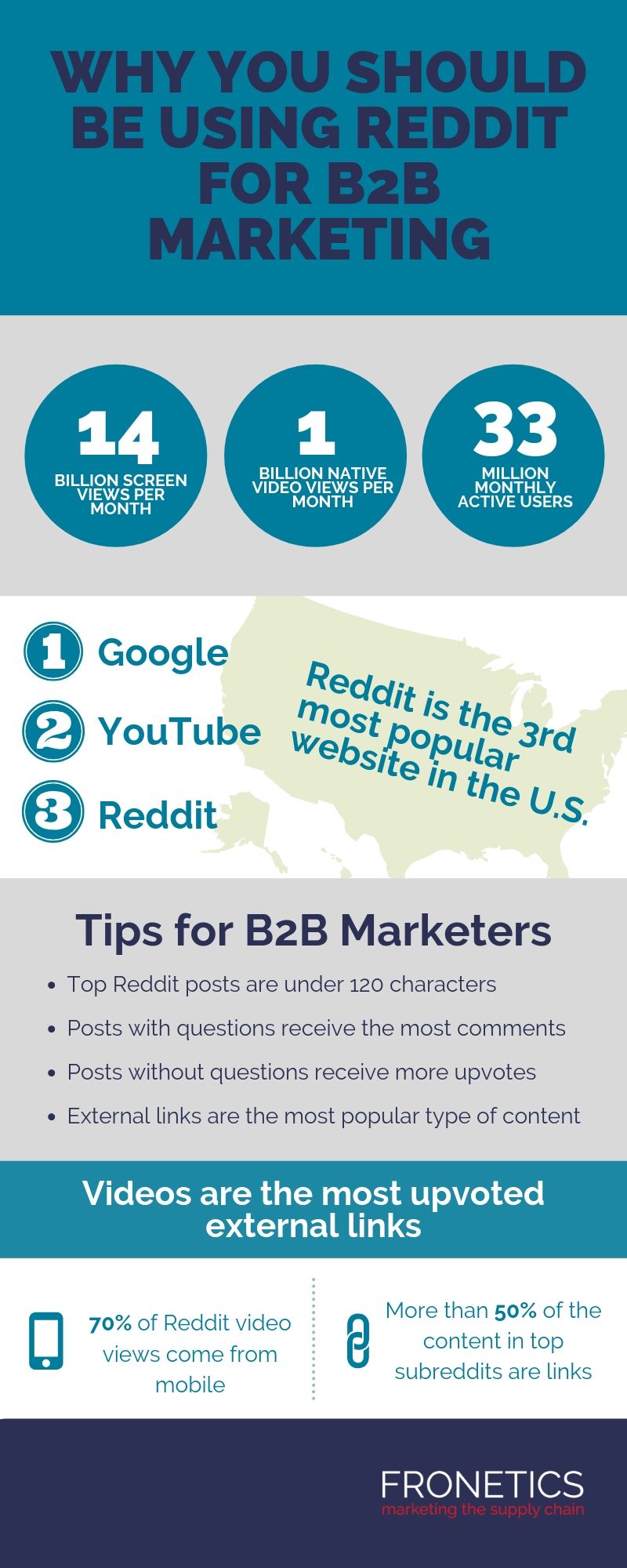
Our infographic gives you everything from the basics to the specifics of using Reddit for B2B marketing.
Highlights:
- Reddit is a social platform made up of thousands of individual forums where users can post content and vote on its relevance and value.
- The first rule of Reddit: avoid overt brand promotion and sales pitches.
- Creating your own subreddit is the best way to make Reddit a high-value marketing channel.
Reddit calls itself the “frontpage of the internet.” And for good reason. The social networking site boasts over 300 million active users, as well as 140,000 active communities and a whopping 14 million pageviews per month. However, when it comes to using Reddit for B2B marketing, it’s still a relatively untapped channel.
Our infographic is your ultimate guide to using Reddit for B2B marketing. Read on to find out more about this platform and how you can put it to work for your business.
What is Reddit?
Since the site was founded in 2005, Reddit’s user base has skewed young. However, as millennials come of age and rise to positions of influence within the B2B purchasing landscape, Reddit is becoming an increasingly effective way to reach your target audience.
At its most fundamental level, Reddit is a social sharing website built around users submitting links, pictures, and text, which the community can then vote on. Similarly to Quora, the content that’s voted as best rises to top visibility, while downvoted content becomes less visible.
The structure of the site resembles an intricate message board, divided up into hundreds of thousands of subfolders, called “subreddits,” which function as specific forums. Imagine just about any topic you can think of, and there’s probably a subreddit for it. In fact, for thinking about Reddit for B2B marketing, the following subreddits could be of interest:
If you’re looking for industry discussion on a specific marketing topic, it’s likely you can find a relevant subreddit. While each subreddit has different moderators and regulations, there’s one common thread that runs through the entire site: there is a premium placed on authentic content and interactions – and a disdain for overt self-promotion.
(Made with Canva)
Using Reddit for B2B marketing in 5 steps
Now that we’ve covered the basics about what Reddit is and how it works, let’s talk about how to make it part of your marketing strategy.
Step 1: Determine your target subreddit(s).
In the same way that a good digital marketing strategy begins with identifying your target audience, determining your target subreddits is the starting point for successfully using Reddit for B2B marketing. While the massive quantity of subreddits can be overwhelming, consider the following three questions to zero in on the right subreddits for your business:
- Does the subreddit relate to your business’ brand or products, as well as any specific keywords that shape your digital marketing strategy?
- How large is each subreddit’s audience? (Note: bigger isn’t necessarily better. A larger audience has the potential to generate more traffic, but it’s easier to establish your brand’s presence in a smaller subreddit.)
- How much engagement does the subreddit generate?
Once you’ve determined a few relevant subreddits with various audience sizes and high engagement, you’re ready to begin posting.
Step 2: Post links… to websites other than your own.
Before you start wondering why we’re encouraging you to promote other pages, there’s another facet of Reddit to consider. The platform takes the idea of Karma to a literal level. On Reddit, your reputation is referred to as your “Karma score,” and it’s determined by your level of positive participation on Reddit, measured by the number of upvotes you receive. As your Karma score rises, your posts become more visible.
One of the most effective ways to boost your Karma score, particularly when you’re starting out, is to post links to content that the subreddit community finds relevant and generate conversation. It’s important to make sure you don’t repost content that another member of your subreddit has already posted, as duplicates can hurt your Karma score.
Step 3: Share valuable content… that’s not a sales pitch.
When posting content to your target subreddits, the path to success is quite simple. Post content that offers value to the community. This means engaging in discussions, asking and answering questions, and, at all costs, avoiding blatant sales pitches.
Sam Holzman of ZoomInfo explains it this way: “Sharing a link to a product page will signal that you’re a marketer who wants to promote products, not an engaged community member. On the other hand, a blog post about the benefits of a particular product will be more useful to your fellow community members and, as a result, is more likely to be upvoted and commented on.”
Step 4: Advertise on Reddit.
While blatant sales pitches on Reddit are a sure way to a low Karma score, the platform does offer its own native advertising. Similar to Facebook and Twitter, Reddit Advertising is a relatively inexpensive way to boost the visibility of your content on the platform. However, it’s important to note that Reddit doesn’t offer the type of analytics as Facebook and Twitter.
Sponsored posts on Reddit appear at the top of targeted subreddits for a specified duration. You pay for duration as well as the number of impressions you receive. Sponsored posts look like any other Reddit posts. Advertising on the platform isn’t necessary for success, but it can help establish a visible presence, particularly at first.
Step 5: Create a subreddit.
Creating a subreddit isn’t easy – it requires a significant time investment to start and maintain. However, doing so is the best way to turn Reddit into an extremely valuable marketing channel. Once you’ve established your presence, creating a branded subreddit gives your customers and prospects a forum to interact, with you and with each other.
Particularly at the outset, you’ll likely need to promote your subreddit on other platforms. Post links to it on your other digital assets, and you could even offer an incentive for engaging on your subreddit.
Your branded subreddit is also an ideal place to offer customer service. Holding exclusive Q&As, referred to on Reddit as AMAs (“Ask Me Anything”), is another effective strategy to drive traffic and engagement on your subreddit.
The bottom line on Reddit for B2B marketing
Reddit is a rich resource for marketers and a fertile ground for marketing your brand and products. The platform is best thought of as a place to share and engage with high-quality, valuable content, rather than as a place for overt promotion. Effectively using Reddit for B2B marketing requires an investment of time and energy, but the results can be well worth the effort.
Related posts:

by Elizabeth Hines | Oct 1, 2019 | Blog, Content Marketing, Logistics, Marketing, Supply Chain
Consumers are more likely to trust content generated by their peers, which means higher conversion rates at a lower cost for your brand. Is your brand benefitting from user generated content?
Highlights:
- User generated content is content created by users of a specific brand or on a specific platform.
- Images and video of real people using your products or talking about your services will create trust and loyalty for your brand.
- Don’t be afraid to engage with your audiences over social media, respond to comments, and answer questions.
Video transcript:
I’m Katie Russell, a marketing strategist here at Fronetics, and today I wanted to talk to you about user generated content. Also known as UGC, user generated content is one of the hottest topics in digital marketing right now, but there are many businesses that don’t know how to use this tool to their advantage.
Let’s start with the basics.
What is UGC?
User generated content is content created by users of a specific brand or on a specific platform. It’s highly effective and comes at little or no cost to your business.
With that said, a lot can qualify as UGC including: comments on your blog, testimonials on your website, social media posts, blog articles, videos, Instagram stories, The list goes on and on. What it comes down to is that UGC is really any form of content that comes from a customer or a user.
So, what are the benefits of UGC?
Authenticity
We know that consumers are more likely to trust content generated by their peers, which means higher conversion rates at a lower cost for your brand. This also means the content is authentic and genuine reviews from buyers. Does it get any better than that?
Inexpensive
Since your brand is not generating the content, you don’t have to invest in the time and resources to create it.
What’s hot in UGC right now?
Visual content
Visual content is by far the most popular among audiences, so visual UGC is a no brainer. Images and video of real people using your products or talking about your services will create trust and loyalty for your brand.
Snackable content
We all know that the attention span for content is extremely short these days. When reposting UGC, focus on short, funny and positive content. Content that leaves users feeling informed and entertained will perform best for your brand.
Enlisting influencers
Whether it’s a famous celebrity or a micro-influencer that’s respected within your industry, brands involving influential people in their marketing campaigns can expect higher ROI from UGC.
Don’t forget to follow-up
Once you’ve grabbed the attention of your community with a successful UGC campaign, it’s up to you to capitalize on the momentum. Don’t be afraid to engage with your audiences over social media, respond to comments, answer questions. Have questions about starting a UGC campaign as a part of your digital marketing strategy? Visit us at fronetics.com.
Related posts:
by Elizabeth Hines | Sep 26, 2019 | Blog, Current Events, Marketing, Social Media
Having the right social media image sizes for each platform is a key part of creating visually appealing posts.
Highlights:
- Each social media platform has its own set of image guidelines.
- Choosing the right social media image sizes ensures that your content is as visually appealing as possible.
- We like Canva Pro for quick resizing of images and graphics.
Social media is all about the visual. Whether it’s Instagram, Facebook, Twitter, or LinkedIn, having the right image can make or break the effectiveness of a post. Social media image size might seem like a relatively unimportant facet of choosing an effective image for a post. But you might be surprised to discover how important it can be.
An incorrect social media image size can make your post less visually appealing than it could be, and it can even erode how the number of impressions a post receives. Because each platform has its guidelines for sizes — and because each image type (profile picture, cover photo, etc.) has different size restrictions — determining correct social media image size is no easy task.
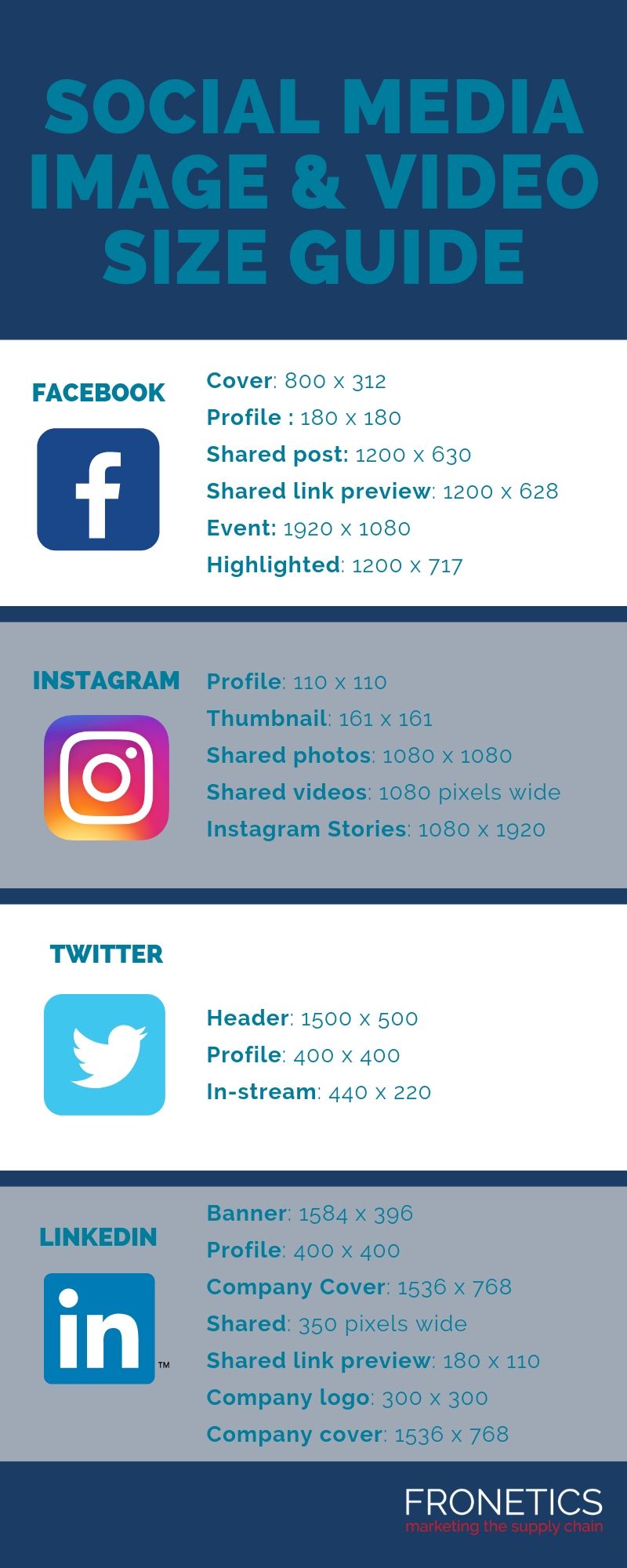
The infographic below gives you a complete guide to the various image size requirements on Facebook, Instagram, Twitter, and LinkedIn. Once you know the correct social media image sizes, you can set your photo editing software to the correct dimensions.
Social media image sizes: by the network
(Made with Canva)
Facebook
Facebook is perhaps the crown jewel of social media platforms, boasting 1.5 billion daily active users. While the platform is text-friendly, images are key to creating engaging content on the platform. An important thing to remember when it comes to images on Facebook is that they will display differently on your page’s timeline as compared to a user’s newsfeed. This means that your choice of image dimensions should be based on where you want your viewers to see your image.
Image dimensions:
- Cover image: 800 x 312
- Profile image: 180 x 180 (though it will display as 170 x 170 on desktop, and 32 x 32 as a thumbnail)
- Shared post image: 1200 x 630
- Shared link preview image: 1200 x 628
- Event image: 1920 x 1080
- Highlighted image: 1200 x 717
Instagram
Instagram is all about the visual – which means that it’s crucial that your brand’s presence on the platform is driven by high-quality images. As a rule, the platform scales down photos to 612 x 612, but it’s still recommended that shared images be set to 1080 x 1080 to optimize quality.
Image dimensions:
- Profile image: 110 x 110
- Image thumbnail: 161 x 161
- Shared photos: 1080 x 1080
- Shared videos: 1080 pixels wide
- Instagram Stories: 1080 x 1920 (minimum 600 x 1067); maximum 4 GB
Twitter
Twitter has 313 billion monthly active users and has recently updated its image guidelines.
Image dimensions:
- Header image: 1500 x 500; maximum 5 MB
- Profile image: 400 x 400; maximum 2 MB
- In-stream image: 440 x 220
LinkedIn
While the network may not be thought of as a highly visual platform, images on LinkedIn make a big difference in terms of post engagement. With 467 million registered users, it’s the world’s largest professional network. Having polished, well-sized images on the platform can go a long way toward maximizing its potential for professional networking and industry visibility.
Image dimensions:
- Banner image: 1584 x 396; maximum 4 MB
- Profile image: 400 x 400 (minimum 200 x 200); maximum 10 MB
- Company Cover image: 1536 x 768
- Shared image: 350 pixels wide
- Shared link preview: 180 x 110
- Company logo image: 300 x 300; maximum 4 MB
- Company cover image: 1536 x 768 (minimum 1192 x 220); maximum 4 MB
- Company page banner image: 646 x 220; maximum 2 MB
- Square logo (appears in company searches): 60 x 60; maximum 2 MB
An insider trick for quick and easy resizing
As you can see, there is quite a bit of variability in social media image sizes. You could spend hours resizing graphics or images for the same post across multiple platforms… Or, you could do what we do, and try a design platform like Canva. Not only does it already have all the proper dimensions available as templates, Canva Pro lets you change the size of graphics you created in a single click. It definitely makes life a lot easier.
Related posts:

by Jennifer Hart Yim | Sep 25, 2019 | Blog, Leadership, Strategy, Supply Chain, Talent
New research shows Gen X business leaders are being promoted slower than their millennial and boomer counterparts. This Gen X talent looking to jump ship.
This guest post comes to us from Argentus Supply Chain Recruiting, a boutique recruitment firm specializing in Supply Chain Management and Procurement.
Much attention has been given to millennial employees over the years –what attracts them, what causes them to stay in a role, how to manage them differently than other generations of employees. It was a hot topic of discussion at the recent SCMA National Conference. At the same time, more baby boomers are beginning to retire. These two generations represent the back and front end of the Supply Chain industry’s talent pipeline, and they’ve been the industry’s focus. But of course, the demographic picture is broader and more nuanced than just these two generations.
Last week, we wrote an article about the importance of the emerging Generation Z – people born between 1997 or so and the 2010s – to companies seeking to win the war for Supply Chain talent. Hopefully, it helped fill in the generational picture even further.
Now a recent, very interesting article in Harvard Business Review has us wondering – are Gen X employees being forgotten by the industry? If so, what’s the impact on their careers, as well as organizations who employ them – the companies who stand to lose if dissatisfied Gen X’ers begin to jump ship?
At the risk of explaining the obvious, Gen X’ers are generally defined as being born between the mid-1960s and early 1980s – after baby boomers, but before millennials. They also came of age with a reputation for being “unambitious” – a reputation that’s just as outdated as some of the most famous slacker movies (classic though those movies may be).
As we said with our article about Gen Z, these generational distinctions are a bit fraught. Career motivations are different for every person. They’re too complex to paint everyone with the same brush. But when you can marshal enough data, you can start to learn some interesting high-level things about the hopes, dreams, and discontents of a particular demographic. In 2018, HBR worked with EY and The Conference Board to collect and analyze data from some 25,000 business leaders. Those surveyed were from all over the business landscape, but there’s data here that will be useful for Supply Chain organizations looking in the mirror.
Some of the results related to Gen X in the workplace were very interesting, in particular:
- The majority of Gen X leaders (66%) had either not been promoted in the past 5 years, or had only been promoted once.
- Baby Boomer and Millennial leaders were more likely to receive promotions (58% and 52% respectively). This is unsurprising for the boomer generation, but it is surprising that a generation younger than Gen X seems to be getting promoted more. It suggests Gen X employees are being “skipped” compared to their counterparts.
- The data found that Gen X employees are promoted typically 20%-30% slower than millennials are.
- Generally speaking, Gen X managers have more direct reports than millennial managers at the same level, indicating a higher workload.
This is the situation on the ground for Gen X talent and leaders. But how are they responding to this lack of advancement?
Gen X employees tend to be more loyal to their current employers, with 37% contemplating leaving their current role compared to 42% for millennials. They came of age before the 2008 financial crisis, in a time before the rise of the gig economy, which might account for their willingness to spend longer in a role.
But companies shouldn’t mistake this loyalty for complacency: according to the data, only 58% of Gen X employees feel that their careers are advancing at a good rate, which is significantly lower than the 65% of millennials who feel the same way. Almost one in five Gen X leaders surveyed reported an increased desire to leave their current role (18%).
Many organizations are beginning to reckon with the retirement of the baby boomer generation. They’re trying to attract and retain millennial talent by improving opportunities for career growth. Maybe they should also be doing more to nurture Gen X talent, to avoid losing that all-important middle group within the talent landscape.
As Stephanie Neal, the HBR writer puts it, a significant number of Gen X’ers might be reaching a “breaking point in” their careers. But she identified some key strategies for companies to avoid neglecting Gen X talent:
- Invest not only in continuing education for employees, but personalize it. Most Gen X employees have developed a broad base of skills, but individual needs and desires vary. Organizations should tailor their talent development to each person. Stay interviews, which we’ve written about recently, are a good strategy to better understand what motivates each individual in your organization.
- Give Gen X leaders opportunity for mentorship, and not just within the organization. We also recently wrote about the power of mentorship in a Supply Chain career, so we were happy to see HBR highlight the importance of mentorship as well. According to the research, a majority of Gen X leaders craved mentorship outside their organizations, which is enabled by things like industry conferences and professional groups. Investment in these opportunities not only helps with retaining Gen X leaders, it also offers chances to expand your supplier network or find new business.
- Hire and promote based on data, rather than gut feelings. Hiring managers often work hard to try to eliminate unconscious bias from the hiring process, but ageism often goes under the radar. Applying stereotypes to a certain cohort introduces bias that harms your process and leads to dissatisfaction. Neal uses the example of assuming that a millennial would be better at a digital marketing role than a Gen X employee. Decisions based on data such as assessments and quantifiable achievements will always be more successful than those based on stereotypes.
It’s a good start, but maybe this is issue deserves an even closer look. If we may add another tip: avoid stereotypes. Data surveying the preferences and mindsets of a large group of people can be instructive, but don’t assume that every Gen X employee is wired the same way.
What do you think? Are there any specific talent retention strategies for individuals in the Gen X cohort? Are you of this generation, and if so, how do you feel about your career prospects? We’d love to hear from you.
Related posts:

by Elizabeth Hines | Sep 24, 2019 | Blog
Although content is extremely important, it’s only effective if it gets in front of the right audience. Here’s everything you need to know about content distrubution.
Highlights:
- Content distribution is the act of promoting content to online audiences in multiple media formats through various channels.
- Don’t fall victim to the “spray and pray” strategy where you post every piece of content anywhere and everywhere to increase the chances of achieving your desired results.
- Kick things off by looking at how each channel you want to use matches with the audience, your goals, and the priorities outlined in your overall content marketing plan.
Video transcript:
I’m Katie Russell, a marketing strategist here at Fronetics, and today we’re going to be talking about content distribution 101.
Content distribution is a term that’s often thrown around in marketing circles without any specifics attached. Given the growing popularity of content marketing, brands run the risk of having content lost in the shuffle. Here’s what you need to know to start implementing a successful content distribution strategy.
What is content distribution?
First off, what is content distribution? Content distribution is the act of promoting content to online audiences in multiple media formats through various channels.
There are three main components in the process for enabling your brand to build (and grow) communities of loyal, engaged consumers:
- Evaluate your distribution options
- Develop and document your strategy
- Promote your content
Evaluate your distribution options
Let’s start with evaluate your distribution options. Don’t fall victim to the “spray and pray” strategy where you post every piece of content anywhere and everywhere to increase the chances of achieving your desired results. You want to make sure your content is getting in front of the right people, with the right messaging.
Whether you are new at content marketing or a seasoned expert wanting to make the biggest splash possible, you need to decide which channels make the most sense for distribution. Some channels are more appropriate for your content than others, so you want a clear understanding of the unique value proposition of each, and how strongly those benefits align with your audience, brand voice, and goals.
Develop and document your strategy
Once you’ve generated a list of the most viable distribution options, building a strategy is the next step. Kick things off by looking at how each channel you want to use matches with the audience, your goals, and the priorities outlined in your overall content marketing plan. Resources and content types will help establish your editorial strategy. Make sure to document the details of your distribution decisions, so the information can be referenced easily, updated as necessary, and shared throughout your company.
Promote your content
Simply posting your content and waiting for your ideal audience to magically discover it won’t cut it. Make sure you are:
- optimizing your content with keywords, backlinks and calls to action
- repurposing and repackage top performing content
- consider sponsored content on social media sites
Want more information on how to successfully implement a content distribution strategy? Visit us at fronetics.com.
Related posts:
