Podcasts are a series of digital audio files that listeners can subscribe to. With the flexibility to listen at their convenience, followers are drawn to the ease and mobility of podcasts. And the available topics are endless.
For supply chain and logistics marketers, podcasts provide the latest digital marketing news, as well as innovative trends that are new to your industry. Here are 10 podcasts that deliver the most up-to-date news in marketing for supply chain and logistics companies.
Millions of dollars are being left on the table right now by supply chain companies because of poor marketing! Supply Chain Gold delivers actionable marketing strategies and information to logistics and 3PL companies, distribution centers, and fulfillment centers to help bring in more sales and increase profit margins. The Supply Chain Gold podcast warehouses internet marketing secrets that your company can leverage to lower customer acquisition costs, grow revenue, increase net profits, drive brand recognition, and dominate your industry.
Gary Vaynerchuk — author, speaker, and owner of multi-million dollar marketing company VaynerMedia — uses his podcast to answer questions about marketing, social media, and general entrepreneurial topics that his followers ask on social media. If you’re looking for a high-intensity host whose responses are no-fluff, honest, and a tad explicit from time to time, Gary might be just the straight-talking expert you need.
The Marketing Book podcast helps business owners and marketers keep up with the smartest thinking in the quickly changing field of modern marketing. Each episode interviews authors and marketers to give you actionable marketing insights, tips, tactics and resources to help grow your business.
Social Media Examiner’s weekly podcast is hosted by Michael Stelzner and other members of SME’s team. Each podcast focuses on new social media features and strategies, providing listeners with actionable tips they can use to improve their social media results.
Copyblogger FM is a weekly, short-form broadcast hosted by Sonia Simone. Each week she and a team of rotating experts discuss the week’s news and updates in the field of content marketing, email marketing, copywriting, conversion optimization, and more.
John J. Wall and Christopher S. Penn host a 20-minute, weekly show recorded in a local coffee shop. The podcast is designed to be casual and conversational. They share tips on social marketing, SEO, search marketing, copywriting, affiliate marketing, and more. They also take listener questions.
Industry experts Eric Siu and Neil Patel offer users unconventional marketing wisdom that will make you want to kick some of your traditional strategies to the curb. Their goal is to bring valuable, actionable marketing tips in just 10 minutes.
Buffer’s blog is highly successful, so no wonder its podcast is equally informative. The content will appeal to anyone who practices social media marketing, whether you’re brand new to marketing or you’re a social media practitioner. They regularly have industry leaders on the show, including Mari Smith and Neil Patel.
Know Your Audience is a weekly podcast that interviews journalists, bloggers, data scientists, and analytics/audience development professionals. The goal is to start a meaningful conversation about what it takes to create engaging content and learn from the people who are shaping the future of media.
Listen and learn from interviews with social business leaders representing top brands and agencies. Host Bernie Borges leads an educational format as guests share their experiences and insights on social business topics including marketing, selling, customer service, employee advocacy, recruiting and commerce to fuel your social business journey.
Measuring brand awareness has been notoriously difficult. But these 4 metrics can help you evaluate if potential customers are encountering your content.
Companies work hard to get their products and services out into the world. It’s a key step in gaining exposure among potential customers and earning new business. This process is called brand awareness, the extent to which consumers are familiar with your brand.
Heightening the public’s knowledge of your business will generate leads, some of which will turn into sales. But this knowledge, or brand awareness, has proven difficult to measure. Do potential customers know your name, what you sell, and where to contact you? Creating ways to measure how recognizable your business is will show you what people think of your company, as well as where you should be focusing your time and money to help grow your exposure.
Here are 4 metrics to measure your brand awareness.
1. Social media reach
The larger your social media reach, the larger the potential audience. The reach of your social media content has a big impact on your brand awareness. Tracking engagements on each network will help you measure progress, build a greater following, and, ultimately, generate more site visits.
Use tools like Sharedcount, a free online tool that tracks the number of times a piece of content has been shared on the most popular social media sites — including Facebook, Twitter and LinkedIn — to easily keep track of your social reach.
2. Blog shares
Your blog content is the perfect fodder for organic brand awareness, especially if sharing your posts is easy. Create a share bar on your blog to allow your readers to quickly share your content through social media networks. Measure your number of shares to track your most popular blogs, monitor your growing brand awareness, and help guide the topics of your future blog posts.
3. Brand mentions
Are customers talking about your brand online? There’s a great deal of value in knowing what they’re saying. Monitoring brand mentions online can provide honest feedback and objective insight from current and potential customers.
There are several tools to help you track brand mentions online. Here at Fronetics, we prefer the ease of Google Alerts, which allows you to set up custom alerts when your brand is mentioned online. We also use Hootsuite, where you can track brand mentions, as well as keywords and phrases across all of your social media platforms.
4. Website traffic
Every visit to your website represents someone who is familiar with your brand. The question is: How are people finding your website? Think of web traffic in terms of sources:
Organic traffic – users come across your website from search engines
Direct traffic – users type in the name of your website or brand directly
Referral traffic – users find your website from links on other websites
Social traffic – users come across your website from social media content
Paid search/social – users click on one of your paid digital ads, which drives them to your site
Email traffic – users click through one of your marketing emails
You’ll want a healthy balance of each source to ensure your brand awareness campaign is diversified. Measure each of these metrics using a platform like Google Analytics or HubSpot. As each grows, you’ll know your brand awareness is growing alongside.
Use these 4 metrics to measure your brand awareness and track your progress as you work to grow your exposure. See where you’re having the most success and where you need improvement, and adjust your strategy accordingly.
With the 2017 holidays right around the corner, consumers are digging into their pockets and getting ready to increase sales, especially online.
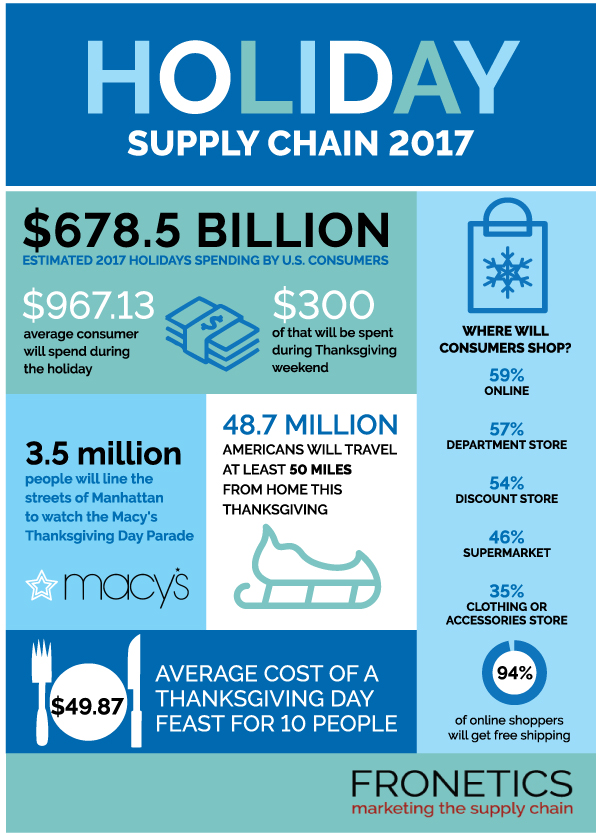
The National Retail Federation is estimating that holiday sales will be up 3.6-4% from last year, totaling $678.5 billion in holiday spending. What’s more, consumers will be hitting the malls earlier than ever. More and more retailors are forgoing the traditional Thanksgiving dinner to open their stores during the holiday. Major retailers, including Target, Kohls, and Toys “R” Us, will open their doors at 5 p.m. on Thanksgiving Day.
“[Thanksgiving] was a strong weekend for retailers, but an even better weekend for consumers, who took advantage of some really incredible deals. In fact, over one third of shoppers said 100% of their purchases were on sale,” said NRF President and CEO Matthew Shay in 2016.
The NRF is estimating that the average consumer will spend $967.13 during the holiday season, almost $300 of which will be spent during Thanksgiving weekend.
Holiday spending can be broken up into three major categories:
Gifts
Items such as food, decorations, flowers and greeting cards
Other non-gift items consumers buy for themselves and their families
For the first time in NRF’s survey history, online shopping has become the most popular shopping destination. In fact, 59% of consumers will head to their computers for holiday spending, where most will benefit from free shipping (94%).
“While many consumers are holding off until November or later to start their holiday shopping, retailers should be prepared for high traffic online and in stores come Thanksgiving weekend,” Prosper Insights Principal Analyst Pam Goodfellow says. “Although sales will remain an important factor for most consumers, many will lean on convenient locations and easy-to-use websites or mobile apps along with free shipping to complete their purchases.”
Tracking these logistics metrics can help you identify and tackle issues in your warehouse before they become a problem.
This guest post comes to us from Demetra Mallios at Catch-Up Logistics, a full-service provider of ambient and temperature-controlled food-grade distribution and warehousing services.
The supply chain plays an integral part in maintaining a well-functioning organization. A well-structured and organized warehouse will help you achieve your distribution goals and adequately analyze metrics.
You can think of it like when you are trying to decide what to make for dinner, but cannot remember what food you have in your fridge. If your items are organized and you are aware of what is in your fridge (the warehouse), then you can properly make your dinner decision (packing and preparing for delivery distribution).
While you may be aware of some metrics to track, you might still be missing others. But, that’s where we come in with our list of the top 10 logistics metrics to measure supply chain efficiency in your warehouse.
10 logistics metrics to measure supply chain efficiency in your warehouse
1. On-Time Shipping
A distribution center’s primary objective is clear in its name: It must accurately and efficiently distribute goods that are coming in and out of the warehouse. In other words, the correct product must be placed on the correct transportation method at the appropriate time. In order to complete this task, you must monitor late shipping departures to the warehouse and early completion of freight loading time.
Although it may seem that finishing shipment loads ahead of schedule is a good idea, in reality it could affect the departure and duties of other shipments. So, your business can be sure to monitor these shipment details via a 3PL system. You should also take into account the varying loading and transportation times needed to shift freights before out-bounding product. (Because delaying shipping can be just as bad as receiving the birthday present you ordered for your mom days later, timing matters.)
2. Warehouse Capacity
While there are measures out there to monitor inventory, it is essential that you complete manual observation as well. A distribution center needs to be aware of its ability to increase or decrease its loading times, create more storage space, and accurately track inventory. Currently, many distribution centers incorporate RFID measures to check inventory. However, you should not underestimate the need for manual observation in order to successfully analyze the listed criteria.
3. Accurate Order Fulfillment
Another highly important metric is, of course, the accuracy of the order picking processes. When your employee goes to retrieve a pallet of a specific product, you want to be able to measure how quickly and accurately that task is completed. However, realistically, human error will sometimes occur, which makes the tracking of the picking and moving process vital. A distribution center does not want to be in a situation in which it is unaware of lost, damaged, or misplaced product.
4. Properly Storing Incoming Product
This metric relates to the previous one about order fulfillment, in that it requires a similar tracking process. Accurate inbound storage is essential for accurate outbound deliveries. Without a well-organized inventory in the receiving end, the outbound end will have trouble accurately and efficiently fulfilling orders.
Additionally, the incoming product needs to be recorded correctly, so that inventory capacity can consistently be updated. Furthermore, incoming product and procedures can vary depending on the type of warehouse and storage facility you are operating. For instance, Catch-Up Logistics focuses on food storage. Therefore, it is essential that the product is placed in the correct freezer, cooler, or ambient temperature zone. If this is not done properly, not only will we ruin the product, but we will also lose credibility in our ability to provide high-quality warehousing services.
5. Peaks in Warehouse Capacity
Changes in product demand can, of course, influence the amount of inventory you are willing to hold in your warehouse distribution center. For instance, the holiday season will result in a peak in inventory, as companies need to store more seasonal product. With Catch-Up Logistics, Thanksgiving is a prime example, as our turkey inventory grows and distribution needs to be timely.
6. Total and Individual Cycle Times
In order to be sure that your warehouse is running efficiently, you should be tracking the cycle times. The total cycle time refers to the time needed to properly place the product in inventory from its time of arrival and then ship it from the distribution center. Individually, you can record the dock-to-load time, picking, packing, and preparing the freight for shipping times. This will enable you to see whether or not a certain process is underperforming and can be improved.
7. Damaged Products
You are bound to deal with damaged product at some point while either receiving inventory or moving it. Thus, it is important to record whether or not the product was already damaged upon arrival or if it was due to mishandling in the distribution center. Knowing this data and taking proper action to reduce such mishaps will help improve the efficiency of your warehouse.
8. Employee Turnover Rate
Because working in a distribution center can be exhausting, it is common for employees to search for other job opportunities. However, being able to minimize the turnover with incentives and an improved working environment can benefit the business. It is best to try and maintain employment, instead of consistently searching for new workers and spending the time and resources to train them, only to have them leave in a few months.
9. Accurate Tracking of Trailers
If your warehouse distribution center makes use of trailers for shipping product, it is essential that you are aware of their location at all times. (For instance, Catch-Up Logistics utilizes trailers for shipping.) A great method for tracking this information is through the use of a GPS tracking system.
10. Recording Temperatures
If you have a food storage warehouse facility, it is essential to install a temperature-monitoring system. At Catch-Up Logistics, we monitor the daily temperatures of all the freezers, coolers, and ambient temperature storage spaces to ensure the optimal temperature for proper food storage and health reasons. Additionally, such a system will notify you of any irregular changes in temperature so that you can immediately solve an arising problem before the food product becomes unusable.
There are many aspects to maintaining a well-functioning warehouse distribution system, as demonstrated from the list of metrics above. Although these tracking suggestions may at first appear excessive and time-consuming, they will help you improve the efficiency of your warehouse.
Being aware of potential issues will allow you to tackle the problem before it has a chance to further develop. So, what are you waiting for? If you have not already begun using these metrics, you should consider implementing them as soon as possible!
No doubt 3D technology has transformed the world of business. There are numerous inspiring ways by which 3D technology has to reshape the future.
This post comes to us from Adam Robinson of Cerasis, a top freight logistics company and truckload freight broker.
If you are also instructed to learn about the impact of this revolutionary technology then you are at the right spot. Here are seven ways in which this new 3D trend will shape the future of manufacturing sector:
1. Boost Local Production
According to a recent survey based report it is come to know that 3D technology will allow the manufacturer to double the mass production level. It will enable the producers to reach their targets without increasing each unit production cost.
It will also reduce the shipment costs as a local manufacturer will no need to bring material from other countries. Instead, they could easily install 3D manufacturing plant in their own factory to cut the extra cost.
This way local business will easily boost their production process as well as reduce the cost of manufacturing.
2. More Customized Products
When you will engage 3D technology in the manufacturing process, you will get a chance to produce customized goods. It means that you could build everything from clothes to cars in a unique way.
According to a report, it is revealed that in coming years mobile users will get the opportunity to use 3D printing app.
In additional professional designers with also use 3D printing techniques to enter into the new age of industrial design. So, if you want to develop customized products to drive more revenue then you should use 3D printing method.
3. Best For Creativity
It is true to say that 3D technology is the best tool for creative lovers. This is because it enables manufacturer to open up new possibilities to grab the attention of more customers,
Many experts have predicted that the introduction of 3D technology will enable the creativity lovers to fulfill their every desire in an innovative manner.
Whether you want to design a phone or furniture mode, 3D technology will soon make it possible for you to accomplish your goals perfectly.
4. Avoid Copyright Issues
We all know the importance of copyrights to safeguard ones intellectual property. This is why businessmen hire lawyers to overcome a number of legal disputes that are rising due to copyright.
It is anticipated that 3D printing will secure the creativity of artists as everyone will hold ownership of their 3D design.
In case, you are also concerned because of the copyright issue then this technology will help you to overcome legal issues quickly.
5. A New Tool For Large-Scale Producers
Suffice to say that 3D technology is best tool for countries which are totally dependent on manufacturing industry. For instance, as China heavily depends on the manufacturing industry, 3D printing will enable China to target a huge domestic market.
In addition, it will also assist countries that are rapidly moving toward manufacturing sector. It gives them the great benefit to switch their operations to mass-manufacturing level all over the world. This strategy will benefit every growing economy to step in the next level in the coming future.
6. Build New Horizons For Every Industry
The 3D technology will revolutionize production process of every industry including the healthcare sector, education sector as well as food industry. The reason behind this is that scientists are working on 3D models that will facilitate every industry so that more people will take benefit from it.
From research, it is come to know that a popular hospital has printed a jawbone by 3D printer. If you also engage in health sectors then you will also find yourself building human body parts in a 3D manner. Many experts have also researched that 3D tools will also help to assemble chemical compounds and printing drugs.
7. Reduce Crime
It is predicted that new 3D technology will reduce the crime level. This is because people can keep guns that are made on 3D printers to secure themselves from criminals.
In addition, people can create CCTV camera and other 3D technology to catch the criminal in an easy manner. Moreover, it will also help in the production process of military equipment and chemical weapons.
Wrap-Up…
Therefore, it could be said now that 3D printing will offer uncountable benefits to small scales as well as the large-scale manufacturing industry to drive more revenue. If you also belong to the manufacturing industry then you should also tap into the potential of this superb technology.
As sales and consumer desire continue to increase for drones and home assistants, the second-life market has a huge opportunity for growth.
Consumers are becoming ever-more enamored with their gadgets and toys. Drones and home assistants are becoming more ubiquitous in our homes (and flying around our skies). However, when these machines run their course — either because they break, or a newer model comes out — is there still use for them?
The market for gadgets
The marketplace for drones is an ever-growing one. Last year drone sales increased by an astounding 60%, and revenue grew to $4.5 billion. The drone market can be segmented into two categories — personal and commercial. Personal drones, which many consumers use for photography, is predicted to grow 40% this year, while commercial drones, which can be used for survey maps and delivery services, are expected to grow 60%.
While personal-use drones dominate unit sales, commercial-drone sales — which make up only about 6% of the market — are projected to represent 60% of the market’s revenue. This is due to the high cost of commercial drones, some with costs that exceed $100,000.
Home assistants are another intriguing category on the rise. These products are intended to control various devices in your home, such as thermostats, lighting, and security. These products also allow an individual to shop online using voice commands.
The frontrunner for this market has been Amazon’s Echo devices. As the primary nature of Amazon’s business is e-retail, the Echo device plays perfectly into this. By making it simple and easy to make Amazon purchases through voice command, these devices have great potential to bolster Amazon’s bottom line.
While this market is still in its early stages, Gartner Research expects tremendous growth, projecting $2.1 billion in consumer spending on personal home assistants by the year 2020.
The second-life market
So what becomes of these products as we replace them with newer models? Smart phones offer a sensible comparison when looking at the second-life market for these products. In 2016, consumers sold or traded in used cell phone devices for an average of $140 per device, generating a total of $17 billion worldwide. This selling and trading doesn’t just end after one transaction. It is predicted that at least 10% of premium ($500 and up) smartphones will have at least three users before they are retired.
We can draw a parallel about second-life potential between drones/home assistants and cell phones. Advances in technology render previous models obsolete or, at best, out of date. Consumers who can afford them will gravitate toward newer products. As with cell phones, they will generally look to recoup some of the cost for the newer product by selling or trading in the old one. These can then be sold to consumers looking for less expensive, older models. Even in the case of drones that crash, parts can be salvaged and sold to individuals that are looking to build their own drones.
The markets for these products are all still in early stages, so second-life markets are still in growth stages as well. As sales and consumer desire continue to increase for drones and home assistants, their life cycle will go on long after the first owners have moved on to newer models.