

Every last mile carrier’s website says the same thing: reliable, flexible, real-time tracking. So shippers compare rates and pick the cheapest. Last mile delivery marketing breaks that cycle by giving one type of shipper a clear reason to see you as the safer choice.
The stakes are high on their side. According to Statista, the last mile grew from 41% to 53% of total shipping costs between 2018 and 2023, and it’s the one leg their customers actually see. Below are the positioning moves, the seven questions shippers ask before they shortlist you, and the channels that turn both into contracts. For the bigger picture, see our transportation marketing approach.
How should last mile carriers position themselves?
Pick the freight and the shipper you serve best, and say so plainly. “We deliver everything everywhere” loses to “We deliver large appliances with two-person installation across the Southeast.” Specialization gives a shipper a reason to shortlist you, and it gives your sales team a story they can repeat.
| Segment | What the shipper cares about most | Proof to lead with |
|---|---|---|
| Big and bulky (furniture, appliances, fitness equipment) | Damage, installation quality, haul-away, customer reviews | Damage claims rate, two-person crew training, post-delivery survey scores |
| White glove and high value | Handling, scheduling precision, professionalism | Appointment adherence, crew vetting, photo proof of delivery |
| Ecommerce parcel and small package | Cost per stop, speed, density, returns | First-attempt delivery rate, coverage map, same-day and next-day zones |
| B2B and job site | Time windows, site access, liftgate and special equipment | On-time percentage by window, equipment list, construction and retail references |
Choose one or two rows and build your messaging around them. You can still take other freight. You just don’t lead with it.
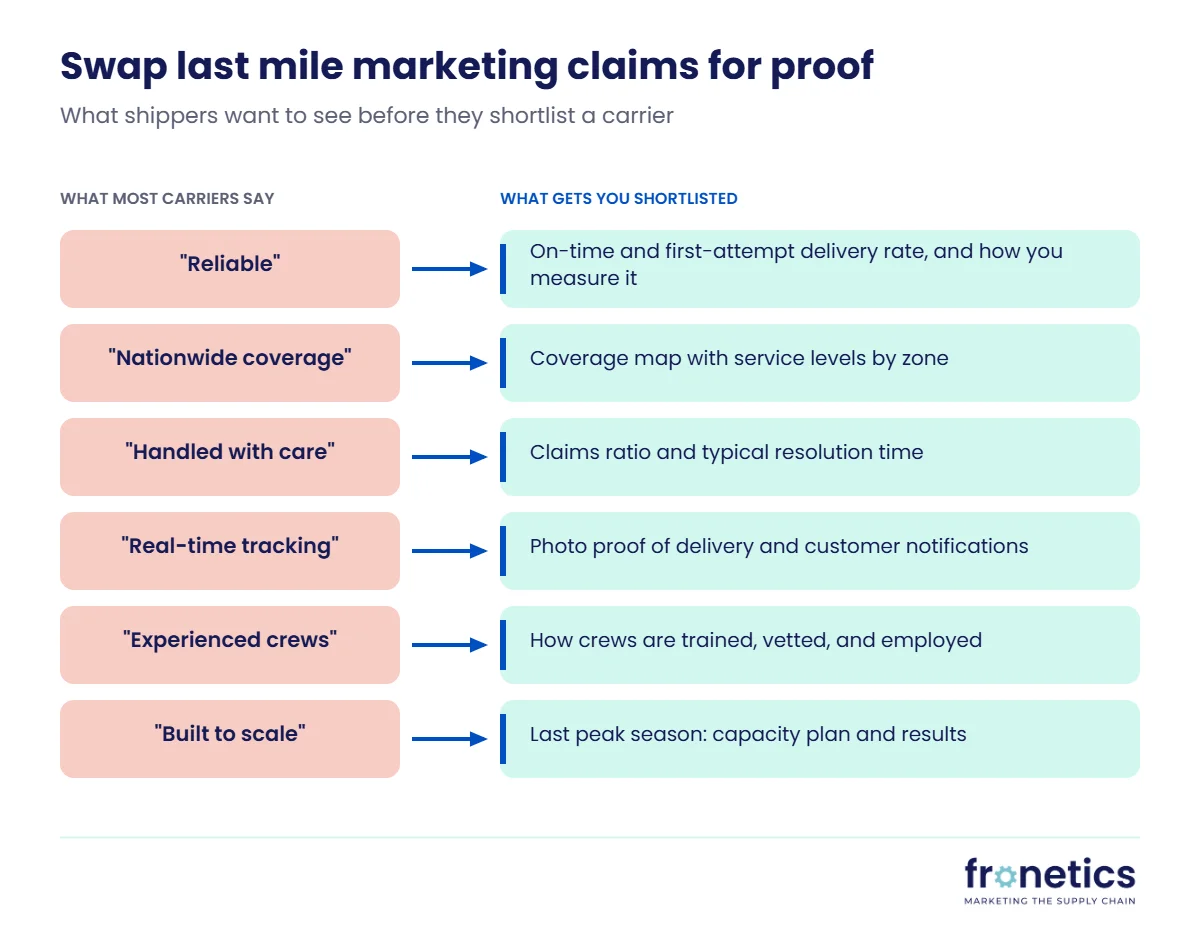
What shippers ask before they shortlist a last mile provider
Whether it comes through an RFP or a first call, expect these questions. Your website and sales materials should answer them before anyone asks:
- Where do you deliver, and how far? A clear coverage map with service levels by zone.
- What’s your on-time and first-attempt delivery rate? State how you measure it and over what period.
- How do you handle damage and claims? Your claims process, typical resolution time, and claims ratio.
- What visibility will my team and my customers get? Tracking, delivery notifications, photo proof of delivery, and integrations with common order and transportation management systems.
- Who’s actually doing the delivery? Employees, contractors, or partners, and how you train and vet them.
- How do you handle peak season? Your capacity plan and what happened last November and December.
- What does it cost, and what drives cost up? Pricing structure, accessorials, and what’s included in a standard delivery.
Carriers that publish these answers make the shortlist more often, because they’ve made the evaluator’s job easier.
Last mile delivery marketing channels that work
A website built for evaluation
Your website is where shippers check whether you’re credible. Lead with your segment and coverage, put proof (metrics, case studies, customer logos with permission) near the top, and make it easy to request a quote. If you serve several segments, give each its own page. Those pages also become the foundation for search and AI search visibility when shippers look for providers in a region or freight type.
Case studies with numbers
A shipper wants to know you’ve solved a problem like theirs. Write case studies around a measurable outcome: claims reduced, delivery windows met, a peak season handled without missed deliveries. Keep them short, and only use results the customer has approved.
Targeted paid campaigns
Last mile buyers are a small, identifiable audience. LinkedIn campaigns aimed at logistics and ecommerce operations titles at retailers and brands in your coverage area, plus search campaigns on high-intent terms, can work well. Paid campaigns should send traffic to the segment page that matches the ad, not your homepage.
Sales and marketing alignment
Last mile deals often come from a sales conversation, so marketing’s job is to create assets that make those conversations shorter. A capabilities one-pager, a coverage map, and two or three segment case studies will get used every week. Tie your marketing to qualified pipeline, and track which assets show up in deals that close.
Mistakes that keep last mile carriers in the price fight
- Generic claims. “Reliable” and “customer focused” without a number behind them are invisible.
- No defined segment. Trying to appeal to every shipper means no shipper sees themselves in your message.
- Hiding the operations story. Shippers want to know how you train crews, handle exceptions, and communicate with their customers. That’s your differentiation.
- Ignoring returns and reverse flows. For ecommerce and big-and-bulky shippers, how you handle returns and haul-away can decide the deal.
Putting it together
Start by choosing the segment where you have the strongest proof. Rebuild your website messaging around it, publish the answers to the seven shortlist questions above, and write one case study with a hard number. Then put paid and sales outreach behind it.
If you’d like a partner that understands how carriers win shipper business, explore our marketing for transportation and trucking companies.
Frequently asked questions
What is last mile delivery marketing?
Last mile delivery marketing is how final mile carriers win shipper contracts, through positioning, website content, case studies, and campaigns aimed at the retail, ecommerce, and manufacturing leaders who need goods delivered to a home, store, or job site.
How do last mile carriers win retail and ecommerce shippers?
They specialize in a freight type or segment, publish clear proof of performance such as on-time and first-attempt delivery rates and claims ratios, and make coverage, visibility, and pricing structure easy to evaluate before the first sales call.
What makes a last mile provider stand out?
A defined specialty, documented performance metrics, a transparent claims process, strong delivery visibility for the shipper and its customers, and case studies that show measurable results for a similar shipper.
What do shippers ask in a last mile RFP?
Common questions cover coverage area and service levels, on-time and first-attempt delivery rates, claims handling, tracking and proof of delivery, crew training and vetting, peak season capacity, and pricing structure including accessorials.
Is last mile delivery marketing different from general trucking marketing?
Yes. Last mile carriers are judged on the end customer’s experience at the door, so their marketing needs to emphasize delivery quality, communication, damage prevention, and visibility, not only lane coverage and capacity.
Related reading
How to grow a trucking company with direct shippers
Freight RFPs: how carriers get on the shortlist