Updated November 2026 with current Thomasnet pricing, program changes, and Xometry details.
Is Thomasnet worth it? For some manufacturers, yes, but not as a substitute for owned search visibility. A paid Thomasnet program can pay off if you sell standard industrial products or contract manufacturing capacity to North American buyers who source on the platform, and if you can trace closed revenue back to it. If most of your Thomasnet “leads” are competitors, spam, or tire-kickers, or you can’t tie the spend to sales, that budget usually works harder building your own website’s rankings in Google and your presence in AI answers from ChatGPT, Perplexity, and Google’s AI Overviews. Those assets keep working after a contract ends. A directory listing doesn’t.
Here’s what Thomasnet costs, what the paid tiers include, what the Xometry ownership means for suppliers, what reviewers say, and how Thomasnet compares with GlobalSpec, Xometry, Alibaba, and investing in your own site.
How much does Thomasnet cost?
Third-party estimates put most paid Thomasnet programs at about $7,000 to $10,000 a year, with competitive categories reaching $25,000 to $50,000 or more. Thomas doesn’t publish a price list or a standard subscription cost. Pricing is quoted per company and depends on which categories you want to appear in, how competitive they are, and which programs you buy. Here’s what the public record shows:
- Free listing: any qualified North American supplier can be listed at no cost.
- Typical annual programs: published third-party estimates and supplier reports commonly put an annual program at $7,000 to $10,000, rising to $25,000 to $50,000 or more in crowded categories.
- Full range: Today’s Machining World has reported paid advertising running from about $500 a month to millions of dollars a year.
- Performance-based listings: since January 2026, suppliers can also buy sponsored listings with a budget they set, paying only for traffic that engages with their profile.
- Contract terms: traditional programs are usually sold as annual memberships, and several reviewers report auto-renewal clauses that require notice months before renewal. Read that section before you sign.
Treat these as ranges, not quotes. The more useful number is what your program has to produce to break even, which we’ll get to below.
Is Thomasnet free? The free listing vs. paid programs
Thomasnet is free for buyers, and suppliers can get a basic company listing for free. When a supplier joins, Thomas’s content team places the company in the categories that best match its products and services, using the supplier’s website or direct outreach. Thomas earns its money from suppliers who pay for more visibility above that free listing.
That framing matters. You’re rarely deciding whether to be on Thomasnet at all. You’re deciding whether to keep paying for placement on top of a listing you’d have anyway.
What Thomasnet advertising, marketing services, and WebTrax include
Paid Thomasnet options fall into three groups: on-platform advertising, Thomas Marketing Services (its agency arm), and the WebTrax analytics tool.
Thomasnet advertising. On-platform options include premium sponsorships on category search pages, display ads on company profiles, and newsletter ads, plus retargeting of category audiences and your own site visitors across the web. The performance-based listings launched in January 2026 let advertisers pick from more than 80,000 categories, set their own budgets, and track results in Thomas’s analytics. The same release introduced Thomas Smart Search, which lets buyers type detailed, multi-capability searches instead of browsing categories. Xometry says Smart Search drove over 15% more supplier evaluations than the old search.
Thomas Marketing Services. This is Thomas’s agency arm, offering website design and development, SEO, and ecommerce work for industrial companies. Thomas publishes success stories, including one supplier it says turned $250,000 in advertising into nearly $8 million in new business.
Thomas WebTrax. WebTrax is Thomas’s analytics platform. It pulls activity from your website, your Thomasnet profile, eCatalogs, CAD downloads, and phone calls into one dashboard and flags companies that look in-market. Thomas has offered it free to qualifying manufacturers, and more than 11,000 companies have used it. Some sources describe it as a paid add-on, so confirm current terms with your rep. It’s useful for spotting interest you’d otherwise miss, but it’s measured by the company selling you the media. Check it against your own GA4 and CRM data.
Thomasnet and Xometry: what the ownership means for suppliers
Xometry, the publicly traded custom manufacturing marketplace, acquired Thomas in December 2021. In 2022 it built Xometry’s instant quoting engine, job board, and financial services into Thomasnet.com. Thomasnet still operates as its own sourcing platform with more than 500,000 listed suppliers, and Thomas continues to announce new tools and partnerships under the Xometry umbrella in 2026.
For suppliers, three things follow from that:
- The growth story is the marketplace, not the directory. Xometry reports Thomas within its services segment, which brought in $57.0 million in 2025, down 4%, while marketplace revenue grew 33% in Q4. In Q3 2026, services revenue was $14.4 million, up 2%.
- Advertising is shifting toward performance. The 2025 and 2026 changes (dynamic ad serving, pay-for-engagement listings, Smart Search) make Thomasnet behave more like a paid search channel inside a vertical directory. That makes it easier to test with a capped budget.
- If you’re a contract manufacturer, Xometry can be both a channel and a competitor. The same parent company that sells you directory visibility also runs a marketplace that quotes buyers directly and routes jobs to partner shops.
Thomasnet reviews and complaints
Thomasnet reviews from suppliers are mixed. Happy advertisers tend to be in categories with steady buyer demand on the platform, while the most common complaints are poor lead quality and hard-to-cancel auto-renewals.
On the positive side, long-time advertisers describe Thomasnet as their main lead source after a decade or more, and one supplier credits it with a six-figure defense contract. Companies that get value tend to have well-defined categories with real buyer demand on the platform, an actively managed program, and a sales team that follows up fast.
The common complaints are consistent:
- “Leads” that turn out to be competitors researching each other, or outright spam
- Few or no qualified RFQs over a full contract term
- Auto-renewals that are hard to stop, including reports of a three-month notice requirement
- Trouble connecting views, clicks, and profile visits to closed revenue
As of this writing, Thomas holds a 3.9 rating on Trustpilot from roughly four dozen reviews, a small sample for a platform this size. Use reviews as a checklist of what to verify in your own data, not as a verdict.
Is Thomasnet legit, good, and reliable?
Yes, Thomasnet is legit. It traces back to the Thomas Register of American Manufacturers, it’s owned by a publicly traded company, and it’s a widely used sourcing tool for engineers, procurement teams, and MRO buyers. As a buyer tool, it’s reliable for finding and vetting North American suppliers.
Whether it’s good for your business as a supplier is a different question, and the honest answer is that it depends on whether your buyers source there and whether you can measure the return. The rest of this post helps you check both.
Thomasnet vs. Alibaba, GlobalSpec, and Xometry
Thomasnet is the better fit for North American industrial suppliers sold by capability and location. GlobalSpec suits engineered components sold to design engineers, Xometry suits shops filling spare capacity, and Alibaba suits overseas sourcing of finished goods. Here’s how they differ for suppliers.
| Option | What it is | How suppliers pay | Who owns the buyer | Best fit |
|---|---|---|---|---|
| Thomasnet | North American industrial sourcing directory | Free listing; paid placement and ads | You, once the buyer reaches out | Job shops, fabricators, standard industrial parts |
| GlobalSpec | Engineering media network and parts catalog | Newsletters, display, webinars, lead programs | You | Engineered components sold to design engineers |
| Xometry | Custom manufacturing marketplace | No ad spend; you accept offered jobs | Xometry | Shops filling spare capacity |
| Alibaba | Global marketplace, mostly Chinese suppliers | Supplier memberships and ads | You, through the platform | Low-cost finished goods, private label |
| Owned SEO and AI search | Your site ranking in Google and cited by AI | Content, technical SEO, authority | You, from the first visit | Any manufacturer that wants visibility it keeps |
Thomasnet vs. Alibaba. For a U.S. or Canadian manufacturer, this is rarely a real choice. Alibaba serves buyers sourcing overseas, with vetting largely left to the buyer. Thomasnet’s audience wants domestic suppliers, shorter lead times, and verified credentials, which is much closer to your customer.
Thomasnet vs. GlobalSpec. GlobalSpec, owned by Compare Networks since 2020, is closer to a trade media company. Its catalog covers more than 122 million parts, and it sells newsletters, display, webinars, and lead programs aimed at engineers. It fits engineered products with a specification-driven buyer. Thomasnet fits companies sold by capability, category, and location.
Thomasnet vs. Xometry. Thomasnet sends buyers to you. Xometry quotes the buyer itself and offers the work to its network of partner manufacturers. Xometry can keep a shop busy, but you don’t set the price or own the customer.
Thomasnet alternatives, competitors, and sites like Thomasnet
A few other directories serve the same buyer. If you’re weighing Thomasnet, you’re probably weighing these too:
- IndustryNet: a U.S. supplier directory run by data company MNI, launched in the 1990s. MNI’s research team keeps a basic listing for each supplier, and paid tiers buy priority placement in results. More than 12,000 suppliers pay for enhanced listings.
- MFG.com: an RFQ marketplace for custom manufactured parts. Manufacturers join on a subscription, and buyers use it free.
Both share Thomasnet’s structural limits: rented visibility, placement that’s bought, and your profile next to competitors on the same page.
Why owned search visibility is the bigger alternative
The strongest Thomasnet alternative usually isn’t another directory. It’s making your own website the thing buyers find, through SEO and AI search optimization. Industrial buyers start supplier research in Google, and increasingly they ask AI assistants instead. Forrester’s 2025 Buyers’ Journey Survey found 94% of B2B buyers use AI during the buying process, and buyers now rate generative AI and conversational search as more meaningful than vendor websites, product experts, or sales reps. That’s changing how procurement teams build supplier shortlists.
When an engineer asks ChatGPT for “AS9100 certified precision machining shops in the Midwest,” your Thomasnet spend has little influence over whether you’re named. What drives that answer is the content on your own site, how clearly it describes your capabilities, certifications, and industries, and how often credible third-party sources mention you. Your free Thomasnet profile can be one of those sources. Paying for top placement inside Thomasnet does little to change it.
What $10,000 a year buys on Thomasnet vs. owned SEO
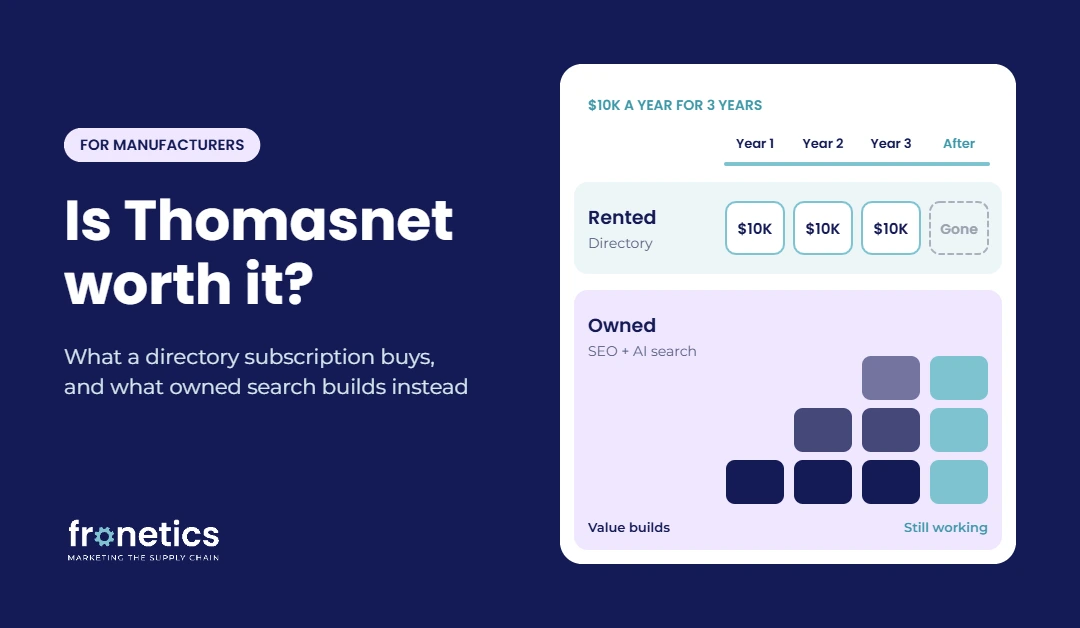
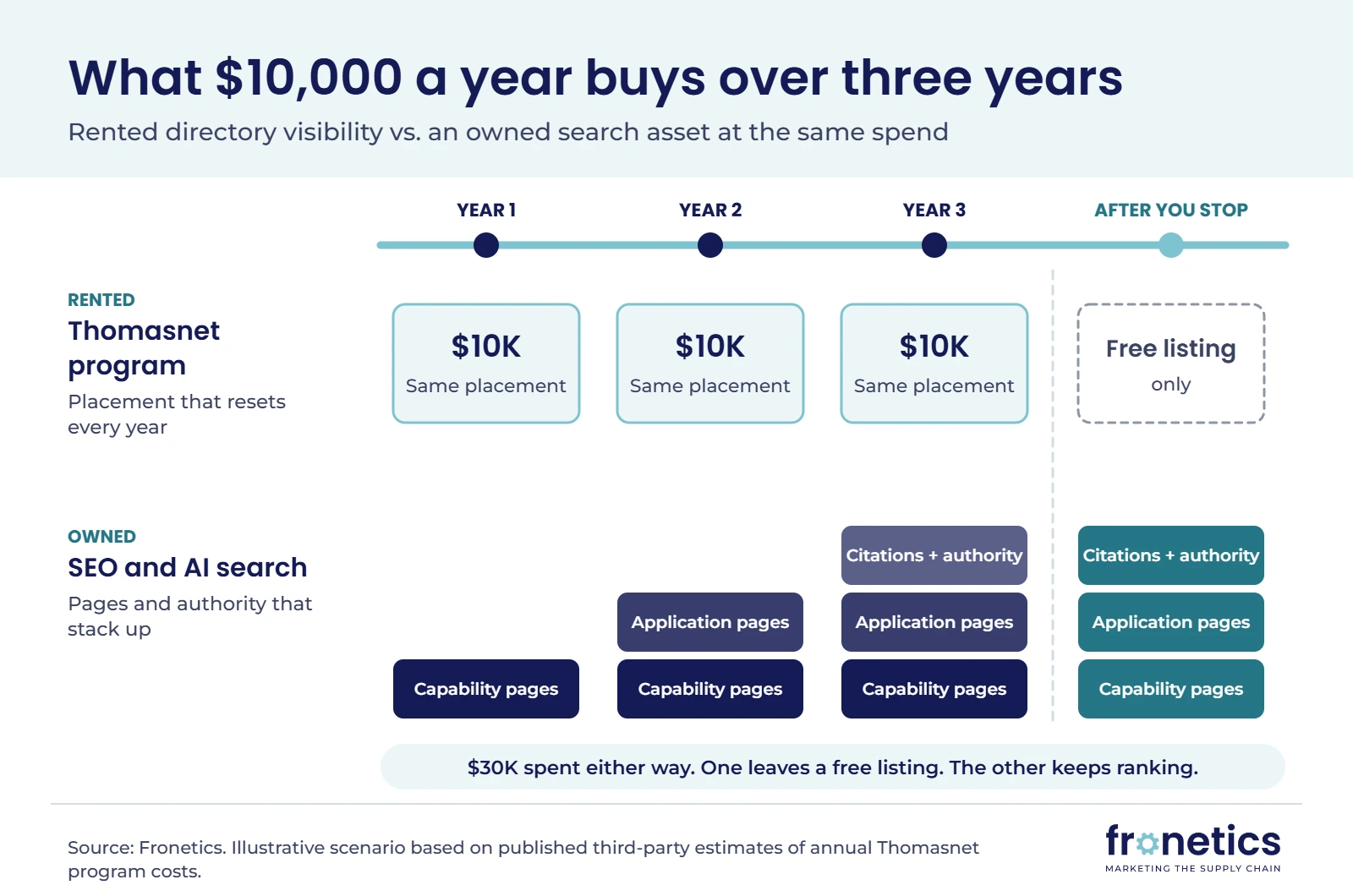
At the same annual spend, Thomasnet buys placement that resets every year, while owned SEO builds pages and authority that keep working after you stop paying. Say you spend $10,000 a year, near the top of the typical range in third-party estimates.
| $10K a year on Thomasnet | $10K a year on owned SEO | |
|---|---|---|
| Year 1 | Enhanced placement in chosen categories | Rebuilt capability pages, new application pages, technical fixes, schema |
| Year 2 | Another $10K for the same placement, if no one outbids you | Year 1 pages keep ranking; new spend adds pages and authority |
| Year 3 | Another $10K ($30K total) | A growing library working in Google and AI answers ($30K total) |
| After you stop | Back to a free listing | Content and rankings stay yours |
The break-even math for Thomasnet is simple. If a new account is worth $25,000 in first-year gross profit, a $10,000 program needs to land one new customer a year, with some margin for error. Plenty of manufacturers clear that bar. Plenty can’t show they do. Run the same math on owned search, but credit the fact that the asset keeps producing in years two and three.
When Thomasnet still makes sense
At Fronetics, we build SEO and AI search programs for manufacturers, so it would be easy for us to say “cancel Thomasnet.” That isn’t always the right call. Thomasnet still earns its place when:
- Your buyers source there. Contract manufacturers, machine shops, fabricators, and suppliers of standard industrial components often see real RFQ volume.
- You can prove it. Your CRM shows quotes and orders traced to Thomasnet that exceed the program cost.
- Your website is thin. A directory presence can carry demand while you build your own site. Treat it as a bridge, not a permanent plan.
- You need fast visibility in a new category or region. Performance-based listings make a capped test practical.
- Government or defense buyers are a target. Certification and diversity filters help those buyers shortlist suppliers.
Either way, keep the free listing. It’s a credible third-party citation that confirms your company, location, and capabilities for buyers and AI tools alike.
How to decide before your next Thomasnet renewal
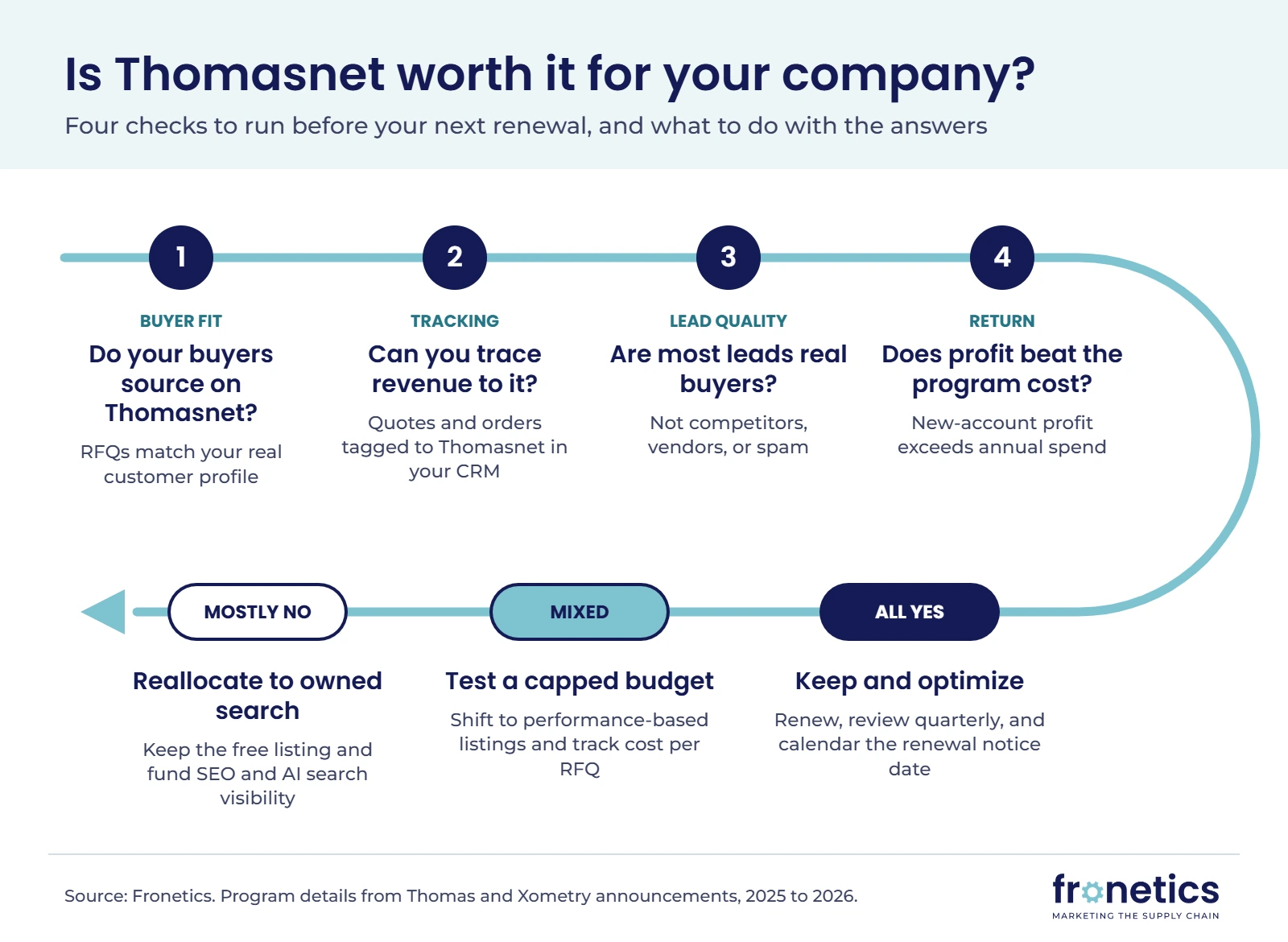
Run four checks: whether your buyers source on Thomasnet, whether you can trace revenue to it, whether most leads are real buyers, and whether the profit beats the program cost. The checklist at the top of this post maps each answer to keeping, testing, or reallocating. Here’s how to run it.
- Pull 12 months of source data. Check GA4 for sessions and conversions referred from thomasnet.com, and your CRM for RFQs, quotes, and closed deals attributed to Thomasnet.
- Audit lead quality. Sort inquiries into qualified buyers, competitors, vendors pitching you, and spam.
- Calculate cost per qualified opportunity and per customer. Compare those numbers with your other manufacturing lead generation channels.
- Check where you stand in Google and AI answers. Search your core capabilities and ask ChatGPT, Perplexity, and Google which suppliers they recommend. If competitors appear and you don’t, that’s a gap a directory won’t close.
- Calendar your renewal notice date. Make the decision before the contract makes it for you.
- Consider reallocating instead of quitting. Many manufacturers drop to a smaller performance-based program and move the difference into their own site.
Frequently asked questions about Thomasnet
Is Thomasnet free?
Thomasnet is free for buyers, and suppliers can get a basic listing for free. Enhanced profiles, higher placement, sponsored listings, and advertising are paid.
How much does Thomasnet cost?
Thomas quotes pricing individually. Industry estimates put a typical annual program at $7,000 to $10,000, with competitive categories reaching $25,000 to $50,000 or more. Performance-based listings let suppliers set their own budget.
What is Thomasnet used for?
Engineers, procurement teams, and MRO buyers use Thomasnet to find, compare, and contact North American suppliers by product category, capability, location, and certification, and to send RFQs. Suppliers use it to be found by those buyers.
Is Thomasnet legit?
Yes. Thomasnet is a long-established sourcing platform owned by Xometry, a publicly traded company. Negative reviews generally concern lead quality and contract terms, not legitimacy.
What are the best Thomasnet alternatives?
Other directories and marketplaces include GlobalSpec, IndustryNet, MFG.com, and Xometry’s marketplace. For most manufacturers, the strongest alternative is investing in their own website’s SEO and AI search visibility, because it reaches buyers who never use a directory and keeps working after the spend stops.
See where you stand in AI search before you renew
Before you sign another directory contract, find out what Google and AI assistants already say about your company and your competitors. Our free AI search visibility report shows whether ChatGPT, Perplexity, and Google’s AI Overviews mention you for the capabilities you sell, which competitors they recommend instead, and what to fix first. Use it alongside your Thomasnet numbers to decide where next year’s budget should go.
Fronetics runs SEO and AI search visibility programs for supply chain, logistics, and manufacturing companies. That includes capability and application pages, technical fixes, and the content that gets you cited in ChatGPT, Perplexity, and Google’s AI Overviews. See how our SEO and AIO work runs.