
When an EMS provider loses an RFQ, it usually blames price. But the winning quote often isn’t the cheapest. It’s the one that arrived first, explained its assumptions, flagged a design risk, and got a follow-up call. Winning an EMS RFQ is as much about how you present the number as the number itself.
Below are the five reasons good quotes lose, what OEMs want to see instead, and six ways marketing can raise your quote-to-win rate. For a broader growth plan, see how we approach marketing for electronics companies.
Why EMS providers lose RFQs they should win
The quote is late
Speed signals capability. When an OEM’s program manager is waiting on four quotes, the one that arrives two weeks after the others starts at a disadvantage, even if the price is competitive. Slow quotes usually come from manual BOM cleanup and component sourcing, which is an operations issue, but the impact shows up in your win rate.
Assumptions aren’t explained
Two quotes can differ significantly simply because one assumed consigned parts or a different test strategy. If your assumptions are buried in a spreadsheet tab, the OEM may compare your number to a competitor’s without realizing they’re quoting different things. Often you lose to a quote that looked cheaper but wasn’t.
There’s no engineering input
OEMs notice when a provider simply prices what was sent. A short design for manufacturability (DFM) note that flags an end-of-life component, a costly footprint, or a test coverage gap shows you’ll be a partner, not just a pair of hands.
The quote doesn’t look like your company
A raw spreadsheet export with no context tells the OEM nothing about who you are. The quote is a sales document. It should look and read like one.
Nobody follows up
Many quotes are sent and then left alone. A follow-up call to walk through pricing and assumptions gives you a chance to correct misunderstandings before the decision is made.
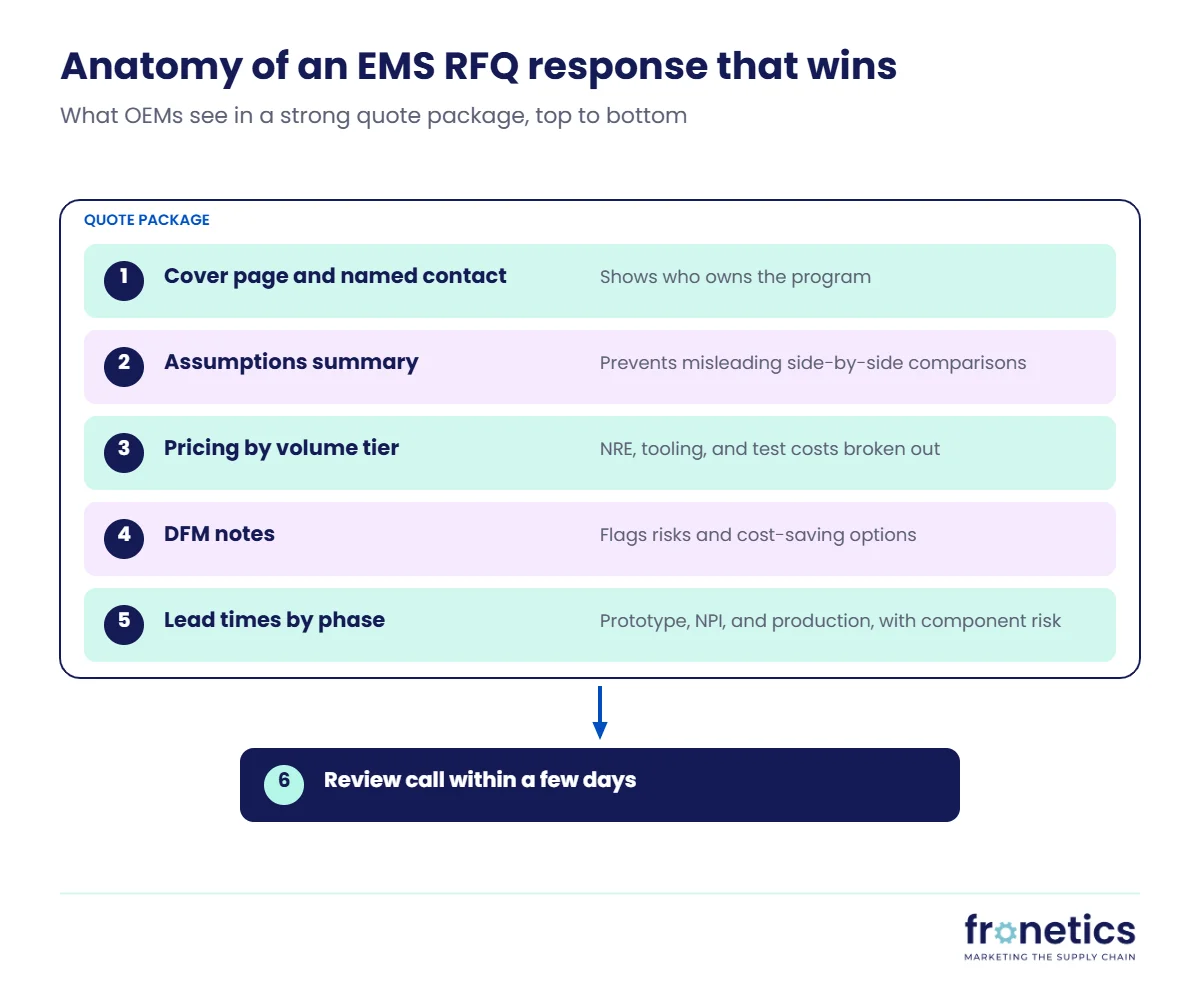
What OEMs look for in an EMS RFQ response
| Weak response | Strong response |
|---|---|
| Price per unit only | Price by volume tier with NRE, tooling, and test costs broken out |
| Assumptions hidden or missing | Assumptions summarized up front in plain language |
| No comments on the design | A short DFM summary with risks and cost-saving options |
| Generic lead time | Lead times by phase (prototype, NPI, production) with component risk noted |
| Spreadsheet with no context | Branded quote package with capabilities, certifications, and a named contact |
| Sent and forgotten | Review call offered within a few days of submission |
How marketing can help you win more RFQs
Marketing doesn’t price the build, but it shapes almost everything around the number. These are the places we’d focus:
- Build a quote package template. A short cover page, an assumptions summary, a DFM section, your relevant certifications, and a named contact. Estimating fills in the numbers. Marketing makes it consistent and professional every time.
- Make it easy to request a quote. A clear RFQ page on your website that explains what to send, accepted file formats, and your typical turnaround time removes friction for engineers and buyers. It also tells them you have a process. A strong website does this well.
- Publish proof that supports the quote. Short case studies on NPI ramps, component shortage workarounds, or cost reductions give the OEM evidence to cite internally. Content marketing should produce assets your sales team can attach to every quote.
- Warm up target OEMs before the RFQ arrives. If the OEM already knows your capabilities, your quote starts with credibility. Account-based marketing aimed at engineering, supply chain, and program management roles at your best-fit OEMs builds that familiarity.
- Use trade shows to start RFQ conversations. Events like IPC APEX EXPO are where many OEM relationships begin. Go in with pre-scheduled meetings and a clear ask, and plan follow-up before the show ends. Our trade show marketing approach covers how.
- Run a win/loss review. After every decision, ask the OEM what drove it. Track reasons over time. If the same objection keeps showing up, fix it in the quote package, your website, or your sales conversations.
Metrics worth tracking
An effective RFQ process is something both OEMs and EMS providers care about. Internally, a few numbers will tell you whether changes are working:
- Quote turnaround time from receipt of a complete package to submission
- Quote-to-win rate overall and by OEM segment
- Reasons for loss from win/loss conversations
- Follow-up rate on submitted quotes
- Source of RFQs (existing customer, referral, website, trade show, outbound)
Even rough tracking in a CRM will show patterns within a quarter.
Start with your last ten losses
Pull the last ten RFQs you lost and look at what you sent. Was the quote on time? Were assumptions clear? Did you offer engineering input? Did anyone follow up? The answers will show you where the quickest wins are.
If you want help building a marketing program that supports your sales and quoting process, talk with our electronics marketing team.
Frequently asked questions
How do EMS providers win more RFQs?
They respond quickly, break out pricing and assumptions clearly, add engineering input such as a short DFM summary, present the quote as a professional sales document, and follow up with a review call. Tracking win/loss reasons helps them improve over time.
What do OEMs look for in an RFQ response?
OEMs look for pricing by volume tier, clearly stated assumptions, NRE and test costs broken out, realistic lead times, design feedback, relevant certifications, and a responsive named contact.
Why do EMS companies lose quotes they should win?
Common reasons include slow turnaround, unclear or hidden assumptions that make comparisons misleading, no engineering input, a quote format that says nothing about the company, and no follow-up after submission.
What should an EMS RFQ package include from the OEM?
A complete package typically includes a bill of materials, Gerber or ODB++ files, assembly drawings, test requirements, target volumes, and program timing.
Related reading
What OEMs really look for when choosing an EMS partner
Why trust is the real product in electronic component distribution