
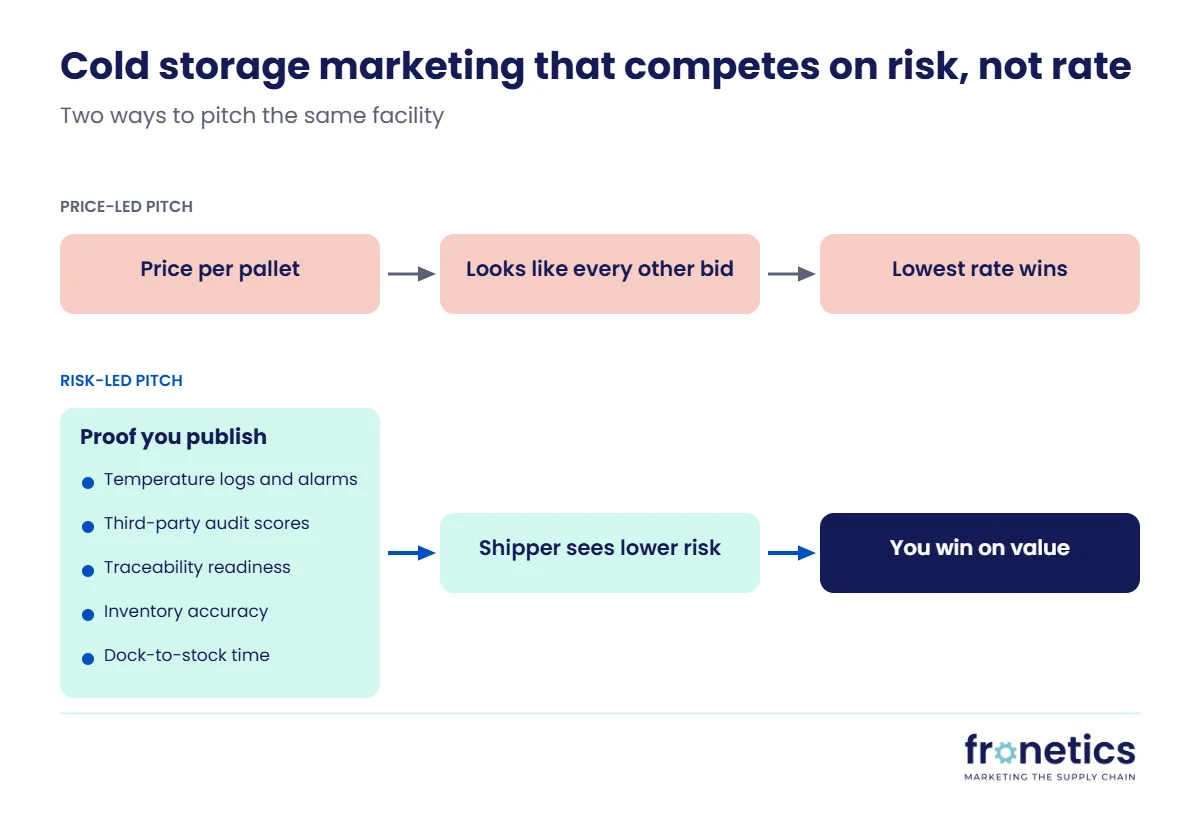
Cold storage vacancy just hit a record high, and shippers know it. When every proposal looks the same, they compare price per pallet and pick the lowest. Cold storage marketing that wins in this market does the opposite: it shows food and pharma shippers, with documented proof, why your facility is the lower-risk choice.
Below are the factors shippers weigh more heavily than rate, how to stop competing on price per pallet, and where cold chain buyers look for providers. For our broader take on the category, see how we approach warehousing and 3PL marketing.
Why are cold storage providers losing deals on price?
Supply caught up with demand, and then passed it. Newmark’s research shows U.S. cold storage vacancy reached 7.7% in the first half of 2026, a new record after the 20-year high set at the end of 2025. The vacancy isn’t evenly spread: warehouses built before 2006 account for 68% of vacant cold storage space, while facilities built between 2006 and 2019 sit at 3.4% vacancy.
Shippers are moving toward facilities they see as modern and lower risk. A well-run older facility that can’t explain why it’s well run will lose to a newer building with a better story. And in cold storage, risk is the whole conversation: a temperature excursion can mean destroyed product, a recall, or a failed audit.
What cold storage marketing should prove besides price
Price matters, but it’s rarely the reason a shipper leaves a cold storage provider. These are the factors that drive switching, and the proof that makes them believable:
| What the shipper worries about | Proof that answers it |
|---|---|
| Temperature integrity | Monitoring and alarm setup, excursion history, backup power, response protocols |
| Food safety and audits | Third-party audit scores (such as SQF or BRCGS), FDA registration, sanitation programs |
| Traceability | Lot tracking, WMS capabilities, readiness for FDA’s Food Traceability Rule |
| Inventory accuracy | Cycle count results, inventory accuracy percentage, reporting access |
| Speed at the dock | Appointment adherence, dock-to-stock time, carrier turn times |
| Value-added services | Blast freezing, tempering, case picking, labeling, cross-docking |
If you can document even three of these with real numbers, you have a stronger pitch than a rate reduction.
How to stop competing on price per pallet
Specialize by product or customer type
Frozen seafood, dairy, produce, meat and poultry, confectionery, and pharma all have different requirements. A facility that says “we specialize in frozen protein for regional grocery distribution” stands out from one that says “full-service cold storage.” Pick the categories where your temperature zones, certifications, and customer base are strongest, and lead with them.
Make your operations visible
Shippers can’t tour every facility. Your website should show them what a tour would: temperature zones and capacity, monitoring systems, sanitation practices, and the people running the building. Short videos and photo galleries of real operations work better than stock images of frosty warehouses.
Turn compliance into a selling point
FDA’s Food Traceability Rule, part of FSMA Section 204, carries a compliance date of July 20, 2028. Food companies on the traceability list will need warehouse partners who can capture and share the right records. If you’re already capable, say so and explain how. That’s a reason to choose you that has nothing to do with price.
Publish proof, not adjectives
Case studies with measurable outcomes beat claims every time. Write about a customer whose inventory accuracy improved, a peak season you handled without excursions, or a fast onboarding. Use only results the customer has approved, and state how you measured them.
Where cold storage buyers look for providers
Cold chain buyers do their homework before they call. A few channels deserve most of your attention:
- Search and AI search. Shippers search for cold storage by city, region, and product type. Location and specialty pages, plus clear answers to common questions, help you show up in Google and in AI tools. Strong SEO and AIO is especially valuable when shippers are actively comparing options.
- Industry events. Food and cold chain shows are where relationships start. Go with a plan for meetings, not just a booth. Our approach to trade show marketing covers how to turn conversations into pipeline.
- Content for the evaluation stage. A facility spec sheet, an audit and certification summary, and a traceability capabilities page give buyers what they need to shortlist you. Content marketing built around these assets supports sales instead of competing with it.
- Your existing customers. Referrals and expansions are often the cheapest growth. Make it easy for happy customers to vouch for you.
A practical starting point
Review your last ten lost bids. If most came down to price, look at what your proposal said about temperature integrity, compliance, and accuracy. Chances are those strengths were buried or missing. Fix the proposal and your website first, then add one specialty page and one case study.
If you want a partner who understands how 3PLs and warehouse operators win business, learn more about our warehousing marketing services.
Frequently asked questions
How do cold storage providers win customers?
The most successful providers specialize in specific product categories, document their temperature control, audit, and inventory accuracy performance, and make that proof easy to find on their website and in proposals so buyers can compare on risk, not just price.
What do food and pharma shippers look for in a cold storage partner?
They look for temperature integrity and monitoring, third-party food safety or GDP compliance, traceability and lot tracking, inventory accuracy, dock performance, and value-added services such as blast freezing or case picking.
How can a cold storage warehouse compete on more than price per pallet?
Lead with a specialty, show your operations through photos and video, highlight compliance capabilities such as readiness for FDA’s Food Traceability Rule, and publish case studies with measurable results.
Is cold storage vacancy rising?
Yes. Newmark reported U.S. cold storage vacancy of 7.7% in the first half of 2026, a record high, with most vacant space concentrated in older facilities built before 2006.
Related reading
Warehouse RFPs: what buyers ask for and how 3PLs win
How to write a 3PL case study that wins warehouse business