
Open the websites of ten supply chain software companies and count how many promise “end-to-end visibility,” “AI-powered optimization,” or “real-time insights.” Most will. It’s not that those claims are false. It’s that buyers have read them so many times they’ve stopped meaning anything. That’s a supply chain software positioning problem, not a copywriting problem.
It affects WMS, TMS, visibility, planning, and procurement platforms alike. The category is crowded, the language is interchangeable, and buyers are skeptical. Clear supply chain software positioning is how you break through. Here’s how to build it.
The short version
- Positioning is a choice about who you’re for, what problem you solve, and why you’re different. It’s not a tagline.
- The most effective positioning is narrower than feels comfortable.
- Operations buyers trust specifics: workflows, integrations, implementation times, and measurable outcomes.
- Positioning should drive your website, content, and sales conversations, not just your homepage headline.
What is supply chain software positioning?
Supply chain software positioning defines the specific market a supply chain technology company serves, the problem it solves best, and why it’s the better choice than alternatives, including spreadsheets and the status quo. Strong positioning makes it easy for the right buyers to recognize themselves and quickly understand why your product fits.
It’s the foundation of every supply chain software marketing program we build, because every page, campaign, and demo depends on it.
Why do so many supply chain software brands sound the same?
A few common reasons:
- Feature-first messaging. Leading with capabilities (“AI,” “dashboards,” “API-first”) instead of the operational problem they solve.
- Fear of narrowing. Trying to appeal to every industry, company size, and use case, so the message fits no one in particular.
- Copying the category leader. Adopting the same language as the biggest player, which only reinforces the leader.
- Internal vocabulary. Describing the product the way the product team sees it, not the way a warehouse manager or VP of logistics would.
How do you build stronger positioning?
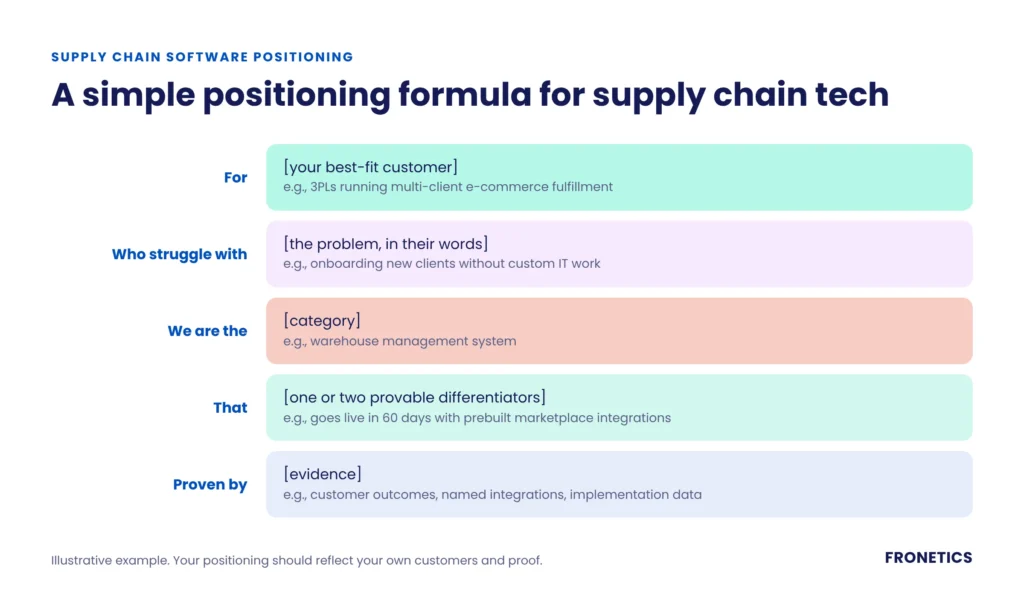
1. Define your best-fit customer precisely
Look at your happiest, most profitable customers. What do they have in common? Industry, operation type (e-commerce fulfillment, cold chain, LTL, multi-site manufacturing), size, tech stack? Your positioning should describe them so precisely that a prospect thinks, “That’s us.”
2. Name the problem in their words
Buyers don’t wake up wanting “orchestration.” They wake up with missed cutoffs, detention charges, mis-picks, or a planning process trapped in spreadsheets. Use the language they’d use in a meeting with their boss.
3. Be honest about the alternatives
Your real competition is often not another vendor. It’s the ERP module they already own, a homegrown tool, or doing nothing. Positioning should explain why your approach beats each of these.
4. Pick one or two differentiators you can prove
Faster implementation, deeper industry workflows, a specific integration ecosystem, better carrier connectivity, or a pricing model that fits mid-market operations. Choose what’s true, valuable to the buyer, and hard for competitors to claim.
5. Back it with evidence
Customer outcomes, implementation timelines, named integrations, and case studies turn positioning from a claim into a fact.
Weak vs. strong positioning: an example
| Weak | Strong |
|---|---|
| “End-to-end supply chain visibility powered by AI” | “Shipment visibility for mid-size food and beverage shippers who need temperature and ETA alerts across their LTL and truckload carriers” |
| “A flexible, scalable WMS for any business” | “A WMS built for 3PLs running multi-client e-commerce fulfillment, live in 60 days” |
| “Transform your planning with real-time insights” | “Replace spreadsheet-based demand planning for manufacturers with 50 to 500 SKUs, without an ERP overhaul” |
These examples are illustrative, but notice what the strong versions do: they name the customer, the problem, and a specific proof point.
How should positioning show up in your marketing?
Positioning only works if it shows up everywhere buyers look:
- Website. Homepage, solution pages by industry and use case, and integration pages should all reflect your chosen niche. Our website design work is built around this.
- Content. Publish content that goes deep on your customers’ operational problems. That builds authority and supports search and AI visibility for the exact questions your buyers ask.
- Sales enablement. Demo scripts, one-pagers, and competitive battle cards should reinforce the same story.
- AI search. When a buyer asks ChatGPT for “the best WMS for multi-client 3PLs,” clear positioning increases the chance your product is described accurately and recommended. That matters more every year: in a 2026 Gartner survey, 45% of B2B buyers said they used AI during a recent purchase.
Clarity wins
In a crowded category, the vendor that’s clearest about who it serves wins more often than the vendor with the longest feature list. Narrow your focus, use your buyers’ language, and prove every claim.
Need help sharpening your positioning and turning it into pipeline? See how we help supply chain technology companies grow.
FAQ
What is positioning for supply chain software?
Positioning defines who a supply chain software product is for, what problem it solves best, and why it’s a better choice than alternatives, including other vendors, ERP modules, homegrown tools, and the status quo.
How do I differentiate my supply chain software from competitors?
Narrow your focus to a well-defined best-fit customer, describe their problem in their own words, choose one or two differentiators you can prove, and support them with customer outcomes, integrations, and implementation data.
Should supply chain software companies focus on a niche?
In most cases, yes. A focused position helps the right buyers recognize your fit quickly and makes your marketing more efficient. You can expand into adjacent niches once you’ve built strength in the first.
How does positioning affect AI search visibility?
AI tools summarize what’s consistently and clearly stated about a company. Specific positioning, repeated across your website, content, and listings, makes it more likely AI tools describe your product accurately and recommend it for relevant queries.