
Most supply chain companies don’t have an SEO problem so much as a keyword problem. They chase broad terms like “logistics” or “supply chain solutions,” compete with global brands and job boards, and never reach the shippers, manufacturers, and operations leaders who are ready to buy. The right supply chain SEO keywords are narrower, more specific, and tied to a page built to answer them.
This guide walks through how we find and organize keywords for 3PLs, carriers, warehousing providers, manufacturers, and supply chain software companies, and how to map them to your site so your pages support each other instead of competing.
Key takeaways
- Pick keywords by buying intent, not search volume.
- Your best keywords usually combine a service with a location, industry, or requirement.
- Give every important keyword one page, and never let two pages chase the same term.
- Blog posts should answer buyer questions and link up to the service and industry pages they support.
What are supply chain SEO keywords?
Supply chain SEO keywords are the search terms your buyers use when they look for a logistics, manufacturing, or supply chain technology provider. Good ones signal a real business need, such as “temperature-controlled warehousing in Dallas” or “WMS for food and beverage distributors,” rather than general curiosity. They form the foundation of any supply chain SEO program.
Why broad keywords waste your SEO effort
A term like “supply chain” gets enormous search volume, but most of those searches come from students, job seekers, news readers, and consumers. Even if you ranked for it, few of those visitors would ever request a quote.
Specific terms get fewer searches but convert far better. Someone searching “cross-docking services Atlanta” already knows what they need and where. That’s the person your sales team wants to talk to.
4 types of keywords that bring in supply chain buyers
| Keyword type | Example | What the searcher wants | Best page to target it |
|---|---|---|---|
| Service | dedicated contract carriage | A provider for a specific service | Service page |
| Service plus location, industry, or requirement | food grade warehouse Dallas, automotive logistics | A provider who fits their market or compliance needs | Industry or location page |
| Problem or question | how to reduce freight costs, WMS implementation timeline | Answers before they’re ready to talk to vendors | Blog post |
| Comparison or vendor selection | LTL vs. FTL, how to choose a 3PL | Help evaluating options | Blog post or guide |
How to build a supply chain keyword list in 6 steps
1. Start with your services and your sales conversations
List every service, mode, facility, and industry you serve. Then ask your sales team what prospects say on first calls. The words buyers use, such as “overflow storage” instead of “flexible warehousing,” are often the words they type into Google.
2. Mine Google Search Console
Your site may already show up for valuable terms you aren’t targeting. In Google Search Console, look for queries where you rank between positions 11 and 50. Those are pages Google already associates with the topic, and they’re often the fastest wins.
3. Expand with keyword tools
Use Google Keyword Planner, Semrush, or Ahrefs to find variations, related questions, and search volume. Don’t dismiss terms with low volume. In supply chain, a keyword with 30 searches a month can still be worth a six-figure contract.
4. Filter out the wrong audience
Remove terms that attract job seekers, students, and consumers, such as “warehouse jobs,” “supply chain management degree,” or “track my package.” Those keywords bring traffic but not buyers.
5. Map one primary keyword to each page
This is the step most companies skip, and it’s where cannibalization starts. Assign each page one primary keyword and a few close variations. If two pages target the same term, Google has to guess which one to rank, and often ranks neither well.
6. Track rankings and AI visibility
Monitor where each target page ranks, how many qualified inquiries it drives, and whether AI tools like ChatGPT and Google’s AI Overviews mention your company. We cover that in how to measure AI search visibility.
How do you map keywords to pages without cannibalization?
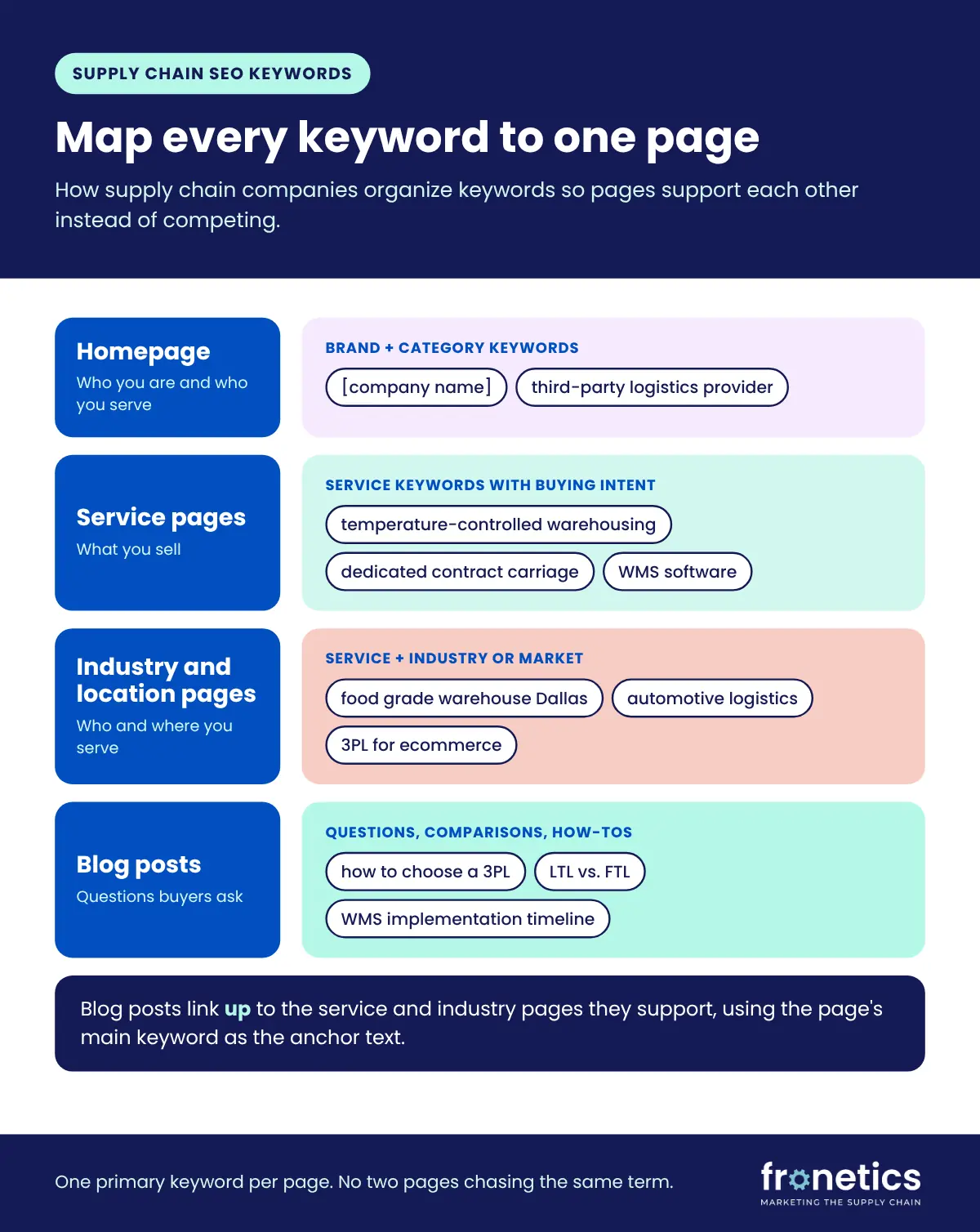
Think of your site as a hierarchy, with each level targeting a different kind of keyword:
- Homepage: your brand name and your broadest category, such as “third-party logistics provider.”
- Service pages: service keywords with buying intent, such as “temperature-controlled warehousing.”
- Industry and location pages: a service combined with an industry or market, such as “3PL for ecommerce” or “food grade warehouse Dallas.”
- Blog posts: questions, comparisons, and how-tos that buyers research earlier in the process.
We organize our own site the same way. Our SEO and AI optimization services for supply chain companies live on a service page, while pages for logistics, manufacturing, and supply chain software companies each target their own audience. Blog posts like this one answer specific questions and link back to those pages.
That last part matters. Internal links tell Google which page is the authority on a topic. When a blog post links to a service page using that page’s main keyword as the anchor text, it reinforces the service page instead of competing with it.
Do keywords still matter for AI search?
Yes, but the way people phrase them is changing. Forrester’s State of Business Buying, 2026 found that 94% of business buyers use AI during their buying process. Those buyers ask full questions, such as “Which 3PLs in Texas handle food grade storage?”, instead of typing short phrases.
The fix isn’t a separate strategy. Pages that clearly answer specific questions, name the services, industries, and locations you serve, and use FAQ sections tend to perform well in both Google and AI tools. For more, see SEO vs. AI search for logistics companies.
Common supply chain keyword mistakes
- Targeting only head terms. “Logistics company” is nearly impossible to win and rarely converts.
- One page for every service. A single “Services” page can’t rank for warehousing, fulfillment, and transportation at once.
- Blog posts that compete with service pages. A post titled “Warehousing services in Dallas” will fight your Dallas warehouse page.
- Ignoring industry language. Shippers search “drayage,” “transloading,” and “FTZ,” not marketing phrases.
- Never revisiting the list. New services, facilities, and markets need new keywords and pages.
Turning keywords into qualified leads
The right keywords only pay off when they lead to pages that convert, with clear service descriptions, proof, and an easy way to contact sales. If you’re a logistics provider, our guide to SEO for logistics companies covers the rest of the process, from local search to technical fixes. Supporting that work with steady content marketing keeps new question-based keywords coming.
Want help building a keyword strategy that brings in buyers? Learn more about our supply chain SEO and AIO services.
Frequently asked questions
How do I find SEO keywords for a logistics or supply chain company?
Start with your services, industries, and locations, and the language your sales team hears from prospects. Then check Google Search Console for terms you already rank for, expand the list with a keyword tool, and remove terms that attract job seekers or consumers.
Are low-volume keywords worth targeting in supply chain?
Often, yes. Supply chain deals are large and buyers are few, so a keyword with only a few dozen monthly searches can still produce valuable leads if it signals a clear buying need.
What is keyword cannibalization?
Keyword cannibalization happens when two or more pages on your site target the same keyword. Google has to choose between them, and often neither ranks as well as one strong page would. Assigning one primary keyword per page prevents it.
Should blog posts target the same keywords as service pages?
No. Service pages should target service keywords with buying intent. Blog posts should target related questions and comparisons, then link to the service page using its main keyword as anchor text.