
When an enterprise retires 5,000 laptops, the decision about who handles them doesn’t sit with one person. IT wants a smooth pickup. Security wants proof every drive was wiped or destroyed. Sustainability wants recycling numbers for the ESG report. Finance wants to know how much value comes back. Procurement wants all of it in a contract. That’s what makes ITAD marketing different from selling almost any other service.
That’s why it’s harder than it looks. IT asset disposition providers aren’t selling a pickup service. They’re selling risk reduction to a buying committee. Here’s how to market an ITAD company so it wins those contracts.
The short answer: ITAD buyers are buying risk reduction first and value recovery second. The providers that win enterprise contracts speak to every member of the buying committee and back each claim with certifications, chain-of-custody detail, and audit-ready reporting.
What is ITAD marketing?
ITAD marketing is how IT asset disposition providers attract and win organizations that need to retire IT equipment securely: data center hardware, laptops, mobile devices, and networking gear. Good ITAD marketing proves three things: that data will be destroyed, that the process is compliant and documented, and that the client will recover as much value as possible.
It’s one of the specialties within our electronics industry marketing work, alongside component distribution, electronics manufacturing, and recycling.
Who buys ITAD services?
ITAD decisions usually involve several roles, each with a different question:
| Role | Primary question | Proof they want |
|---|---|---|
| IT and infrastructure leaders | Will this be easy and on schedule? | Logistics process, onsite services, timelines |
| Security and compliance | Can we prove every device was sanitized? | NIST 800-88 methods, certificates of destruction, audit trails |
| Sustainability and ESG | What happens to the equipment? | Downstream vendor policies, recycling and reuse metrics |
| Finance | How much value comes back? | Remarketing approach, revenue share, reporting |
| Procurement | Is this vendor qualified and low risk? | Certifications, insurance, references, contract terms |
Content that only talks to one of these roles leaves gaps the others will notice.
What makes an ITAD provider stand out?
Certifications, explained
R2v3, e-Stewards, NAID AAA, ISO 14001, and ISO 27001 are table stakes for many enterprise buyers. List the ones you hold, link to certificates, and explain in plain language what each one covers. Many buyers know the acronyms but not the differences.
Chain of custody, shown
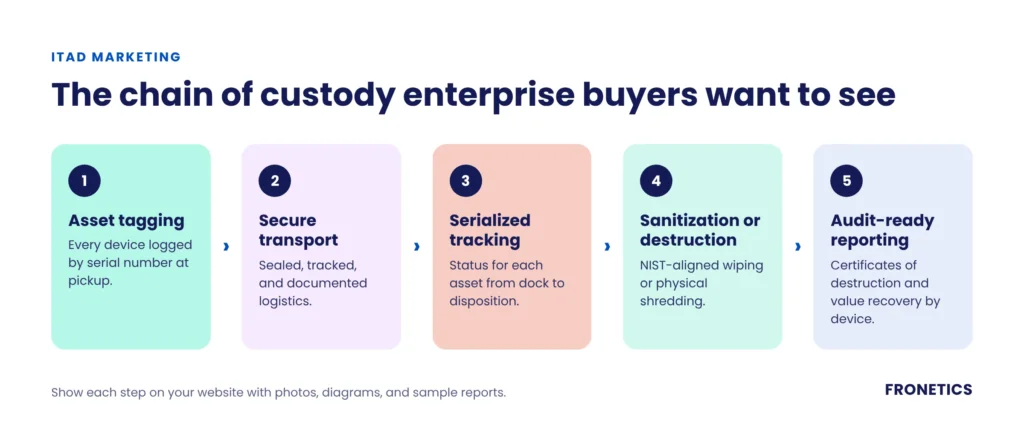
Walk prospects through every step: asset tagging, secure transport, serialized tracking, sanitization or destruction, and reporting. Diagrams, photos, and sample reports make an abstract process concrete.
Reporting as a product
Enterprise clients need audit-ready documentation. If you offer a client portal, serialized reports, or certificates of data destruction by device, feature them prominently with screenshots.
Value recovery with real numbers
Explain how you test, refurbish, and remarket equipment, and share examples (even ranges) of value returned. This is often the line item that shifts a decision.
Sustainability proof
Describe your downstream partners, your zero-landfill policy if you have one, and the environmental metrics you report. Sustainability teams increasingly sit in on ITAD decisions.
What content works for ITAD lead generation?
- Service pages by asset type and need (data center decommissioning, laptop refresh, onsite shredding), written to answer specific searches.
- Buyer guides, such as “how to choose an ITAD vendor” or “ITAD RFP checklist,” that help procurement and security teams evaluate options.
- Case studies that show a decommission project from start to finish, including timelines and outcomes.
- Compliance explainers on data sanitization standards and industry-specific requirements for healthcare, finance, and government.
- Account-based campaigns aimed at enterprises with known refresh cycles or data center moves. Our account-based marketing programs are built for exactly this kind of high-value target list.
How do ITAD buyers find providers?
Most start with search, peer referrals, and increasingly AI tools. A security manager might ask, “Which ITAD providers offer onsite hard drive shredding with serialized reporting?” To show up in that answer, your site needs pages that state those capabilities clearly, and your company details need to be consistent across certification body listings, directories, and industry sites. That’s the focus of our SEO and AI optimization services.
Putting it together
ITAD is a trust purchase with many stakeholders. The providers that win enterprise contracts make their process visible, speak to every member of the buying committee, and back each claim with certifications, documentation, and results.
Ready to build an ITAD marketing program that reaches enterprise buyers? Learn how we help ITAD and electronics companies grow.
FAQ
What is ITAD marketing?
ITAD marketing is how IT asset disposition providers attract and win organizations that need to retire IT equipment securely. It focuses on proving data destruction, compliance, chain of custody, and value recovery to IT, security, sustainability, finance, and procurement buyers.
What certifications matter most in ITAD marketing?
Enterprise buyers commonly look for R2v3 or e-Stewards for responsible recycling, NAID AAA for data destruction, and ISO 14001 and ISO 27001 for environmental and information security management. Feature the ones you hold and explain what each covers.
How do ITAD companies generate leads?
Effective ITAD lead generation combines search-optimized service pages, buyer guides and RFP checklists, case studies, and account-based campaigns aimed at enterprises with upcoming refresh cycles or data center moves.
How can an ITAD provider differentiate from competitors?
Differentiate with transparency: show your full chain of custody, offer audit-ready reporting, share real value recovery examples, and report sustainability metrics. These are the details buying committees compare.
Related reading