by Elizabeth Hines | Dec 31, 2014 | Blog, Content Marketing, Marketing, Strategy
Content marketing is among the hottest topics in marketing and media. However, most companies should stop their content marketing efforts – immediately. The reason these companies should stop is because, despite the hipness of content marketing, they will not realize a positive ROI and will not grow their business through content marketing. In short, many companies are just plain wasting their time and money.
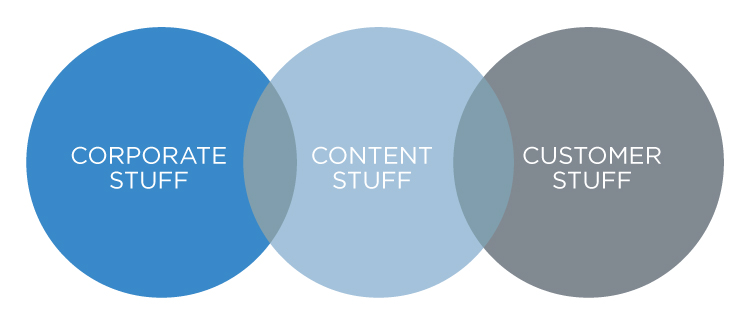
Everybody – companies and customers – has stuff. Joe Pulizzi, Founder of the Content Marketing Institute, discusses the importance of not only recognizing this reality, but also the importance of acting on it.
Pulizzi defines three categories of stuff:
- Corporate stuff;
- Content stuff; and
- Customer stuff.
The majority of companies fall prey to focusing on content stuff within a vacuum. But, as Pulizzi points out: “For content marketing to work, we need to link the corporate stuff with the customer stuff through content.”
What does this mean? This means that in order for content marketing it be effective you need strategy. Strategy is what enables you to link what you know as a brand (corporate stuff) with customers’ needs (customer stuff) through content.
The importance of strategy is underscored by the results of a 2014 study. The study found that 93% of B2B marketers use content marketing. 60% of companies who have a documented content strategy in place consider their efforts to be effective as compared to 11% of companies with no documented content strategy in place. Similarly, the study found that companies who put a person in charge of content marketing were more likely to be successful than those who did not (86% vs. 46%).
If your company is employing content marketing and does not have a strategy in place, stop. Create a strategy, put someone in charge, then re-start your efforts. With a strategy in place, content marketing will drive profitable customer action.

by Elizabeth Hines | Dec 30, 2014 | Blog, Logistics, Manufacturing & Distribution, Marketing, Social Media, Strategy, Supply Chain
 I wrote a guest blog for freight logistics company Cerasis in October which discussed how companies within the manufacturing, supply chain, logistics, and industrial industries can increase their B2B visibility on LinkedIn.
The catalyst for writing the blog were results from a recent survey focused on the supply chain and logistics industry. 58% of respondents rated LinkedIn as “very impactful,” and 37% rated LinkedIn as “somewhat impactful.” At the same time, respondents reported challenges associated with strategy (33%) and a lack of understanding about the application of social media (24%).
Leveraging LinkedIn
There are over 3 million LinkedIn company pages. Being present on LinkedIn is critical, but is not enough. To maximize your LinkedIn presence you need to take steps to increase your B2B visibility. Here’s how:
-
Create a compelling company page
Your company page is an extension of your company. Make sure that the page is compelling, informative, and presents your company as a leader within the industry.
-
Be active
In addition to keeping your company page up-to-date, you need to be active on LinkedIn on a daily basis. LinkedIn groups are great. Actively participating in LinkedIn groups will allow your company to: 1) gain business and market intelligence; 2) introduce you to new, interesting, and relevant topics; 3) help you increase brand awareness; and 4) position your company as an industry leader.
-
Distribute content
If you want your content to be seen you need to get it out there; you need to distribute your content. Distribute your content and curated content via your company page and (when relevant) within the LinkedIn groups to which you belong.
-
Employee engagement
Your employees are your brand ambassadors. Empower your employees to be active within LinkedIn groups as representatives of your company. Encourage employees to share your content and industry content with their connections. Additionally, encourage employees to share open positions with their LinkedIn connections, and to identify great talent within their network.
-
Prospect for leads
LinkedIn is an effective prospecting tool. Use LinkedIn to prospect for leads and to build your sales pipeline.
-
Optimize your profile
Every employee is a reflection of the company. Encourage employees to optimize their personal LinkedIn profiles.
-
Don’t be annoying
You will fail if you take a “me, me, me attitude.” Constantly self-promoting is bad for business.
If your company is not using LinkedIn you are missing out on opportunities and revenue.

by Elizabeth Hines | Oct 30, 2014 | Blog, Marketing, Social Media, Strategy, Supply Chain
The use of third-party logistics providers are on the rise. As many as nine out of ten 3PLs surveyed by Inbound Logistics reported their client base grew by 5 percent this year, continuing the unabated expansion of recent years.
And there’s good reason for it.
In an interesting article on SupplyChain 24/7, Adam Robinson, the marketing guru at Cerasis, lists seven reasons companies should outsource non-core transportation management functions to 3PL providers. Surprisingly, perhaps, many of the same arguments can be applied to companies debating who should be in charge of their content creation.
As the number one reason to outsource, Robinson cites “Time and Money.”
He writes:
“3PL providers are able to reduce the amount of infrastructure investments in equipment, software, facilities and personnel… These 3PLs are like having non-paid employees on your staff and allow shippers to focus resources on areas where they are the expert (i.e. manufacturing, product sales).”
Time and money – or lack thereof – are similarly common issues among companies with respect to social media. In a new Fronetics report on social media use in the supply chain and logistics industries, nearly half of the respondents cited time and budgetary constraints as their top two challenges. Such companies may, as a result, participate only sporadically or not at all.
Since consistency is crucial to online lead generation, anything but a fulltime commitment to the company blog, content curation, and social media outreach is doomed to fail. An outside provider can, just like a 3PL, take these tasks off your hands, allowing you to focus on your core competencies.
Robinson also argues:
“As shippers rely on 3PL partners to provide more strategic oversight, and help catalyze business process change within the organization, the relationship is growing more fluid, and less analytical. Service providers are becoming an extension of the enterprise.”
In short, 3PL providers should not be perceived as outsiders but as partners who know their stuff. They contract with thousands of carriers and know the fastest and most reliable routes to move product from point A to point B.
A marketing company, especially one specialized in content creation for the logistics, transportation and supply chain industries, works the same way, drawing on a wealth of industry knowledge. In essence, you hire experts equipped with the right strategic tools to leverage their market expertise to your advantage.
Finally, Robinson writes visibility of loads gives 3PLs a leg up on the competition:
“Many 3PLs are able to integrate tracking into shipper IT systems, provide integration into ERP and WMS automated notices or even real-time delivery notifications by e-mail.”
Losing track of a shipment equals chaos. 3PL providers are there to ensure it never happens. In the same vein, companies need to track the metrics of their content strategy or risk wasting resources on something that yields no results. They need to know which social media outlets work for their business and what types of content draw traffic to their site. It takes time and resources – and as our survey revealed, both tend to be in short supply.
Your content marketing partner, on the other hand, knows metrics is as important as a shipment is to a 3PL provider.
Outsourcing content creation may be your strategic advantage over your competition.

by Elizabeth Hines | Sep 16, 2014 | Blog, Content Marketing, Marketing, Social Media, Strategy, Supply Chain
I work with companies from the supply chain and logistics industries to identify and execute strategies that will grow their business. Too often I see companies who have invested time and money into developing a B2B inbound marketing strategy and have fallen flat. Here are six reasons why inbound marketing strategies tend to fail:
The ideal customer is not being targeted
A successful inbound marketing strategy will attract and engage the “right people” – ideal customers. It is therefore essential that time is taken to understand who the ideal customer is, the needs of the customer, and the customer’s pain points. Your company’s website, social media presence, and email communications, should speak to your ideal customer.
Content is not published consistently
A common pitfall is establishing a blog, but only publishing content on a sporadic basis. To establish your company as an industry leader and gain leads, you need to publish content on a consistent basis. For example, your company needs to commit to publishing blog content every Tuesday.
Content is not quality content
All content is not equal. If you want your inbound marketing efforts to succeed, your content needs to be quality content. Your content should be well-researched, sourced, and edited. Grammatical errors and misspellings are inexcusable.
More isn’t always better
It is easy to sign up for a social media account. I’ve seen many companies who have decided to jump into social media feet first and have established many social media accounts, only to become overwhelmed. If you want your inbound marketing strategy to succeed, it is more important to be active on one social network than inactive on five.
Lack of strategy and commitment
A 2014 study of B2B marketers found that companies that have a strategy in place are more likely to consider their efforts effective than companies that do not have a stated strategy in place. Companies that do not have a strategy in place, and who do not have someone in charge of the strategy tend to fail.
A focus on sales
Content that informs and educates attracts and engages. Content that is “salesy” not only fails to attract and engage, it turns customers away.
Is your inbound marketing strategy falling flat? Assess your strategy – honestly. Has your company fallen prey to these common pitfalls?

by Elizabeth Hines | Sep 4, 2014 | Blog, Marketing, Supply Chain
The temptation is obvious: You want to use your business blog to proclaim the virtues of your excellent products. You throw around words like “unique,” “outstanding,” “robust,” and “industry-leading.”
Perhaps you even add a blinking “Buy Now!” button at the end, convinced your reader simply can’t resist hitting it.
There is only one problem: Your sales pitch made your prospective customer tune out long before they reached the last paragraph.
Imagine the following scenario: You enter a car dealership and are greeted by an enthusiastic sales agent, grinning ear to ear. He launches into his pitch about mega sales and the best deal of the century. Any question from you is brushed aside as he has more to say about the car model that he has decided you must have. Turned off by his sales strategy, you make a quick exit.
Or think of another example: A sales representative from a company whose website you browsed a few days ago follows up with a call and leaves a voice mail. The message is friendly. She does her best not to sound pushy. She introduces her “leading” company, which offers “a wide range of services” and a “one-stop-shop” for all your needs. By the time she reaches, “I look forward to meeting you,” you’re still ready to hit the delete button. Again, the voice mail was loaded with sales lingo.
As strange as it may sound, being “salesy” is bad for business. HubSpot, a marketing consulting service and software developer, goes as far as calling it one of the “7 Deadly Sins of Inbound Marketing.”
It reads:
Sin 3: Gluttony – Don’t be gluttonous and stuff your content with information about your company products. Focus on solving problems and helping your customers and community first and not jamming your product pitch down their throats.
Let’s go back to the two examples above and transfer the line of thought to your blog. Rather than forcing your products on your prospective customers, take time to answer their questions. You are there for them. They may be in the beginning of their buyer’s journey and far from ready to sign off on a brand new car. Perhaps they entered that dealership to browse, to check out the view behind the steering wheel.
And what if that voice mail had been phrased differently? What if the sales representative had spent a moment talking about what your browsing history said about the problems you’re seeking solutions to and presented some real-life proof of how her company could help? Basically, she would have been more effective showing how her company can deliver value to you. The same goes for your blog.
Here’s what you should do:
- Stay informative and educational.
- Demonstrate market expertise.
- Sound like a business peer.
- Focus on topics and questions of crucial importance to your target audience.
The bottom line: If you want to make a sale, stop selling.