by Elizabeth Hines | Feb 11, 2015 | Blog, Content Marketing, Marketing, Strategy
Most businesses don’t optimize blog posts. Here are 7 things you can do to optimize a blog post so you can improve your ranking and attract more visitors.
Most businesses don’t optimize blog posts and therefore miss out on ranking and, by extension, organic traffic opportunities. The good news is that there are 7 simple steps you can take to optimize a blog post so that you can improve your ranking and attract more visitors.
Step 1: Identify your keywords
Identify the keywords you are going to use in the blog post. Once you have identified the keywords you want to use, write your blog post around these keywords.
Something to remember: while it is important to write the post around the keywords you have identified, you don’t want to stuff the post with the keywords. You want to make sure your post is easy (and enjoyable) to read and doesn’t sound spammy.
Step 2: Optimize your title
Keep the title of your blog post under 60 characters. Include your keywords in the title.
Step 3: Optimize your meta description
Your meta description doesn’t impact search results. However, your meta description can improve click through rates (that is, it can increase the number of people who actually click on your link versus someone else’s).
When you write your meta description write it in a conversional (not spammy) manner and be sure to include your keywords. In short, think about what would attract your target reader to your blog post, and write it here. Try to keep your meta description to between 150 and 160 words.
Step 4: Optimize your heading
Using your keywords in the heading provides an SEO benefit and informs your visitor what your blog post is about. Be sure to not just use a keyword phrase, instead use additional content around the keyword.
Step 5: Optimize the body of the post
Search engines such as Google, Yahoo, and Bing use the keywords in the body of your post as a ranking signal. That being said, don’t go overboard with using your keywords in the body of your content because too many occurrences of your keywords can be viewed as keyword stuffing. Keyword stuffing can lead to search engines giving you a penalty and drop your organic rankings. Additionally, no one wants to read a blog post that reads like spam.
The short and sweet: use your keywords, but don’t go overboard, and always remember to write first to your audience and then search engines.
Step 6: Optimize images
Image search is becoming more popular. Write a SEO friendly title for your images. It doesn’t hurt to also write a description that explains the blog post itself.
Step 7: Optimize the URL
When you use your blog title as the URL extension you can improve your click through rate.
If you haven’t optimized your blog posts in the past, the good news is that you can go back and optimize them.

by Elizabeth Hines | Feb 10, 2015 | Blog, Content Marketing, Marketing, Strategy
You’ve likely heard it before – your business should be blogging. It’s understandable if it isn’t. Given the finite nature of a single workday, we all face daily pressure to prioritize projects and streamline strategies. But isn’t it true that our priorities should align with activities that have the most significant impact on performance? When data becomes the guide to choosing where to focus marketing efforts, it becomes clear that blogging is the powerhouse of digital marketing activity.
Blogging positively impacts a number of typical objectives for businesses. It makes it more likely for companies to be found in search engine results, produces higher quality leads, establishes industry expertise, and shortens sales cycles. To understand exactly to what degree blogging is affecting these outcomes, let’s take a look at the data.
Blogging generates high-quality leads and increases sales.
Practically all marketing activities ultimately seek to drive one objective – to increase sales. Many businesses are tying big sales wins to their blogging efforts. In a 2013 publication of Marketing Benchmarks, HubSpot reported companies that blog once or twice per month generate 70 percent more leads than those who don’t blog at all. Further, companies nearly double their sales leads by increasing blogging frequency from 3-5 times per month to 6-8 times per month.
Blogging drives increased website traffic.
Increased website traffic can almost always be linked to an increase in leads and sales. Companies with 51-100 pages on their website generate 48 percent more traffic than those with 1-50 pages according to the same HubSpot report. Consistent blogging activity builds the number of website pages and consequently the number of opportunities for your company to connect with customers, leads, and industry peers. Publishing frequency matters, too. Companies that blog at least 15 times per month get five times more traffic than those that don’t blog. Small businesses with 1-10 employees see the largest gains by posting more often.
Blogging links businesses and customers.
Business websites with blogs have 434 percent more indexed pages and 97 percent more indexed links based on the findings of a 2013 Social Media Today report. If search engines can easily find your business, prospective customers will find you easier, too. Building links ensures existing and potential customers can connect and engage meaningfully with your company.
Blogging seeks to educate and establish expertise.
Crafting and publishing quality blog content builds credibility and trust. Social Media Today reports a full 70 percent of consumers learn about companies through articles rather than ads and that 61 percent of consumers have made a purchase based on a blog post.
Data makes it clear that relevant and engaging blog content is a valuable marketing asset and sales driver for many businesses. In fact, marketers who have prioritized blogging are 13 times more likely to enjoy positive ROI. Is your company taking full advantage of this powerhouse marketing activity or is it missing opportunities to attract leads and delight customers?
![Why you need to understand what B2B buyers think about content [Infographic]](https://fronetics.com/wp-content/uploads/2024/10/content-B2B-buyers-643x675.png)
by Elizabeth Hines | Jan 27, 2015 | Blog, Content Marketing, Marketing
If you want to attract B2B buyers with content, you need to understand what B2B buyers think about content.
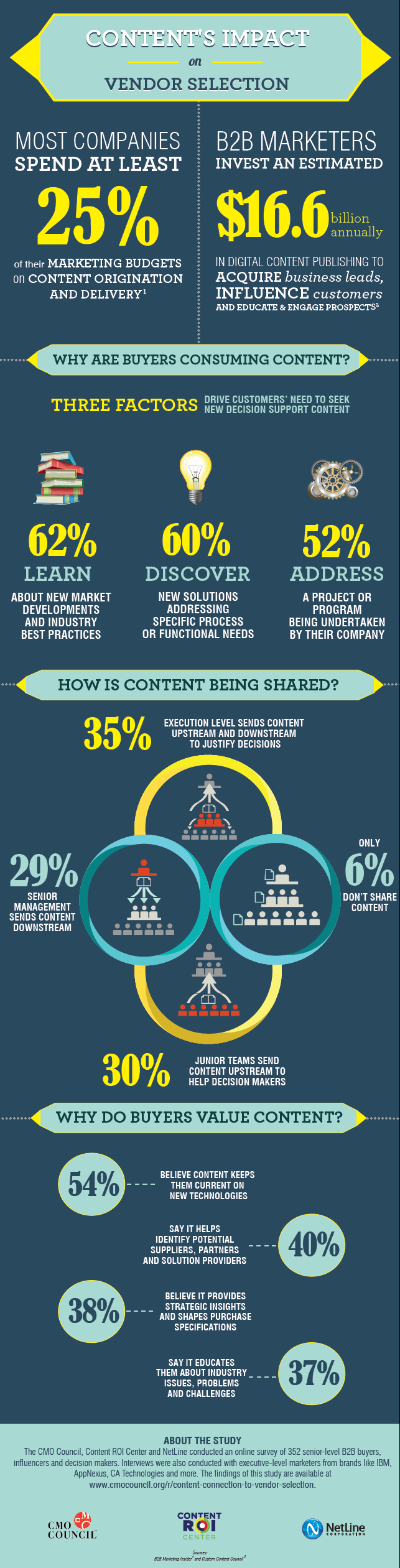
93% of B2B companies use content marketing. If you want your content marketing efforts to be effective you need to understand why B2B buyers consume and value content. When you understand what B2B buyers think about content you can create and distribute the right content – content that will help you grow your business by driving profitable customer action.
The CMO Council, Content ROI Center, and Netline conducted a survey of 352 senior-level B2B buyers, influencers, and decision makers with the objective of determining content’s role in influencing B2B buyers in the purchase process.
Why do B2B buyers consume content?
B2B buyers turn to content for a number of reasons including to:
- Learn about new market developments and industry practices;
- Discover new solutions to address a specific problem;
- Address a project or a program being undertaken by their company.
Why do B2B buyers value content?
B2B buyers value content because it:
- Keeps them current on new techniques;
- Provides strategic insights and shapes their purchase specifications;
- Educates them about industry issues, problems, and challenges.
Source: CMO Council
Understanding what B2B buyers think about content and why they use content will enable you to create, curate, and distribute content that speaks to B2B buyers and attracts new customers and engages current customers.
If you consistently create, curate, and distribute content that B2B buyers find valuable, you will realize results.

by Elizabeth Hines | Jan 21, 2015 | Blog, Logistics, Strategy, Supply Chain

Share your experience with the use of content within the logistics and supply chain industries.
The amount of content on the internet is astounding, and it is growing by the second (check out One Second on the Internet). 93% of B2B companies are using content marketing and are thereby contributing to the increasing amount of content that is out there.
How do companies within the logistics and supply chain use content? What do companies see as the most effective methods of content creation and content distribution?
Fronetics Strategic Advisors is conducting a brief survey focused on the use of content within the logistics and supply chain industries. The survey will take less than five minutes to complete. All data collected will be used in aggregate and no identifying information will be shared or reported.
A report focused on the survey results will be published in March 2015.
Thank you in advance for your participation.


by Elizabeth Hines | Jan 20, 2015 | Blog, Content Marketing, Marketing, Social Media
Content and social media are integral to business growth
Editor’s Note: This is a guest blog written by Kecia Gray, Vice President, Corporate Marketing & Communications, Transplace. Transplace is a premier provider of transportation management services, intermodal, truck brokerage, and SaaS TMS solutions. Transplace successfully leverages social media and content to expand the company’s brand awareness and thought leadership. The company’s LinkedIn page, Facebook page, and blog were named as “favorites” in a survey conducted by Fronetics.
At Transplace, social media has become an integral part of our marketing and communications strategy and key to expanding our brand awareness and thought leadership in the logistics and transportation space. Our marketing and communication team has had the opportunity to utilize multiple social channels, including:
While we consistently post content to all of these channels, what has been and continues to be important to our social strategy is creating our own original content and utilizing it within a more aggressive approach on Facebook, Twitter and LinkedIn. Sharing content on these channels has allowed our newest blog to achieve fast success in under a year’s time.
Content Is King…
Within any industry, there is always significant opportunity to create original thought leadership content that is informative and insightful. When developing a social media strategy, our foremost goal was to establish a thought leadership blog resource for the market, in addition to providing engaging and personalized content across social channels that was easily sharable. Our main objectives focus on connecting with customers, and creating content that resonates with the members of our industry and provides value to their businesses. By distributing this content across our social channels to foster sharing, conversation and engagement, we’ve continued to gain influence with our targeted audiences.
…And Metrics Are Key
Because of the rapid pace of developing content, it’s important to track and report on levels of engagement to optimize and repurpose information. We created a social plan that included a comprehensive calendar to capture the topics and content items we’d be working on throughout the year. For maximum integration, we purposely aligned new pieces to marketing campaigns and corporate objectives such as events, transportation services and current industry issues. In addition, we established benchmarks and metrics that were important for us to track, such as followers and level of engagement. Analyzing the data allowed us to regularly monitor and evaluate our program, maximize what worked and adjust areas that did not meet expectations.
Incorporating Talent for Quality Thought Leadership
We have also taken advantage of the significant opportunity for Transplace employees at all levels to contribute quality thought-leadership posts across a number of channels. We’ve learned that the best place to utilize this content is on the company’s logisticallyspeakingblog.com. Some of the posts we’re most proud of turned out to be the most popular of 2014, including:
- A motivating guest blog post highlighting our dedication to our customers – from George Abernathy, our president and CCO.
- An insightful commentary on the growth of Transplace in light of a recent acquisition – from Frank McGuigan, president of transportation management at Transplace.
- An informative infographic recap of our signature event, the annual Transplace Shipper Symposium, highlighting some amazing speakers.
To ensure we always stay up-to-date and focused, our team holds quarterly meetings in which we share key highlights, metrics and snapshots of the program quarter by quarter. The time is used to plan for what’s coming up in the future, brainstorm new ideas and make changes as needed. We always make the utmost effort to continually update our program and assess our short and long term goals – an important aspect to any social program!
How is your organization utilizing social media and thought leadership content?