by Elizabeth Hines | Oct 23, 2018 | Blog, Content Marketing, Logistics, Marketing, Social Media, Supply Chain
As social networks reaffirm their commitment to keeping their platforms truly social, brands need to evaluate their social media marketing strategies and ensure that they align with what users want to see.
This year, we’ve seen social networks attempt to take back the “social” element of their platforms by decreasing the reach of brands and businesses (think Facebook News Feed changes). We’ve thus seen a decline across the board in social media reach.
The 2018 Sprout Social Index shows that people are still using social media primarily for connecting with friends and family. As brands put together campaigns and messaging, they must remember that they are “guests at dinner, not members of the nuclear family: their role in user feeds is delicate, valuable, and to be treated with great care.”
The task for brands is to carry out the necessary disruption of the user experience in the most relevant, and least disruptive way. Sprout Social’s data gives a clear answer: awareness and consideration stage content. This means thinking long-term and prioritizing relationships, not quick fixes and attribution.
Give the people what they want
As part of its 2018 Index, Sprout Social researched the types of content that users prefer to see from brands on social media. 30% of users expressed a preference for links to more information, while 18% prefer graphics/images, 17% want produced video, 11% value text/conversations, and 7% said produced/edited photos.
The obvious answer for brands is to cater to the expressed wishes of the public. Building lasting relationships with prospects on social media means presenting your brand in a visually engaging way while linking them to useful and relevant information. Furthermore, it means placing focus and resources on authentic engagement. “This is the content that consumers, who use social primarily to interact with friends and family, are most interested in from brands,” reports Sprout Social.
Redefining success
Marketers naturally place a premium on ROI, though measuring social media ROI remains difficult. In fact, 55% of social marketers reported it as their biggest challenge. Conventional wisdom when it comes to ROI for social media has focused on direct attribution to sales. But according to Sprout Social, “that model doesn’t actually reflect where social marketers are focused.” In fact, 80% report increasing brand awareness as their primary social media goal, and just as many point to increasing engagement across their social channels.
A meager 14% of marketers report being able to quantify the revenue from social media. This is a problem — one that’s caused by looking at social media primarily as it relates to sales. According to Sprout Social, this “breeds an overly microscopic perspective.”
It’s time for social marketers to redefine ROI, and put an end to wasted time and resources on content and campaigns that don’t resonate. Realigning priorities from sales to what users actually want to see on social media is key to cultivating strong, lasting relationships with prospects, and being a helpful rather than invasive presence online.
Related posts:

by Elizabeth Hines | Oct 1, 2018 | Blog, Content Marketing, Current Events, Logistics, Marketing, Strategy, Supply Chain, Talent
Considering instituting a work from home policy for your business? Ask yourself these three questions first.
As the supply chain becomes increasingly digital, many employers may be considering implementing a work from home policy. After all, we know one way to attract millennial talent is to allow for this kind of flexibility.
But before you make the decision to open the door to a work from home arrangement, consider these three questions.
3 questions to ask before implementing a work from home policy
1. Are your employees organized and self-motivated?
Ask any employee who works remotely, and they’re very likely to tell you that working from home makes them happier and more productive. And they aren’t necessarily wrong. There’s certainly evidence to suggest that with today’s technology, there’s essentially no downside to working from home, and it does often enhance productivity.
But working from home isn’t for everyone. Writing for the Harvard Business Review, marketing strategist and Duke University Professor Dorrie Clark suggests that workers considering a work-from-home arrangement first take a moment to introspect and understand how they work best.
According to author Natalie Sisson, “If you’re good at managing your own time, and you’re productive and have discipline, you’ll be able to do work from anywhere. But if you need to be in one place, and you need to go into an office, or need to be surrounded by the same people all the time, it probably won’t work for you.”
2. Is there a wealth of local talent?
One of the less-often-considered factors when businesses consider remote work arrangements is actually an important potential benefit for employers. Not every location has a tremendous amount of local talent, but that doesn’t have to limit your business. If you’re in an area where finding qualified employees is a challenge, making remote options available can be a big resource — essentially, the world is your oyster!
Consider having remote hires come onsite for training, team-building, or orientation, and make sure they’re equipped to meet the requirements of their positions. Once that initial foundation is laid, and expectations are clear, they can work from anywhere in the world — and save you the office space.
3. How much collaboration is required?
Are you considering remote work options for positions that require extensive collaboration with other employees? If so, it’s not necessarily a deal-breaker, but it does require some additional forethought.
With the technology available today, remote collaboration should theoretically be a piece of cake. But it’s important that everyone be on the same page about expectations. If remote workers are needed in a scheduled daily meeting, for example, it’s important that that expectation be made clear from the outset.
It’s also crucial to make sure that remote workers are given the resources they need to collaborate with their colleagues, and that they have a good understanding of the technology they’ll be using.
Work from home arrangements can be beneficial for employees and employers alike. But it’s important to consider all the variables to ensure that it’s the right thing for your business.
Related posts:

by Elizabeth Hines | Sep 27, 2018 | Blog, Content Marketing, Current Events, Marketing, Social Media
Also in social media news, September 2018: Twitter launches audio-only live streaming, and Facebook Creator Studio is going global.
The kids are back to school, football is back on tv, and the leaves are starting to change colors. This can only mean one thing: fall is officially upon us. What does this mean for our most popular social media platforms? Similar to battling dropping temperatures, it’s time to heat things up to keep users engaged and active.
Especially for Facebook. In a new survey by the Pew Research Center, users revealed how their engagement with the social media platform has changed in the wake of privacy and security concerns. Most notably, 44% of Facebook users ages 18 to 29 reported deleting the Facebook app from their phone in the past year. Despite the fall chill, Zuckerberg and his crew need to continue heating up their security updates and find new ways to gain user trust and ensure user privacy.
Here’s what else has been happening in September with the hottest social media platforms and how the latest updates help businesses gain exposure and target new audiences.
Here’s your social media news for September 2018.
Facebook Expands Ad Pixels to Group
Facebook will now allow pixels to be added to a brand’s Facebook Group. This expanded feature will enable marketers to track user growth, activity, and engagement with their websites. Facebook is hoping the new update will boost attention for Groups as an advertising avenue. “Facebook Groups are the new email for brands. They get push notifications. The engagement rate of Groups is extremely high. It makes sense they’re going to put a pixel in there, just like you would with email, because now through groups you can track conversions,” says Nik Sharma, Director at Hint Inc.
Snap Inc. Announces New Webinars for Ad Tools
Snap Inc. announced two upcoming webinars that provide more insight into how Snapchat can boost marketing campaigns for advertisers. These webinars are “for advertisers who want to learn more about the Snap Pixel. From how it differs from other pixels, the optimizations and attribution it enables, to implementation and troubleshooting, we’ll cover everything you need to know to power your eCommerce campaigns.” Though Snap’s niche is young adults, the app is working overtime to provide more advertising options, including performance tracking and user engagement.
Twitter Rolls Out Audio-Only Live-Streams on Twitter and Periscope
Twitter launched a new audio-only option on its app and Periscope. The popular feature, available on Facebook since 2015, has been heavily requested by users for years. “Broadcasting with audio only in Periscope is something the community has been asking for, and have been doing already by covering the camera lens. Sometimes people are not comfortable being on camera, but they still want to broadcast and interact with others via Periscope’s powerful chatroom feature.” writes Periscope engineer, Richard Plom. The new feature allows users to hear content without being locked to a screen. This will help businesses tap into the podcasting trend (streaming without video), creating new ways for users to tap into a brand’s content.
Facebook’s Creator Studio Launches Globally
Facebook officially launched Creator Studio globally, “providing one central place for Pages to manage their entire content library and business.” Publishers and account managers can now manage content, interactions, insights, video publishing, and much more in one central location.
Related posts:

by Elizabeth Hines | Sep 24, 2018 | Blog, Content Marketing, Current Events, Logistics, Marketing, Social Media, Strategy, Supply Chain
A new generation of buyers, digital natives, is shaking up the B2B purchasing landscape. Is your business ready to meet them online?
Digital natives, who now make up the majority of the B2B purchasing landscape, have completely changed how vendors need to market and sell to buyers.
In fact, according to a study of millennial buyers by Merit, some 73% of 20 to 35 year olds are involved in product or service purchase decision-making at their companies. Not only that, about half of all B2B product researchers are digital natives — and the number is rising by the year, according to a Google/Millward Brown digital survey of buyers.
It goes without saying that the B2B purchasing landscape is going through a radical shift. Here are 6 ways that digital natives have changed B2B purchasing — and how companies have to respond.
6 ways digital natives are changing B2B purchasing
1. Product searches begin with a generic web search.
This means that companies now have to focus on SEO and producing informative content. First impressions are everything in B2B markets, and when it comes to digital natives, your first impression is conveyed through every piece of content you produce and distribute online.
2. They bypass sales people.
So companies should aim to switch from primarily outbound marketing to inbound marketing. This doesn’t mean that salespeople are going to be out of jobs. But it does mean that sales and marketing need to work together in new ways.
3. Online search, vendors’ websites, and peer/colleague reviews are their most important sources of information.
It’s time to place focus on SEO, website development, social media, influencer marketing, and B2B review sites. Again, your reputation depends on your online content. Are you establishing your brand as a trusted source of information?
4. They prefer short bursts of information, often in visual formats.
Not only that, they find phone calls tedious and disruptive. Companies need to be strategic about the type and format of any content they distribute. Emails and websites should be mobile-friendly, and visual formats like infographics are a highly effective way to present dense information.
5. Social media is a preferred source.
These digital natives are relying on social media for information on brands, products, and services. How does your social media presence stack up?
6. They know what they want by the time a salesperson enters the process.
This new generation of buyers already has a clear idea of the value they expect from a vendor by the time they’re ready to move down the sales funnel. So vendors need to deliver on the promises made by their content.
How is your company accommodating the research and purchasing habits of digital natives?
Related posts:


by Elizabeth Hines | Aug 27, 2018 | Blog, Content Marketing, Logistics, Marketing, Social Media, Strategy, Supply Chain
Repurposed and repackaged, your existing content is a valuable asset for your sales force throughout the buyer’s journey.
If you’re a supply chain marketing professional, it’s likely that you spend a tremendous portion of your day researching, creating, packaging, and disseminating content. Your hard work is all about growing brand awareness and building your reputation as a trusted industry thought-leader — all with the goal of having that work eventually convert leads.
But, consider this: When it comes to engaging prospects and clients, only 20% of salespeople actually use content. When we know that potential buyers are far more willing to engage with someone offering them information and insight, why are B2B businesses abandoning content as soon as prospects are handed over to sales?
B2B buyers prefer content throughout the buying journey
According to DemandGen’s 2018 Content Preferences Survey Report, “Buyers are becoming increasingly more selective in the content they are consuming,” relying more on “trustworthy sources, industry influencers, and their peers to educate themselves.” And furthermore, 88% of those survey respondents want less focus on product specifics and more on the value that product can bring to their business.
And on the other side of that coin, according to HubSpot writer and marketing expert Bethany Cartwright, sales reps spend about 15% of their day leaving voicemails, and only about 20% of all sales emails are ever opened. “This means 80-85% of sales outreach efforts are going unnoticed by those prospects you’ve worked so hard to capture with content,” writes Cartwright.
It’s time to start leveraging your content throughout the buyer’s journey by arming your sales force with content. Before you panic at the idea of creating reams of new content, take a breath. It’s more than likely that you can repurpose your existing content, optimized to give your sales force the tools they need to close deals.
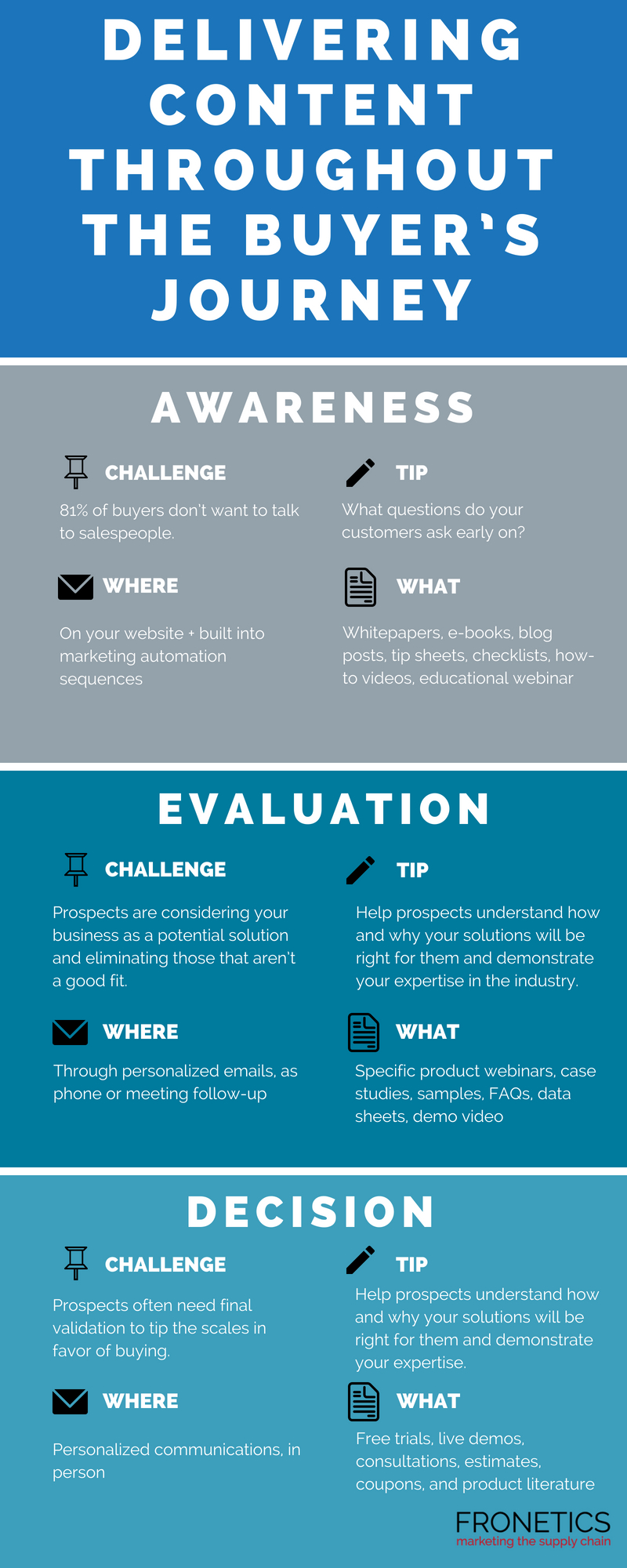
So how do you go about repurposing your content and giving your sales force the best possible tools with which to convert prospects to buyers? Web Profits co-founder and author Sujan Patel suggests “mapping content generated by your marketing team to each stage of your customer’s buying journey.” We’ve created the infographic below to help you optimize content for each of the three stages of the buyer’s journey.
Infographic: Delivering content throughout the buyer’s journey
(Made with Canva)
Related posts: