by Elizabeth Hines | Jul 26, 2018 | Blog, Content Marketing, Logistics, Marketing, Social Media, Supply Chain
Social messaging apps have taken over the way consumers are interacting with brands. Their increasing popularity means your business needs to embrace this new trend.
No one can deny the reach of social networks. After all, Facebook has over 2 billion active users. But as marketers, we’re noticing that consumers are moving away from social networks and welcoming the popularity of messaging apps with open arms.
Social media is constantly changing, and every new app gives users a new way to engage with family, friends, and brands. With the shift toward messaging apps, your target audience is making the leap, so your business needs to as well.
Messaging apps have a strong appeal: personalized engagement. Brands are able to make a one-on-one connection with every potential customer that comes in contact with their app pages. This is an opportunity you cannot miss!
Companies reaping the messaging app benefits
Yoox Net-a-Porter, a UK-based ecommerce firm with U.S. operations, made the switch to messaging apps after the brand discovered that many of its customers preferred WhatsApp for product details and suggestions and purchases. WhatsApp easily integrated with its order management system and is currently being tested as the company’s shipping notification system.
“Realizing that consumers increasingly prefer to receive information via personal messaging services rather than email, we have been working with WhatsApp to improve the way we use the WhatsApp service with great results so far,” writes Yoox Net-a-Porter on its blog.
And Yoox Net-a-Porter isn’t the only brand making the switch. WhatsApp, a social messaging platform owned by Facebook, reported 1.5 billion active users and over 60 billion messages sent per day at the end of 2017. These numbers, continuing to grow at a staggering rate, make it hard to ignore that brands need to be investing their marketing time and dollars in messaging apps.
In our latest video, Kettie Laky, our social media director, discusses why social messaging apps are becoming so popular and the top four apps your brand should become familiar with.
Video: Top 4 social messaging apps your brand needs to be using
Takeaway
As with any new marketing effort, trial and error are a big part of the equation. In order to get the most from your time (and budget!), make sure you’re utilizing the best messaging app for your brand. Before committing to an app, ask these important questions:
- Who is my target audience?
- How will the app add value to my target audiences?
- How do I want to deliver my content?
- Do I want to use more than one app?
- How frequently will I be marketing on the app?
These questions can help you find the social messaging apps that will work best for your marketing campaign and start connecting with customers in a more personalized way. These apps making sharing valuable content easier than ever.
What social messaging apps has your business tried?
Related posts:


by Elizabeth Hines | Jul 25, 2018 | Blog, Content Marketing, Logistics, Marketing, Social Media, Strategy, Supply Chain
Here are 4 components of an effective lead-nurturing campaign that will entice your potential customers and have them moving down the sales funnel.
Your content marketing objectives really come down to one basic goal: to generate a high number of quality leads. These leads will help drive tomorrow’s revenue and increase sales. In fact, 85% of B2B marketers say lead generation is their most important content marketing goal.
As more and more buyers discover brands before they are ready to purchase, an essential function of any marketing department is lead nurturing. That is, moving leads through the sales funnel by leveraging what’s known about their needs and online behavior.
Marketo, a marketing software company, describes lead nurturing as being “personalized, adaptive, and able to listen and react to buyer behavior in real time.”
We know that marketers need to focus their lead nurturing strategy on multi-channel engagement. This includes utilizing email, social media, blogs, and video to interact with potential customers. A multi-channel lead nurturing strategy is essential for companies looking to optimize their user experience and bring in high-quality leads.
With so many variables contributing to a productive lead-generation campaign, it can be challenging to pinpoint what differentiates a successful campaign from a mediocre one. Here are four tools that will help you deliver a series of targeted messages across multiple touch points and platforms to help solidify your lead-nurturing strategy and increase your quality leads.
4 building blocks of an effective lead-nurturing campaign
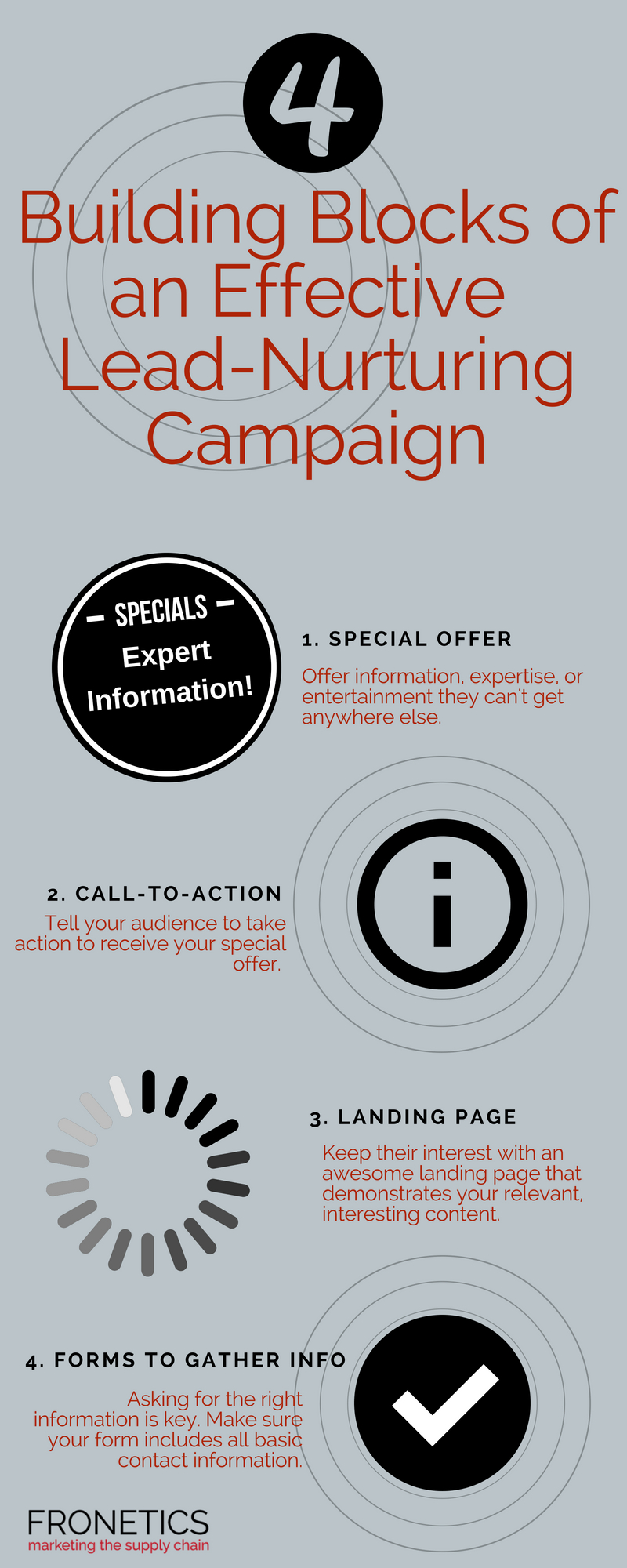
(Made with Canva)
Takeaway
Successful lead nurturing is really about utilizing all the tools at your disposal to meaningfully connect with your leads in order to build trust and establish credibility. Using these four key points, marketers can start building on their lead-generation efforts as they guide potential customers on their journey to becoming a client.
And don’t forget: Asking for the right information is key! If you want to nurture high-quality leads, you need to make sure you’re capturing relevant, helpful information along the sales journey.
Related posts:


by Elizabeth Hines | Jul 18, 2018 | Blog, Content Marketing, Logistics, Marketing, Supply Chain
Once you’ve decided how to create and package a valuable offer, the next step in an effective lead generation is creating calls-to-action that convert leads.
If you read part one of our four-part series on effective lead generation, you’re familiar with the first step in creating a campaign that will generate a high volume of quality leads: creating a valuable offer. So what’s next?
In part two of this series, we’re exploring how to draw visitors from reading content on your website to taking a desired action.
When we talk about this second step, we use the term “call-to-action” (CTA). It refers to the tool that asks the reader of your content to take the next step — rather than just assuming they will do it. A call-to-action can be in-line text with a hyperlink, a button, or an image-based web-banner.
Why do you need a CTA?
CTAs are the vital step where you ask your potential client or buyer to take an action that moves them one stop closer to your objective of connecting them with your company. But plenty of marketers forget this crucial element of an effective campaign.
If you’re offering high-value content (like an ebook, webinar, infographic, or product demonstration), but you aren’t including a specific CTA, you’re not giving your audience direction for obtaining the offer — and you’re probably missing out on plenty of qualified leads.
A CTA is yet another opportunity to optimize your campaign. Remember that you’re competing with every other brand in a fight for the attention of your audience, and you need to make the most of every opportunity to draw them toward your business.
Keep in mind that if your CTAs aren’t effective at capturing the attention of your prospective leads and persuading them to click, then no matter how impressive your offer or how well-written your content, it’s pretty much useless. Your CTA can be used on product pages, in display ads, email, social media, direct mail, or pretty much anywhere you’re marketing your offer.
Elements of calls-to-action that convert leads
Not all CTAs are created equal. As you think about incorporating a call-to-action into your offer, keep in mind these 4 tips for maximizing its productivity:
1. Choose your location wisely.
Back when people read newspapers, editors would place important news “above the fold:” high enough on the page so the reader wouldn’t have to unfold the paper to see it.
A well-placed call-to-action follows the same principle, and should be high enough on the page so your target lead won’t have to scroll down to see it. You should also place a second CTA further down within the offer.
2. Be clear.
You don’t want to leave your reader puzzling about what will happen when he or she follows your CTA. State the offer clearly, and be specific. For instance, rather than “download now,” say “download your free ebook.”
3. Don’t hide your light.
Your call-to-action should stand out on the page. Choose contrasting colors for your CTA, so it draws the eye and doesn’t blend into the rest of your text.
We’ve found, in many cases, our clients have the most success with calls-to-action that are image-based (particularly in emails). A really well-designed, attractive, image-based CTA can effectively draw click-throughs in a way other kinds of calls-to-action can’t. Give it a try!
4. Link to a landing page.
Send potential leads to a targeted landing page that is relevant to what they are looking for. Your CTA should send them to a page that will convert them into a lead.
For more information, check back in with our next post, when we explore how to create a landing page that converts leads.
How do you design calls-to-action that convert leads?
Related posts:
by Elizabeth Hines | Jul 17, 2018 | Blog, Content Marketing, Logistics, Marketing, Strategy, Supply Chain
The first step in an effective lead generation campaign is creating valuable offers to convince website visitors to entrust you with their contact information.
Welcome to part one of my series on effective lead generation.
In this four-part series, I’ll guide you through the four most crucial components of the creating an effective lead-generation and lead-nurturing campaign. And I’ll help you tailor your strategic marketing objectives to generate a high volume of quality leads.
Today, we’re looking at how to create valuable offers, the first step in converting a website visitor into a lead.
Offering value
To generate a lead, you need to convince visitors on your website to give you their contact information — and this takes work. You can’t simply expect them to generously hand over their personal information. (Don’t we all get enough emails?!) This means you need to tempt them with something they really want, which you give them in exchange for their contact info.
You may be asking, what will my audience find valuable? And this is where your content comes into play.
One of the fundamental principles of content marketing is that your expertise is just as valuable as your products and services. Well-written, high-quality content is always more effective at generating leads than an overt sales pitch.
Creating valuable offers
When designing your content, keep these three questions in mind:
1. What does my audience need?
It might seem like a basic consideration. But before you jump with both feet into creating an offer, take a step back and really consider the needs of your audience.
This is a good time to check out other industry blogs, social media, and online forums like Quora. What kinds of questions are your prospective buyers asking? What problems are they facing, and how can you help them?
2. How do I best serve the information I’m presenting?
Once you have a clear, well-researched idea of what your audience needs, think about what format best serves the content you’ll be offering them.
Depending on how your information should be structured, valuable content offers could be industry reports, guides, infographics, free consultations, product demonstrations, discounts, or webinars. You’ll often find that you can repurpose your existing content into an exclusive new, valuable offer.
3. How do I let my audience know that my offer is valuable?
So you’ve figured out what your audience needs, and created and structured a content offer to meet that need. Now it’s time to let your audience in on the secret.
The higher the perceived value of an offer, the more irresistible it becomes. And a big part of what we perceive to be valuable is about exclusivity and high demand.
To create this feeling of exclusivity and demand, use elements like:
- Limited-time offers
- Limited quantities
- X number of people have seized this offer
- Content that matches current trending topics
- A title that hooks interest
When you create an offer that your target audience perceives as truly valuable, your lead-generation efforts will begin to grow exponentially.
What tips do you have for creating valuable offers? Want to learn more about the crucial components of the creating an effective lead-generation and lead-nurturing campaign? Here’s the rest of the posts in our series:
Related posts:


by Elizabeth Hines | May 23, 2018 | Blog, Content Marketing, Logistics, Marketing, Strategy, Supply Chain
If you’re hoping to generate more leads on your website, you’re going to have to develop a holistic content strategy and create many strong calls-to-action.
You may have read part one of this mini-series about the importance of having a solid website if you’re going to invest in content marketing. Essentially, there’s no point in pouring a bunch of time, money, and resources into a robust content marketing program if the website that you’re driving traffic to stinks.
Be thoughtful about the role your website plays in the lead-generation process. It’s a really important piece of the puzzle that companies often overlook.
Consistently producing quality content and distributing it through various channels, like social media, will help attract your target audience to your website. But unless you provide them with a good user experience while they’re there — and give them plenty of opportunity to opt in to learn more about your business — you’re not going to move them down the sales funnel. And you’re not going to generate more leads on your website.
So how do you ensure your website is a lead-generating machine? Here’s what I know.
5 tips to generate more leads on your website
1) Create a holistic content strategy.
I can’t overstate the importance of creating a content marketing strategy, documenting it, and then designating someone to lead it if you want your content marketing to be successful. As part of that strategy, you should outline the role your website will play in assisting the conversion of leads.
Ask yourself these questions:
- Do different pages of my website suit prospects at different stages of the buyer’s journey?
- Where do I want traffic to go from each page (so prospects move further down the funnel)?
- What calls-to-action can I add to each page to assist them in that move?
- Which pages are ripe for lead conversion, and which are better for providing information?
- If you’re using the topic cluster model (which you should be!), where are my pillar pages and corresponding topic cluster pages?
Also, make sure your messaging is consistent across your website and your regularly published content (like blog posts).
2) Think about the user and how s/he experiences your site.
Hopefully in creating a holistic content strategy that includes your website, you’re thinking primarily about how the user will be interacting with your site and each page. That means organizing pages in a way that makes sense for the prospective customer, rather than internal politics.
That sounds easy, but I have helped many organizations for whom this is incredibly challenging. Often, one department (or person) feels strongly that something very important to them deserves real estate on the homepage or in the main navigation. But, if it’s not something that is meaningful to a prospective customer, you’d best not cave. Doing some usability testing with prospects is a good way to collect data to support your reasoning.
Also to consider: think about the language your buyers are comfortable with, and avoid any overly jargony or technical wording. Make sure to lay things out in a way that is approachable for them. And aim to provide the information they seek, rather than trying to sell them at every step.
3) Publish original, quality content.
Along those same lines, the best way to convince today’s B2B buyer to choose you as a vendor is to win them over with your content. Content marketing is all about positioning yourself as an expert in the industry, after all, the business that knows the most about your product/service.
Instead of promoting your business on every page, use each as an opportunity to showcase your expertise. Create resources that will help buyers better understand how to solve their pain points. And make sure everything you publish is well-written, offers value to prospects, and is completely original. You want people to want to read what you have to say.
Consider incorporating various content formats to cater to different learning preferences:
- In-depth blog posts and articles
- Infographics for visual learners
- Short video tutorials or explainers
- Podcasts for those who prefer audio content
4) Strategically place strong, visible calls-to-action.
I’ve hinted at this one already, but it bears further explanation. Make sure your website is full of calls-to-action, or buttons/links/forms that ask visitors to do something further. After all, how do you expect someone to take an action (like providing their email address) if you don’t ask them to do it?
You can generate more leads on your website by asking visitors to become leads more often.
Make sure these calls-to-action stand out on the page so that visitors’ eyes naturally go there. Be very clear about what you’re asking for and/or what the user will get in return when they complete the action. And, again, be strategic about what you’re asking people to do on which page. You won’t have much luck, for example, asking visitors to call a sales rep on a page that is designed to assist them with initial information-gathering.
Pro tip: Use A/B testing to optimize your CTAs. Try different colors, copy, and placements to see what resonates best with your audience.
5) Offer value with your calls-to-action.
Sometimes it might take a little convincing to get visitors to provide their contact information. The best way to persuade them? Give them something they want in exchange.
We call this high-value content. Examples might include:
- Case studies
- White papers/industry reports
- Webinars
- Tutorials or how-tos
- Demonstrations
- Sneak peaks or previews
- Guides or ebooks
- Podcasts
Ask visitors to download your high-value content by completing a form, which asks for their email address. Set up your marketing automation to email the content to them, then send a series of lead-nurturing emails following up at strategic intervals to keep them moving down the sales funnel.
If you want to generate more leads on your website, follow these five steps. Above all, just be thoughtful about the role your website plays in the lead-generation process. It’s a really important piece of the puzzle that companies often overlook.
Related posts: