by Elizabeth Hines | Jan 29, 2019 | Blog, Content Marketing, Logistics, Marketing, Social Media, Supply Chain
Knowing the right video distribution channels can go a long way toward driving traffic and getting your content to your target audience.
Highlights:
- An effective video distribution strategy is key to success.
- Choose video distribution channels that match your marketing goals.
- Paid ads can give video an extra boost.
Video transcript:
I’m Christy Lemire, the Director of Video Marketing here at Fronetics. Today we’re going to be talking about the four best distribution platforms for video.
Here are the four best platforms for distributing your marketing videos.
1. Your network
Don’t underestimate the power of your own existing network. Send your videos, via email, to your primary contacts and everyone in your current database.
2. Social media
Platforms like Facebook, Instagram, Twitter, Snapchat, and of course YouTube are great to reach your target audience. Of course within the category of social media, you want to consider what platforms suit your content best. YouTube is a great place to start, but there are also many industry specific online forums and social groups that can benefit you as well.
3. Blogs
Promote your video on your own blog to reach your followers and boost your SEO. It’s also a good idea to distribute your video on other industry specific blogs to overlap your target audience.
4. Paid ads
While the first three channels of distribution we discussed are organic, sometimes it is well worth it to use paid ads to give your content a significant boost, such as Google Adwords and AdSense.
Bottom line is using the right distribution channels helps you get the most out of your video marketing efforts. For more information about video marketing, visit Fronetics.com.
Related posts:


by Elizabeth Hines | Jan 17, 2019 | Blog, Content Marketing, Logistics, Marketing, Supply Chain
Blogging should be a central part of your content marketing strategy. Here are our top tips for creating and sustaining a successful supply chain blog in 2019.
Highlights:
- Blogging needs to be a central part of your content marketing strategy.
- Focus on quality over quantity.
- Make all posts mobile-friendly.
It’s the start of a new year and the perfect time to start setting goals and strategizing how to achieve them. Hopefully, blogging is a big part of your strategy for 2019 — after all, supply chain companies should make blogging a central part of their content marketing strategy for all kinds of reasons.
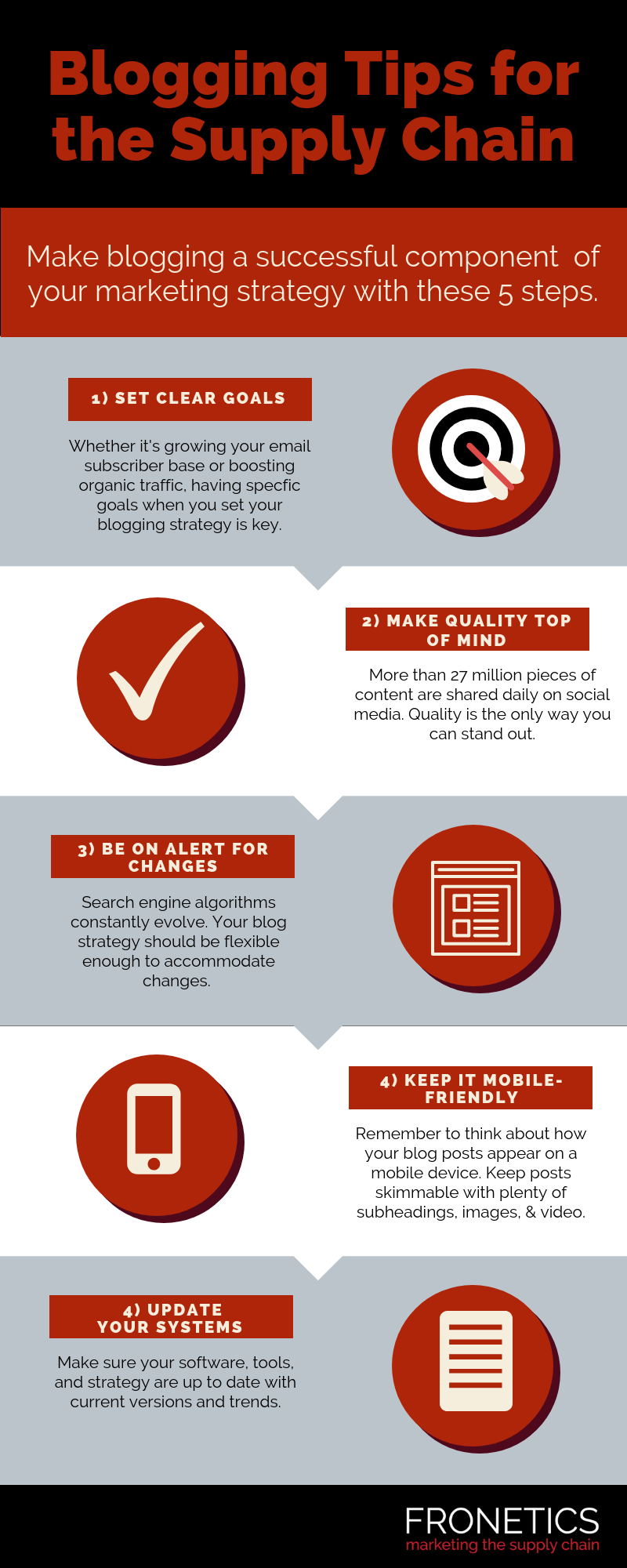
Making your supply chain blog stand out from the pack isn’t always easy. That’s why we created the infographic below. Read on for our top 5 supply chain blogging tips for 2019.
5 tips for your supply chain blog
(Made with Canva)
1. Set clear goals
We know, this one sounds obvious. But you’d be surprised how often marketers overlook this seemingly simple step or settle for general, vague goals. It’s true that blogging can have all kinds of positive impacts for the supply chain, but that doesn’t mean that you should just be blogging without a clear, documented set of goals specific to your business.
Whether it’s growing your email subscriber base, boosting organic traffic, or generating more qualified leads, having specific goals in mind when you set your blogging strategy is key. For one thing, it lets you target your efforts and generate content that is focused on achieving a specific result or set of results. Furthermore, having objectives allows you to be far more effective in evaluating your results, including measuring blogging ROI, and tweak your strategy accordingly.
What are your top three goals for your supply chain blog in 2019? Let us know in the comments!
2. Make quality top of mind
Ponder this for a minute: At last count, users share 27 million pieces of new content on social media every single day. Twenty-seven million. In a world of skyrocketing quantity, quality is ever-more important. There’s a huge amount of pressure on supply chain marketers to produce a constant stream of content, but the sad truth is, if you’re not producing high-quality, substantive content, you’re wasting time and energy.
For supply chain companies in particular, it’s crucial that every piece of your content be well-researched, clearly written, focused, and trustworthy. We know that producing consistently high-quality content isn’t easy, but, trust us: if you invest the time and energy to make your content stand out, you will see the results. To get you started or keep you focused, check out our guide to creating good content for logistics and supply chain marketers.
3. Be on the alert for changes
Particularly when it comes to search engine optimization (SEO), changes happen fast these days. In August of 2017, Google updated its algorithm, continuing a set of changes we’ve been watching for a while now. Voice searches are becoming increasingly prevalent, and researchers estimate that by 2020, 50% of all searches will be voice queries.
As these changes continue to happen, it’s crucial that your strategy is lithe and flexible, ready to adapt to a quickly shifting climate. This means keeping abreast of conversations going on in the industry, following blogs you trust and respect, as well as tracking your own results, and being alert to changing trends.
4. Keep it mobile-friendly
You don’t need researchers to tell you: people are increasingly receiving and reading content on their phones. Whether it’s social media, emails, or blogs, mobile usage continues to skyrocket as devices become more and more ubiquitous and user-friendly.
What does this mean for supply chain blogs? Of course, your website needs to have a visually attractive and accessible mobile version, but it’s also helpful to think about your blog posts in terms of how they appear on a phone. Keep your posts skimmable, with plenty of subheadings to orient the reader, and absolutely include video whenever possible.
5. Make sure your systems are up to date
We keep coming back to the reality of the rate of change these days. It can be exhausting and overwhelming for marketers to keep pace. Take the opportunity of the new year to make sure all your blogging-related tools are updated and running the current software.
As you’re keeping your tools fresh, it’s also a good time to make sure your procedures are running smoothly and are at a pace with the current marketing climate. This means evaluating responsibilities and results within your team, ensuring that your editorial calendar is serving you well, and taking a look at your data collection and reporting methods.
Bonus: What not to do in 2019
These might seem obvious, but again, you’d be surprised how may marketers fall victim to these blogging “don’ts.” We figured it bore repeating.
- Don’t: attempt to post content that doesn’t reflect your business’ “comfort zone.” Stick to what you know, and do it well.
- Don’t: copy and paste text or images from other blogs. Using other content for ideas is great. Copying it verbatim is verboten.
- Don’t: post at irregular intervals. Creating a content schedule and sticking it is key to establishing a loyal following and boosting your credibility.
What goals do you have for your supply chain blog this year?
Related posts:


by Elizabeth Hines | Nov 21, 2018 | Blog, Content Marketing, Logistics, Marketing, Social Media, Supply Chain
With a growing shift toward social messaging platforms, your business needs to find a way to incorporate these apps into your content marketing strategy.
Feel like giving yourself a pat on the back for finally getting a handle on how to effectively use social media networks like Facebook, Instagram, Google+ and Twitter in supply chain marketing? Well, you might not want to celebrate just yet.
In the constantly changing world of online connection, social messaging apps are the new social media. The top four social messaging platforms have overtaken the top four social media networks in terms of monthly active users.
The increasing popularity of social messaging platforms means your business needs to consider how to incorporate social messaging apps into your marketing strategy if you want to continue to best meet your costumers.
Here’s what supply chain businesses need to know about social messaging apps — and why to use them in supply chain management.
What’s a social messaging platform?
Social messaging platforms are exactly as they sound. They are applications that allow people to easily and quickly connect with friends, family, and businesses for personal and professional conversations. They are basically email’s hip, smart, stylish grandchild. Sending text, photos, multimedia files, and even making voice calls are all available options.
Let’s take a closer look at the top four social messaging apps to gain a better sense of what they can do.
- WhatsApp. The enormously popular WhatsApp, owned by Facebook, is the most used social messaging app in the world with more than 1.5 billion users. Easy to understand and designed for smartphones and tablets, users can send text messages, photos, voice recordings and videos and even make voice calls over the internet. And guess what? It’s all free. In addition, WhatsApp lets users set a status for their contacts to see without having to message everyone, use the map function to communicate location info with someone, and share files from a phone or computer.
- Facebook Messenger. Facebook has its own messaging app too, and it’s just behind WhatsApp at 1.3 billion users. This social messaging app builds on Facebook’s user network but the message functionality was separated from the main social networking app a few years ago. Users can send messages and exchange photos, videos, stickers, and audio files, and they can react to other users’ messages too. You can also make free voice and video calls through the app.
- WeChat. With nearly 700 million users, WeChat dominates in China and is making a serious push for global reach. WeChat provides users with free mobile instant messaging, video and voice calls, group chat, and multimedia messaging with images, video, audio, stickers, and more.
- Viber. Viber is another free messaging app that works between phones, tablets, and computers. It currently has 400 million users. Users can send texts, stickers and emoticons, photos, voice and video messages. Viber also has a feature called Communities, which are public chat channels where the user can like and reply to messages in group conversations. It also has a built-in QR code scanner and, like WhatsApp, the ability to share your GPS location in conversations.
Why move to social messaging platforms?
If you’re questioning why to move toward one (or more!) of these four social messaging apps, here’s the short answer: because your customers are.
The longer answer is that supply chain businesses can use these platforms to deliver content, engage with customers one-on-one, and offer superior personalized customer service, all of which result in high-quality relationships and leads. And with the successful rise of chatbots in supply chain marketing, this kind of interaction is more feasible than it may initially sound.
If you need more reasons, don’t just take my word for it. Consider these 10 graphs that show why your business should gravitate toward increasing your social messaging presence.
Social messaging apps for the supply chain
So, which social messaging app is best for the supply chain? There’s no one-size-fits-all answer here. These are the top 4 platforms where your customers and potential customers are spending time, so this is where you should meet them.
But we all know that “doing it all” isn’t always feasible. So, in order to get the most from your time (and budget!), make sure to take the time to choose the best social messaging app for your marketing needs.
Ask these important questions:
- Who is my target audience?
- How will the app add value to my target audiences?
- How do I want to deliver my content?
- Do I want to use more than one app?
- How frequently will I be marketing on the app?
These questions can help you find the social messaging apps that will work best for your marketing campaign and start connecting with customers in a more personalized way.
With the shift toward messaging apps, your business needs to find a way to do the same. But however you plan to incorporate a social messaging app, here’s a final word of caution: you aren’t a friend, and you aren’t family. Be engaging, be helpful, be available. Just don’t be intrusive. The 2018 Sprout Social Index shows that people are still using social media primarily for connecting with friends and family. As businesses consider how to use messaging apps to deliver content and engage with leads, it is very thin line between getting into your costumers’ hearts or getting under their skin.
This post originally appeared on EBN Online.
Related posts:


by Elizabeth Hines | Nov 12, 2018 | Blog, Content Marketing, Logistics, Marketing, Social Media, Supply Chain
Social platforms create an opportunity to connect with prospects but only if your efforts align with customer preferences. Here’s how brands can focus on creating content that customers actually want.
In 2018 social media platforms have made a concerted effort to keep their platforms, well, social. User experience is the top priority, and many brands and businesses feel like they’ve been pushed to the back burner.
Businesses aiming to increase brand awareness must think long-term when it comes to social media. Social media marketers need to engage with users, not simply disrupt the user’s experience. This means that content shared by a brand needs to be relevant, useful, and let’s face it, visually engaging.
The overlap between brands and users
In the 2018 Social Sprout Index, researchers found that 61% of marketers create posts that teach readers something. But that’s not all, 59% of consumers reported wanting to read posts that teach something. The connection is obvious.
Businesses looking to increase user engagement on social platforms need to focus on providing users with what they want. Users want you to teach them. So, showcase why your brand is a leader in your industry or highlight how your products or services can be the solution to a problem.
Most social media users are still using platforms to connect with friends and family, so it’s imperative for businesses to focus on authentic engagement. This can only be accomplished by connecting readers to useful and informative information.
“The most enlightened social marketing strategy integrates awareness and consideration stage content — opening the door with entertainment and inspiration, then carrying audiences across the threshold with education, information about new product offerings and discounts and sales.” Social Sprout Index 2018
And while 80% of marketers report increasing brand awareness as their primary social media goal, it’s not always easy to know how to get started creating relevant content that will resonate with users. Here is Kettie Laky, Social Media Director, to explain how businesses can be helpful to users on social platforms.
Video: How businesses can be helpful on social platforms
Takeaway: Focus on what’s important
It’s time for marketers to stop wasting time and resources on content that doesn’t resonate with users. Aligning priorities between what users want and what marketers are producing is key to creating long-lasting relationships with prospects. Brands who are actually helpful, not intrusive, will reap the benefits of their hard work.
Related posts:

by Elizabeth Hines | Oct 24, 2018 | Blog, Content Marketing, Logistics, Marketing, Social Media, Supply Chain
Brands need to focus on the awareness and consideration stages of the buyer’s journey to build relationships and boost social media ROI.
Are you focusing on the right phases of the buyer’s journey in your social media strategy? The 2018 Sprout Social Index shows that customers prefer businesses to provide social media content that aids in awareness and consideration, not the end sale.
Misaligned priorities
Sprout Social’s 2018 Index found that users “want brand awareness and consideration stage content from brands on social, but 80% of social marketers are hyper-focused on awareness activities, leaving out the consideration piece of the puzzle.” When brands don’t meet the needs of their audience with consideration stage content, they’re missing out on building relationships and ultimately cutting into social media ROI.
Sprout Social found a great deal of misalignment when it comes to what marketers post versus what consumers want to see on their social media platforms. Part of the issue is a failure to define ROI in the most productive way. Thinking about social media’s value in terms of direct attribution leads to a skewed focus on sales, and erodes the effectiveness of brands’ social media efforts. According to Sprout Social, “social’s true value isn’t in direct attribution — it’s in the awareness and consideration stages of the funnel.”
The right kind of content
Despite the misalignment, there is one area of overlap between what marketers focus on and what users want to see: “posts that teach.” Which brings us back to consideration stage content. “If you aren’t already, meet consumers in this sweet spot in the consideration stage,” suggests Sprout Social. This means taking users beyond recognizing your brand and into knowing where your expertise and thought leadership lies.
Educational content is key in the consideration stage. It’s important to remember that this kind of content doesn’t necessarily need to showcase your product to be valuable — it’s all about offering your audience the information and expertise they’re looking for. For B2B businesses, particularly the supply chain, this could mean anything from product demonstrations to think pieces about how to optimize production.
“The most enlightened social marketing strategy integrates awareness and consideration stage content — opening the door with entertainment and inspiration, then carrying audiences across the threshold with education, information about new product offerings, and discounts and sales,” says Sprout Social.
Diversifying focus between awareness and consideration is crucial to getting the most out of your social media efforts. As social networks home in on preserving the social aspects of their platforms, it’s all the more important for brands to align their activities with what users actually want to see, to stay relevant.
Related posts: