Privacy Policy
Privacy Policy Last updated: August 24, 2026Effective date: August 24, 2026 1. Introduction Welcome to Fronetics. Fronetics Strategic Advisors, LLC (“Fronetics,” “we,” “our,” or “us”) respects your privacy and is...
4 Ways to Manage a Social Media Crisis
Knowing how and when to respond to a social media crisis is crucial for reputation management and preventing future issues.
News travels at lightning speed thanks, in large part, to social media. With the ability to amplify news – both good and bad – you hear, almost daily, about brands battling a social media crisis. Look at Facebook, who is still managing the aftermath of the Cambridge Analytica scandal almost two years after the news broke.
When your company suffers from negative reviews on social media, it hurts. A single post can have a direct impact on your bottom line. That’s why it’s crucial for B2B brands to know how and when to respond to online reviews and comments. Here are four ways to help your company manage a social media crisis.
4 steps to managing a social media crisis
1. Establish policy
We recently wrote about the importance of a social media policy, and there’s never a better time to implement one than during a social media crisis (except for maybe before it happens). When you provide employees with guidelines on how to respond to negative feedback online, you minimize the risk of employees guessing the appropriate response. Because speed is critical in these situations, a social media policy allows your team to respond quickly and confidently.
2. Listen
You know customers are talking about your company, but is the tone a positive one? And if it’s not, how are you responding? Social listening gives you the opportunity to take a negative customer-service situation and not only correct the problem, but deescalate a situation from turning into a crisis.
Through consistent social listening, you’ll understand the difference between grumblings and a significant change in sentiment toward your brand. Though no company is perfect, a personalized response to negative comments on social media shows a genuine concern for your customers and an investment in customer satisfaction.
3. Engage
As we’ve said, time is of the essence. A short, initial response on social media is a must, but your brand needs to follow up with more in-depth messaging. Social media thrives on engagement, and responding to a crisis is no different.
Lauren Teague suggests, “Avoid getting pulled into a long discussion of what went wrong. Instead, try to move the conversation to a more personal channel, like private messaging. You could also offer a phone number, email address, or other means of communicating outside of social media.”
4. Learn
Deep breaths. Once you’ve survived a social media crisis, the experience isn’t over. Take the time to meet with your employees and examine what happened, what worked well, and what needs to change in the event another crisis occurs. Learning how to minimize the damage of a social media crisis will only benefit you when future issues arise.
Give your staff the opportunity to share their experience during the crisis. Insight from your different departments can help determine areas in your social media policy that need updating, including how to prevent similar crises in the future.
Has your company experienced a social media crisis? How did you put out the fire?
Related posts:


Infographic: Creating the Right Content for Lead Nurturing: ToFu, MoFu, and BoFu
Ushering qualified leads through the sales funnel requires the right kind of content at the right time. Here’s what kind of content you need for ToFu, MoFu, and BoFu.
Highlights:
- ToFu, MoFu, and BoFu are abreviations for top of funnel, middle of funnel, and bottom of funnel, respectively.
- ToFu content should be geared toward audience engagement and getting contact information – not converting.
- MoFu stage content should establish that your business can address a prospect’s specific needs.
Consider this statistic: 50% of qualified B2B leads aren’t ready to make a purchase when they initially convert. That means that in order to usher prospects effectively through the sales funnel, marketers need to deliver the right content for each stage of the buyer’s journey. That’s where idea of ToFu, MoFu, and BoFu content comes in.
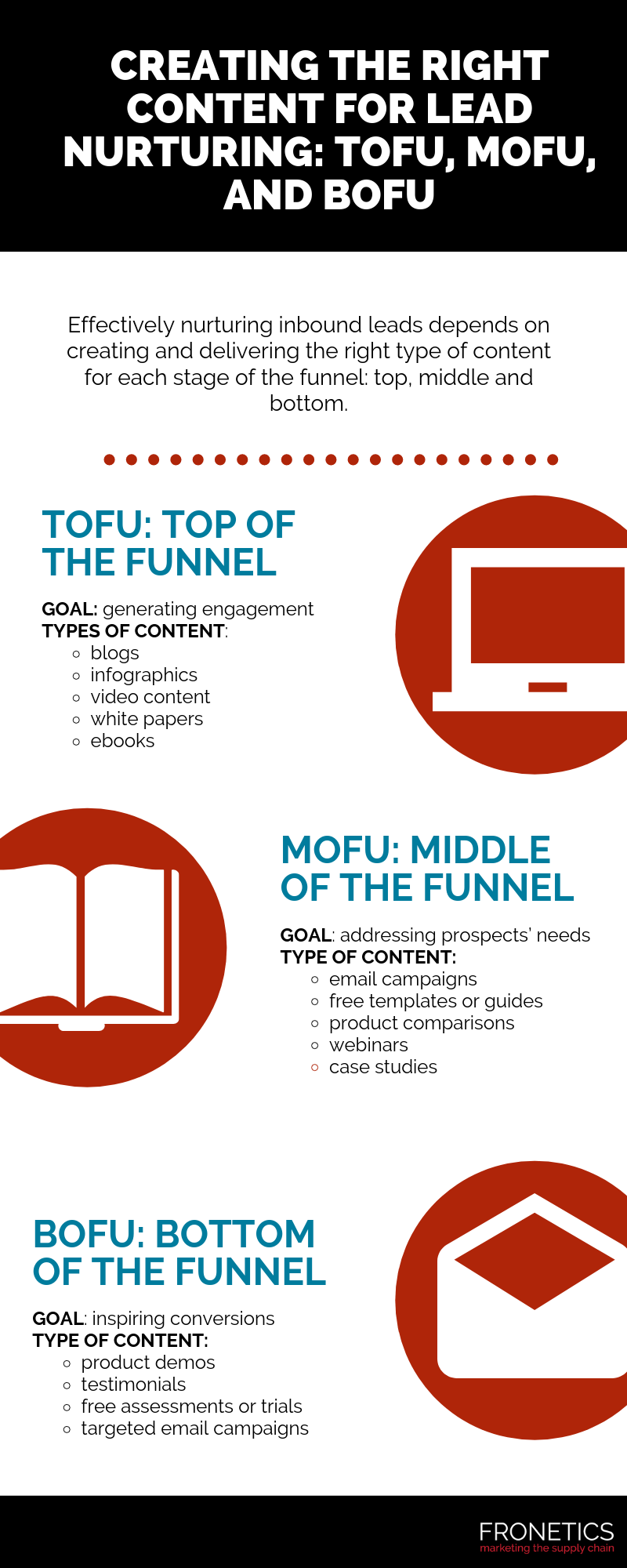
In case you’re wondering, none of these three words refer to soy-based vegetarian snacks. Instead, ToFu, MoFu, and BoFu are marketing portmanteaux, meaning top of funnel, middle of funnel, and bottom of funnel, respectively. Effectively nurturing inbound leads depends on creating and delivering the right type of content for each stage of the funnel.
ToFu, MoFu, and BoFu: a primer
Before we talk about what kind of content to deliver to prospects at each stage of the buyer’s journey, let’s take a closer look at what the terms ToFu, MoFu, and BoFu refer to and what your goals should be at each stage.
ToFu: top of the funnel
At the top of the sales funnel (ToFu), your goal is to draw in a wide audience of prospective leads, increasing brand awareness and customer engagement. This is the awareness stage of the buyer’s journey, and it represents your first impression. Leads at the top of the funnel are getting a sense of what your business does and your brand identity.
For ToFu leads, your goal isn’t conversion but simply to obtain contact information and generate interest. Says Gaetano DiNardi, Director of Demand Generation for Nextiva, ToFu “is where strangers become familiar with your brand for the first time… At this stage of the game, you don’t care about conversions; you care about piquing intrigue.”
MoFu: middle of the funnel
The middle of the funnel (MoFu), is the consideration stage of the buyer’s journey. This can be a tricky and uncertain stage as your leads continue to engage with your brand and learn about your products and services but remain unready to commit to purchase. “MoFu is usually the most complicated funnel stage because of how hard it is to define,” says DiNardi.
Ideally, by the MoFu stage, you should have a clearer idea of who your leads are and what they’re looking for. Your focus should be on continuing to educate your leads and situating your products and services as the solution to the challenges and needs of your prospects.
BoFu: bottom of the funnel
The bottom of the funnel (BoFu) is the decision stage of the buyer’s journey. You’ve established a relationship with your prospect during the MoFu stage, and your lead is now turning to you for specific information about your products and services. It’s at the BoFu stage that leads are ready to make a purchasing decision.
This is the stage when it’s all about conversion. Your goal is to inspire your lead to convert, helping them to realize that your business has the solutions they need. It’s important to note here that your goal is not to “sell,” but rather to make sure your leads know that you’re there to help.
Optimizing ToFu, MoFu, and BoFu content for lead nurturing
Once you have a clear idea of the stages of the sales funnel and your goals for each, it’s time to consider the right types of content to ensure that prospects receive exactly the right message for each step of the buyer’s journey.
ToFu content: generating engagement
At the top of the sales funnel, where your goal is to engage your audience and collect contact information from qualified prospects, your content needs to educate leads and establish thought leadership. ToFu content shouldn’t pressure your audience to make a purchase, but instead should be geared toward providing information that speaks to needs, challenges, and questions common to your target audience.
According to Coralie Wood, Director of Demand Generation at LoginRadius, “Top-of-funnel content needs to be much more digestible and informative to ensure you are positioned as a thought leader.”
Some types of content that work particularly well for the ToFu stage:
- Blog posts
- Infographics
- Video content
- Whitepapers
- eBooks
MoFu content: addressing prospects’ needs
At this challenging middle stage, your content should begin to establish your business as the solution to a prospect’s specific needs and challenges. This is the consideration stage, and your lead is in the process of evaluating all available information to prepare to make a purchasing decision. Developing the relationship requires that your content be highly informative about how your business is ready to meet your prospect’s needs.
Because of the “wide net of interested leads who haven’t been fully qualified,” says DiNardi, “if you are too shameless about plugging your products or services, you’ll come across as pushy and likely to turn off buyers.” Instead, he suggests being “helpful and knowledgeable, while guiding your prospects into the right decision.”
Effective content types for the MoFu stage include:
- Email campaigns
- Free templates or guides
- Product-to-product comparisons
- Webinars
- Case studies
BoFu content: inspiring conversions
Now that your ToFu and MoFu content have attracted and nurtured a qualified lead, it’s time for your BoFu content to convince your lead to convert. It’s the closing stage of the buyer’s journey, which means marketers should be directing prospective buyers toward content that sells. This type of content is about cementing a decision and helping your leads recognize that your business has the right solutions.
“It’s important to note here that BoFu content can also lead directly into validation. This starts to cross the line from traditional content marketing to things like product marketing and customer testimonials,” says Mike Baker, marketing director at Lola.com. “As you work closer to the bottom-of-the-marketing funnel, your content should shift from purely educational to a more consultative, product-focused and a ‘show-don’t -ell’ style of marketing.”
BoFu content types geared to inspiring conversions include:
- Product demos
- Case studies and testimonials
- Free assessments or trials
- Targeted email campaigns
Related posts:
- 4 Components of Effective Lead Generation and Lead Nurturing Campaigns
- 5 Tips to Generate More Leads on Your Website
- Using Analytics to Align Sales and Marketing Teams

Report: Internet Users Prefer Private Messaging Apps to Shared Content
As social media users increasingly prefer to share content and recommendations via private messaging apps, brands need to be aware of how to take advantage of this trend.
Highlights:
- Nearly two-thirds of social media users now prefer to share content and recommendations through private messaging apps.
- Facebook Messenger is by far the most popular of these platforms.
- Chatbots can help brands engage in conversations on messaging apps and capture leads.
A recent study has confirmed a trend we’ve long predicted: A significant majority (63%) of social media users now express a preference for private messaging apps for sending messages or recommendations to people in their circle, as opposed to posting publicly on social media.
Marketers need to be aware of the implications of this shift toward private messaging apps, or “dark social channels.” Recognizing that three out of five users now prefer to connect via a private channel rather than open social media platforms, brands can tailor content accordingly and create a strategy that capitalizes on this shift.
Private messaging apps by the numbers
GlobalWebIndex and WeAreSocial teamed up to conduct research on content-sharing preferences, looking at more than 3,100 internet users. They asked research subjects how they tend to share information like articles, photos, videos, and recommendations and received the following responses:
- Private messaging apps: 63%
- Social media accounts: 54%
- Word of mouth: 51%
- SMS: 48%
- Email: 37%
Next, researchers broke down the results further, to reveal which messaging platforms users prefer:
- Facebook Messenger: 82%
- WhatsApp: 56%
- Instagram: 34%
- Snapchat: 32%
These are striking numbers. Not only is the preference for messaging apps clear, but brands should take note of the dominance of Facebook Messenger as the preferred platform. It’s likely that this preference is accounted for by the prevalence of social media for content consumption and distribution. Therefore, private messaging apps within social media platforms, with Facebook Messenger chief among them, are an easy and convenient way for users to share information.
What brands need to know about private messaging apps
The trend toward content sharing via messaging apps is mixed news for brands. On the one hand, marketers are likely be dismayed that a significant percentage of website visitors will likely be coming from these untraceable sources. On the other hand, says Olivia Valentine of We Are Social, “it means that there are likely more brand advocates than you might think.”
Valentine is right. When users share content and recommendations on messaging apps, they are engaging in authentic, private conversations, making the recommendations all the more meaningful.
Not only are social messaging apps becoming the preferred content-sharing platform among users, but brands can use these apps directly to engage with their audience. Facebook Messenger now has over 1.3 billion active monthly users globally and offers businesses the opportunity to connect directly and authentically with their audience.
Chatbots
Perhaps you’ve been reading about the rise of private messaging apps for content sharing and despairing over the idea that to keep your business relevant, your marketing staff will now need to be spending every working hour responding to thousands of messages with prospects.
Don’t despair. This is where the latest trend in artificial intelligence for marketers can help. Chatbots are computer programs that simulate, with ever-increasing accuracy, human conversation. This software communicates with your prospects inside a messaging app, carrying on a conversation until a prospect is ready to move down the sales funnel.
When it comes to creating chatbots, we recommend platforms including HubSpot’s Chatflows, Chatfuel, ChatScript, and Facebook’s Bots for Messenger tool.
The takeaway: the shift toward messaging apps is a net positive for marketers
To take full advantage of the growing user preference for private messaging apps, marketers need to ensure that their content is easily shared, engaging, and generative of authentic conversations among their audience. Furthermore, using chatbots can help businesses capture leads and engage in direct conversations on these platforms.
As Valentine points out, while the increased use of private messaging apps does mean that a certain amount of web traffic will be coming from untraceable sources, brands should be celebrating the fact that this trend means that recommendations are far more meaningful and your audience is becoming increasingly empowered to advocate for your brand.
Related links:
- Chatbots: No Longer Just a Buzzword
- Social Messaging Platforms: Why Your Supply Chain Company Needs to Pay Attention
- Video: Social Messaging Apps are the New Social Media