by Elizabeth Hines | Nov 27, 2017 | Blog, Current Events, Marketing
It’s time for retailers to cut their dependence on holiday season shopping, and take advantage of opportunities to generate demand over a more sustained period of time.
When was the last time you stood in a pre-dawn line at a Black Friday doorbuster sale? If it was within the past years, you’re actually part of a dwindling minority of shoppers. Increasingly, customers are in shopping mode all the time, and deals that are restricted to a limited timeframe or buying mode are only a source of frustration.
In a recent Harvard Business Review article, brand-building expert Denise Lee Yohn makes the argument that retailers are over-dependent on the holiday shopping season, as the retail landscape has shifted seismically in the past decade. “It no longer makes sense to rely on disproportionate revenue from the holiday season to make up for the softness in sales during the rest of the year,” she argues.
Accommodate the way people shop today
So what does this mean for marketers? Yohn suggests that it’s time for brands to rethink how they promote themselves during the holidays and beyond, with marketing dollars better spent accommodating the ways people shop now.
“Customers don’t want retailers to dictate their shopping schedule,” says Yohn. Shoppers at every price point are becoming more accustomed to buying whenever the interest strikes them. They often shop from their mobile devices or in the stores during post-season sales, rather than at times traditionally associated with peak retail activity.
In their book Absolute Value, Itamar Simonsen and Emanuel Rosen posit the idea that people are now engaging in what they call “couch tracking,” or “keeping track of what they learn about products from reviews, friends, and news items on an ongoing basis.” This means that customers are likely to have well-formed preferences long before they have a specific plan to purchase. “Therefore,” concludes Yohn, “it doesn’t make sense for retailers to try to influence product or brand decisions only during discrete windows of time.”
In case you need further convincing, Yohn also points out that a disproportionate emphasis on the holiday season isn’t to a retailer’s best advantage even from a logistic perspective. “The large fluctuations in demand wreak havoc on supply chain, labor management, and accounting.”
It’s time for retailers to cut their dependence on holiday season shopping, and take advantage of opportunities to generate demand over a more sustained period of time. Millennials and other shoppers are increasingly choosing to spend discretionary dollars on experiences like recreation, travel, and eating out, rather than on products like clothing and shoes. To keep pace, Yohn suggests that “a year-round approach would likely help retailers compete with restaurants and other experiences which people seek out throughout the year.”
How to better distribute your marketing dollars
Here are three key takeaways for retailers looking to put marketing dollars to better use:
1) Encourage year-round “self-gifting”
Millennials are nearly as likely to buy something for themselves as someone else during the holiday season. Encouraging this tendency year-round could lead to more consistent purchasing rather than waiting for a holiday occasion.
2) Delay holiday-specific messaging
This one may seem counter-intuitive, but not having a holiday-specific message during fall months will actually help you capture wider demand. You also buck the trend of creating deal-fatigue, as shoppers quickly get weary of holiday promotions that start in October.
3) Make technology your friend
Says Yohn, “The technology and analytics now exist for retailers to better predict what people want and when they want it, so they should use these capabilities to move away from the traditional seasonal approach.”
Related posts:

by Elizabeth Hines | Nov 21, 2017 | Blog, Current Events, Marketing
These 10 podcasts for marketers discuss the latest news and trends in the marketing world relevant to the supply chain and logistics industries.
Podcasts have surged in popularity over the past few years. At least 112 million Americans have listened to podcasts, a figure up 11% from last year, with 67 million listening at least monthly. So why are they so popular?
Podcasts are a series of digital audio files that listeners can subscribe to. With the flexibility to listen at their convenience, followers are drawn to the ease and mobility of podcasts. And the available topics are endless.
For supply chain and logistics marketers, podcasts provide the latest digital marketing news, as well as innovative trends that are new to your industry. Here are 10 podcasts that deliver the most up-to-date news in marketing for supply chain and logistics companies.
10 supply chain and logistics marketing podcasts
Millions of dollars are being left on the table right now by supply chain companies because of poor marketing! Supply Chain Gold delivers actionable marketing strategies and information to logistics and 3PL companies, distribution centers, and fulfillment centers to help bring in more sales and increase profit margins. The Supply Chain Gold podcast warehouses internet marketing secrets that your company can leverage to lower customer acquisition costs, grow revenue, increase net profits, drive brand recognition, and dominate your industry.
- #AskGaryVee
Gary Vaynerchuk — author, speaker, and owner of multi-million dollar marketing company VaynerMedia — uses his podcast to answer questions about marketing, social media, and general entrepreneurial topics that his followers ask on social media. If you’re looking for a high-intensity host whose responses are no-fluff, honest, and a tad explicit from time to time, Gary might be just the straight-talking expert you need.
The Marketing Book podcast helps business owners and marketers keep up with the smartest thinking in the quickly changing field of modern marketing. Each episode interviews authors and marketers to give you actionable marketing insights, tips, tactics and resources to help grow your business.
Social Media Examiner’s weekly podcast is hosted by Michael Stelzner and other members of SME’s team. Each podcast focuses on new social media features and strategies, providing listeners with actionable tips they can use to improve their social media results.
Copyblogger FM is a weekly, short-form broadcast hosted by Sonia Simone. Each week she and a team of rotating experts discuss the week’s news and updates in the field of content marketing, email marketing, copywriting, conversion optimization, and more.
John J. Wall and Christopher S. Penn host a 20-minute, weekly show recorded in a local coffee shop. The podcast is designed to be casual and conversational. They share tips on social marketing, SEO, search marketing, copywriting, affiliate marketing, and more. They also take listener questions.
Industry experts Eric Siu and Neil Patel offer users unconventional marketing wisdom that will make you want to kick some of your traditional strategies to the curb. Their goal is to bring valuable, actionable marketing tips in just 10 minutes.
Buffer’s blog is highly successful, so no wonder its podcast is equally informative. The content will appeal to anyone who practices social media marketing, whether you’re brand new to marketing or you’re a social media practitioner. They regularly have industry leaders on the show, including Mari Smith and Neil Patel.
Know Your Audience is a weekly podcast that interviews journalists, bloggers, data scientists, and analytics/audience development professionals. The goal is to start a meaningful conversation about what it takes to create engaging content and learn from the people who are shaping the future of media.
Listen and learn from interviews with social business leaders representing top brands and agencies. Host Bernie Borges leads an educational format as guests share their experiences and insights on social business topics including marketing, selling, customer service, employee advocacy, recruiting and commerce to fuel your social business journey.
Related posts:

by Elizabeth Hines | Nov 1, 2017 | Blog, Manufacturing & Distribution, Strategy, Supply Chain
Manufacturing companies are hoping to continue their revenue growth in 2018 by focusing on 3 key areas.
KLR has released the results of its annual manufacturing industry outlook report, and the optimism following last year’s elections will continue straight through 2017.
With promises of tax reform, decreased federal regulations and looser trade agreements, manufacturers have slowly seen revenue growth throughout the U.S. markets. That growth is projected to continue into 2018.
56% of respondents expect business will continue to increase throughout the year.
And though manufacturing companies are striving to control their costs and cut back on unnecessary expenses, many companies reported increasing their marketing budgets, including technology, to invest in the future of their revenue growth.
So where is the additional money going? Manufacturing companies are investing their profits back into new products, expanding markets and breaking into new territories.
Here are the top 3 priorities for manufacturing companies in 2018.
1. Increasing share in existing markets
Over the next 12 to 18 months, 64% of the manufacturers surveyed expect their growth to come mainly from increased market share and organic growth in existing domestic markets. Manufacturing companies are looking to increase their market share through innovation, strengthening customer relationships, reliable hiring practices, and staying ahead of their competitors.
2. Seeking new markets for products and services
Manufacturing companies are trying to think outside of the box when it comes to expanding their markets. Avon got its big break when it took the now-dated approach of selling products door to door. By trying a different avenue, it was able to increase revenue without fighting for retail space with other corporate giants. Like Avon, companies are working hard to come up with innovative ways to break into untapped markets.
3. Developing new products and services in response to changing consumption patterns
Using social media platforms and other marketing tools, it’s easy for manufacturing companies to stay in touch with their customers. This engagement provides the best insight into the types of products, features and solutions your customers are looking for. Based on this crowdsourcing, or social listening, companies are able to develop products that they know will resonate with consumers and their changing needs. Though product development can be expensive and risky, incorporating customers into the conversation helps manufacturing companies minimize risk.
Despite growth throughout 2017, there are still challenges that manufacturing companies face. How are manufacturers coping with these challenges? They are adjusting their priorities and focusing on these three areas to continue growing their business and, ultimately, their sales.
Related posts:

by Elizabeth Hines | Apr 25, 2017 | Blog, Content Marketing, Marketing
Use this checklist to make sure your marketing emails don’t end up in your customers and prospects’ spam folders.
When celebrities make the headlines, it’s normally for far more salacious reasons than a patent award. But for Kevin Spacey and his longtime producing partner Dana Brunetti, that’s exactly what’s got people talking.
The pair was awarded a patent on April 5 for “systems and methods for implementing email delivery,” which Brunetti unveiled on his Instagram account. Essentially, the invention is aimed at providing a way to screen and manage non-authorized emails.
“It allows in only the ones it knows or whoever is on the list,” Brunetti explains. The idea stemmed from Spacey’s frustrations at receiving countless unwanted emails, and being unable to do anything but change his email address.
Spacey’s impulse points to a pervasive issue: We’re all bombarded with marketing emails. But, as a business, it’s one of the most effective ways to reach customers and prospects. How do we make sure our emails are relevant and aren’t just ending up in spam filters?
Are my marketing emails spam?
Firstly, check out our post on making sure your emails aren’t annoying prospects. Then go through this checklist for avoiding spam complaints and unsubscribes:
- Are my emails relevant to my recipient list?
- Am I sending emails at a good cadence?
- Is my email format mobile-friendly?
- Do I have a mobile-friendly landing page experience?
- Do I have an easy opt-out/unsubscribe process to avoid frustrated subscribers?
- Does the unsubscribe link work properly?
- Am I emailing a subscriber who has just had a poor customer experience? (Don’t!)
- Is easy to quickly identify me as the sender?
- Did I include a valid postal address and reply-to email address?
- Are my emails honest? (Am I hiding the commercial character of my email or using false or misleading subject lines or content?)
- Am I emailing people who have opted in to receive my emails only?
- Have I removed all email addresses that have unsubscribed from previous emails?
Follow these best practices — which are, in some cases, international law — and be confident your marketing emails won’t end up in your recipients’ spam folders.
Related posts:


by Elizabeth Hines | Oct 19, 2016 | Blog, Content Marketing, Marketing, Social Media, Supply Chain
Native advertising is the non-ad-like way to promote your business’ content to users who might be interested in it.
Is your business using native advertising to promote your content with a targeted audience? If not, you’re missing out on one of the biggest upcoming trends in content marketing.
So how can your business use this technique to promote your content and, ultimately, your products and services? Let’s take a look at the basics of native advertising.
What is native advertising?
Native advertising blurs the line between advertising and editorial content. It allows publishers (of content) to get their message to a targeted audience in a format the audience is already using. Think of sponsored updates on LinkedIn, which look just like regular posts, or when a radio DJ promotes a product within the regular broadcast.
Content Marketing Institute founder Joe Pulizzi defines native advertising with the following three qualities:
- “A Directly Paid Opportunity. I hate to bring out the obvious, but native advertising is ‘pay to play.’ If a brand or individual did not pay for the spot, it’s not native advertising.
- “Usually Content Based. The information is useful, interesting and highly targeted to the specific readership. So, in all likelihood, it’s not an advertisement promoting the company’s product or service directly.
- “Delivered In-Stream. To truly be a native ad, the user experience is not disrupted. The advertising is delivered in a way that does not impede the normal behavior of the user in that particular channel.”
Native advertising is not content marketing…
… But it can be an effective way to promote your content.
Remember, content may be king, but distribution is queen, and she wears the pants. That is to say: Publishing valuable and relevant content in a strategic and consistent manner will create demand for your products and services. But content doesn’t go far — actually it goes nowhere — without distribution.
Native advertising is a paid opportunity to distribute your content to more people. It can be more effective than non-native advertising, like banner ads or commercials, because it does not interrupt the user experience but rather complements it. It doesn’t feel like an ad, even though someone paid to have it appear on your screen.
Social media platforms are offering more and more opportunities for businesses to advertise this way through sponsored posts and updates. LinkedIn, Facebook, Instagram, Pinterest — you may have noticed that more and more posts from companies you don’t follow appear in your newsfeeds now. These platforms use proprietary algorithms to help businesses target users might be interested in the content they are promoting.
Here’s what a sponsored post on LinkedIn looks like, for example:
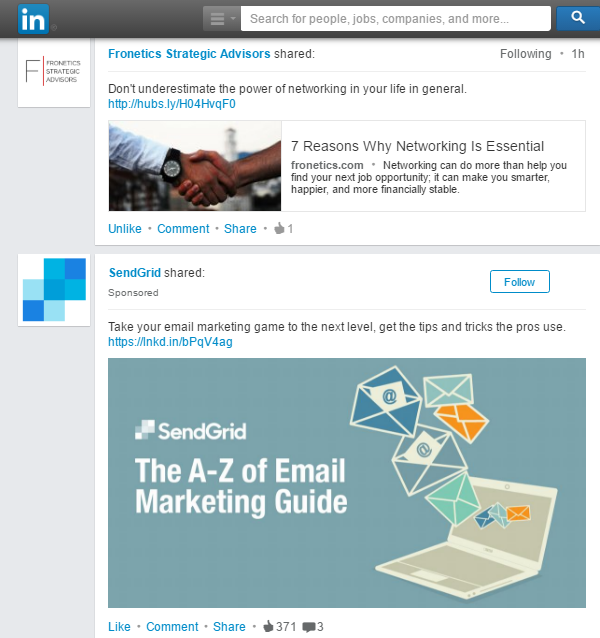
The sponsored post from SendGrid looks just like the other posts in my feed. Another important thing: It’s totally relevant for the kind of content I consume. I might even ignore the comma splice and click on it to get the information about email marketing because that’s what I like to read about on LinkedIn.
Some native advertising facts
The use of native advertising is growing among businesses because it is proving to be so effective. Here are some facts that might interest you.
Doing it right
Because native advertising blurs the line between editorial and advertising, some advertisers have gotten in trouble for violating rules of compliance. In response, the FTC has come out with some official guidelines for native ads in order to prevent confusion and to protect consumers. If your business is launching a native advertising campaign, make sure that you are familiar with these rules and best practices.
Related posts: