by Elizabeth Hines | Sep 18, 2018 | Blog, Content Marketing, Current Events, Logistics, Marketing, Social Media, Strategy, Supply Chain
Ask yourself these five questions before you dive headfirst into an influencer marketing campaign to set you on the right path.
We’ve been writing a lot lately about influencer marketing and how it can work for the supply chain. These campaigns can be extremely effective — but getting the most bang for your buck requires a strategic approach from the outset.
Before you start an influencer marketing campaign, ask yourself these 5 questions.
5 questions to ask before starting an influencer marketing campaign
1. Why do I want to use influencers?
According to Natasha Lekwa, influencer marketing and social media editor at Snapchat, it’s important to “make sure you have a clear idea why you want to use influencers.” Answers might include boosting brand awareness, gaining followers, or increasing sales, to name a few. But each of these answers will lead you to a different strategy.
Being fully and deliberately aware of why you’re embarking on a campaign will help you set key performance indicators, determine your audience, and “envision what success will look like at the end of the campaign.” You’ll also be able to choose strategically the best platform to use, based on your content and target demographic.
2. Who are my influencers?
It may seem obvious, but you’d be surprised how often businesses dive into an influencer marketing campaign without having fully identified key influencers in their sector.
Lekwa suggest using hashtags to search Instagram for appropriate influencers and advises not just focusing on the obvious influencers in your industry. In fact, exploring influencers in other related industries can help expand your reach.
3. Who are my micro-influencers?
So you’ve identified your major influencers. Now you can start thinking about your “micro-influencers,” those with 10K to 100K followers. “Micro-influencers can give you a much higher ROI than big stars, and audience engagement tends to get higher as social niches get narrower,” Lekwa says. And since engagement is the name of the game when it comes to any kind of social media marketing, micro-influencers can be enormously valuable.
4. What are your terms?
Since influencers tend to be content creators at heart, they often have plenty of great ideas. But it’s important that your goals are transparent and aligned.
“It’s important to be on the same page,” says Lekwa. “Having a clear contract that spells out what each side will execute will help manage expectations for both your team and for the influencer.” In fact, Lekwa points out that influencers generally appreciate having guidelines and “the big conceptual themes of a campaign handed to them.”
5. What is my own value?
Approaching influencers can be intimidating. As Forbes writer Andrey Slivka points out, “As you might expect from people who get deluged with free stuff, influencers can be hard to impress.” This means you need to be clear and specific when you approach them about what you have to offer.
“Especially with micro-influencers, who are building their brands, what you offer doesn’t always have to be monetary,” Lekwa says. Often, brands can offer influencers exposure, the prestige of having their own brand associated with a larger business, or the resources to improve their content production.
Influencer marketing can be daunting at first, but it’s a powerful tool of the supply chain. If you lay the right foundation, an influencer marketing campaign has the potential to expand your brand’s reach exponentially.
Related posts:

by Elizabeth Hines | Sep 13, 2018 | Blog, Content Marketing, Logistics, Marketing, Supply Chain
When sales and marketing misalignment plagues your organization, it can have motivational and financial consequences.
Imagine your business spending millions of dollars trying to fix one perceived problem — and it wasn’t even the problem, after all.
Too often, B2B companies fall victim to the dangers of sales and marketing misalignment, often without even being aware that it’s an issue. In fact, a recent study by HubSpot found that only 22% of companies report that their sales and marketing relationship is tightly aligned.
That’s a big problem. And, recently, four business and marketing professors set out to explore just how bad it is for companies when sales and marketing don’t line up. In a recent article in the Harvard Business Review, Wendy Ritz, Michelle D. Stewart, Felicia N. Morgan, and Joseph F. Hair, Jr., described their findings from an experiment and interviews, designed to tackle the issue of sales and marketing misalignment, specifically in regard to the pricing of products and sales initiatives.
What’s wrong with sales and marketing misalignment?
The researchers identified three major dangers for businesses when sales and marketing don’t share goals.
Danger 1: Demotivation
A key part of motivation is the belief that a team can achieve its goal. When goals are misaligned, “it reduces the sales force’s perception that they can achieve either goal.”
In turn, the researchers point out that this demoralizing effect can reduce commitment to the organization, in addition to specific goals. In their experiment, they found that “the effect of misaligned goals reduced hope of the salespeople and created a defeatist climate.”
Danger 2: Goals seem insurmountable
Again, the perception that goals can be achieved is crucial. When sales and marketing are misaligned, people are much more likely to view goals as more difficult or even impossible to achieve.
The researchers point out that “while difficult goals are not necessarily problematic, the challenge is when the sales force believes that the misalignment of goals is simply unnecessary, or that the goal combination makes it impossible to be successful.” In other words, if goals don’t line up, you wind up with a sales force who feels defeated immediately.
Danger 3: It’s going to cost you
Remember the old adage, “Be careful what you wish for?” When it comes to sales and marketing misalignment, the highest cost often comes when goals are met.
“To compensate for the mismatch between pricing and sales force compensation goals,” the researchers found, “salespeople may offer additional resources such as free training, free freight, and customized products.” When goals seem insurmountable or counterproductive, sales teams find themselves resorting to desperate measures to get the job done — which can unnecessarily erode profits.
When things go right
According to a recent study by Data Room and Marketo, “Sales and marketing alignment can improve sales efforts at closing deals by 67% and help marketing generate 209% more value from their efforts.”
The survey found that sales teams closely aligned with their marketing counterparts ranked the quality of marketing-sourced leads much higher than those that were rarely aligned or misaligned. The bottom line: sales and marketing teams that are aligned perform better.
Thinking about getting your sales and marketing on the same page? Consider these six ways to boost sales and marketing alignment.
Related posts:

by Elizabeth Hines | Aug 27, 2018 | Blog, Content Marketing, Logistics, Marketing, Social Media, Strategy, Supply Chain
Repurposed and repackaged, your existing content is a valuable asset for your sales force throughout the buyer’s journey.
If you’re a supply chain marketing professional, it’s likely that you spend a tremendous portion of your day researching, creating, packaging, and disseminating content. Your hard work is all about growing brand awareness and building your reputation as a trusted industry thought-leader — all with the goal of having that work eventually convert leads.
But, consider this: When it comes to engaging prospects and clients, only 20% of salespeople actually use content. When we know that potential buyers are far more willing to engage with someone offering them information and insight, why are B2B businesses abandoning content as soon as prospects are handed over to sales?
B2B buyers prefer content throughout the buying journey
According to DemandGen’s 2018 Content Preferences Survey Report, “Buyers are becoming increasingly more selective in the content they are consuming,” relying more on “trustworthy sources, industry influencers, and their peers to educate themselves.” And furthermore, 88% of those survey respondents want less focus on product specifics and more on the value that product can bring to their business.
And on the other side of that coin, according to HubSpot writer and marketing expert Bethany Cartwright, sales reps spend about 15% of their day leaving voicemails, and only about 20% of all sales emails are ever opened. “This means 80-85% of sales outreach efforts are going unnoticed by those prospects you’ve worked so hard to capture with content,” writes Cartwright.
It’s time to start leveraging your content throughout the buyer’s journey by arming your sales force with content. Before you panic at the idea of creating reams of new content, take a breath. It’s more than likely that you can repurpose your existing content, optimized to give your sales force the tools they need to close deals.
So how do you go about repurposing your content and giving your sales force the best possible tools with which to convert prospects to buyers? Web Profits co-founder and author Sujan Patel suggests “mapping content generated by your marketing team to each stage of your customer’s buying journey.” We’ve created the infographic below to help you optimize content for each of the three stages of the buyer’s journey.
Infographic: Delivering content throughout the buyer’s journey
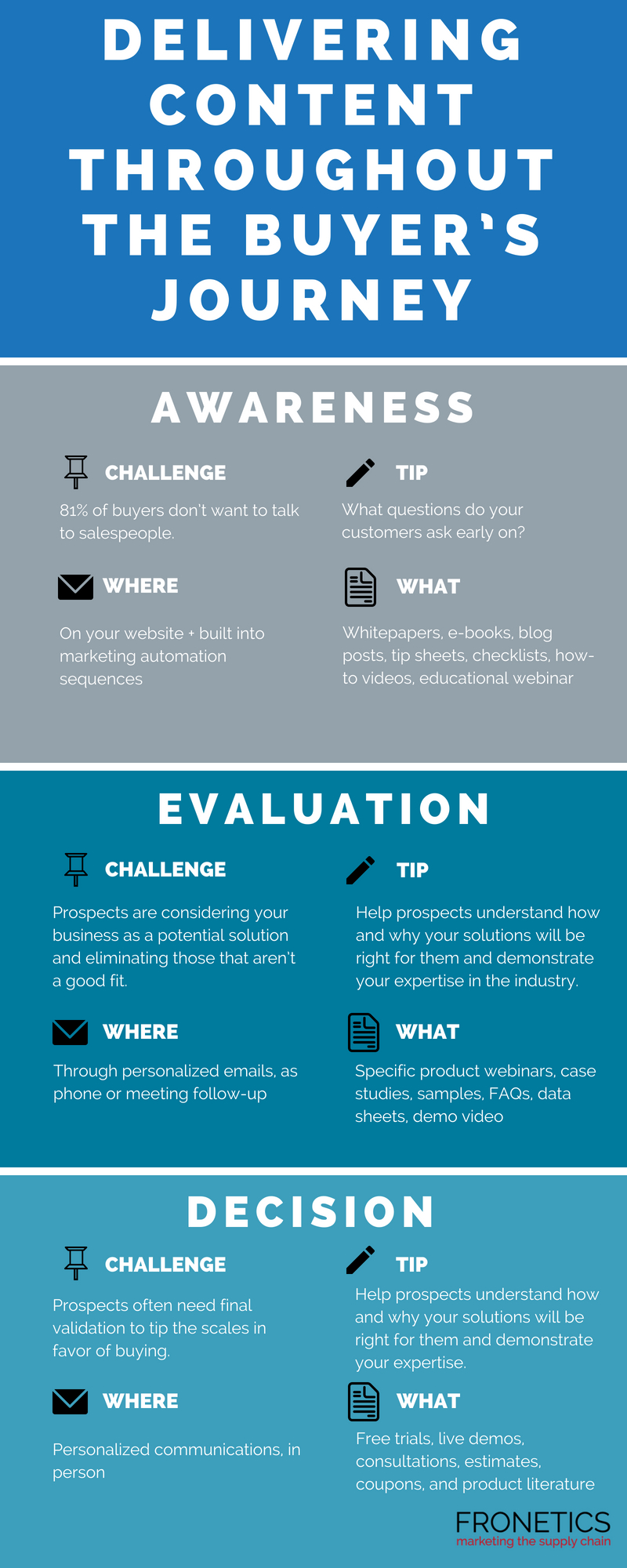
(Made with Canva)
Related posts:

by Elizabeth Hines | Jul 2, 2018 | Blog, Content Marketing, Logistics, Marketing, Social Media, Supply Chain
The growth of social messaging platforms is a big opportunity for your business to reach your audience with targeted content.
Gone are the days when social messaging platforms are just about chatting or making plans with family and friends. You might be surprised to learn that “the combined total monthly active user count of the top 4 messaging apps has grown to 4.1 billion in 2018.”
Just to put that in perspective, that’s well over half of the world’s population and — perhaps even more strikingly — dwarfs the 2.19 billion monthly active users that Facebook reported in the first quarter of 2018.
It’s official: Social messaging platforms have surpassed “traditional” social media when it comes to active users. Not only that, marketers are taking notice, and beginning to think about how to leverage messaging platforms to deliver content to target audiences.
Conversational content
As you might expect, a key element of successfully using social messaging platforms is to tell your story conversationally. This means tailoring your content to the specific wants or needs of your target audience, creating a compelling narrative with your content, rather than an overt sales pitch.
This kind of storytelling is fundamental to content marketing.
“Messaging and chatbots represent the next logical extension of the content marketing mission,” writes Chris Frascella of the Content Marketing Institute.
According to Thomas Husson of Forbes, “Messaging apps will introduce a paradigm shift for marketers where interactive and contextual conversations will replace ad broadcasting. New conversational interfaces will drive deeper relationships between consumers and brands.”
You may be thinking that this is all well and good for B2C marketing, but how does it apply to B2B marketing? But the truth is, if you have a content marketing strategy in place, chances are, you have a story to tell, and these are tools to help you do it.
Chatbots
Enter chatbots, the technology to turn your content into conversations. Chances are, you’ve already come face-to-screen with a chatbot and may not have even known it.
These computer programs simulate human conversation using auditory or textual methods. Basically, it’s software that communicates with your target audience inside a messaging app. Chatbots are already changing the way businesses interact with their customers — and with each other.
If you’re thinking that you’re about to be replaced by a robot, relax. We’re extremely far from AI technology replacing human interaction. Chatbots are a tool, and they need to be fed content and trained by human marketing professionals.
Tips for using chatbots
The first step is adapting your content for use in a chatbot conversation. “You can’t just duplicate existing content in your conversational scripts,” says Frascella. While the goals for your content are the same, the way it is delivered is different. That requires a shift in how it’s structured.
It’s also important to be mindful of timing. Because chatbots require users to opt into conversations, retaining permission to access your audience in this way depends largely on content and timing. This means delivering engaging, meaningful, and valuable content at regular intervals, but not intrusively.
For more ideas on creating a chatbot, check out this post.
Social messaging platforms are opening new doors for you to deliver personalized content straight to your target buyers. Make the most of this opportunity!
Related posts:

by Elizabeth Hines | Jun 26, 2018 | Blog, Content Marketing, Logistics, Marketing, Strategy, Supply Chain
More and more supply chain marketers are realizing the benefits of inbound marketing (over outbound marketing) including cost savings and increased lead generation.
Marketers are constantly coming up with new and trendy ways to attract leads. With endless platforms available to us, it can be overwhelming for even the most seasoned marketers to know where they need to focus their efforts.
In order to find the right solutions for your supply chain marketing needs, you first have to understand the difference between inbound and outbound marketing. And more importantly, how they can help — or hinder — your marketing efforts.
Outbound marketing
Outbound marketing describes any marketing approach that pushes a message onto a buyer. Traditional marketing — tv and radio ads, telemarketing, banner and display ads — are all examples of outbound marketing.
Another name for this marketing tactic is interruption marketing, as it typically tries to take “attention away from what your buyer is doing and bring it, forcibly, on to your product or service.”
Inbound marketing
Inbound marketing focuses on audiences finding you. Instead of pushing a message onto buyers, inbound marketing allows you to establish your brand as an industry leader and let interested audiences come to you. This type of marketing attempts to draw in potential customers through interesting and engaging content.
Content marketing is a type of inbound marketing. Examples include blog posts, social media, infographics, white papers, and videos.
Why is inbound marketing better for the supply chain?
Outbound marketing used to be the ‘go to’ for generating leads, but this is simply no longer the case. Marketers across industries have found that inbound marketing has many advantages over traditional marketing practices. In fact, almost three-quarters (68%) of inbound organizations believe their marketing strategy is effective, while more than half (52%) of outbound marketers don’t believe their strategy is effective.
Here’s why we think inbound marketing is better for supply chain marketers than outbound marketing.
Video: Why supply chain marketers need inbound marketing
Related posts: