Influencer marketing capitalizes on the relationship between popular influencers and their followers to help your organization reach your target audience.
By now you’re aware of the latest marketing trend: influencer marketing. For decades, Hollywood elite have been used to promote everything from make-up to movies and now this trend is taking over the most popular social media sites.
Influencer marketing is a form of marketing in which marketers identify individuals that have influence over potential buyers and create marketing campaigns and activities around these influencers. Why is this so effective? Because buyers trust influencers talking about your products and services more than they trust you talking about yourself.
Is influencer marketing here to stay?
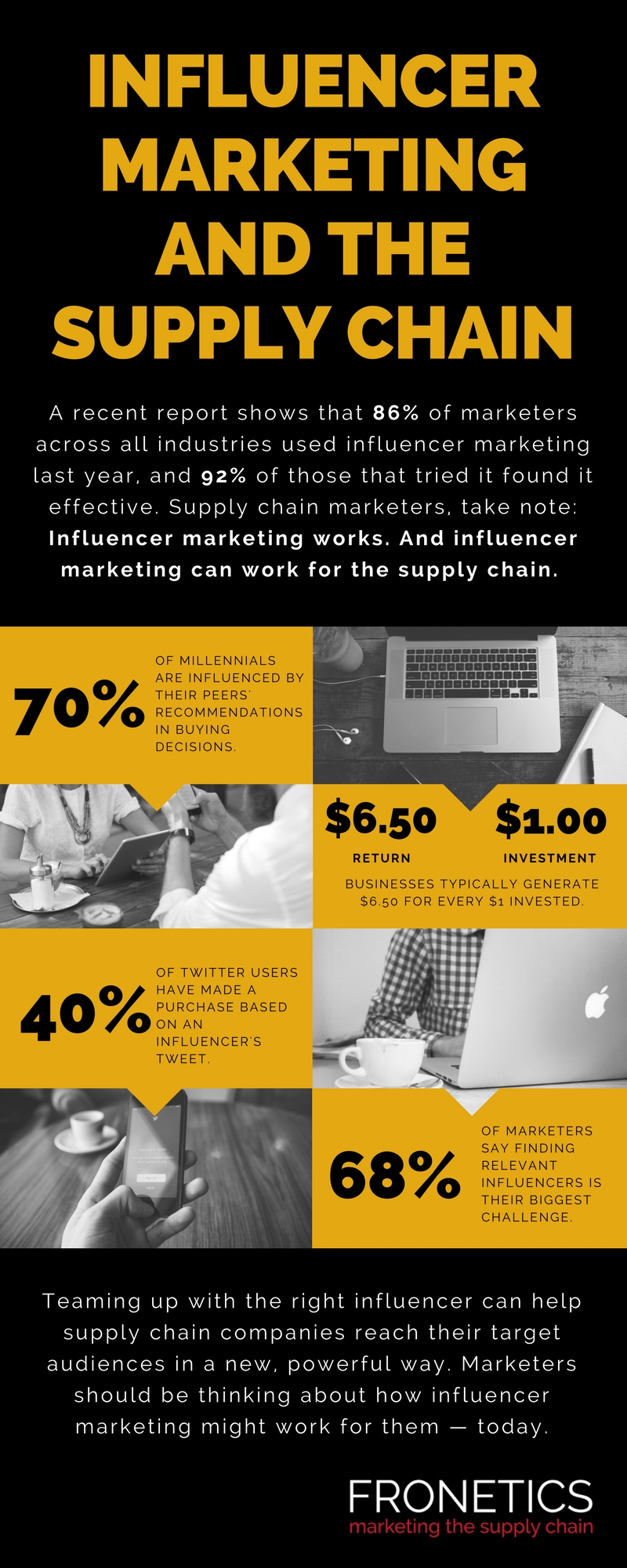
Linqia’s latest report, The State of Influencer Marketing 2018, shows that companies are already taking full advantage of this marketing trend. The report shows that 86% of marketers used influencer marketing in 2017, and 92% of marketers that tried it found it to be effective.
But don’t just take our word for it. Here are some statistics that prove you should pay close attention to this trend.
Infographic: Influencer Marketing and the Supply Chain
With 39% of marketers planning to increase influencer marketing budget this year, B2B companies are quickly seeing the leverage that influencers can have over their target audiences. By teaming up with the right influencer, marketers can easily reach thousands of potential consumers, increasing website traffic and leads.
The bottom line: influencer marketing can be an extremely effective aspect of a B2B business’ content marketing strategy.
Have you tried influencer marketing? How was your experience?
These metrics to benchmark marketing performance will give you insight into how your brand stacks up against your competition.
A few months ago, the winter Olympics were in full swing, and Mikayla Shiffrin became the youngest slalom champion in Olympic alpine skiing history. Shiffrin achieved this incredible record, not only working to beat her best personal performance, but also that of her biggest competitors. After all, you don’t become a two-time Olympic gold medalist without the knowledge — and drive — to beat out the world’s best athletes.
You have to know how your competitors are performing to be the very best at what you do. That goes for Olympic athletes and supply chain companies alike.
We call this benchmarking performance. For we marketers, it’s important, albeit difficult, to find metrics to benchmark marketing performance. We tend to turn inward to focus on key performance indicators (KPIs), like website traffic, social engagement and conversion rates. But it’s time to start looking outward, as well.
Competitive benchmarking gives brands the ability to compare themselves against a number of competitors using a set collection of metrics. These metrics allow you to benchmark marketing performance against that of your competitors. This will give you the knowledge and drive you need to improve your performance and chance of success.
Here are four metrics to benchmark marketing performance against your competitors.
4 metrics to benchmark marketing performance against your competitors
1. Content
Benchmarking your content allows you to compare the differences and similarities between you and your competitors’ types and relevancy of content. Are they focusing on video content or blog posts? Are they creating infographics? How often are they posting content?
2. Social activity
Knowing what social media platforms your competitors are using is critical in today’s digital marketing world. Are they having success on a specific platform? Are you using the same platforms? And how often are they posting on social media? How do you compare? Knowing when and where to post on social media can help get you in front of your target audience.
3. Social engagement
You’re posting and tweeting, but are audiences interacting with your content? Benchmarking your social engagement against your competitors lets you see if and how audiences are interacting with your posts and videos. How many likes and shares are you receiving? And how many are you competitors?
4. Keywords and topics
We talk a lot about the importance of keywords and topics. After all, that’s how audiences are searching for — and finding! — your brand and your competitors. Using online tools like SERPS, you can easily determine how you and your competitors rank for specific keywords and topics.
Analyze and adjust
Use these metrics to benchmark marketing performance. Once you have collected data, you can start analyzing your results. How does your marketing strategy stack up against your competitors and industry leaders?
Benchmarking allows you to see strategic opportunities — what you’re doing well and what you need to improve. You’ll gain valuable insight into what your competitors are doing better than you. Use this knowledge to improve your strategy. After all, action is key!
Which metrics to benchmark marketing performance do you use?
An important part of your content strategy should be optimizing historic blog content to ensure it’s attracting as much traffic as possible.
We all know that creating original content on a regular basis is important to improving SEO and attracting organic traffic to your website. But, here’s a surprise: Most of your traffic will come from older blog posts.
An important part of your content strategy should be optimizing historic blog content to ensure it’s attracting as much traffic as possible.
If you have a lot of content, that may scare you. (Sounds like a lot of work!) But, as with everything, being strategic about optimizing historic blog content will pay off many times over. Here’s how I suggest going about that.
Pick your posts
At Fronetics, about 80% of our traffic comes from posts that are 6 months old or older. HubSpot also discovered a similar trend: 76% of its monthly views came from old posts, as well as 92% of the company’s monthly leads!
But not all posts were created equal. In fact, HubSpot found they got about half of their monthly leads from only 30 posts, and they blog at a blistering pace of about 200 new posts every month. Going back and optimizing hundreds of your old posts is a waste of time.
Hunt through your analytics and look for historical blog posts with:
High traffic and high conversion rates: Readers view these posts often and convert frequently after reading them. Found any of these? Congrats. Most companies won’t have more than 1 or 2.
High traffic but low conversation rates: These are the posts are viewed often but don’t generate leads.
Low traffic but high conversion rates: These posts only garner a small number of hits but do well generating leads due to a higher-than-normal number of call-to-action click-throughs.
All set? Have a list of good blogs to work with? Here comes the fun part!
5 tips for optimizing historic blog content
Here are 5 tips to squeeze the absolute most out of your older blog posts (in terms of leads and conversions).
1. Update the content.
Rework it for today. Take out anything outdated and use a little finesse to make it more relevant. Don’t overhaul it; that’s unnecessary for a well-performing post.
2. Spice up the call-to-actions.
You’ll want to pay special attention to this for the posts that have high traffic but low conversion rates. CTAs have evolved. Old ones just aren’t going to appeal.
Revamp the CTA placement and appearance, and think (hard) again about your CTA content. Consider the language of the CTA and whether it fits the reader’s goal. What keyword(s) are they using to find the page? And does the CTA reflect this?
There’s so much information out there on making strong CTAs, but the bottom line is the CTA must match the intent of the audience.
Keep it bold. Keep it clear. And make ‘em an offer they can’t refuse.
3. Relook at your keywords.
For the posts that do well converting leads but don’t get a lot of traffic, you’ll need to take a fresh look at keywords.
Trying to rank for certain keywords in each blog post you publish is a practice on the way out. But it still has merit here, as long as you understand it within the larger picture of restructuring your website content into topic clusters and pillar content.
And here’s the beauty of optimizing historical blog content: You already have the data to know which keywords your audience are using to find the posts. Then prominently feature the keyword(s) in several places.
If you’ve done the hard work to update the CTA and the keywords, updating the meta description is a natural next step. Keep it as close to (but not over) 155-165 characters. Include your keyword(s). Explain the value of the post to the reader. And keep in mind your ultimate CTA goal. Everything should align to make the meta description a true synthesis of the post; if it doesn’t, go back and tweak a little more.
5. Republish and keep the URL.
Things that are “fresh” receive preferential treatment from Google. (We know it’s hard to believe when 2012 articles are at the top of your search results, but it’s true.)
But do not lose that original URL when you publish again. It pulls way more SEO “rank” than a new one. Keep the URL even if you updated the title of the post and the URL doesn’t match perfectly anymore. It’s OK.
(It’s not a bad idea to put in an editor’s note at the end of the article if the blog already has garnered comments, so your future audience won’t be confused by a publish date that is later than the date on the comments.)
And that’s it. 30 days after optimizing your historic blog content, go back and see how successful your efforts were. Track the metrics: post views, CTA click-throughs, lead generation, and keyword ranking. We’re betting they’ve gone up.
Measuring the success of your SEO strategy shouldn’t be done by measuring the success of one post at a time. But making the most of your best old posts is an important part of any good content marketing strategy.
Final tip
The final tip isn’t really about optimizing historic blog content, so let’s call it a ½ tip. Remember how Tip 1 recommended reworking the old posts but warned against overhauling them with large rewrites?
Well… Here’s the thing. If you have 12 historic blog posts you just optimized, you should write 12 new blog posts on that same content, too.
Recycle that good historic content into additional fresh content. After all, it’s what your audience is searching for!
In fact, more people are using email than ever before (close to 3.8 billion worldwide). Fronetics works with supply chain and logistics businesses every day, so we have a first-hand understanding of how email marketing can be successful in these industries.
That being said, it’s true that email is changing. Marketers need to be on top of these latest changes to keep pace and stay relevant. Here are 5 email marketing trends supply chain and logistics marketers should be ready for in 2018.
5 email marketing trends
1) Interactive emails
According to a recent survey by Litmus, more than 27% of marketers believe interactive emails make a big impact in email marketing. Making your emails engaging to read will reduce bounce rates and capture your target audience’s attention span for longer. A few ideas to make your content interactive: image galleries, sliders, buttons, quizzes, search bars, surveys, and, of course, an “Add to Cart” button.
2) List segmentation
If you’re not segmenting your email lists, you’re shortchanging your email marketing campaigns. MailChimp found that businesses who use list segmentation generate more than 14% more email opens and get 100.95% more clicks from email campaigns.
Effective email list segmentation is about collecting adequate data to create and target optimal email content based on audience preferences. A simple way to collect this type of data: email opt-in forms that collect more information than simply name and email.
3) Artificial intelligence
Artificial intelligence and machine-learning technologies will shape the future of email marketing. For example, Adobe has invested in AI-powered marketing, including features with the ability to suggest the best subject line for an email based on what it has learned about users. Machine learning can make email marketing easier, suggesting ways to segment email lists, send more personalized emails to key individuals, and generate product recommendations.
4) Plain-text emails
This one may seem counter-intuitive. While high-quality email design filled with images used to be a trend, marketers are increasingly finding that plain-text emails are more effective. This is largely because plain-text renders the same across all devices, and it has the added benefit of seeming more personal.
5) The rise of mobile-first
It’s not news that most emails are now opened on mobile devices. This means that it makes sense to start designing emails mobile-first. In addition, email subscription forms will start becoming more mobile-friendly, and content, such as articles and blog posts, should end with an email sign-up form to increase conversions.
What email marketing trends are you paying attention to?
Focus on what you do best — and save time and money — by parceling off these 6 marketing tasks to outsource.
If you’re anything like me, you’re busy — not-enough-hours-in-the-day busy. We find that supply chain and logistics marketers are some of the most overworked professionals in the industry. One person (or a very small team) is often responsible for all marketing and sales efforts for an organization. So I want to let you in on a little secret: Outsourcing is your solution to being too busy.
Outsourcing marketing tasks allows you to focus on insourcing your core competencies. In other words, you can start focusing on what you do best and delegate specified tasks to external experts.
The content marketing landscape is constantly changing. There are more and more marketing tasks to cover: social media, videos, blogs, emails, etc. How can you truly focus your attention on any one area when you have so many balls in the air?
Don’t work harder. Work smarter.
Outsourcing marketing gives you the opportunity to remove some of the time-consuming and laborious tasks from your desk, so you can get back to the core of your marketing efforts.
That doesn’t mean you have to outsource all your marketing tasks, or even half of them. Choosing several areas beyond your staff’s expertise, or tasks that are particularly tedious, can help you improve your marketing efforts and take stress off an overworked internal team.
Here are six areas you should consider outsourcing.
Video: 6 marketing tasks to outsource
Final thoughts
Finding the right partner is key when you choose to outsource marketing tasks. You have to trust the people to whom you are delegating tasks, so that you know the work is getting done the way you want while you focus your attention on other tasks.
The right partner will work with you to develop a strategy that closely aligns with your business goals. Your partner can even execute the strategy for you and provide regular updates on how it’s working. This kind of results-driven approach will ensure you’re stretching your marketing dollars to the fullest extent and getting the kind of results that will grow your bottom line.