by Elizabeth Hines | Dec 18, 2018 | Blog, Content Marketing, Logistics, Marketing, Supply Chain
Aligning sales and marketing can help achieve big-picture goals. Here are the top five sales and marketing posts of 2018 that highlight how these two teams can work together.
The sales process is often a complicated journey that includes uphill climbs and unexpected roadblocks. Sales teams are all too familiar with these obstacles, but they don’t have to fight these battles alone.
Arm a sales rep with targeted content to share with prospects during specific moments in the purchasing process, and it will build his or her reputation as a knowledgeable resource. That can be the key to getting a foot in the door, advancing through the final stages of a purchasers’ decision, or closing the deal.
Strong communication between sales and marketing can help create better content and nurture leads. Here are our top five sales and marketing posts of 2018.
Top 5 sales and marketing posts 2018
1. Infographic: the B2B Buyer’s Journey
Technology has completely changed the B2B buyer’s journey. The vast amount of information available on the internet has afforded buyers a level of self-sufficiency that renders traditional sales models ineffective. Marketers must leverage the latest trends and technologies to boost their content marketing efforts and turn leads into sales. Here are nine factors affecting today’s B2B buying journey. Read full post
2. Infographic: How Digital Natives are Changing B2B Purchasing
Long gone are the days of men and women sitting around a conference table listening to a sales pitch over a free lunch. Today’s B2B buyers are younger, more technologically savvy, and more independent — they’re a generation of digital natives. And they’re making waves across the B2B buying landscape and changing how marketers must work to reach new customers. Here’s what you need to know about the new B2B buyer. Read full post
3. The 3 Most Important Sources of Information for B2B Buyers
From a content marketing perspective, knowing where your buyers get their information is critical to an effective strategy. So what are most important sources of information for today’s B2B buyers? 20 years ago, you might have named things like product info sheets or sales reps. But not anymore. Read full post
4. 3 Dangers of Sales and Marketing Misalignment
Too often, B2B companies fall victim to the dangers of sales and marketing misalignment, often without even being aware that it’s an issue. Such misalignment can have serious motivational and financial consequences. These are the major dangers of sales and marketing misalignment compared to what can happen when things go right. Read full post
5. Infographic: Delivering Content Throughout the Buyer’s Journey to Help Your Sales Team Close Deals
If you’re a supply chain marketing professional, it’s likely that you spend a tremendous portion of your day researching, creating, packaging, and disseminating content. It’s time to start leveraging your it throughout the buyer’s journey by arming your sales force with content. Before you panic at the idea of creating reams of new content, take a breath. It’s more than likely that you can repurpose your existing content, optimized to give your sales force the tools they need to close deals.Read full post
Related posts:


by Elizabeth Hines | Dec 4, 2018 | Blog, Content Marketing, Logistics, Marketing, Strategy, Supply Chain
Repurposing content is an efficient way to reach a broader audience and build brand awareness.
You spent hours pouring over stats and interesting facts for a blog post. Don’t let all of that effort fall to the wayside. Breathe new life — and reach new audiences — by repurposing that content into engaging new formats.
Some social users like video, while others prefer pictures or podcasts. Taking content and changing its original format is just smart business. Repurposing high-quality content saves marketers time and money and helps to reach a broader audience.
Be picky
Not all of your blog posts and content get the same attention, and that’s ok. Some pieces will resonate more, increasing engagement and driving website traffic.
Run analytics on your content and see what pieces have performed the best. Use tools like Google Analytics to determine your most popular blog posts, your most engaged tweets, or your most viewed videos. This data will help you decide which content should be repurposed. The idea is to take one piece of content and gain visibility and expand your audience by turning it into multiple pieces of content.
The Rule of 7
Repurposing content isn’t just about cutting and pasting content. Have you heard of the Rule of 7? The Rule of 7 is a marketing principle that states your prospects need to encounter your content seven times before they take notice. That’s right, seven times.
[bctt tweet=”The Rule of 7 is a marketing principle that states your prospects need to encounter your content seven times before they take notice. That’s right, seven times.” username=”Fronetics”]
Repurposing content is a great way to take high-quality content and continue to get it in front of audiences without seeming redundant. HubSpot reports that brands who blog around 16 times or more per month get 3.5 times more traffic and 4.5 times more leads than businesses that blog fewer than four times a month. Frequency clearly gets results, but it can also be incredibly time-consuming to create new content 16 times every month. Repurposed content can help your marketing team increase frequency while focusing on quality.
Infographic: 6 ways to repurpose content
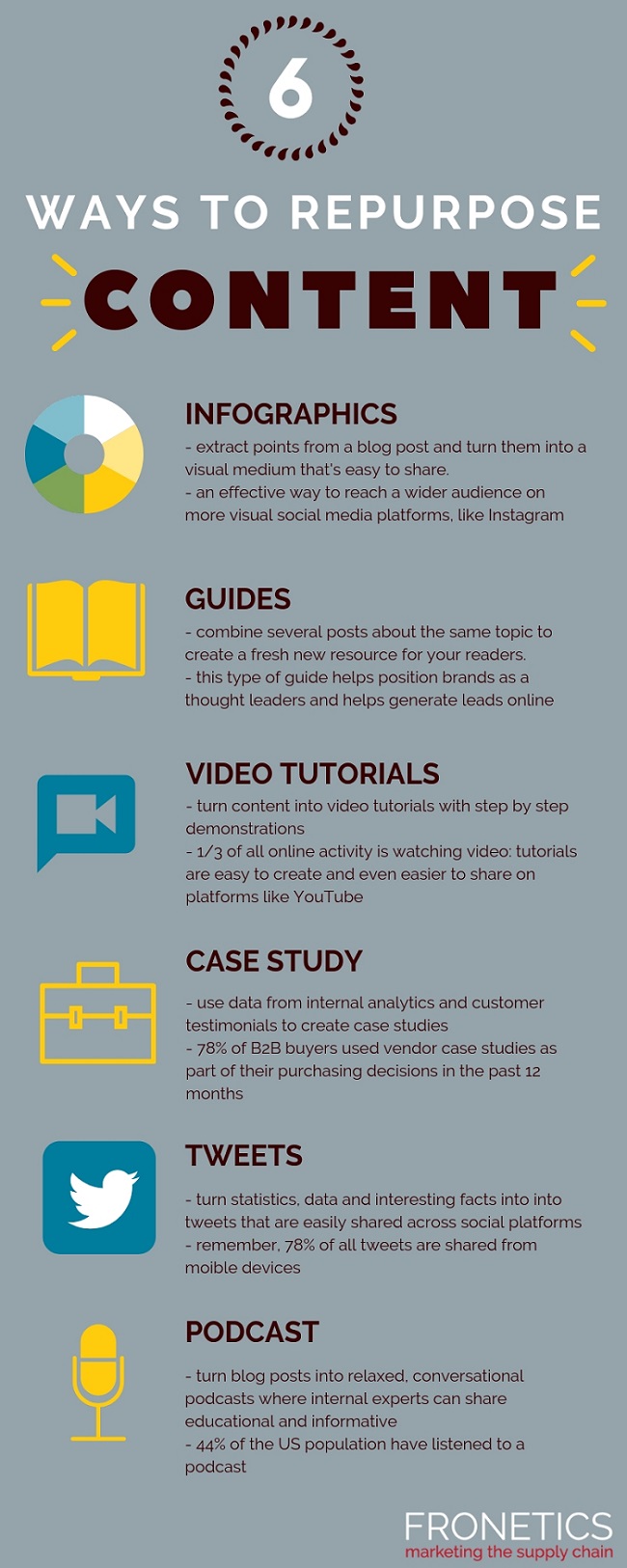
(Made with Canva)
Takeaway
How much value does your company put on content? It may be even more important than you think. Use these tips to repurpose high-quality content or yet better, start creating content with these tips in mind. Thinking about a topic and how you can turn that topic into multiple pieces of content will help your hard work go further and perform better.
Related posts:


by Elizabeth Hines | Nov 26, 2018 | Blog, Content Marketing, Current Events, Logistics, Marketing, Social Media, Supply Chain
Here’s how content can help support sales during the seven stages of the sales cycle, including personalization and building last relationships.
The sales process is often an uphill journey with lots of unexpected bumps along the way. Sales teams are all too familiar with these obstacles, but they don’t have to face these challenges alone.
Arm your sales rep with content to educate prospects during specific points in the purchasing process, and it will build his or her reputation as a knowledge source. That can be the difference in getting a foot in the door, advancing through the final stages of a purchasers’ decision, or closing a deal.
Strong communication between sales and marketing can help achieve big-picture goals when it comes to creating content. These teams can work together to create a better understanding of the buyer’s journey, make updates on buyers insights, and brainstorm solutions to bottlenecks in the sales funnel.
You need to take a close look at your sales process and be strategic about the times when content would be helpful — as well as the types of content that will successfully assist sales reps in educating and informing prospects. Here’s how content can support sales in each of the 7 stages in the sales cycle:
Video: 7 Stages in the Sales Cycle Content Can Help
Takeaway
Don’t forget how important it is for sales teams to be armed with informative, relevant content to support the sales cycle. It’s not enough to just produce content, sales teams need to be ready to provide this content to potential customers at every point of contact.
Want help identifying what content your supply chain and logistics company can provide to your sales team? Let us help.
Related posts:


by Elizabeth Hines | Nov 15, 2018 | Blog, Content Marketing, Logistics, Marketing, Social Media, Supply Chain
The popularity of video marketing is on the rise, and savvy supply chain marketers are using this medium to tell their brand’s story, broaden their audience, and generate leads.
Video is the most popular form of content being consumed online today — and it shows no sign of slowing down. Smart supply chain marketers are developing a visual storytelling strategy that offers consistent delivery of valuable content.
Wyzowl’s The State of Video Marketing in 2018 provides a lot of data and an excellent overview of video marketing. Read on for our key takeaways.
Video usage is continuing to grow
Not only are more and more businesses using video as a marketing tool, and planning to continue to do so, but a majority of businesses that don’t use video plan to start doing so this year. This means that supply chain marketing will continue to expand in this more visual direction. Marketers should adjust their strategies to favor content that lends itself to this kind of storytelling.
Of course, it doesn’t take a survey to know that video is taking over the way we consume content. If you use the internet, you’re bound to have seen the significant uptick in video content over the past three years. This medium is now a central part of how we live, and it’s not going anywhere.
When it comes to user experience, video adds a tremendous amount of value. In fact, when both video and text are available on the same page, Wyzowl found that 72 percent of people reported that they would rather use video to learn about a product or service.
What does this mean for your marketing strategy? The obvious answer is use more video content. Consider accompanying data-heavy blog posts with explanatory animated videos, conducting and sharing video interviews with executives or industry leaders, or turning a case-study into an animated video presentation.
Sharing is everything
Creating compelling video is only half the battle — the next step is making sure it gets to the widest possible segment of your audience. You might think that it’s just cat videos that get shared on social media, but according to Wyzowl, “if you create video content that your specific audience enjoys, 83 percent of consumers would consider sharing it with their friends.”
So, what makes content share-worthy? There aren’t really any gimmicks here. What you need is quality, well-researched content that visually engages viewers. At Fronetics, we’ve written extensively about video marketing. Here are a few posts that may interest you if you’re curious about how video can fit into your content strategy.

by Elizabeth Hines | Nov 13, 2018 | Blog, Content Marketing, Data/Analytics, Logistics, Marketing, Strategy, Supply Chain
The results are in: Artificial intelligence (AI) has significant value for many business sectors. But what are the most effective ways to apply AI to your supply chain management company?
Executives of many leading companies are looking for ways to integrate AI into their operations. A recent McKinsey & Co. study estimates that 40% of the potential value associated with data analytics today comes from techniques called “deep learning.” Deep learning refers to AI that can monitor a system and make adjustments rather than simply repeate a single task. Industry use of deep learning techniques remains relatively low as companies determine how best to use AI to meet business needs.
Supply chain management is one of the business sectors that can get the most value out of deep learning techniques. Brick-and-mortar retailers tend to see a 1-2% increase in sales revenue when they use AI to personalize promotions based on customer data analytics. Supply chain management organizations can expect to see greater benefit from AI that forecasts demand by analyzing the underlying market factors. Using AI this way can improve forecasting accuracy by 10-20%, allowing companies to reduce inventory costs by as much as 5% and generate 2-3% increased revenue.
In addition to reducing inventory costs in supply chain management organizations, deep learning can create trillions of dollars in value in marketing and sales revenue and save costs through predictive maintenance. The best way to determine how AI can serve your needs is to look at how your organization uses traditional analytics techniques: AI can often provide higher performance in conducting analytics and introduce additional layers of analysis. The technology is always improving, so the potential value for companies adopting deep learning techniques is expected to continue to rise.
There are, however, obstacles facing companies looking for ways to use AI techniques. It is essential to plan for the security and privacy issues of data analytics. Deep learning works best with large-scale datasets, which not all organizations can assemble or access. The level of expertise necessary to implement and service AI technology comes with added expenses, but determining the right way to apply AI to your organization makes these costs and challenges a rewarding investment.
Related posts: