by Elizabeth Hines | Mar 31, 2016 | Blog, Content Marketing, Marketing, Social Media, Supply Chain
Employ a content and social marketing strategy to nurture leads you meet during MODEX.
Hundreds of potential customers will be heading to Atlanta next week for MODEX, and you’re gearing up to gain lots of new business. That is, you and over 800 other exhibitors are hoping to gain lots of new business. So how do you plan to stand out among the competition?
Using content and social marketing to nurture leads surrounding the event will help maximize the benefits of attendance. You can bring more attention to your presence, which will help you find more new potential customers, and then you can increase your chances of converting them if you use these tools properly.
Here are some tips for before, during, and after MODEX for using content and social media to gain new business.
Before the show
1) Define your goals.
A trade show represents an opportunity to spread brand awareness, find new leads, and, of course, make sales. Decide what is most important to your business, and strategize around those goals. For example, if one of your goals is to increase your social following, make sure every handout, landing page, and face-to-face interaction includes a request to like you on Facebook (or elsewhere).
2) Promote your attendance.
With the trade show hashtag (#MODEX2016), use Facebook, Twitter, and LinkedIn to let your followers know that you will be attending and when and where they can find you. Engage with other attendees who are using the event hashtag. Offer teasers — such as photos of the freebies you’re bringing — to entice visitors, and provide any longer-form information (e.g., an excerpt from a presentation you’ll be giving) in a blog post, distributing it through your social channels.
3) Set up a landing page/landing pages.
Create an event-specific landing page that includes a call to action (CTA), like reserving a time to speak with you at the conference or downloading a coupon to redeem a free sample. Make sure to ask for some information (such as a name, company, or contact information) in exchange. Monitor traffic and keep a running list of leads who visit and provide their information.
4) Research the attendees.
Perform prospect research using the list of attendees, paying special attention to those who have provided their information on your landing page or connected with you on social media about the event. Check out their social pages to see what they’re saying about the event, and like or follow them. Connect with high-value prospects on LinkedIn and try to arrange a time to meet up during the show.
5) Prepare to nurture.
Draft content that you can distribute during and after the show. Examples include lead-nurturing email templates, slides from presentations you are giving, and other offers you plan to provide visitors. Create another landing page, which includes a special offer or specific information you’ll be providing during the show, to drive attendees to during and after the event.
During the show
6) Keep chatting.
Reach out to the people you meet during the show on their social media handles. A nice-to-meet-you tweet and/or an invitation to connect on LinkedIn shows that you remember and appreciate the potential customer. Send the lead-nurturing emails you prepared in advance.
7) Monitor social media.
Continue using the show’s hashtag to monitor the conversations that are happening online, and see if anyone is talking about your company. Like or reply to anyone who does to show you’re listening.
8) Generate content.
Trade shows are a great place to generate content. Post photos of your booth and attendees from your company, and create videos of product demonstrations, presentations, or customer testimonials. Share your thoughts on the issues being discussed, and keep track of those themes, as well as any recurring questions that attendees ask, for future content.
After the show
9) Plan out your editorial calendar.
Develop posts for your company’s blog over the coming months around the questions and issues that were raised during the show.
10) Keep up the conversations.
Continue to engage the people you met on Facebook, Twitter, and LinkedIn. Follow and like their pages, and invite them to connect.
11) Offer your leads something of value.
Make event presentation or speaking materials part of your lead nurturing activities by sharing them with prospects using Slideshare or email. Remind leads with whom you shared your special-offer landing page to visit. Make sure to segment your contacts based on their interests and send them only relevant offers.
How do you nurture leads around trade shows? Will you be attending MODEX this year?
Related posts:
by Elizabeth Hines | Mar 28, 2016 | Blog, Marketing, Social Media
 A recent collection of social media facts and stats offers an interesting look at B2B company and buyer behavior.
Last month, Webbiquity published a list of 49 social media facts and stats about user behavior on Facebook, Twitter, LinkedIn, Pinterest, Instagram, and Google+. These figures, collected from various studies, offer insight into how people and businesses are using social networking in recent times.
B2B companies may find several of the stats particularly interesting, and it may influence the way they think about social media marketing. I have pulled out some of the most applicable and offered some thoughts below.
Social media facts and stats from Webbiquity
88% of B2B companies use Facebook for marketing (and 96% of all B2C companies )
If you are not using Facebook in your marketing efforts, you are in a quickly growing minority. With 968 million active daily users, the largest social networking site offers a huge opportunity — actually, the most expansive opportunity available — for your business to attract, court, and convert potential customers. Here are some of our top tips for using Facebook to market your business.
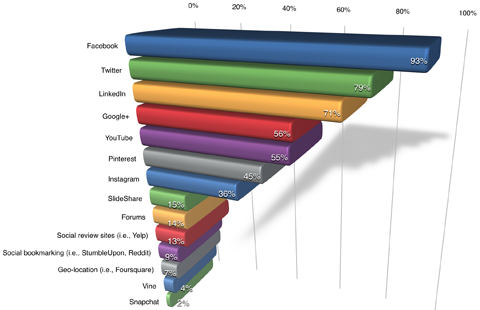
93% of small business owners and marketers use Facebook.
Small businesses don’t have the time or budget to compete with large brands when it comes to marketing — but social media can level the playing field. Social media, and Facebook especially, is an ideal marketing platform for small businesses because it can be relatively inexpensive but have a high impact on growth. Your company can cultivate your brand, engage with customers, and form business relationships. Learn how two small companies saw enormous growth thanks to social media.
21% of consumers say they unfollow brands that post repetitive or boring content. 19% say they would unfollow a brand on Facebook if the brand posted too often — more than six times a day.
We know that creating good, original content is key to a successful inbound marketing strategy. But knowing how often to post to the various social channels can be one of the more intimidating obstacles to overcome. How do you know what’s too much and what’s too little? Learn how often you should post on social media.
74% B2B decision makers use LinkedIn to help make purchasing decisions.
Don’t let anyone convince you that social media channels are for personal use only: customers are online, and if you aren’t, you’re at a disadvantage. And since nearly three-quarters use LinkedIn for purchasing decisions, it’s critical that your business is strategic about your presence on the network. Check out this guide for creating the perfect LinkedIn company page to get started.
88% of B2B marketers in North America use Twitter for content distribution.
Twitter is one of the more effective channels for gaining business, and the numbers prove it. A Market Probe International survey found that 72% of those who follow a business on Twitter are more likely to make a purchase from that business, and that 82% of followers are more likely to recommend a product or service to friends and family. Additionally, 85% of respondents reported feeling a closer connection to a small business if they follow them on Twitter. Learn more about Twitter for business.
Pinterest has 47 million active monthly users worldwide, 80% of whom are women.
While Pinterest use is rapidly growing among B2C marketers, the B2B world still hasn’t quite figured it out yet. I pulled out the two above stats to show the enormous potential this channel has, particularly for businesses whose customer base is primarily women. Fronetics’ social prospecting workbook has some ideas on how to get started using Pinterest.
32% of U.S. companies with 100+ employees used Instagram for marketing activities in 2015. eMarketer predicts that number will jump to 70.7% by 2017.
The importance of Instagram for B2B companies will continue to grow. Here’s why: 90% of Instagram users are under age 35. A recent Google study showed an increasing number of Millennials on the B2B purchasing path — up to 46% of potential buyers were of this generation in 2014. Their preferences and behaviors are having a noticeable impact on B2B buyer behavior as a whole. So if your business wants to capitalize on the nearly 300 million active monthly users, Instagram should be on your radar.
64% of North American B2B marketers use Google+ to distribute content, but just 17% use it for new product launches (vs. 81% who use LinkedIn).
Americans may use Google+ less frequently than some of the other networks, but don’t count it out entirely. More people check the site than people realize, including die-hard fans of Google products and the many businesses who use the Google suite professionally.
Related links:

by Elizabeth Hines | Mar 24, 2016 | Blog, Marketing, Social Media, Supply Chain
These four supply chain companies constantly post fresh, quality content to their social media accounts.
When it excels at social media, a company’s opportunity for growth is as vast as the web itself. Today, even small businesses can compete shoulder to shoulder with their biggest competitors if leveraging social media properly.
It is estimated that for every 5 minutes people spend online, 1 minute of that is spent on some kind of social media network. And most of your customers are on social media — statistics indicate that more than 79% of adults in the U.S. use social media each day. As the popularity of sites like Facebook, Twitter, Instagram, and company blogs continues to grow, it is vital to utilize these tools to your own marketing advantage.
When you think of social media masters, you may not think of companies in the supply chain industry. But there are a few excellent examples, and much can be learned from what they do. Here are four supply chain companies that excel at social media and the reasons why they stand out above the crowd:
1) Cerasis
Cerasis, a top freight logistics company and truckload freight broker, excels at social media because their content is fresh, posted daily, and of high quality. Simply put, they create engaging, informative content and are consistently active across all of the major social networks.
2) Kinaxis
Kinaxis, a global company offering advanced supply chain management systems to customers in a variety of discrete manufacturing industries, offers in-depth blog posts and is consistently active in social media channels such as Twitter, Google+, and LinkedIn.
3) Transplace
Transplace, a provider of transportation management services, posts informative articles and incites topics of conversation on Twitter several times per day. The company is active across all social media platforms, including their own YouTube channel.
4) UPS Longitudes
Longitudes is a blog with insights on the trends reshaping the global economy by United Parcel Service, a global leader in shipping. The blog also engages true thought leaders on topics ranging from trade to transportation and ecommerce to emerging markets. Posts are consistently new, innovative, and informative. Longitudes also has its own social media accounts, separate from UPS’s primary accounts, which distribute the blog’s content and engage in related discussions.
Why do these four supply chain companies excel at social media? Here are three commonalities that help these businesses rise above the rest:
Consistent daily posts and content
Having consistent, reliable, fresh social media posts is essential. The more active you are, the greater your outreach to potential new customers.
Think of it this way: search engines pick up on social media activities — like when someone shares content from your website on Twitter or Facebook, for example. Search engines use this to weigh the relevancy and validity of your website and your company. So, fresh daily or weekly content gives people a chance to read and share every time you publish a blog post, ebook, buying guide, case study, testimonial, and other interesting content to your social media accounts. Your marketing efforts reap the benefits of better search engine rankings as a result.
Engaging readers
You want readers to connect and engage with your social media posts. Every time they leave a comment or share or like a post, your social media presence — and your digital footprint — grows.
Quality content
Posting anything just for the sake of posting is not a good social media strategy. Content that is boring and basic will not help your business grow. Content needs to capture the interest of readers and engage them to read, share, and follow your business. Posts should be timely and relevant. This is what builds your following and your brand and generates new customers.
With social media you can find new customers and fans, connect with existing customers who can help spread the word about how great your product or service is, and drive more traffic to your website, which creates new avenues into the digital realm of marketing, company branding, and lead generation. The most successful companies today work daily to improve their social media content and reap the benefits of consistent, quality content marketing.
Related posts:

by Elizabeth Hines | Mar 16, 2016 | Blog, Leadership, Strategy, Supply Chain
Men hold 85% of all executive officer positions within Fortune 500 companies, despite research that consistently shows when women are in positions of leadership, companies perform better. In the supply chain industry, 20% to 30% of positions are held by women, but the dearth of women in the C-suite is astounding; just 5% of top-level supply chain positions within Fortune 500 companies are held by women.
As I have written about previously, the lack of gender diversity in the supply chain is not because women do not have the skillset and ability to succeed within the industry:
“Women are as capable as men when it comes to working within the supply chain industry. Indeed, it has been put forth that women are better suited for roles in supply chain management than men. Research conducted by SCM World found that the majority of men (63%) and women (75%) believe that the natural skillsets of women differ from those of men and that these differences are advantageous for supply chain management.”
Last year I was fortunate enough to interview Cathy Morris, senior vice president and chief strategy officer at Arrow Electronics, and Mickey North Rizza, vice president of strategic services at BravoSolution, about women in the supply chain. Morris was twice named one of the “Top 50 Most Powerful Women in Technology,” and North Rizza was named a “Top Female Supply Chain Executive.” Both Morris and North Rizza shared how they got started in the industry, and the steps they took to get to where they are today. They also shared their desire to increase diversity in the supply chain.
As a woman working within the supply chain industry, I believe that it is important to discuss the lack of gender diversity and point to research highlighting why the industry needs to increase the number of women in all positions, including the C-suite. Additionally, it is just as important to highlight the incredible women who already are working within the industry.
This year I’m turning my focus to showcase the work that these trailblazing women are doing. I spoke with Kendrea Durr-Smith, director of global trade compliance at Arrow Electronics, Kelli Saunders, President of Morai Logistics, Hailey McKeefry, editor and chief at EBN, and Barbara Jorgensen, co-founder and managing editor, EPS News. I also invited Tania Seary, founder of Procurious, to share what is happening at her company, and Jennifer Cortez, director of marketing and communications at Transplace, to discuss the role of quality content within the industry. These interviews and stories will be shared over the next couple weeks.
As I share the work of even more women in the future, I look forward to continuing a dialogue that will hopefully facilitate welcoming more women to the industry.

by Elizabeth Hines | Mar 8, 2016 | Blog, Marketing, Social Media, Strategy
Social prospecting helps you identify potential customers outside your established audience using social platforms.
Social media should be an integral part of your marketing strategy — we know it helps build brand reputation, gather market intelligence, discover customer problems, and influence purchasing decisions. But your lead generation efforts should also include the use of social platforms. It’s a practice called social prospecting that can be highly effective in identifying new prospects.
You’ll use your existing social handles to identify and pursue potential customers that may be interested in your business but that don’t yet know about it. HubSpot describes social prospecting: “It’s about scouring the social web, identifying potential prospects, and engaging them through content to get them to your site and move them through your funnel.”
Why does it work?
Think about the size of your established audience. Now think about the total number of active users on social media: As of the fourth quarter of 2015, Facebook had 1.59 billion active monthly users, Twitter averaged at 305 million, LinkedIn had 414 million, Google+ had 111 million, and Pinterest had more than 100 million. Those enormous numbers equal enormous potential for your business.
That’s because social media isn’t just for recreational purposes anymore. More than half (53%) of B2B buyers report using social media to research purchases, in fact. Social prospecting allows you to be proactive in finding all of the considerable number of social-media-using prospects who are looking for you, too.
How do you get started?
If you already have a social media presence, that’s step one. It gets a little more complicated from there.
Fronetics has developed a free social prospecting workbook to learn how to use social listening to generate new leads for your business. We’ve identified the quickest way to find potential customers on Twitter, Facebook, LinkedIn, Pinterest, and Google+. Every worksheet includes:
- Short preparatory work to make the actual prospecting easy
- Visual instructions on how and where to find prospects
- Pro tips that will help you get the best results
- Prescriptions (Marketing Rx) for success
- Take-home exercises for follow-up prospecting

Happy prospecting!
Related articles: