by Elizabeth Hines | Jun 2, 2016 | Blog, Content Marketing, Marketing
As the prevalence of smartphones increases, businesses must consider how their emails appear on mobile devices.
You may have created a marketing email masterpiece, but how will it look when someone reads it on a cell phone? This is a very real concern, considering that 56% of email opens occur on mobile devices.
The ubiquity of smartphones has changed our relationship with email. The 72% of American adults who own smartphones are checking email much more frequently throughout the day. This equates to better chances for your brilliant marketing email to be seen and read.
But, the caveat is that your email, which is typically designed to be read on a laptop or desktop computer, must be easy to read on any device. If you send a marketing email that is not optimized for mobile, more than half of your recipients are straining and struggling to read your content. You’ve given them a good reason to delete it instead of reading it.
Here are a few tips for optimizing emails for mobile:
Keep it short and sweet.
Your message should be well articulated but simple. Keep paragraphs short and concise, and put all of the most relevant facts first.
Don’t picture this.
When it comes to images, less is more. Android devices automatically block images unless the user changes their settings. And for those who do see your image, it’s rarely optimized for their specific phone, since shapes and sizes of mobile screens vary. It becomes work for your reader to try to shrink or enlarge the image to see the whole message. Also note that when you embed large image files, they may take an excessively long time to load.
Hello. It’s me.
Be very concise with your “subject” and “from” lines, which are super-condensed on cell phones. For example, an iPhone (held vertically) only displays the first 25-30 characters of a subject line. Often, sender’s name is boldfaced and the first thing the reader sees. Make it easily recognizable!
Responsive: your new best friend.
Choose a “responsive” template, which will automatically fit an email to the screen on which it’s being viewed. This assures you that your marketing email will look the way you intended, whether it is viewed on a smartphone, tablet, laptop, or desktop computer. WordPress has pre-built themes that incorporate responsive design elements. Unfortunately, there’s no simple plugin to make a non-responsive template responsive.
Button up.
Avoid adding links. Use a button instead for your call-to-action. Make sure to set plenty of space around it, so it is easy to click without accidentally clicking something else. Buttons essentially prove to be much easier for people to click on when using a touchscreen.
Keep in mind: With 98.4% of the market share today, Android and iOS are the operating systems your emails typically will be viewed on.
To remain competitive, your marketing email designs must be optimized for mobile to remain consistent across multiple devices. It is wise to test how your emails look on different devices to see how they appear on each screen. But most importantly, choose a template that is responsive, and make these five tips a regular part of your email marketing strategy.
Related posts:

by Elizabeth Hines | May 9, 2016 | Blog, Marketing, Social Media, Strategy
A cross-departmental social media team will improve your company’s social presence.
At a former job, I was part of a team pushing for expanding access to our company’s social media pages. The accounts were administered by a handful of marketing managers, who did not want to relinquish control. After all, weren’t we using social media for marketing purposes? Why would the content or sales teams need access? Wouldn’t that cause chaos and anarchy?
No. In fact, giving access to key people in various departments could actually help your company get more out of social media.
The truth is, social media is too integral to too many different aspects of a business to control it in a silo. The title of a recent Harvard Business Review article says it all: “Social Media Is Too Important to Be Left to the Marketing Department.”
Businesses can use social media for everything from generating leads to gaining market intelligence. And today’s customers expect a brand’s social media accounts to answer all sorts of different needs, from product inquiries to problems with their orders. If only one team is responsible for operating your pages, they need to be able to perform multiple functions, to liaise effectively between customers and internal stakeholders, or to forego some of the valuable benefits of social media.
For example, say your customer does not receive part of a shipment and posts on your Facebook feed to say as much. The marketing person managing your social media either has to 1) also be trained in customer service, 2) reach out to someone on your customer service team (or someone who can locate the shipment) and act as a go-between with the customer, 3) ask the customer to contact someone else in your company, or 4) ignore the post. Any way you slice it, it’s not efficient or a good use of anyone’s time.
That scenario is more common than you might think. Research shows that the number of customers who expect a response through social media has doubled in the last three years, and that seven of eight messages to companies go unanswered for 72 hours. Imagine if your customer service department didn’t respond to emails or pick up the phone for three days!
My former company suffered enormously from problems like these. The marketing managers administering our social accounts were spending hours each week tracking down various employees in other departments to help them problem-solve. They didn’t have time to strategize about content distribution. And even the best communicators were so overloaded with other tasks that leads were going cold before being handed to the sales teams.
If each department identified an employee responsible for overseeing social media, we could have functioned so much more efficiently and effectively. The marketing manager would be responsible for marketing messaging; the content person for generating and distributing content; the sales team for identifying leads and building relationships; and customer service for handling customer inquiries and problems.
Of course, having that many cooks in the kitchen is not without its problems. Keith Quesenberry, the author of the aforementioned HBR article, offers this advice for building a cross-functional social media team from his book Social Media Strategy, Marketing, and Advertising in the Consumer Revolution:
- Develop a social care team that can address all areas of social information efficiently and effectively. Identify policies and software systems needed for implementation.
- Organize departmental responsibilities in the social care team. Clearly define roles and responsibilities among marketing, customer service, public relations, sales, corporate communication, human resources, etc.
- Assign specific employees from each department to social media tasks. Set up social media accounts and give employees access to social media systems.
- Create brand guidelines for standards, tone, and style of social media communication. Ask legal and human resources to provide a list of do’s and don’ts for real-time consumer engagement.
- Define specific goals based on key performance indicators such as response time, sentiment analysis, engagement, views and shares, and other important metrics.
With the right planning and people in place, a cross-departmental social media team is better suited to interact with customers and business partners on these platforms, and it can help your business get the most out of its social media accounts.
Related posts:

by Elizabeth Hines | Apr 28, 2016 | Blog, Marketing, Social Media, Strategy

In today’s digital world, it is amazing that many businesses, particularly those in the supply chain and logistic industries, are still questioning whether they should be on social media. The simple answer is yes — social media channels are the ideal place to brand, market, and grow your business.
Here are five reasons why your company should be on social media.
1. Lead generation.
Sales teams can also use social media as a lead-generation tool. Social media takes the old marketing billboard and makes it a conversation, which is a huge benefit to businesses who use it well.
2. Trust and thought leadership.
Though the results are not instant, the amount of time and marketing dollars you spend on social media pays off. How long will it take? That varies depending on your business and your sales cycle. But by distributing quality content and engaging customers through these channels, you eventually will establish your company as a knowledgeable, thought-leader in your industry. This creates a level of trust with potential customers, which is invaluable to securing the sale down the road.
3. Brand awareness.
Social media not only builds your brand but can expand your content’s reach. Those who follow you and enjoy your content will “like” and share it, meaning their followers will see it, thus expanding your audience. This makes your reach virtually limitless, providing that your content is compelling, engaging, and worthy of sharing.
4. Business intelligence.
Being on social media keeps you on top of the latest trends; it is a valuable business tool. You not only engage potential customers, but you can learn what they are looking for, what your competition is doing. It can also provide data that serves as a strategic compass to generate ideas and guide the direction of your business in the future.
5. Talent acquisition.
You can find new talent for your company through social media, which gets you connected with qualified job-seekers and streamlines the search process.
Harvard Business Review surveyed 2,100 companies and found that 79% use or plan to use social media. But, only 12% of those organizations felt that they were using social media effectively. The fact is unless you are using social media correctly, you will probably not see the results that you desire.
Content needs to be fresh, engaging, informative and sometimes entertaining. You need to post consistently and respond to questions that are posted by your readers. (You are creating a relationship, after all.) All of this may seem daunting, but the reward is a highly visible, respected, presence within the social media community. Your business can strategically reach a myriad of potential customers online, which as you know, can be a game-changer in its potential for growth.
Related posts:

by Elizabeth Hines | Apr 21, 2016 | Blog, Marketing, Social Media, Strategy, Supply Chain
Fronetics’ new report explores the adoption of social media within the logistics and supply chain industries. Learn why your company is at a disadvantage if you are not participating.
It is estimated that over $1 trillion annually could be realized across the value chain through the use of social technologies. Yet companies in the logistics and supply chain industries have lagged behind when it comes to social media participation. The question is: why?
In short, many companies within these industries did not realize that their customers, employees, and competitors were leveraging social media to conduct business. In today’s world, the exponential growth of social media platforms is largely fueled by commercial activity. Consumers and corporations alike are increasingly turning online to do research and make purchases. This holds true for both the B2C and B2B sectors. In fact, a dominant 88% of B2B marketers are using social media in their marketing programs.
Companies within the supply chain and logistics industries, however, have begun to recognize the value of social media — and are starting to reap the benefits. Both large and small businesses alike can profit from the use of social technologies as part of their marketing strategy, and they can reduce their marketing costs by doing so.
About the report
This report offers an overview of social media and social technologies. It identifies users and usage patterns, and describes some of the benefits which companies within the logistics and supply chain industries can realize through participation. Further It offers insight into how businesses are using social media and some strategies for measuring ROI.
Learn more about how your company can benefit by participating in social media by downloading the report below.


by Elizabeth Hines | Apr 11, 2016 | Blog, Content Marketing, Marketing, Social Media
What is the ideal frequency for posting to Twitter? We did the experiment.
 I came across an article on Socialbakers that suggested that posting to Twitter three times per day is the ideal frequency for brands. Intrigued by this statistic, I looked further and found that Buffer posts to Twitter 14 times per day.
At Fronetics we typically post content to Twitter an average of 40 times per day. That’s an average of 40 times per day for Fronetics, and an average of 40 times per day for each of our clients. That’s a lot of time on Twitter. Given this, the numbers given by Socialbakers and Buffer caught my attention. Could we reduce the frequency to which we post to Twitter and keep (or even increase) engagement and ROI? We decided to do the experiment.
The results
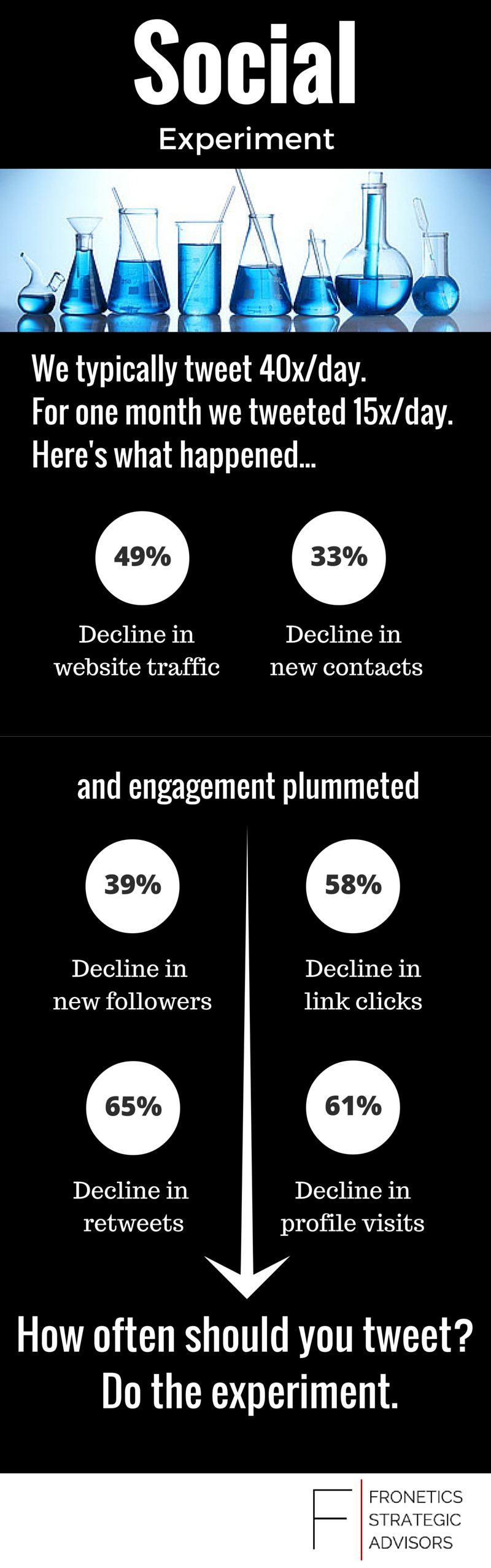
As shown in our social experiment infographic, when we reduced the number of times we post to Twitter from 40 times per day to 15 times per day, our engagement and ROI plummeted.
Not only did we realize close to a 50% decline in traffic to the website, we also realized a 33% decline in new contacts. That’s a 33% decline in our lead pipeline.
We also realized a decline in link clicks (58%), profile visits (61%), retweets (65%), and new followers (39%). In short, our engagement numbers took a dive – off a cliff.
So, how often should you tweet?
Although the numbers were abysmal, the experiment was a good one. It showed that, for Fronetics, posting to Twitter at a frequency of around 40 times per day is right for our company.
Does that mean the frequency is right for each of our clients? No. Does it mean that the frequency is right for your business? No. What it means is that there is no magic number when it comes to the ideal frequency for posting to Twitter.
Your company, or your marketing partner, should conduct due diligence and determine what the right frequency is for your business. Yes, you may realize a significant decline in engagement in ROI during your experiment. On the other hand, you may realize an increase in engagement and ROI — captured with lower output in terms of time and resources.
Do the experiment. I’d love to hear your results, and learn what frequency works for your business.
Not tracking your metrics on a monthly basis? Start now. Metrics enable you to measure success, drive strategy, and demonstrate the ROI of your marketing efforts.
Related posts: