by Elizabeth Hines | Jan 31, 2017 | Blog, Content Marketing, Marketing, Social Media, Strategy
Sales teams can use social media to cultivate relationships with potential buyers, a process called social selling.
With the dawn of the social media age and the exponential increase in choices and information available to buyers, we’ve seen a massive shift in the way B2B sales occur. According to the Harvard Business Review, a striking 84% of B2B sales start not with a salesperson, but with a referral.
As outbound sales become decreasingly effective, peer recommendations are influencing more than 90% of all B2B buying decisions. So how do we make the shift from outbound sales to this new reality? One of the more popular answers is social media.
It’s likely that your organization has some sort of social media marketing strategy in place. But making full use of these platforms requires a more nuanced, well-rounded strategy than blanket social media marketing. It’s time to introduce the idea of “social selling.”
Social media as a sales tool
In a basic sense, social selling is the strategy of adding social media to the sales professional’s toolbox. This means using social platforms to research, prospect, and network by sharing curated educational content and answering questions. The key is building relationships until prospects are ready to buy.
So what’s the difference between social media marketing and social selling, and why is it important? While both are necessary to an integrated marketing and sales strategy, the former is about engaging many — with the goal of increasing brand awareness or promoting a specific product — by producing content that users will ideally share with their networks.
Meanwhile, social selling means producing focused content, and providing personal communication between the salesperson and the buyer. Again, the key is building and cultivating a relationship using social media platforms.
How to start social selling
The benefits of social selling are numerous and significant. For example, according to a LinkedIn survey, B2B buyers are five times more likely to engage with a sales rep who provides new insights about their business or industry. Social media is a powerful engagement tool, giving sales people a platform for sharing these insights.
Here are some steps your sales team can take to implement social selling.
1) Put it in your calendar.
Allot a small portion of your day for social media. It doesn’t take a big time investment to reap the benefits of regular interaction with your prospects.
2) Integrate sales and marketing.
Encourage collaboration between sales and social marketing departments, to make the most of both efforts. HBR suggests that “marketing can train salespeople in social media systems, processes, and best practices.” In addition, sales and marketing should be regularly sharing information to make sure their goals are aligned, and efforts are dovetailing. According to a study by Data Room and Marketo, “sales and marketing alignment can improve sales efforts at closing deals by 67% and help marketing generate 209% more value from their efforts.”
3) Prioritize relationship-building.
Focus your business’ ongoing efforts to building and cultivating quality relationships with prospects. This means building in time every day for personal communication. Make your prospects’ needs your priority.
The bottom line here is building and maintaining relationships. Social media — and social selling — are powerful tools for doing just that.
Related posts:
![The State of Supply Chains: The Supply Chain Has Gone Digital [Infographic]](https://fronetics.com/wp-content/uploads/2017/01/virtual-reality.jpg)
by Jennifer Hart Yim | Jan 23, 2017 | Big Data, Blog, Data/Analytics, Logistics, Strategy, Supply Chain
2016 was the year of the digital supply chain — here’s a look at how things changed.
This guest post comes to us from Adam Robinson, director of marketing for Cerasis, a top freight logistics company and truckload freight broker.
2016 marched onward with a drive to improve the use of digital technology throughout the supply chain. In our first supply chain trends post, we surmised the previous year’s trends would continue. However, this prediction proved to only touch on how important the digital supply chain would become.
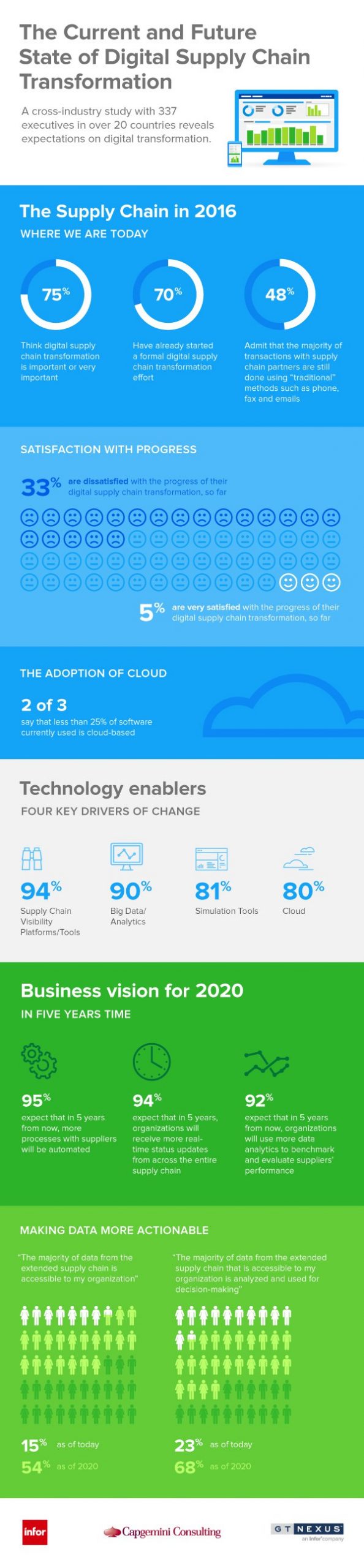
Within four months, the digital transformation had already reached most supply chain organizations. Per GT Nexus, 75% of executives surveyed recognized the digital supply chain as an important factor for the next five years. Meanwhile, 70% have also started processes to implement digital supply chain technologies throughout their companies.
Unfortunately, many supply chain entities continue to hope for a better tomorrow. In other words, the digital supply chain transformation has only been rated as very satisfying for 5% of respondents. In addition, just less than half (48%) of respondents report continued use of traditional technologies exclusively, which include the following:
- Fax machines
- Manual order entry and review
- Land-line phones, not voice over internet protocol (VoIP), which reduces overall costs and downtime
- Email, although beneficial, is susceptible to internet connectivity issues, security breaches and other problems
- Chaotic picking protocols
This infographic, created by GT Nexus, also shows other ways the digital supply chain evolved in 2016.
(Made with Canva)
Essentially, the digital supply chain is essential to gaining and maintaining competitive advantage. Digital technologies, reports Richard Howells of Forbes, including Big Data, analytics, the Internet of Things, social media, and point-of-sale reporting, enable business to know more about consumer needs and wants than ever before. Consequently, they can more accurately respond to changes in product demand across large distances and within infinitesimally small time frames.
Supply chain execs retained fundamentals throughout change.
Innovation is the driving force behind change and improvement in the modern world. Supply chains must evolve to meet an increasing number of omnichannel sales, and technologies must be integrated within existing systems to reach maximum efficiency and productive value.
As explained by Grant Marshbank of VSC Solutions, “The rate of change is not going to slow down. Technology will only delivery […] if it’s implemented with strategy and operations that adhere to best practices.”
Marshbank’s words highlighted the need to focus on fundamental concepts while responding to changes and improvements in the supply chain. For example, an optimized supply chain is good, but it opens more opportunities for errors. Simply putting all an organization’s proverbial eggs into one basket may be risky if appropriate auditing and review measures are not undertaken to ensure continued compliance and accuracy in all orders.
Change is a necessity for businesses, including the supply chain, to grow and expand. Yet many destructive forces can severely undermine a company’s progress. Bad weather, poor hiring practices or inefficient maintenance of consumers’ financial data can decimate a company. However, the response to hindrances in 2016 continued to showcase the importance of fundamental concepts, asserts Ryder, which include the following:
- Continually seeking the fastest, most cost-effective means of transporting products to consumers, including enhanced delivery optins.
- Expansion of global footprint while adhering to local, state, federal and international requirements
- Keeping companies accountable and focused on giving back to their domestic partners through reshoring or nearshoring
- Working with more outside agencies, also highlighted by Samantha Carr of Business 2 Community, including crowd-sourced logistics, warehouse optimization and outsourcing, and greater use of cloud-computing
Augmented reality found its place among consumers.
Augmented reality sounded amazing and far-fetched early in 2016, but the year has shown it to be one of the most successful product in existence. There tends to be more acceptance of technologies in the workplace once consumers can identify how they work.
For example, new hires are likely to pick up tablet-based systems more easily since they have been using them recreationally for some time. Essentially, the virtual-reality (VR), which is the precursor to augmented reality, hype of the 2016 Christmas shopping season is making more people excited about this new way to “see the world.”
While the VR hype may seem like it only emerged for Christmas, think about one of the hottest games of 2016, Pokémon Go! This app was built on augmented reality, combining the digital and physical worlds into one interactive environment. This technology, reports JOC.com, will be a key to practically eliminate extensive training courses and repair time requirements throughout the supply chain.
Ultimately, it translates into greater use of augmented reality in supply chains, which is growing by 100% annually, reports Barcoding Incorporated.
What’s next?
Clearly, technology dominated the conversation for 2016, but there are also changes in how supply chains operate that require a more in-depth discussion as well. In the next post of this series, we discuss the impact of artificial intelligence, agile processes and procurement expansion on the supply chain of 2016.
Related posts:

by Elizabeth Hines | Jan 4, 2017 | Blog, Content Marketing, Logistics, Marketing, Supply Chain
Supply chain professionals should be following these eight blogs to keep up with the latest industry news and happenings in the coming year.
Fronetics is currently conducting a survey to determine which supply chain blogs you think are the best of 2017. (You can vote for that here.) But we also wanted to weigh in with some of the blogs we’re following.
These eight supply chain blogs are great resources for industry news and trends. They cover a range of topics, from technology to strategy, and feature thought leadership by some of the brightest minds in the field.
8 must-follow supply chain blogs
Here is our selection of blogs with timely content that supply chain executives need to read, in no particular order:
1) Supply Chain Management Review
This vast website includes trending articles on supply chain and logistics strategies developments, many written by university-level professors. Read this blog.
2) Logistics Viewpoints
This blog features think pieces from three leading supply chain and logistics analysts with the mission to provide clear and concise analyses of logistics trends, technologies and services. Read this blog.
3) Supply Chain Nation Blog
Interesting news bits from “around the supply chain horn,” this is JDA Software’s blog, a powerhouse in supply chain solutions. Read this blog.
4) Supply Chain Matters
The blog of Bob Ferrari offers his expertise on all aspects of supply chain business processes and supporting information technology. Read this blog.
5) Supply Chain Brain
A portal aimed at supply chain executives featuring original and aggregated content touching on multiple industries. Read this blog.
6) Supply Chain Shaman
Lora Cecere’s blog focuses on “the use of enterprise applications to drive supply chain excellence.” Read this blog.
7) Argentus Blog
Argentus is a boutique recruitment firm specializing in supply chain management and procurement. The blog offers insight into pressing issues in supply chain talent acquisition, career management, and more. Read this blog.
8) Cerasis Blog
The Cerasis blog covers industry trends, educates, explains rules and regulations, busts myths, and has awesome infographics. Read this blog.
Bonus/shameless plug: Fronetics Blog
Our blog covers topics of interest to the supply chain industry from marketing and social media to lead generation and strategy. Read our blog.
Related posts:


by Elizabeth Hines | Dec 22, 2016 | Blog, Content Marketing, Marketing
At Fronetics, we work with companies in the logistics and supply chain industries to create and execute digital and content marketing strategies. Understanding the sales processes of our clients, working closely with sales, and developing effective lead generation strategies is at the heart of what we do.
Here are our 5 most read sales and lead generation posts of 2016.
Sarah Collins, an intern Fronetics and a student at James Madison University, College of Business studying Marketing, writes how aligning sales and marketing helps companies achieve 20% higher annual growth rates and improves deal closings by 67%. Read more.
Leads are only valuable if they convert into customers. So, generating quality leads is only half the battle. You need a sales team that knows how to resuscitate a lead, nurture it, and, ultimately, turn it into a customer. Read more.
B2B sales must recognize and accommodate buyers at various levels of self-sufficiency in the purchasing process. Read more.
The most efficient lead-generation strategy includes a way to capture potential customers’ information. Read more.
If you feel your marketing campaign falls short in generating quality leads, you are not alone. Typically, one in 10 marketing professionals questions the effectiveness of their lead generation methods. While you may have some of the components of a strong campaign in place, it is possible that you are leaving out a very important ingredient for success: a call to action (CTA). Read more.

by Elizabeth Hines | Dec 21, 2016 | Blog, Diversity, Leadership, Logistics, Manufacturing & Distribution, Strategy, Supply Chain, Talent
Women hold just 15% of all executive officer positions within Fortune 500 companies, yet research consistently shows that when women are in positions of leadership, companies perform better. In the supply chain industry, just 5% of top-level supply chain positions within Fortune 500 companies are held by women.
As a woman working within the supply chain industry, I believe that it is important to discuss the lack of gender diversity and point to research highlighting why the industry needs to increase the number of women in all positions, including the C-suite. It is just as important to highlight the incredible women who already are working within the industry.
In 2015 I interviewed Cathy Morris, senior vice president and chief strategy officer at Arrow Electronics, and Mickey North Rizza, vice president of strategic services at BravoSolution. Morris was twice named one of the “Top 50 Most Powerful Women in Technology,” and North Rizza was named a “Top Female Supply Chain Executive.” Both Morris and North Rizza shared how they got started in the industry, and the steps they have taken to get to where they are today.
In 2016 I interviewed Kendrea Durr-Smith, director of global trade compliance at Arrow Electronics, Kelli Saunders, President of Morai Logistics, Hailey McKeefry, editor and chief at EBN, and Barbara Jorgensen, co-founder and managing editor, EPS News. I also invited Tania Seary, founder of Procurious, to share what is happening at her company, and Jennifer Cortez, director of marketing and communications at Transplace, to discuss the role of quality content within the industry.
Here are the most-read women in the supply chain posts of 2016.
It was a “fluke” that Kelli Saunders found the supply chain industry. More than 30 years later, Saunders is president of Morai Logistics Inc., an Authorized Agent of Mode Transportation. Read more.
When Arrow Electronics came across Kendrea Durr-Smith, senior leader of export control audits, training, and communications at Honeywell Aerospace, on LinkedIn, the company was impressed with what she had accomplished in her nine years there. Now Arrow’s Director of Global Trade Compliance for the last four years, Durr-Smith has led a group that is both unique and diverse, and has helped to shepherd in significant changes. Read more.
Data shows that gender equality has improved in recent decades, such as the 15% increase of women working full time in the workforce since 1979. But there is still much progress to be made. As a recent UN Working Group mission to the US to explore discrimination against women found: “In the US, women fall behind international standards as regards [to] their public and political representation, their economic and social rights, and their health and safety protections.” Read more.
Women within the supply chain industry are doing incredible things. Here are some of their stories. Read more.
While there remains a gender gap in the supply chain industry, progress has been made. McKeefry is a clear example of progress. Her internship at EBN in 1990 was a “minority internship,” and today, 26 years later, she holds a leadership position within the company. Read more.
Barbara Jorgensen has more than 20 years’ experience as a journalist, working for leading electronics industry publications such as Electronic Business, Electronic Buyers’ News, and EDN. She is the co-founder and managing editor of EPS News. Read more.
This is a guest post written by Tania Seary, founder of Procurious, the world’s first online social network for supply chain and procurement professionals. Seary shares how she has built Procurious. Read more.
This is a guest post by Jennifer Cortez, Director, Marketing Communications, Transplace. Cortez discusses how Transplace, a North American non-asset-based provider offering manufacturers, retailers, chemical and consumer packaged goods companies the optimal blend of logistics technology and transportation management services, has used content marketing and she offers up 3 tips for creating valuable and compelling content. Read more.