Fronetics is a boutique marketing firm focused on the supply chain and logistics industries. Not only does our firm have deep roots within these industries, we are also focused on the future.
Here are our top 10 supply chain and logistics posts of 2016.
The buying process for B2B buyers has become more complex and longer. The 2015 B2B Buyer’s Survey Report found that 53% of respondents reported their purchase cycle was longer than it was the previous year. The buying process has gotten longer because the majority of buyers (82%) are using more sources to research and evaluate products and services, and they are spending more time in the research phase itself. A full 80% of respondents reported they spend more time on research alone — this is up from 58% in the previous survey. Read more.
Here are 5 more TED Talks from 2016 that companies in the supply chain and logistics industry will want to see. They cover a range of topics, from technology to business strategy. Read more.
Culture is not rhetoric for Eimskip. This key player in worldwide reefer logistics has placed a high value on culture since it was founded in 1914. “When identifying where we operate,” says Isfeld, “we look to smaller communities where there are cultural similarities and where we can make connections and be involved.” Read more.
New research shows how supply chain and logistics companies currently are using the Internet of Things and how they plan to expand use in the future. Read more.
If you’re looking for the latest news and information about happenings in the industry, you should have these five supply chain websites on your radar. In no particular order. Read more.
The Supply Chain industry is changing, while it’s becoming harder for companies to hire at the same time. These supply chain demographics provide a picture of the industry today. Read more.
The shortage of drivers paired with the continued growth of the trucking industry paves the way for driverless trucks.
This guest post comes to us from Rachel Everly, a writer for Cerasis, a top freight logistics company and truckload freight broker.
The trucking industry has been serving America for many decades, and even today it is the main method by which freight is transferred all over the country. Anyone who says the trucking industry is facing a decline or a reduced demand is way off the numbers. More large trucks are coming on U.S. roads, traveling more miles, and transporting more good than ever before.
We have seen more than 3% increases in the number of trucks, which translates to almost 11 million trucks. Also, trucks are still transporting 73% of almost all cargo weight moved in one year. With all these impressive numbers, surprisingly there is a shortage of drivers. That spells both trouble and opportunity for this industry.
Where is there a shortage of drivers?
The U.S trucking industry is facing a severe driver shortage. One estimate shows that around 48,000 drivers are required to move about 70% of freight.
To improve safety, in December 2015, the U.S. Department of Transportation’s Federal Motor Carrier Safety Administration (FMCSA) announced that driver hours will be recorded via Electronic Logging Devices by 2017. This becomes mandatory by December 18, 2017. This was introduced because the existing systems of time-logging are purposely made very complicated, thus not allowing one to check how many hours is a driver on the road.
This is being introduced to ensure that driver safety is not compromised, keeping fatigued drivers off the road. According to calculations, this will save 26 lives a year and prevent 562 injuries every year. Not just this, the ELD will save companies the hassle of paperwork, eventually leading the trucking industry to save somewhere around $1 billion due to reduced paperwork and time-savings.
However, this means reduced hours per driver, thus increasing the need for more drivers. Small trucking companies will be hit the hardest, but overall the industry will be in a better position thanks to this rule. It is estimated that this new rule would cost the industry $1.8 billion, but cost savings from reduced accidents and paperwork amount in excess of $3 billion.
The way to driverless trucks
Humans are amazing creatures, but we are prone to human errors. Human errors account for the majority of the road accidents. Plus with the new rule in, companies will need more drivers, adding to costs. Uber has been actively working on getting driverless trucks on the roads, with a project already started in Singapore, and now has turned its eyes on the trucking industry.
Uber has recently acquired the start-up Otto. Otto has made great inroads into driverless trucks. Otto currently has 6 working self-driving trucks, with plans to expand to 15. This year Otto is continuously running tests; trucks are hauling random items from the company’s garage to test how the vehicles respond to hauling weight.
The company is confident that soon they will be moving all kinds of goods for shippers. They have already started forging relationships with big names in the trucking industry. The self-driving trucks have shown that they can easily operate on highways, maneuvering off the open interstate is still a work in progress.
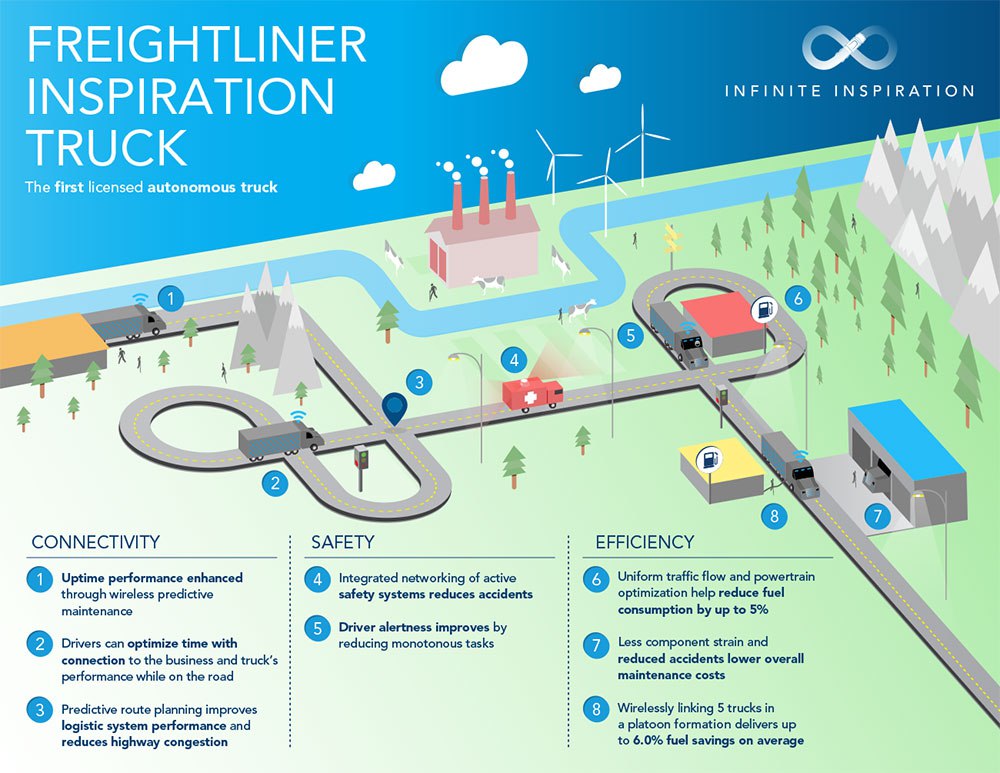
The following infographic outlines some of the benefits of driverless trucks:
Company X also saw web traffic grow by 180% in 90 days by using Google AdWords and Facebook Ads.
Sometimes our clients can be a little hesitant to try pay-per-click advertising. Take Company X, for example.
Company X’s target customer fits a very particular profile, in terms of geography, income, and age. Because of those specific demographics, the client was not confident that a pay-per-click advertising campaign would be an effective way to reach those target customers. But we thought differently.
When paired with a content marketing program, pay-per-click can be one of the cheapest, in terms of cost-per-lead, and most efficient ways to reach a target audience. Thus, we convinced Company X to try PPC on a trial basis, investing just a small budget.
We developed a strategy for the client, using Google AdWords and Facebook Ads. Over the course of 90 days, the results were phenomenal.
A few key results:
Company X acquired 54 leads.
Traffic from paid search grew by 180%.
The lead-to-customer conversion rate was nearly 3x the industry standard.
Needless to say, Company X will be expanding the use of pay-per-click advertising in the future.
How can pay-per-click help your business?
PPC can seem intimidating to the novice. But, when done right, it can be a highly effective way to reach the very specific kind of customer your business is looking for. A little bit of know-how can be all the difference.
As such, Fronetics has developed a quick training on the basics of pay-per-click advertising: what it is, what platforms are available, etc. If you are interested in learning more about PPC and how it might complement your marketing program, download our free guide below.
Big-data insights can help you segment your email database to better target prospects based on where they are in the buyers’ journey.
Most companies these days are swimming in a sea of big data, the great swaths of information they’ve amassed from sales records, social media connections, website leads and contacts, and online analytics.
At first glance it’s a tangle of information that is hard to organize and even harder to learn anything from. That’s a stumbling block that forward-looking businesses need to overcome. Big data can help breathe new life into one of the most reliable yet shopworn tools of the trade: email campaigns.
Embrace Big Data
A study by the executive head-hunting firm Spencer Stuart surveyed 171 companies regarding big-data usage. Just a little over half of the companies used their big data to help guide email, SEO, and SMS marketing campaigns. That’s a fairly low rate, given the potential leg-up that big data can provide.
Consider what Walmart is doing. The company has big-data information on about 60% of all Americans, with which it micro-targets customers based on their individual interests and habits. It’s a powerful strategy that is spreading quickly to businesses of all sizes.
How can you use big data to freshen up your email campaigns?
Be a Collector, Not a Hoarder
Chances are, you are obtaining a lot of data, especially if you have an active content marketing plan in place. Not all of the data you get is equally important. Your focus should be on data that can lead to an actionable and quick response — for example, are you gathering information on your customers’ buying habits? Do you know who they are, where they are, what their interests are, what their email address is, and how your business connects with them?
Collect that relevant data and study it. Much of it will come from the buyer’s journey — the breadcrumbs that potential buyers leave for you in your big data. These pieces of information are keys to your personalized email responses.
Respond In Kind
Most experts agree that a quick and targeted email response is a good strategy for encouraging a new customer to make a purchase. The email needs to respond directly to the buyer’s interests — using information you’ve (hopefully) logged with your big data.
From this point on, it’s crucial to make sure that every email that is sent to that buyer is built around a backbone of big data. Nurture your customers with personalized emails that offer content and deals that line up with their specific interests.
Don’t Mess with the Masses
Mass emails — the generic sales pitch email — used to be the cost-effective and simple way of reaching and converting customers. Now, it’s more than likely they’ll get sent to the trash, or worse, the spam filter. The mass email is your one-way ticket to spam purgatory.
“Traditional methods of mass marketing doesn’t resonate anymore and they’re being ignored by the audience,” said Volker Hildebrand, Global Vice President of Strategy at SAP Hybris, in a recent interview with Forbes. “Data is the fuel for customer engagement, and being able to pull together all the relevant information about in real-time.”
You can do better than the mass email approach. If you’ve collected relevant data and you’ve studied your buyers’ journeys, you have the tools in place to build a smart email campaign. Tailor your campaign to personalize your approach to your customers, and more than likely they’ll open that email.
This list of social media articles includes useful information for both people who rarely use social networking sites and for more advanced users.
We’ve been using this space to write about social media a lot lately. That’s partly because so many exciting new developments and enhancements keep popping up. It’s also because we can’t underscore enough how important it is for companies in the supply chain industry to participate in social media.
I thought it would be helpful to revisit some of our recent information, guides, and tips and tricks regarding social media use for B2B marketers. The following list encompasses both general, how-to-type instruction and more detailed advice for more advanced users.
I’ve segmented articles by platform and included a catch-all category at the bottom as well. Don’t see what you’re looking for? Shoot me an email to let me know what social media-related content you’d like to hear about on our blog.
LinkedIn’s 433+ million member base presents an enormous opportunity for your company to earn new business. Start attracting those members to follow you.
You may find yourself frequently strapped for quality tweeting material. Here are some ideas to not only fill your feed but to keep your followers interested and engaged.
We did an experiment to determine the ideal frequency for posting on Twitter. The resulting numbers were abysmal. But that means the experiment worked.
Facebook Live offers businesses a new, creative platform for engaging customers. This article describes what marketers need to know about it and how to use it.
YouTube is a useful engagement tool for B2B marketers who want to reach the social network’s more-than-3-billion users. Learn how to get started in this article.
Fronetics has developed this training specifically for business owners, marketers, and employees looking to learn more about social media and how they can contribute to their company’s success through these networks.
Fronetics has developed a comprehensive report exploring social media use in general and, specifically, within the logistics and supply chain industries.
Businesses are using social media as a strategic tool. This article explains the top three benefits companies in the logistics and supply chain industries can enjoy from participating on social platforms.
If your social media strategy doesn’t align with your business objectives and target audience, your marketing budget is probably better spent elsewhere.