by Elizabeth Hines | Jun 5, 2019 | Blog, Content Marketing, Logistics, Marketing, Robotics & Automation, Social Media, Supply Chain
When it comes to digital marketing, social media is here to stay. Here’s our four-step guide to leveraging social media for the robotics industry.
Highlights:
- Having a documented strategy is key to reap the benefits of social media marketing.
- Define your audience and establish concrete goals for social media campaigns.
- Set metrics and use data to adjust your strategy consistently over the long term.
The demand for high-performance robotic systems is growing steadily and showing no signs of slowing down. In fact, New Equipment Digest predicts that the robotics vertical within the materials-handling-equipment sector will grow by over 8%, reaching $20 billion by the year 2024. To capture the benefits of the sector’s growth, robotics companies need to invest in digital marketing. Social media for the robotics industry holds tremendous potential — if it’s leveraged properly.
In our work with clients across various verticals in the supply chain, including robotics, we frequently hear that they have been skeptical about the potential of B2B social media use. While social media management does require time and resources, robotics companies should absolutely be reaping the benefits of social media marketing.
Read on for tips on how to create a strategy and leverage social media for the robotics industry.
4 steps to developing a strategy for social media for the robotics industry
1) Define your audience.
For supply chain companies, one of the biggest predictors of success in a social media marketing campaign is a clearly documented strategy. A big part of that is defining your target audience. Chances are, you have some target buyer personas already. Keep these top of mind as you create your social media strategy.
What are the unique needs and challenges faced by your audience? Where do they go online for information? What are their goals? What do they value from you? The more you ask and answer questions about your audience, the better positioned you are to create a strong and effective social media strategy.
2) Determine your goals.
Next, consider what your goals are on social media. You’d be surprised how often this step gets skipped. Marketers are often pressed for time or resources and think of social media marketing itself as a goal, rather than defining specific, measurable objectives for their social media campaigns.
When it comes to social media for the robotics industry, common goals often include increasing brand awareness and authority, generating leads, or establishing thought leadership. But before you embark on a social media strategy, consider what your company specifically needs to achieve.
3) Define your metrics.
One of the best things about having documented goals for your social media strategy is that it helps you define what metrics you should be using to track your progress toward those goals. Measuring social media ROI is no easy task, but there are plenty of tools and strategies that can help. While your full list of metrics will be determined by the goals you set, robotics companies should be tracking at least these four metrics:
- Where traffic is coming from
- Revenue derived from posts
- Visitor behavior on your site
- Social media conversions
In addition to the analytics tools offered by social media platforms like Facebook, Twitter, Instagram, and LinkedIn, Google Analytics can give you a bird’s eye view of your social media efforts, as well as delving into detail on the metrics that matter most to you. For more, be sure to check out our guide to getting the most out of Google Analytics.
4) Choose your platforms.
Not all social media platforms are created equal. When it comes time to choose your social media platforms and create a strategy for each, it’s important for robotics companies to consider where their audience spends their time online (see step 1).
As you identify what social media channels are the best fit for your company, keep in mind that the characteristics of each platform should inform what content and how often you should be posting. Twitter, for example, lends itself to short-form, pithy content or links and frequent posting, while a more visual platform like Instagram only requires 1-2 posts per day.
Going forward: using your metrics to stay agile
Once your strategy is established, you can simply put it into place, start posting content, and forget about it, right? Wrong. Effective use of social media for the robotics industry requires ongoing evaluation and adjustment.
If you’ve defined the right metrics to track, the data you collect should help you determine where your efforts are successful and where your methods need to be adjusted. As you refine your strategy and learn the needs and preferences of your target audience, you’ll find that social media is an extremely effective tool for capturing leads, broadening your brand’s reach, and building your reputation.
Related posts:
by Elizabeth Hines | May 29, 2019 | Blog, Content Marketing, Data/Analytics, Marketing
These Google Analytics reports are crucial to understanding the visitors who are browsing your website and how you are more likely to get them to convert.
Highlights:
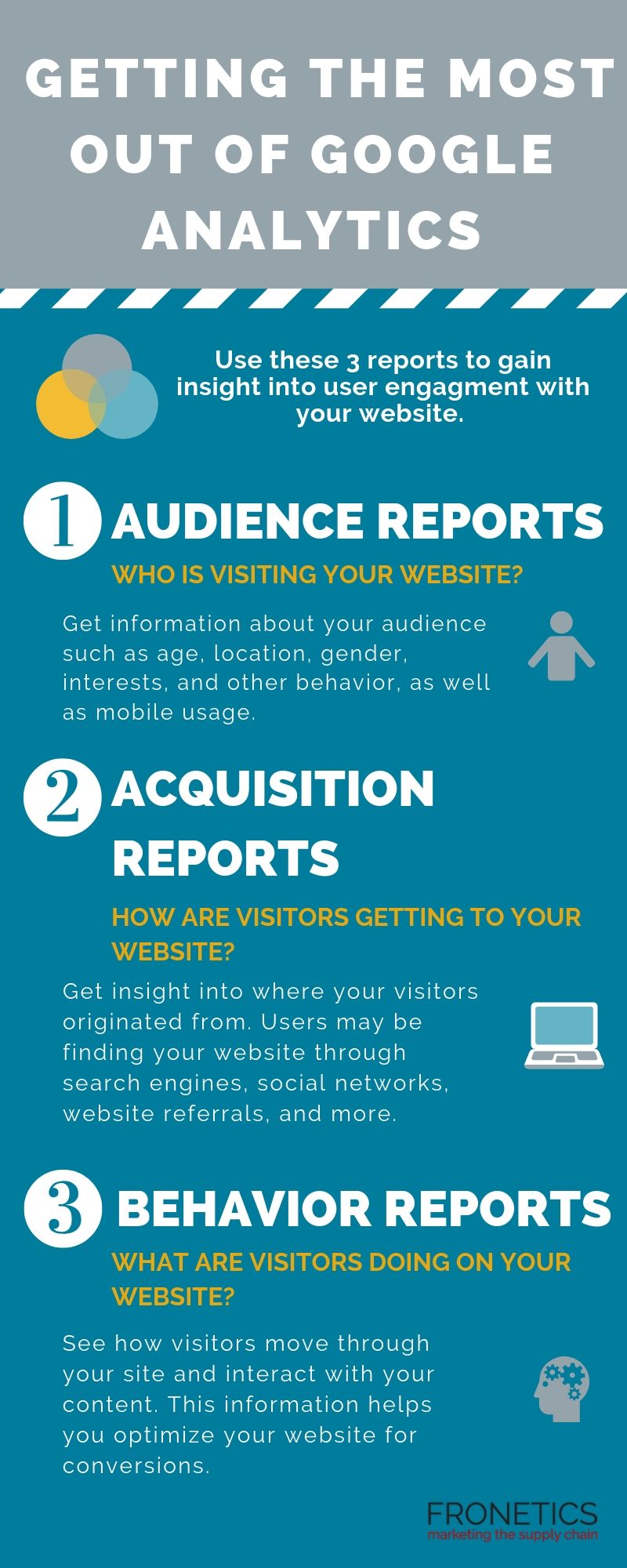
- Audience reports tell you who is visiting your website.
- Acquisition reports convey how are users getting to your website.
- Behavior reports show what visitors are doing on your website.
(Made with Canva)
Your website is your best opportunity to convert digital prospects into leads. But how can you learn who is browsing your website and what they are doing while they’re there? Most importantly, how can you get more of them to convert? Here’s where tools like Google Analytics can help.
Google Analytics is one of if not THE most comprehensive analytics tools available to digital marketers. But it can be very overwhelming if you don’t know how to navigate it. So, we’ve come up with the 3 Google Analytics reports you should be running if you want to understand how to get more visitors to convert on your website.
But, first, let’s start with the basics.
Understanding Google Analytics
At a fundamental level, Google Analytics helps you understand and make decisions based on the traffic that comes to your website. This free tool is a powerhouse that uses a JavaScript code to collect data surrounding how users interact with your website. It then processes that data and generates customizable reports for you within the platform.
I should say: the data you gain from Google Analytics is all the richer if you begin by setting up Goals on the platform. This way, Google Analytics can go to work for you, measuring how well your website is fulfilling your specific objectives. If you start by properly setting and configuring your goals, Google Analytics can provide you with critical information that’s specific to your strategy. Of course, you can always add to or adjust your goals, as you collect data.
Getting the most out of Google Analytics can empower you to make improvements to your website based on the data it collects for you. The more information you have about your site and its traffic, the more you can make adjustments to meet your objectives. Furthermore, the insights you gain from your metrics can help shape future objectives, to improve user experience on your site.
3 Google Analytics reports that are key to getting the most out of the platform
Using Google Analytics, you can gain insight into some of the most important questions surrounding user engagement with your website. In particular, these 3 reports are helpful in getting the most useful data for understanding lead conversion opportunities:
- Audience reports: Who is visiting your website?
- Acquisition reports: How are users getting to your website?
- Behavior reports: What are website visitors doing on your website?
Here’s what you need to know about each report.
1) Audience reports
As you create and publish content on your website, you need to know who’s reading/watching/viewing/listening to it. With Google Analytics, you can get information about your audience such as age, location, gender, interests, and other behavior.
As users are increasingly engaging with websites on mobile devices, we often encourage clients to monitor the Mobile report as well as other audience demographics. This report shows you what percentage of your audience comes from a mobile device, as compared to a desktop or tablet. You need this information, particularly because mobile device users tend to have different behavior and goals from those on desktops. If your traffic is heavily mobile, your site needs to be optimized for these visitors.
We also encourage clients to make use of Google Analytics’ audience benchmarking reports. These reports allow you to compare your results with aggregated industry data, giving you the context you need to set targets. Benchmarking can also give you insights into industry-wide trends and help you determine how you’re doing as compared to your competitors.
2) Acquisition reports
Knowing how visitors are getting to your website will empower you not only to improve your site, but to make strategic decisions surrounding your other digital channels. Google Analytics offers acquisition reports that provide insight into where your visitors originated from. Users may be finding your website through search engines, social networks, website referrals, and more.
Use the Acquisition Overview to get a quick overview of the top channels that are funneling visitors to your website. You can also see associated acquisition, behavior, and conversion details for each of these channels. If you have your Google Analytics Goals in place, the Acquisitions Overview report will display how well each channel is driving conversions.
Next, take a deeper dive in the Channels section, which gives you rich information about each of your channels. For example, if you click on the “Organic Search” channels, Google Analytics takes you to the Keywords report, which lets you know how you’re faring with specific search queries. Clicking the “Direct” channel will take you to the top landing pages for direct site visitors, and “Social” shows you your top-referring social networks.
3) Behavior reports
Once visitors are on your site, what are they doing there? If you’re getting the most out of Google Analytics, you can see how visitors move through your site and interact with your content – and, in turn, you can be strategic about optimizing your website for conversions.
Start with the Behavior Overview. Here, you’ll find a graph of the amount of traffic your website receives, as well as additional metrics such as Pageviews, Average Time on Page, Bounce Rate, and more.
For more insight, the Behavior Flow report shows you the path users typically take on your website. You can see the first page they view, all the way to the final page they typically visit before exiting your site. Here, you’re getting a visual of how long visitors stay on your website — and learn a bit about why they leave.
The bottom line: Google Analytics reports help you optimize your website
Data empowers you to make informed decisions and tailor your strategies to meet your objectives. Not only that, data can help you determine your objectives in the first place. Google Analytics is perhaps the most robust tool out there for gathering information and insights into essentially every aspect of your website. Make sure you’re making use of it.
What Google Analytics reports have you found most helpful?
Related posts:


by Elizabeth Hines | May 22, 2019 | Blog, Content Marketing, Logistics, Marketing, Social Media, Supply Chain
Social listening describes the process of scanning online platforms to find the sentiment around your brand. Here are 4 ways that social listening can boost SEO.
Highlights:
- Social listening describes the process of scanning social media platforms, blogs, news websites and other digital forums to find the mention of any keywords.
- Regularly monitoring the sentiment around your brand through social listening can help prevent a problem before it blows up.
- Track your organic brand mentions and use that information to create a strategy about how to grow brand awareness.
Video transcript:
This is Elizabeth Hines. I’m the Creative Director at Fronetics, and today we’re talking about four ways social listening can boost your SEO.
Social listening describes the process of scanning social media platforms, blogs, news websites and other digital forums to find the mention of any keywords. In particular the name of your company or your CEO for example, to figure out the general sentiment around your company and your people. We used to use social listening mainly for social media marketing, but it can also be a really effective search engine optimization tool if you do it properly. So here are four ways social listening can boost your SEO.
1. Learn if your backlinks are coming from spammy websites
Backlinks from spammy or untrustworthy websites can negatively impact your search ranking. So a Google executive recently noted that this is just a normal part of being on the web and really you shouldn’t worry that much about it. But the one exception would be if there’s some kind of dedicated activity from a competitor, for example, buying up a lot of links and trying to ruin your search ranking. In this instance you should consider disavowing them and using social listening to figure that out.
2. Find guest blogging opportunities
One of the greatest benefits of social media is the opportunity to network with your industry peers and social influencers. Building relationships with reputable businesses and people could be a gateway to guest blogging, which is one of the most sound and effective ways to build your reputation with search engines, not to mention the people that follow those peer sites and influencers.
3. Monitor your brands reputation
Mistakes happen and even companies with the best intentions will sometimes suffer from a social media crisis. So regularly monitoring the sentiment around your brand through social listening can help prevent a problem before it blows up, goes viral or at least is big enough for Google’s algorithm to down rank you for providing a poor user experience.
4. Grow brand mentions
Now a lot of people will tell you to use social listening to find linkless backlinks, which are websites that mention your content but don’t provide a hyperlink to your site. Then you should reach out to those people and see if they’ll add that link in. But in my opinion, this is an enormous waste of time. We’re seeing that linkless backlinks are becoming equally as important as regular backlinks for search engine optimization. So instead, I encourage you to use that time and energy to track your organic brand mentions and use that information to create a strategy about how to grow more. For example did you say something on Reddit that got lots of attention? Well, you should do more of that.
For more tips like these, check out our blog at fronetics.com.
Related posts:
by Elizabeth Hines | May 16, 2019 | Blog, Content Marketing, Logistics, Marketing, Social Media, Supply Chain
LinkedIn is a powerhouse B2B social media network and an ideal place for gaining industry insight. Here are 8 must-follow professionals on LinkedIn for the supply chain.
Highlights:
- 94% of B2B marketers are using LinkedIn to distribute content.
- With its publishing platform, LinkedIn lets users create long-form content.
- Follow industry thought leaders to fill your LinkedIn newsfeed with the most up-to-date insights and analysis.
LinkedIn is an overwhelmingly popular platform for B2B marketers when it comes to content distribution. In fact, recent reports indicate that 80% of B2B leads come from LinkedIn, as opposed to 13% from Twitter and 7% from Facebook. The platform isn’t just a powerhouse when it comes to content distribution and lead generation. LinkedIn, for the supply chain, is also an ideal place to keep up with industry news, trends, and thought leadership.
One of the features that sets LinkedIn apart is its Publishing platform. Through the network, users can create long-form posts and articles and share them with followers. This means your LinkedIn newsfeed can become a go-to resource for keeping pace with the latest in-depth industry analysis. Having the right connections in the industry is key to curating the most valuable content for your newsfeed. Here are our 8 favorite professionals to follow on LinkedIn for the supply chain and logistics industry.
Top 8 professionals to follow on LinkedIn for the supply chain
Don Tapscott, Co-Founder and Executive Chairman of the Blockchain Research Institute
A preeminent authority on the impact of technology on business and society, Don Tapscott has written 16 books and has a record of over three decades of thought leadership. In 2017, Tapscott and his son, Alex, co-founded the Blockchain Research Institute, with more than 70 projects doing definitive investigation into blockchain strategy, use-cases, implementation challenges, and organizational transformation. Blockchain has the potential to reshape the supply chain. Tapscott is a great resource for staying ahead of the changes that are coming.
Kelli Saunders, President of Morai Logistics Inc. at Mode Transportation Associates
Recently named as one of Canada’s Top 100 Most Powerful Women, Kelli Sanders is blazing a trail for women in the supply chain. Recognized for her extensive work in the Women’s Executive Network, Saunders actively speaks on encouraging women/young leaders to pursue rewarding careers in entrepreneurship, supply chain, and logistics. In 2016, we were fortunate enough to interview Saunders, who shared her insights on key issues within the supply chain.
Sean Griffey, CEO and Co-Founder at Industry Dive
A recipient of the Digital Hall of Fame and Media News Award, Sean Griffey specializes in strategic growth planning, financial management, technology strategy, online media, lead generation, business development, and B2B media. His company, Industry Dive, publishes business news and original analysis in 12 vertical markets. Griffey continues to run the Logistics and Supply Chain Professionals group on LinkedIn, with nearly 300,000 members.
Tim Debus, President & CEO of Reusable Packaging Association
Tim Debus brings his 20+ years of experience in bringing to market new technologies and leading industry initiatives to improve the production and supply of agricultural commodities. He focuses on promoting the use and value of reusable transport packaging systems and advancing the common business interests of members of the Reusable Packaging Association. He works to clearly demonstrate supply chain efficiencies, environmental benefits, ergonomic improvements, and cost advantages to end users in all industries.
Patrick Bian, Director of Supply Chain Management at Watts Water Technologies
Patrick Bian boasts an impressive track record developing supply chain strategic roadmaps and leading multi-national teams to support the business vision for global companies. In his work at Watts Water Technology, he provides solutions used to safely convey, conserve, and manage water. Standing president of the French American Chamber of Commerce, New England for the past four years, Bian is also a lecturer at Northeastern University for the Masters Program in Business and Engineering.
Yossi Sheffi, Professor of Engineering and Director of the MIT Center for Transportation and Logistics
An expert in systems optimization, risk analysis, and supply chain management, Dr. Yossi Sheffi is a leading academic in supply chain and logistics studies. He has authored numerous award-winning books, consulted with leading entrepreneurs, and founded or co-founded five successful companies. His LinkedIn publications highlight industry trends ranging from autonomous driving to the latest in retail and e-commerce.
Adrian Gonzalez, President at Adelante SCM & Founder/Host of Talking Logistics
Adrian Gonzalez is a well-respected, trusted, and influential supply chain and logistics analyst and strategic advisor to high-level executives in manufacturing, retail, third-party logistics, and technology companies. He is the founder, host, and creative force behind Talking Logistics, a weekly online video talk show. On both LinkedIn and Talking Logistics, he gives supply chain and logistics professionals interactive and engaging information about the industry, focusing on interviews with thought leaders and key players.
Bart De Muynck, Research Vice President at Gartner
Bart De Muynck is a prolific and insightful publisher on LinkedIn, where he analyzes complex technology topics that are currently impacting the transportation sector. He frequently writes about advanced transportation management systems, as well as the many ways blockchain will impact the supply chain industry.
Did we miss anyone? Who are your favorite professionals to follow on LinkedIn for the supply chain?
Related posts:


by Elizabeth Hines | May 15, 2019 | Blog, Content Marketing, Logistics, Marketing, Social Media, Supply Chain
Recent research aims to get the bottom of the biology behind social media engagement. There’s now scientific evidence to support the best time to post on social media.
Highlights:
- Researchers from Notre Dame have linked optimal social media post timing with human circadian rhythms.
- Emotional content performs best in the mornings.
- For think-pieces, afternoon is the best time to post.
We frequently remind our clients of a fundamental truth of digital marketing, summed up nicely by BuzzFeed’s Jonathan Perelman: “Content is king, but distribution is queen and she wears the pants.” Essentially, you need content of the highest quality, but that’s not enough. Knowing the best time to post on social media and to distribute content across your other digital channels is crucial to ensuring that your content goes to work for you.
As digital natives increasingly populate decision-making positions within the B2B marketplace, social media is increasingly becoming a space where buyers gain information for use in decision-making. In fact, 54% of all B2B buyers report that they rely heavily on social media to research vendor solutions.
Many marketers remain uncertain about how to time posts optimally for maximum engagement and ROI. For lack of clear information, social media managers often resort to a “spray and pray” strategy, in which they post frequently and spend increasingly on boosting their content.
There are some excellent tools out there, which we recommend, to help you determine the best time to post on social media for your business. Now, thanks to three pioneering researchers, there’s science to back up the logic on post timing.
The research
Three researchers at the University of Notre Dame — Vamsi K. Kanuri, Shrihari Sridhar, and Yixing Chen — investigated the question of the best time to post on social media. Among other findings, their research showed that “digital content platforms can increase traffic to their websites from social media and boost digital ad profits by at least 8%, simply by aligning their posting schedules with target audiences’ sleep-wake cycles, or circadian rhythms.” Their findings, entitled Scheduling Content on Social Media: Theory, Evidence and Application, were published in the Journal of Marketing.
The authors began by interviewing social media managers from major content platforms to understand how they make decisions about what and when to post, as well as investigating a year of Facebook post and boosting data. What they found is that managers have been relying not on science, but on personal experience and “gut feelings.”
“It turns out managers’ intuition on when audiences consume content was generally accurate, but the engagement rates for specific content categories (sports, local) and content types (high-arousal content and content requiring higher cognitive processing) and temporal variation in the effectiveness of boosting came as surprise to managers,” author Kanuri says. “The fact that firms can increase their engagement without spending an additional dime is jaw-dropping for most managers we interviewed.”
Working memory and social media post timing
The team’s findings hinge on the biological idea of human working memory, which “stores and manipulates information used in daily tasks.” Working memory capacity varies throughout the day, in accordance with circadian rhythms. The capacity is at its peak upon waking in the morning, reaches its lowest point mid-afternoon, and is at a moderate level in the evening.
“Higher working memory makes us feel alert and curious, meaning consumers are more likely to devour content in the morning,” says Kanari. “When working memory is resource-deprived, the brain prioritizes information to remain efficient and will better respond to boosted content, which legally must look different to consumers. The different look signals to the brain the information is important, thus, boosted content is most effective in the afternoon as working memory lowers.”
Perhaps most significantly, the research demonstrated that “articles that required deeper engagement with ideas — think op-eds and science-based articles — were more frequently clicked on when working memory was high.”
Using the science to find the best time to post on social media
The authors designed an algorithm that allows firms to automatically make profitable decisions about post timing and boosting spend. But, even without purchasing the algorithm software, the research offers extremely valuable, actionable insights for social media managers. Here are four main takeaways:
- In general, morning posts yield higher engagement.
- Spending money to boost posts is most effective when the target audience is at low working memory (afternoons and evenings).
- Content designed to elicit high-arousal emotions (like anger or worry) performs best in the morning.
- Deep-think content like op-eds and scientific research performs best in the afternoon.
Social media success doesn’t necessarily depend on high-dollar spending to boost posts. Paying attention to the science behind audience engagement is key. Aligning content types and post timing with the biological evidence presented will ensure that content performs optimally.
Related posts: