by Elizabeth Hines | Jul 24, 2019 | Blog, Leadership, Logistics, Supply Chain
Corporate social responsibility is no longer optional; it’s expected. Here are five trends that today’s business leaders need to be aware of.
Highlights:
- 75% of millennials expect their employers to take a stand on social issues.
- In a polarized political climate, successful corporate social responsibility requires authenticity and open dialogue.
- Companies are increasingly measuring the results of corporate social responsibility campaigns, ensuring that they align with business objectives.
Corporate social responsibility in increasingly becoming a buzzword — and a consumer expectation. Businesses are facing external and internal pressures to act in socially responsible ways, tackling issues related to sustainability, social advocacy, and more. And, corporate leaders, in response, are increasingly paying attention.
A recent study by Glassdoor found that 75% of employees between the ages of 18 and 24 expect employers to take a stand on social issues ranging from immigration and equal rights to climate change. Not only that, 84% of U.S. workers of all ages believe that companies have an important role to play in proposed legislation, regulation, and executive orders.
In 2019, donating to charities is no longer enough. Writing for Forbes, Community Health Charities President and CEO Thomas Bognanno points out that today, “corporate leaders are aligning social impact and employee engagement with business objectives.” Companies are evaluating the effects of corporate social responsibility to ensure that these efforts “demonstrate real value to the company.”
Staying abreast of trends, expectations, and issues related to corporate social responsibility is a must for today’s business leaders.
5 corporate social responsibility trends leaders should know about
1) Authenticity
Let’s start with one that’s likely here to stay. Social media has rapidly accelerated the expectation that companies should be both authentic and transparent in their digital marketing. It’s had a similar effect when it comes to corporate social responsibility.
Companies are learning to actively promote authentic social engagement, whether through encouraging internal dialogue among employees or company leaders’ sharing personal messages related to important issues. From Dan Schulman of PayPal standing up against North Carolina’s so-called “bathroom bill” to Chick-fil-A’s Dan Cathy voicing his opposition to gay marriage, corporate leaders across the political spectrum are increasingly speaking out authentically.
As Bognanno points out, however, “Aligning a corporate brand with social issues can backfire if it’s not done thoughtfully and with authenticity, so be sure to understand your brand, measure stakeholder interest, and align with issues that resonate.”
2) Dialogue
In times of deep political and social division, companies and corporate leaders are increasingly recognizing their role in fostering dialogue. In fact, one expert predicts that dialogue is replacing taking a stand when it comes to corporate social responsibility in 2019.
“Faced with the prospect of a divided government in Washington, a looming presidential election in 2020, and the fact that some companies are seeking more federal oversight of their work in areas like data security, businesses will tone down their public advocacy in favor of more dialogue on the issues,” writes leadership strategy expert Timothy J. McClimon.
Whether increased dialogue comes at the expense of advocacy or goes hand-in-hand with it, the fact is that it’s a trend to watch. Companies like Campbell’s are stepping up their efforts to engage employees in social dialogue, using platforms like Workplace by Facebook. Externally, Campbell’s UnCanned by Campbell’s campaign has promoted open conversations on “real food,” GMOs, MSG, BPA, and more.
3) Educational opportunities
Workplaces are arguably far more complex environments than they were a few decades ago. The #metoo movement, for example, has thrown glaring light on issues of sexism and sexual harassment, and companies are tackling them not only with policy, but through education to enact real and lasting changes to corporate culture.
Whether it’s internal training classes, peer-to-peer dialogues, or formal executive education classes in corporate social responsibility at programs like Harvard and Wharton, companies are encouraging personnel to educate themselves on the complex issues we face in the modern workplace.
4) Preventing or mitigating disasters
Disaster relief has been considered a primary corporate social responsibility for generations. American Express, for example, has made disaster relief grants dating back to 1872. However, as natural disasters become more and more frequent globally, companies are looking at new approaches to tackling this issue.
While companies are expected to continue their relief efforts for natural disaster victims, there’s a trend toward increasing proactivity. This means helping communities build up resiliency, as well as taking a tough look at business practices that may be leading to or worsening natural disasters.
“While most natural disasters cannot be prevented from occurring, the impact on people can be mitigated or even largely eliminated through better urban and rural planning, and more restrictions on building and development,” writes McClimon. Companies are increasingly seeing these efforts as a key aspect of their corporate social responsibility.
5) Measuring results
Corporate social responsibility is increasingly being viewed not as a nicety, but as an aspect of doing business – and that means it needs to be measured, evaluated, and adjusted accordingly. Benefits of corporate social responsibility range from increased employee satisfaction to increased creativity, and companies are looking to quantify results.
Recent campaigns from Nike and Gillette have demonstrated that a strong stand on important and controversial issues can have varying consequences for a company’s bottom line. In its essence, corporate responsibility is about serving global interests without regard for gain, but companies are increasingly recognizing that for advocacy to be effective, it needs to align with business interests.
Related posts:
by Elizabeth Hines | Jul 23, 2019 | Blog, Marketing, Social Media, Video Marketing
Videos drive greater conversion rates and increased leads. Here are four takeaways from Vidyard’s 2019 State of Video in Business Report.
Highlights:
- Over 82% of businesses reported greater investments in video last year
- Vidyard’s report stated that high-value video content has become a key factor in SEO and ranking.
- Aside from just tracking views, businesses will also track engagement time, drop-off rates, and reach across all channels, as well as the impact of video on lead generation and revenue.
Video Transcript:
Hi I’m Christy LeMire, the Director of Video Strategy at Fronetics, and today I’ll be sharing 4 takeaways from Vidyard’s 2019 State of Video in Business Report.
This report confirmed what us digital marketers already know, video is everywhere. Over 82% of businesses reported greater investments in video last year and it’s no surprise why. Videos drive more sharing, produce greater conversion rates and increase leads.
Here are the 4 key takeaways from the 2019 State of Video in Business Report
-
Video isn’t just for social media
Though Facebook and Snapchat saw over 8 billion video views every day on their platforms, video didn’t stop with social media. Video took center stage in digital marketing and brand awareness. Vidyard’s report stated that high-value video content has become a key factor in SEO and ranking. This trend will continue to grow as marketers begin using video for frequently asked questions and explanations of complex and intricate business details.
-
Short and sweet videos
Marketers used to create highly produced promotional videos for their websites and blogs. But now marketers are focusing on conversational and educational videos created specifically for social media. These casual videos give followers timely updates on industry trends, a behind the scenes look at projects, and interviews with clients and colleagues. The transparency created in these videos brings personality to your business. Marketers will continue to create video for social media, their blog and YouTube channels, resulting in a spike in short-form content like snackable video series.
-
Video experiences focus on engagement
New approaches to video—including series-based content, video podcasts, interactive video, and personalized video—are helping marketers boost engagement and expand audiences. Experts predict we’ll see these new approaches gain more traction as the tools to create them become more user-friendly and best practices become more widely understood.
-
Expanation of video analytics
As video has expanded, so have the needs of video analytics. Businesses will start making use of analytics tools to track video metrics that align with their digital marketing strategy. Aside from just tracking views, businesses will also track engagement time, drop-off rates, and reach across all channels, as well as the impact of video on lead generation and revenue. With more detailed reporting, businesses will see more efficiency and a higher ROI from their video content.
Check out the full report on our blog and find more digital marketing tips on our website at Fronetics.com.
Related posts:

by Elizabeth Hines | Jul 18, 2019 | Blog, Logistics, Marketing, Social Media, Supply Chain
Reading social media blogs is an excellent way to ensure that your business is on top of the latest industry trends, insights, and analysis.
Highlights:
- Subscribe to blogs using an RSS reader to make sure you’re keeping up with the latest.
- Social Media Examiner is a great all-around source, while Social Media Today is the best place to go for up-to-the-minute news.
- Duct Tape Marketing is specifically geared to social media for small businesses.
It’s an old adage, but it holds true: When it comes to social media marketing, the only constant is change. Platforms are constantly refining their algorithms, seeking to stay in line with ever-evolving user behavior, and trends and memes come and go in the blink of an eye. In order to be successful, businesses need to stay abreast of all these constant shifts. Becoming a voracious reader of social media blogs is one of the best ways you can stay on top of what’s going on in the social media marketing world.
These five social media blogs are our favorite go-to resources for the latest news, as well as keen insights and expert analysis. Use your RSS reader to subscribe, and you’ll be privy to free knowledge from some of the leading industry voices.
Fronetics’ 5 favorite social media blogs in 2019
1) Social Media Examiner
Social Media Examiner has been one of our favorite social media blogs for years. Widely known for providing consistently valuable content, the blog features articles from in-house social media experts, as well as regular guest contributors.
We recommend Social Media Examiner whether you’re a beginner at social media marketing or a seasoned expert. The blog frequently features beginner-friendly, step-by-step guides to leveraging social media for marketing purposes, as well as up-to-date coverage of all the most important happenings in the industry, along with terrific analysis.
Recent must-read posts:
2) Duct Tape Marketing
If you’re a small business, Duct Tape Marketing is a fantastic resource for social media marketing specifically geared to small and midsized corporations. Social media is one of the blog’s main focus points, but it also offers suggestions and insights for digital marketing in a broader sense, SEO, marketing automation, and more — all of which help inform a robust social media strategy.
We love the strategies Duct Tape Marketing offers, with small businesses top of mind. You’ll find tactics for leveraging social media to generate leads, expand reach, and grow your business.
Recent must-read posts:
3) Social Media Today
When it comes to social media news, no one does it better than Social Media Today. The team of regular contributors posts several times a day and is remarkably adept at staying on the cutting edge of all the latest happenings, algorithms, and releases in the social media industry.
You won’t just find news on this social media blog. It’s also a rich resource for analysis, opinions, and insights, as well as tips and how-to articles from experienced marketers.
Recent must-read posts:
4) Socially Sorted
Run by social media guru Donna Mortiz, Socially Sorted has been named one of Social Media Examiner’s Top 10 Social Media Blogs for three years in a row. Mortiz personally authors most of the articles that appear on her blog and carefully curates contributors who bring expert perspectives to complement her own.
Socially Sorted focuses heavily on visual content social media platforms, like Instagram and Pinterest, but offers value for readers looking to round out their strategy on any platform. These days, visual content has a tremendous amount of power, and Mortiz is a fantastic resource for boosting your visual game.
Recent must-read posts:
5) Convince and Convert
No list of social media blogs is complete without Convince and Convert. While it’s a general digital and content marketing blog, it boasts a heavy focus on social media marketing topics. Founder Jay Baer and other industry experts offer a steady stream of new content, primarily in the form of how-to guides, case studies, tips, tools, and opinion pieces.
Convince and Convert is a good place for beginners and advanced social media marketers alike. However, more advanced readers will be better to take advantage of the specific and often highly technical guides. The topics never fail to be engaging and often slant toward using strategies informed by human psychology to optimize social influence.
Recent must-read posts:
Which social media blogs are you reading these days?
Related posts:

by Elizabeth Hines | Jul 11, 2019 | Blog, Content Marketing, Current Events, Logistics, Marketing, Social Media, Supply Chain
Here are our most-viewed supply chain and logistics blog posts from this year as of July 1, 2019.
Throughout the year, we regularly write blog posts to help our readers stay on top of the latest news and trends happening in the supply chain and logistics industries, particularly in regards to digital marketing. We hope these posts provide insight, tips, and insider information on how to stay ahead of your competitors with the consistent publication of quality content.
We’ve covered some great stuff this year, from new trends in automation to the best places to distribute your videos. Here’s a look at our most popular posts so far this year.
Top supply chain and logistics blog posts from 2019 (so far)
1. Top 3 Logistics and Supply Chain Blogs of 2019
You voted, and the results are in! Cerasis is your number one blog of the year, with Women in Trucking and Hollingsworth coming in second and third. Read more
2. Digital Marketing for the Supply Chain and Logistics Industries
Today’s B2B buyers are researching, evaluating, and coming to conclusions about companies without a single contact with a team member or salesperson. This kind of B2B buying landscape requires cutting-edge marketing strategies to showcase nut-and-bolt industries that have survived without them for many years. Read more
3. Send in the Drones: How PINC & Amazon Have Optimized Inventory Management
It’s been five years since Charlie Rose interviewed Amazon CEO Jeff Bezos on 60 Minutes about new innovations that Amazon was working on. Bezos revealed that Amazon was on the brink of a supply chain revolution involving octocoptor drones transporting parcels: Amazon Prime Air. Read more
4. 4 Examples of AI for the Supply Chain
Artificial intelligence is not simply affecting supply chain management; it is revolutionizing it. With the power to drastically increase efficiency in all areas of the supply chain, McKinsey estimates that firms could gain $1.3 trillion to $2 trillion a year from using AI in supply chain and manufacturing. Read more
5. Infographic: 10 Companies that Are Getting Instagram for B2B Marketing Right
Instagram now boasts over 1 billion monthly active users, making it one of the most popular social media platforms out there. It’s a tremendous opportunity for businesses. In fact, recent research has shown that 66% of brands now use Instagram. But many B2B marketers are still struggling to find their footing on this highly visual platform. Read more
6. B2B Digital Marketing Trends, Budgets, and Benchmarks: Highlights for 2019
The Content Marketing Institute has published its ninth annual survey, giving insight into the most significant digital marketing trends and priorities for 2019. We’ll get into some key takeaways in detail, but perhaps the most striking finding was one that we’ve been talking about for years. Read more
7. Video: 4 Best Channels for Video Distribution
Knowing the right video distribution channels can go a long way toward driving traffic and getting your content to your target audience. Bottom line is using the right distribution channels helps you get the most out of your video marketing efforts. Here are the 4 best channels for distributing your videos. Read more
8. Video: 6 Digital Marketing Trends for the Supply Chain 2019
Digital marketing has become essential for creating brand awareness, educating audiences and building trust and credibility with your customers. Supply chain and logistics companies increasingly see the value in digital marketing. They’re increasing their budgets, and it’s important to understand what the trends are for the upcoming year. Read more
9. How Rogue Ales is Leveraging IoT to Revolutionize the Beer Brewing Industry
Rogue Ales believes that its “Ground to Glass, Grow your Own Revolution” is a key tenet to its success. The company leverages the Internet of Things (IoT) to ensure that the supply chain is able to deliver the highest-quality ingredients to its breweries just in time. Read more
10. 6 Content Marketing Trends for the Supply Chain in 2019
Content marketing is no longer optional. It’s essential in creating brand awareness, educating audiences, and building credibility. Here’s a look at the biggest digital marketing trends for 2019. Read more
Related posts:


by Elizabeth Hines | Jun 11, 2019 | Blog, Content Marketing, Logistics, Marketing, Social Media, Supply Chain
An effective social media strategy requires data. Here are our 10 favorite social media analytics tools to empower you with insights that will boost your social media game.
Highlights:
- Hootsuite and Sprout Social are all-around social media management tools that offer analytics.
- Google Analytics is an overall powerhouse tool to track the performance of all your digital assets.
- Newcomers to the list include Awario, Squarelovin, Keyhole, and image analytics tool PixL.
At Fronetics, we believe in a data-driven approach to digital marketing. A solid analytical framework has the potential to offer insights that will shape and refine your strategies, increasing your ability to generate, nurture, and convert leads. We’ve pulled together 10 of the best social media analytics tools to help you determine what’s working and what’s not — and to empower you to develop a data-driven strategy.
Our 10 favorite social media analytics tools
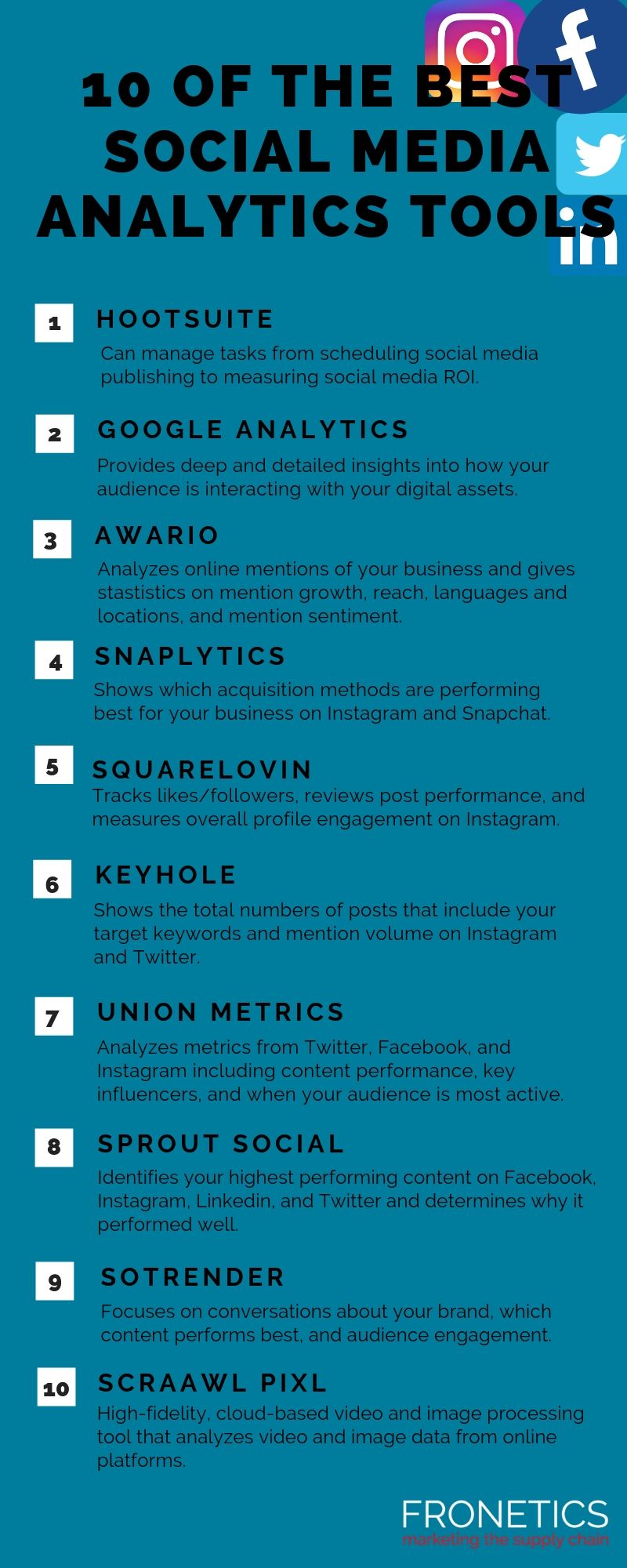
(Made with Canva)
1) Hootsuite
There are so many tools out there, and our internal list of the best social media analytics tools often shifts. But there are a few platforms that always make the list, and Hootsuite is one of them. It’s one of the most popular social media management tools for a reason – it’s a powerhouse that can manage tasks from scheduling social media publishing to measuring social media ROI.
Hootsuite gives you key metrics from Twitter, Facebook, and Instagram with audience and post insights, as well as performance data. It packages all the data in approachable charts and graphs. One of our favorite features is the AutoSchedule tool, which lets Hootsuite determine the optimal time to post or tweet based on when similar content performed well in the past.
2) Google Analytics
Another of our perennial favorites, Google Analytics is a robust platform that can provide deep and detailed insights into how your audience is interacting with your digital assets, including social media. This is one of the best social media analytics tools out there, and we’ve written extensively about how to get the most out of it.
For social media analytics, we particularly recommend three custom reports: Best Days to Post on Social Media, Best Time to Post on Social Media, and the Social Media Traffic by Date and Hour. These three reports offer real-time data, along with the in-depth insight you need to help your business optimize its social media strategy.
3) Awario
Awario analyzes online mentions of your business and gives you statistics on mention growth, reach, mentions’ languages and locations, mention sentiment, and where on the web mentions are occurring. We particularly appreciate that the tool also identifies social media users who have used your keywords and provides you with a list of social media influencers in your specific area.
Benchmarking your social media marketing strategy against your competitors is key to understanding how you’re doing. Awario lets you create alerts for your main competitors and offers you a step-by-step comparison of your social media performance against theirs.
4) Snaplytics
While all-inclusive tools like Hootsuite and Google Analytics are excellent for evaluating your overall social media strategy, we also recommend a few tools that focus on specific platforms. Snaplytics hones in on Instagram and Snapchat, including offering insights on Instagram Stories.
For both networks, Snaplytics shows you which acquisition methods are performing best for your business, as well as what precipitates rises and falls in engagement levels. Snapchat can be a tricky platform for brands, and Snaplytics provides the kinds of insights you need to make inroads on this millennial-dominated network.
5) Squarelovin
We’ve written extensively about how supply chain companies can make the most of Instagram and Instagram Stories. Squarelovin is an analytics tool specifically for Instagram that provides you with the data you need to optimize your strategy. It tracks likes and followers, reviews post performance, and measures overall profile engagement.
One of the best social media analytics tools for Instagram out there, Squarelovin highlights the best times to post, ideal filters to use, and most popular hashtags. It also gives you a history of engagement with your posts, broken down by hour.
6) Keyhole
This social media monitoring tool offers up deep analytics for Twitter and Instagram. Keyhole will show you the total number of posts that include your target keywords, as well as how mention volume has changed over time. It displays engagement data, hashtag usage trends, sentiment metrics, and reach statistics.
Influencers are key on Instagram and Twitter, and influencer marketing should be part of your social media strategy. Keyhole provides insights into influencers and trends in your specific niche, along with audience demographics and locations.
7) Union Metrics
Union Metrics analyzes a range of metrics from Twitter, Facebook, and Instagram. Like Hootsuite, it lets you know which content is performing best across each platform, the times when your audience is most active throughout the day, and who your key influencers are.
What really sets Union Metrics apart is in its potential for optimizing content creation. The tool goes above and beyond by tracking relevant trends to help you generate ideas for new content, based on hard performance data.
8) Sprout Social
Sprout Social is probably Hootsuite’s biggest competitor, and it’s another of our frequent favorites. Like Hootsuite, it’s an all-around social media management tool that provides key analytics as well. It measures performance and engagement across Facebook, Instagram, LinkedIn, and Twitter and benchmarks your data against competitors.
Sprout Social also helps you identify your highest performing content and determine why it has performed well. It can also show you how your paid ads are performing through a comparison of paid versus organic impressions and followers gained.
9) Sotrender
This formidable social media analytics tool shows you where conversations about your brand are happening, which of your content performs best, and how your audience engages with your social media content. Sotrender analyzes Twitter, YouTube, Facebook, and Instagram and makes it easy for you to benchmark your efforts against your competitors.
We like any tool that not only offers data but gives you advice for improving your strategy. Sotrender offers customized tips on where your marketing strategy needs improvement, based on the analysis it performs.
10) Scraawl PixL
As the internet, and social media in particular, becomes more visual, experts have pointed to a dearth of analytics tools with the capability to perform rich analysis on images. Scraawl PixL is a relatively new kid on the block, and it’s attempting to fill the void when it comes to image-based analytics.
This high-fidelity, cloud-based video and image processing exploitation tool offers an easy-to-use interface, as well as workflows for analyzing video and image data from online digital platforms. It relies on machine learning-based algorithms that enable face detection and recognition as well as object detection, tracking, and classification.
What are your favorite social media analytics tools?
Related Posts: