by Elizabeth Hines | May 13, 2019 | Blog, Content Marketing, Marketing, Social Media, Supply Chain
Instagram Stories offer an on-trend platform for delivering targeted content to B2B buyers, and we’re joining the fun.
We’ve written extensively about the benefits of using Instagram as a part of your social media strategy. And, though we’ve been active on Instagram for over two years, we’re now taking on Instagram Stories.
Instagram Stories are sequences of content that a user (or business) posts to Instagram over a 24-hour period. Besides photos, Stories can include videos, live and prerecorded. The content plays as a continuous feed, creating a narrative about the user’s day — hence the term “Stories.”
Audiences can view the Stories of the users they follow within the 24-hour window after they are posted. They can find users with active Stories by scrolling the user icons at the top of the app. Or users can tell their followers that they’ve posted a story by tagging them, which notifies them through a direct message.
Fronetics’ Stories will be a fun mix of breaking news, highlights of upcoming events, and live video on the latest industry trends. Ideas for Stories you’d like to see us cover? Email me at [email protected].
Related posts:

by Elizabeth Hines | May 7, 2019 | Blog, Content Marketing, Logistics, Marketing, Social Media, Supply Chain
When it comes to social media, timing is everything. These 5 tools will help you determine the best time to post on social media for your business.
Highlights:
- Social media is playing an increasing role in B2B purchasing decisions.
- Even if you’re posting great content, if you’re doing it at the wrong times, you’re losing out.
- Social media management tools can help you understand your audience and make informed decisions about post timing.
If you’re a B2B marketer, chances are, you’re well aware of the importance of social media. But since, as BuzzFeed’s Jonathan Perelman famously put it, “Content is king, but distribution is queen, and she wears the pants,” simply posting your content is only half the battle. Knowing the best time to post on social media is nearly as important as what you post.
It’s difficult to overstate importance of an effective social media strategy. Not only do 78% of marketers who have used social media for 2 years or more report increased traffic to their websites, but B2B decision-makers increasingly report that they are influenced by social media when purchasing. According to Demand Gen’s 2018 B2B Buyers Survey Report, more than half (54%) of all B2B buyers rely on social media to research vendor solutions.
These are powerful numbers, and all signs point to social media playing an ever-increasing role in the B2B buyer’s journey. For your social media content to pack the biggest punch, you need to be posting at the optimal times. Luckily, there are a plethora of social media management tools that can help you refine your strategy. Here are our 5 favorite tools for determining the best time to post on social media for B2B brands.
5 tools for determining the best time to post on social media
1) Google Analytics
This robust analytical tool is among the most popular all-around web tools for B2B businesses, and for good reason. Google Analytics can help you determine how your audience is interacting with all your digital assets, and it offers some great insights about social media in particular. You can create various types of custom reports based on your business’ goals and results. We recommend three in particular to help you find the best time to post on social media:
- Best Days to Post on Social Media
- Best Time to Post on Social Network by Hour
- Social Media Traffic by Date and Hour
2) Buffer
A company with an impressive record when it comes to social media management, Buffer’s platform lets you easily manage all your social media platforms. Like its biggest rival, Hootsuite (more on that soon), Buffer offers among its features some useful insights for determining ideal post timing and frequency. For example, it analyzes follower activity and suggests the perfect moments to post on each social media platform.
3) Hootsuite
Hootsuite has been one of our favorite tools for a long time, and it truly offers a rich variety of features and insights to maximize the effectiveness of your digital assets. Not only is it effective at scheduling social media posts, it’s an excellent tool for measuring social media ROI — no easy task! Hootsuite’s AutoSchedule feature is one of its best assets. For each piece of content you plan to post on social media, it analyzes when similar content performed best in the past and determines the optimal post time. In addition, it considers the platform and publishes based on audience engagement on each network.
4) Followerwonk
Followerwonk is new to our list, and it’s different from most social media management tools. While it doesn’t offer the kind of scheduling and management features as the other platforms on our list, what it does do extremely well is help you gain valuable insights and understanding of your audience. For example, Followerwonk lets you analyze your current Twitter followers by things like location, post timing, engagement, accounts they follow, and more, as well as contrast those relationships with your competitors. Understanding your followers at this level will not only help you determine when your business should post on social media, but will allow you to analyze and adjust your strategy in all kinds of ways.
5) SproutSocial
Another perennial favorite, SproutSocial offers the whole menu of social media management tools: everything from monitoring to scheduling to analytics. The customized dashboard gives you a bird’s eye overview of how your social media channels are performing. You can find deeper insights, including individual statistics on each post, and customer data like gender, age, and location demographics. The platform’s ViralPost technology boasts impressive results at finding the best time to share your content.
Figuring out the best time to post on social media for your business is no easy task, but it’s key to getting your content to reach your target audience. There’s no one-size-fits-all solution, and any one, or a combination, of these tools can help you understand your audience better and get your content out to them at the right times.
Related posts:
by Elizabeth Hines | May 1, 2019 | Blog, Content Marketing, Logistics, Manufacturing & Distribution, Marketing, Social Media, Supply Chain
We get many queries from manufacturers about social marketing — mostly, why and how should I use it — so here are our answers to the most-popular questions manufacturers ask about social media.
Highlights:
- Facilitate networking opportunities, thought leadership, and prospect/client relationships.
- Consider using popular platforms like YouTube and Instagram to engage users and drive website traffic.
- Don’t use social media to push your products.
(Made with Canva)
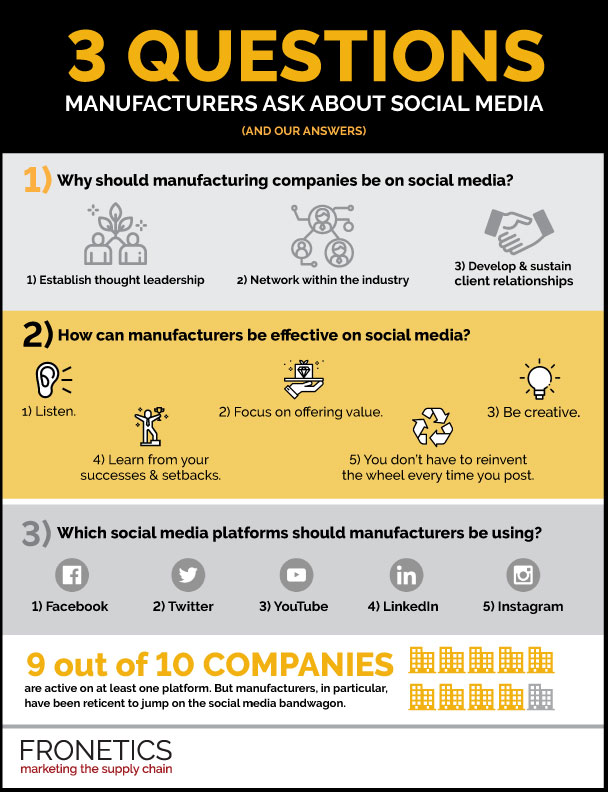
B2B operations have increasingly embraced social media as a strategic marketing tool. In fact, 9 out of 10 companies are active on at least one platform. But manufacturers, in particular, have been reticent to jump on the social media bandwagon.
If your manufacturing operation isn’t making use of social media as a tool to engage with your audience, you’re missing out on big lead generation potential. Manufacturers like the Dow Chemical Company, ArcelorMittal, and CAT Products are among those that have figured out how to harness the power of social media.
To help you launch or refine your efforts, we’ve put together the following answers to the most-popular questions manufacturers ask about social media.
Why should manufacturing companies be on social media?
There are three major reasons that manufacturing brands should be all over social media:
- Establish thought leadership
- Network within the industry
- Develop and sustain client relationships
Notice that none of these involve selling products. As with content marketing in general, good social media marketing isn’t about pushing your products.
To make the most of social media as a marketing tool, abandon the idea that it’s about blatant sales pitches. Instead, approach it from the perspective that it’s an inherently social tool – that is, its value for manufacturers is in its potential to establish and expand thought leadership and to cultivate meaningful and fruitful relationships within your industry and among prospects and clients.
Which social media platforms should manufacturers be using?
Not all social media platforms are created equal. Each requires its own strategy, content format, and media. We recommend that manufacturers consider these five platforms:
1) Facebook
Facebook is an excellent place to share content with a wide segment of your audience, to promote engagement (through likes, comments, and shares), and to engage with peers and prospects. Not only that, the savviest marketers are using Facebook to understand their industry better – everything from strategies of peer brands to a fuller picture of your target buyer persona to the informational or product needs of your prospects.
2) Twitter
Twitter’s format is about brief, pithy content, used to engage with and inform your audience. This is an ideal place to let customers know what you’re planning next, to establish your corporate personality, and to let your audience in on a slice of your day-to-day operations and values.
3) YouTube
Video marketing for manufacturers is skyrocketing. With video being the most popular form of content online today, YouTube is an obvious choice for marketers. Whether it’s “how to” videos, footage of your operations, or interviews with subject-matter experts, your brand should be using YouTube to drive search traffic and educate prospects.
4) LinkedIn
B2B marketers unequivocally rank LinkedIn as the most effective network for lead generation, follower engagement, and traffic to their websites. An ideal place to engage with industry leaders, LinkedIn is also great for distributing content to a focused audience.
5) Instagram
The popularity of this highly visual platform has continued to skyrocket – it’s currently the second-most-used social media platform (up from fourth just two years ago). And believe it or not, this picture-based network is a powerhouse for B2B brands. We’ve written extensively about how brands can leverage Instagram and Instagram Stories. Suffice it to say, this is a perfect place to post your most engaging visual content and actively engage with followers.
How can manufacturers be effective on social media?
As with any content marketing effort, a well-thought-out social media strategy is a big part of success. As you create and begin to implement your strategy, start with these five tips.
1) Listen.
Before you post even a single piece of content, start by listening to your audience. In the days before social media, marketers had it much harder when it came to determining audience needs and preferences. Use these platforms to research your target prospects, as well as how competitors are engaging followers. Make note of the questions your target audience has, frustrations or challenges they express, and what types of content they engage with.
2) Focus on offering value.
You’d be surprised how many manufacturers neglect to place a premium on simply being useful with their social media content. It’s not complicated: If you post relevant, valuable content for your target audience, you’ll boost engagement, grow brand awareness, and generate and convert more leads.
3) You don’t have to reinvent the wheel every time you post.
One of the great things about social media is that it rewards not only content creation, but content curation. While you do want to be posting original content most of the time (experts recommend about 60%), a good chunk of your posting activity should include curating relevant content from third parties to share with your followers.
4) Be creative.
Separating yourself from your competitors can be a challenge, but it’s one worth striving toward. Start by asking yourself what makes your operation unique, what’s special about your process, what industry-leading expertise does your executive team have, what unusual perspective can you offer? Next, start breaking these four rules.
5) Learn from your successes and setbacks.
There are many tools out there to help you track the results of your social media efforts. Determine the right KPIs for your business and keep track of your results relentlessly. These metrics will allow you to study your impact and frequently tailor your strategy accordingly.
It’s time for manufacturers to fully embrace the marketing potential of social media. Whether you create and implement your own strategy, or decide to outsource your social media efforts, social media is a powerful set of tools that manufacturers should be harnessing.
Are there other questions manufactures ask about social media that we missed? Let me know in the comments.
Related posts:

by Elizabeth Hines | Apr 17, 2019 | Blog, Marketing, Marketing Automation
Chatbots are a must-have lead generation and customer service tool for supply chain businesses in 2019.
The newest generation of B2B buyers is increasingly dominating the two-way conversation between marketers and buyers. They prefer to gather purchasing information on their own — overwhelmingly via online searches, vendor websites, and peers and colleagues — rather than talking to sales representatives. They are unsubscribing from marketing emails at alarming rates, citing over-communication as the number-one reason why. And they are using messaging platforms to speak directly with brands when they have questions or problems.
At the same time, buyers are demanding more personalized communications, faster response times, and an improved, cohesive user experience on all of a vendor’s digital channels.
All these factors are driving the growing popularity of chatbots as a lead generation and customer service tool. But, at Fronetics, we think it’s time to stop viewing them as a trendy communication mechanism and more as a necessary part of a supply chain operation’s marketing strategy.
Chatbot applications for the supply chain
I’ve written before about the impressive implications that automation has for supply chain marketing & sales efforts. (HubSpot reports that businesses using marketing automation receive a 451% increase in qualified leads.) At Fronetics, we’re seeing chatbots as one of the most successful and easy-to-implement marketing automation tools in the current marketplace.
Chatbots are relatively inexpensive, inherently low-maintenance, and surprisingly user-friendly — to both the buyers interacting with them and the vendors setting them up. They help website visitors find the information they need quickly, while gathering user data that is useful in marketing and sales efforts, all without taxing human resources. In fact, Chatbots Life reports that businesses can save up to 30% of costs associated with servicing customer requests by using a chatbot.
Millennials, in particular, appreciate the quick, easy, and unobtrusive communication option that chatbots offer. And, as we all know, this generation comprises an increasing percentage of the B2B purchasing landscape. In a crowded marketplace, vendors that offer a pleasing user experience will have the competitive edge when it comes to winning business and growing a base of loyal customers.
A real-life example
We are recommending chatbots to clients because we have seen firsthand how effective they can be. I’ll give you an example from our own experience at Fronetics.
We recently implemented a chatbot on our website that we synced with my calendar, allowing users to schedule a time to speak with me about our services. I am not exaggerating when I say that within 24 hours, we had a lead come through the bot. I spoke with that lead at the time he scheduled, the next morning, and delivered a proposal to him the next day.
Chatbots are here — in a big way. If you’re not using one, your competitors certainly are (or will be soon). Having a chat mechanism on your website will soon be the difference between winning more business and missing out… if it’s not already.
This post originally appeared on EBN Online.
Related posts:


by Elizabeth Hines | Apr 9, 2019 | Blog, Content Marketing, Marketing, Social Media, Video Marketing
If you’re trying to build a YouTube audience, you’ll need equal parts strategy, creativity, concision, and valuable subject matter. Highlights: Strategy and creativity are top priorities. Keep content short and sweet for maximum impact. Offer value to your audience...