by Elizabeth Hines | Oct 24, 2019 | Blog, Marketing, Social Media
Facebook Messenger is the latest trend in chatbots for the supply chain. Here are powerful numbers to prove why your brand needs to be active on the messaging platform.
Patience is a virtue of the past. Today’s buyers want (and expect) marketers to actively engage with them throughout the purchasing journey. And offering them generic information won’t work — they want personalized communications based on who they are, what they have purchased in the past, and what they are interested in buying. Businesses can no longer afford a one-size-fits-all communication strategy.
The focus has shifted from passive marketing to engagement, which has marketers scrambling to be everywhere, at all times, to ensure a positive customer experience. In response, we’ve seen an increase in chatbot usage in the supply chain and logistics industries. Chatbots help improve the customer experience through automated systems that emulate human conversation.
Chatbots rely on the popularity of messaging apps. And, luckily for marketers, messaging app usage is on the rise:
- There were 2.18 billion messaging app users globally in 2019. (Statista)
- At the end of 2018, 78% of the world’s smartphone users were messaging every month. (Facebook)
- By 2021, it’s predicted that the global user base for mobile messaging apps will have risen by a further 23%. (Facebook)
- People share more than 17 billion photos on messaging apps every month. (Mobile Monkey)
And though WhatsApp has the highest percentage of users worldwide, Facebook Messenger has taken over as the most popular messaging app in the U.S. With over 1.3 billion monthly users, this powerful messaging platform holds a lot of potential for marketers.
Even though marketers know that Facebook Messenger is a platform they can no longer ignore, supply chain and logistics brands have been slower to jump on board. But if you’re questioning if you should be using Facebook Messenger to engage with audiences, the answer is yes.
Supply chain businesses can use this platform to deliver content, engage with customers one on one, and offer superior personalized customer service, all of which result in high-quality relationships and leads.
Here are some staggering numbers to back up our point.
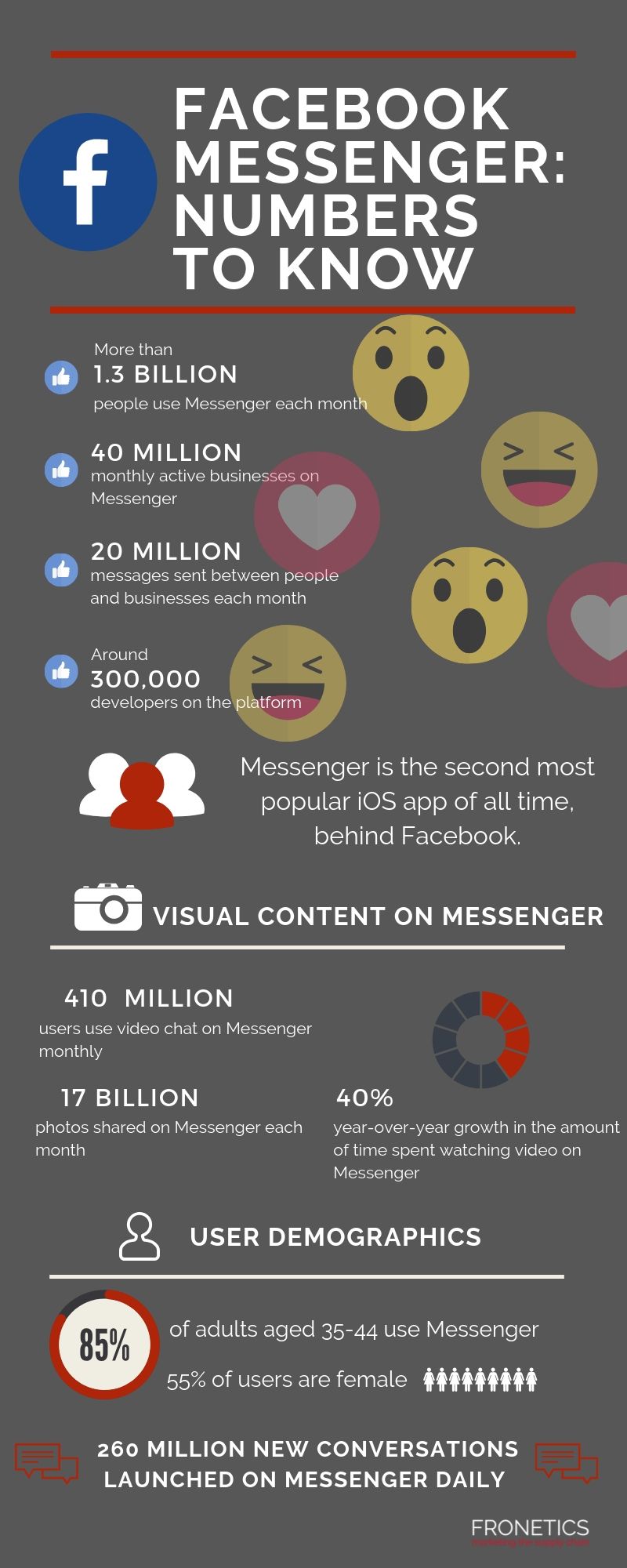
(Made with Canva)
Final thoughts
What was once thought of a teen social app, Facebook Messenger is now dominating the business world with increasing popularity and no sign of slowing down. In fact, we as a brand have found huge success using Messenger to engage with new leads. In the first 24 hours of using the platform, we were able to set up a meeting with a new prospect. That was just in the first 24 hours. This prospect turned out to be our next client, and the initial connection was all made through Facebook Messenger.
Related posts:


by Jennifer Hart Yim | Sep 25, 2019 | Blog, Leadership, Strategy, Supply Chain, Talent
New research shows Gen X business leaders are being promoted slower than their millennial and boomer counterparts. This Gen X talent looking to jump ship.
This guest post comes to us from Argentus Supply Chain Recruiting, a boutique recruitment firm specializing in Supply Chain Management and Procurement.
Much attention has been given to millennial employees over the years –what attracts them, what causes them to stay in a role, how to manage them differently than other generations of employees. It was a hot topic of discussion at the recent SCMA National Conference. At the same time, more baby boomers are beginning to retire. These two generations represent the back and front end of the Supply Chain industry’s talent pipeline, and they’ve been the industry’s focus. But of course, the demographic picture is broader and more nuanced than just these two generations.
Last week, we wrote an article about the importance of the emerging Generation Z – people born between 1997 or so and the 2010s – to companies seeking to win the war for Supply Chain talent. Hopefully, it helped fill in the generational picture even further.
Now a recent, very interesting article in Harvard Business Review has us wondering – are Gen X employees being forgotten by the industry? If so, what’s the impact on their careers, as well as organizations who employ them – the companies who stand to lose if dissatisfied Gen X’ers begin to jump ship?
At the risk of explaining the obvious, Gen X’ers are generally defined as being born between the mid-1960s and early 1980s – after baby boomers, but before millennials. They also came of age with a reputation for being “unambitious” – a reputation that’s just as outdated as some of the most famous slacker movies (classic though those movies may be).
As we said with our article about Gen Z, these generational distinctions are a bit fraught. Career motivations are different for every person. They’re too complex to paint everyone with the same brush. But when you can marshal enough data, you can start to learn some interesting high-level things about the hopes, dreams, and discontents of a particular demographic. In 2018, HBR worked with EY and The Conference Board to collect and analyze data from some 25,000 business leaders. Those surveyed were from all over the business landscape, but there’s data here that will be useful for Supply Chain organizations looking in the mirror.
Some of the results related to Gen X in the workplace were very interesting, in particular:
- The majority of Gen X leaders (66%) had either not been promoted in the past 5 years, or had only been promoted once.
- Baby Boomer and Millennial leaders were more likely to receive promotions (58% and 52% respectively). This is unsurprising for the boomer generation, but it is surprising that a generation younger than Gen X seems to be getting promoted more. It suggests Gen X employees are being “skipped” compared to their counterparts.
- The data found that Gen X employees are promoted typically 20%-30% slower than millennials are.
- Generally speaking, Gen X managers have more direct reports than millennial managers at the same level, indicating a higher workload.
This is the situation on the ground for Gen X talent and leaders. But how are they responding to this lack of advancement?
Gen X employees tend to be more loyal to their current employers, with 37% contemplating leaving their current role compared to 42% for millennials. They came of age before the 2008 financial crisis, in a time before the rise of the gig economy, which might account for their willingness to spend longer in a role.
But companies shouldn’t mistake this loyalty for complacency: according to the data, only 58% of Gen X employees feel that their careers are advancing at a good rate, which is significantly lower than the 65% of millennials who feel the same way. Almost one in five Gen X leaders surveyed reported an increased desire to leave their current role (18%).
Many organizations are beginning to reckon with the retirement of the baby boomer generation. They’re trying to attract and retain millennial talent by improving opportunities for career growth. Maybe they should also be doing more to nurture Gen X talent, to avoid losing that all-important middle group within the talent landscape.
As Stephanie Neal, the HBR writer puts it, a significant number of Gen X’ers might be reaching a “breaking point in” their careers. But she identified some key strategies for companies to avoid neglecting Gen X talent:
- Invest not only in continuing education for employees, but personalize it. Most Gen X employees have developed a broad base of skills, but individual needs and desires vary. Organizations should tailor their talent development to each person. Stay interviews, which we’ve written about recently, are a good strategy to better understand what motivates each individual in your organization.
- Give Gen X leaders opportunity for mentorship, and not just within the organization. We also recently wrote about the power of mentorship in a Supply Chain career, so we were happy to see HBR highlight the importance of mentorship as well. According to the research, a majority of Gen X leaders craved mentorship outside their organizations, which is enabled by things like industry conferences and professional groups. Investment in these opportunities not only helps with retaining Gen X leaders, it also offers chances to expand your supplier network or find new business.
- Hire and promote based on data, rather than gut feelings. Hiring managers often work hard to try to eliminate unconscious bias from the hiring process, but ageism often goes under the radar. Applying stereotypes to a certain cohort introduces bias that harms your process and leads to dissatisfaction. Neal uses the example of assuming that a millennial would be better at a digital marketing role than a Gen X employee. Decisions based on data such as assessments and quantifiable achievements will always be more successful than those based on stereotypes.
It’s a good start, but maybe this is issue deserves an even closer look. If we may add another tip: avoid stereotypes. Data surveying the preferences and mindsets of a large group of people can be instructive, but don’t assume that every Gen X employee is wired the same way.
What do you think? Are there any specific talent retention strategies for individuals in the Gen X cohort? Are you of this generation, and if so, how do you feel about your career prospects? We’d love to hear from you.
Related posts:

by Elizabeth Hines | Sep 12, 2019 | Blog, Content Marketing, Marketing, Social Media, Video Marketing
Live video streaming offers businesses a cost-effective strategy for engaging with and appealing to today’s buyers.
With YouTube emerging as the world’s second largest search engine and video becoming themost popular form of online content,it is no surprise that businesses are looking for ways to engage their target audience through video. And they’re even diving into a growing trend in video marketing: publishing content in real time. It makes sense, given live video streaming now represents 33% of all online activity.
Live video was used more for niche markets in its early days. But 68% of marketers plan to start using live video in the next year, and 77% of marketers plan to increase their use of video overall.
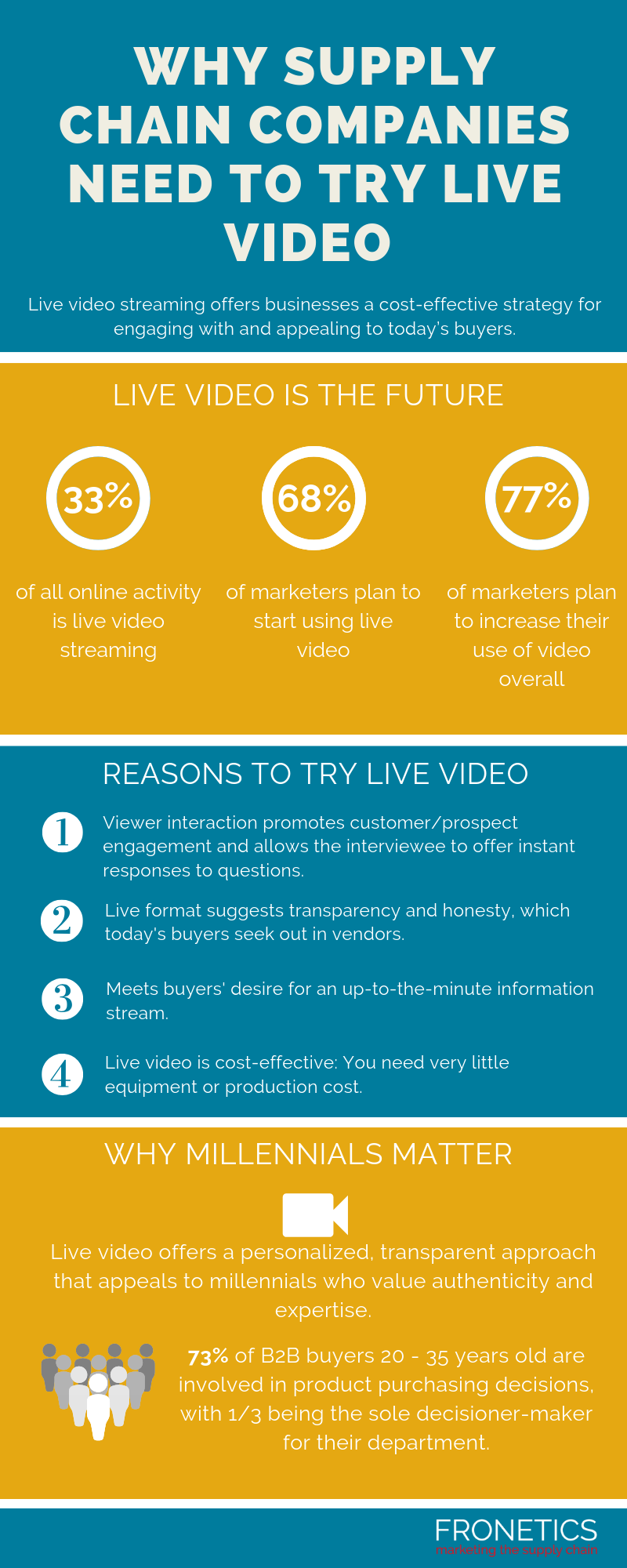
(Made with Canva)
How can live video work for the supply chain?
Live video is an increasingly popular content medium for the millennial generation, which is important for supply chain marketers to note as the B2B purchasing landscape skews younger. Consider that around 73% of 20 to 35 year olds are involved in product purchasing decisions at their companies, with one-third reporting being the sole decision-maker for their department. And a 2015 Google/Millward Brown survey of buyers found that about half of purchasing researchers were between the ages of 18 and 24 — and that percentage has only grown in the last few years.
Another important trait to note about millennials? They’re immediately turned off by overt sales pitches. Instead, they expect vendors to offer them value outside the sales funnel by way of education, entertainment, inspiration, or knowledge. So instead of creating video content to promote products, supply chain companies should use the opportunity to provide viewers with these elements of value they expect.
Live video streaming is the ideal medium for doing so, as it offers the transparency, emotion, and personal elements millennial buyers desire. Vendors can connect with buyers on an emotional level while simultaneously communicating their companies’ expertise, which directly impacts the buyers’ opinions of their solutions.
4 reasons to try live video streaming
Live video streaming offers real benefits for supply chain companies in addition to the increasing opportunity to connect with prospective buyers. When clients ask about whether they should try live video, I give them these four reasons:
1. Earn customer/prospect engagement and feedback
Most live video platforms have features that allow for viewer interaction, meaning customers and prospects can ask you questions and get instant responses. (Talk about excellent customer service!) That generates a positive experience that strengthens their relationship with your company. Also, you get the benefit of hearing feedback from a portion of your audience, which you can use to drive change and growth.
2. Promote transparency
Live video can be unpredictable, raw, and honest — which, admittedly, can be scary for the person filming. But today’s buyers crave this kind of transparency. When you go live, things may not always go as planned, but that will work in your favor more often than not.
3. Appeal to those who love to be in-the-minute
Social media users love to feel on top of their information streams. Live video offers that sense of insider, up-to-the-minute scoop that appeals to them.
4. Publish video in a cost-effective way
High-production videos can be costly and can take weeks to produce. One of the best parts about live video is that you need only a smart phone, a Wi-Fi connection, and someone willing to appear on camera (which is sometimes harder than it sounds). Publishing happens in real time, and then most platforms allow you to archive the footage for viewers to access later.
The takeaway
We’ve seen clients have great success with live video streaming. It’s one of those trends that’s not going away anytime soon. In fact, social platforms are increasingly adding “live” and “Stories-like” features to satisfy users’ seemingly insatiable appetite for this format.
That means if you haven’t tried live video, you should think about it. Pretty soon you’ll be one of the only ones among your competitors who is not — if you’re not already.
This post originally appeared on EBN Online.
Related posts:


by Elizabeth Hines | Aug 29, 2019 | Blog, Content Marketing, Current Events, Logistics, Marketing, Social Media, Supply Chain
Also this month in social media news: Facebook adds Instagram scheduling to Creator Studio and Twitter launches 6-second video ad bidding.
Highlights:
- Facebook is adding an easy option for users to create a still-image slideshow in its Stories feature.
- LinkedIn’s new audience engagement insights will offer improved audience discovery, content recommendations, and industry benchmarking.
- Marketers can now use Facebook’s Creator Studio app to schedule posts on Instagram.
After a somewhat tumultuous July in the world of social media news, August has been calmer. Our updates this month are less concerned with reproaches of Facebook from the Fed and more with news that directly impacts marketers, particularly in the B2B sector. LinkedIn has partnered with third-party providers to offer a robust set of audience engagement insights, and Instagram made the welcome announcement that posts can now be scheduled the Facebook Creator Studio App.
As Stories’ popularity continues to grow, particularly on Instagram, Facebook is working diligently to make its native Stories feature an attractive place for users to post. As part of an ongoing series of updates, this month the social media giant rolled out two new Stories features geared to boost usage. Keep reading for more details on the social media news this month.
Facebook Announces Continued Updates to Stories
As the popularity of Instagram Stories continues to grow, Facebook remains tenacious in trying to encourage usage of its Stories feature. This month, the social network began testing a Stories update prompt displaying a split panel, encouraging users to share to their personal as well as business Page Stories.
Earlier in the month, Facebook added a slideshow option to Stories. The feature allows users to add a still image slideshow to their Story, providing a simplified way to add a stream of images that play out through Story frames. While it was previously possible to achieve the same result by selecting images one by one for each frame, the new option will make it easier.
Facebook believes that Stories are the future of social sharing. While reports indicate that Stories usage is growing, it remains to be seen whether the social media giant can position itself as the preferred platform for Stories content.
LinkedIn Adds New Audience Insights
As part of ongoing efforts by LinkedIn to develop more insight into central topics of interest among its users, the platform has rolled out a new expansion of its marketing partner program with new engagement insights. Responding to the challenge of “reaching and engaging the right audiences at scale,” LinkedIn is partnering with multiple third-party providers to offer a robust set of audience engagement insights.
According to the announcement from LinkedIn, “With these insights, you can better refine your content strategy and make smarter marketing decisions to help deliver better ROI for your LinkedIn ad campaigns and organic posts.” Benefits include audience discovery, content recommendations, and industry benchmarking.
LinkedIn has long been a preferred platform for B2B marketing, and this latest announcement strengthens the network’s credentials.
Facebook Adds Instagram Scheduling to Creator Studio
The latest addition to Facebook’s Creator Studio app is a welcome one for social media marketers. Earlier this month, users began to receive in-app notifications saying, “Instagram and IGTV publishing now available.” Since Instagram scheduling has proven a challenge for social media marketers, this update promises an improved experience.
The new option to schedule Instagram and IGTV posts through Creator Studio offers increased capacity, and it allows marketers to upload to Instagram from a desktop, rather than only through a mobile device. Needless to say, the new publishing and scheduling option will make Instagram marketing far easier. However, it remains to be seen whether posts coming through this process will receive less engagement, a concern in the past with third-party scheduling tools.
Twitter Launches 6-Second Video Ad Bidding
Twitter is launching a new video ad option, namely, 6-second video ad bidding. The ad bidding option means that advertisers will only be charged if their video ad is viewed for 6 seconds. According to the network, “With mobile video consumption at an all-time high, studies show brand impact happens almost instantaneously (within seconds) with video ads.”
Twitter cited the results of a study by EyeSee, which “determined short-form (under 6 seconds) sound-off videos with clear branding drive significantly better ad recall and message association on mobile than linear TVC style videos.” Advertisers will be able to publish on-platform video ads as in the past, but the new option means they can choose only to be charged when a video is viewed for 6 seconds.
Stay tuned for next month’s social media news.
Related posts:

by Jennifer Hart Yim | Jul 30, 2019 | Blog, Content Marketing, Leadership, Marketing, Supply Chain
Supply Chain Management can boost productivity – and alleviate issues – for companies as they scale.
This guest post comes to us from Argentus Supply Chain Recruiting, a boutique recruitment firm specializing in Supply Chain Management and Procurement.
Awhile ago, we blogged about how more Startups are looking to Supply Chain Management to boost their productivity as they scale. Procurement – the effective purchasing of raw materials, back-office goods and professional services – as well as Logistics – the orchestration of the movement of those goods – might not seem to be as important as sales, marketing, R&D or finance at first blush. But failure to account for these factors can be a major bottleneck to growth, and many a startup has failed because of Supply Chain issues.
Supply Chain Management is an important factor for fast-growing hardware manufacturing companies, whether they’re producing goods overseas or at home. But it’s important in food manufacturing, consumer goods, Pharma, and Cannabis as well, as well as any industry with direct B2B sales. In fact, we recently brought on a new Cannabis client who’s scaling up a strategic sourcing operation in all of their Procurement, so that all their spend is captured and accounted for as they grow, rather than after. Rather than taming out-of-control spend later, they’re maximizing profitability by being strategic about the company-wide spend now, by hiring a team of Procurement category managers.
The most successful startups grow quickly by relentlessly focusing on the consumer – giving them a better product, or a better customer experience – but customer service is dead on arrival without an effective Supply Chain. Any growing company needs people to forecast demand, produce or source the goods to meet that demand, and ship it quickly and reliably to consumers, while only holding as much inventory as absolutely necessary.
As a founder or senior leader in a growing company, you might think that you have the expertise to “figure it out” on the fly, because how hard can it be? But trust us, if you don’t have Supply Chain experience, you can’t. Developing a product line and business model is hard. Getting it funded is harder. But as a founder, you don’t know true pain until you’ve been saddled with massive inventory because you failed to plan, or until you’ve seen an entire shipment waiting at port for customs clearance three weeks before your launch because you don’t have someone on staff who has the experience to get the paperwork in order before you need to.
Avoid failure.
That’s how Supply Chain has always advocated for itself, and you may have even heard about these considerations before. Get your Supply Chain in order, and you might avoid pain, but you’ll also experience innovation and opportunities to improve your customer experience in ways you never thought were possible. It can also reinforce your core company values and mission, and pass it on to customers in ways you haven’t considered.
As Dave Evans recently talked about in Bloomberg, setting strong values early is the key to sustainable growth at a startup. Most entrepreneurs get that. But what they don’t always get is the importance of making sure that these values extend into your Supply Chain. Founders need Supply Chain experts who can forge close relationships with suppliers, and find manufacturing partners who can provide opportunities to improve the brand.
Too many founders treat Supply Chain like a transactional necessity: “okay, where are we going to source product from fastest and cheapest?” But Evans talks about how founders can actually use Supply Chain Management as an opportunity to improve and build their brand. He uses the example of Everlane, which has built a successful fashion brand out of radical supplier transparency – making it plain to customers exactly where their products come from, and breaking down all the costs associated with bringing it to market.
So where do you start?
Different areas matter more for different industries, and different levels of maturity. A seed-stage startup might need to set an overall direction for logistics and distribution (i.e. what sort of 3rd party logistics solution will you look to leverage?), whereas a scaling business might be able to leverage strong Procurement to extract additional value from supplier relationships – as with the Cannabis company we mentioned above.
Do you want your Supply Chain to be fast, cheap, or flexible? Skilled supply chain professionals can usually help you excel at two of those. The best in the business can get you all three. But if you don’t have any of that expertise, you’ll get zero.
Areas that startups need:
- Logistics and Distribution Strategy
- Demand Planning
- Production Planning
- Lead Time Management
- Inventory Planning
- Supplier Relationship Management
- Strategic Sourcing/Shared Services Procurement (growth stage)
Today’s top Supply Chain Management professionals can bring all these considerations to bear. One other thing to consider: manpower expenses are one of the highest costs in scaling a business, and you don’t want to take on extra full-time staff if you don’t have to. So one thing companies will do is hire a seasoned expert who has developed and implemented Supply Chain strategies at scaling companies before on a contract basis – say 6 or 12 months – to implement the process and strategy, and then move on to another contract. You will likely have to pay a bit more per-hour, but it can be a tremendously flexible and high-value option, especially because some of the best in the business are now working on contracts for growing companies.
Any way you go about it, failing to plan a Supply Chain can quickly sink a growing company – and developing one that excels will make a growing company soar.
If you fail to plan, you plan to fail. Having Supply Chain Management professionals in the room is some of the best business planning possible in 2019. That’s why they’re a founder’s secret weapon.
Related posts: