![The Girl Scout Cookie Supply Chain [Infographic]](https://fronetics.com/wp-content/uploads/2024/10/Girl-Scout-Cookie-Supply-Chain-810x675.jpg)
by Elizabeth Hines | Jan 15, 2015 | Blog, Marketing, Supply Chain

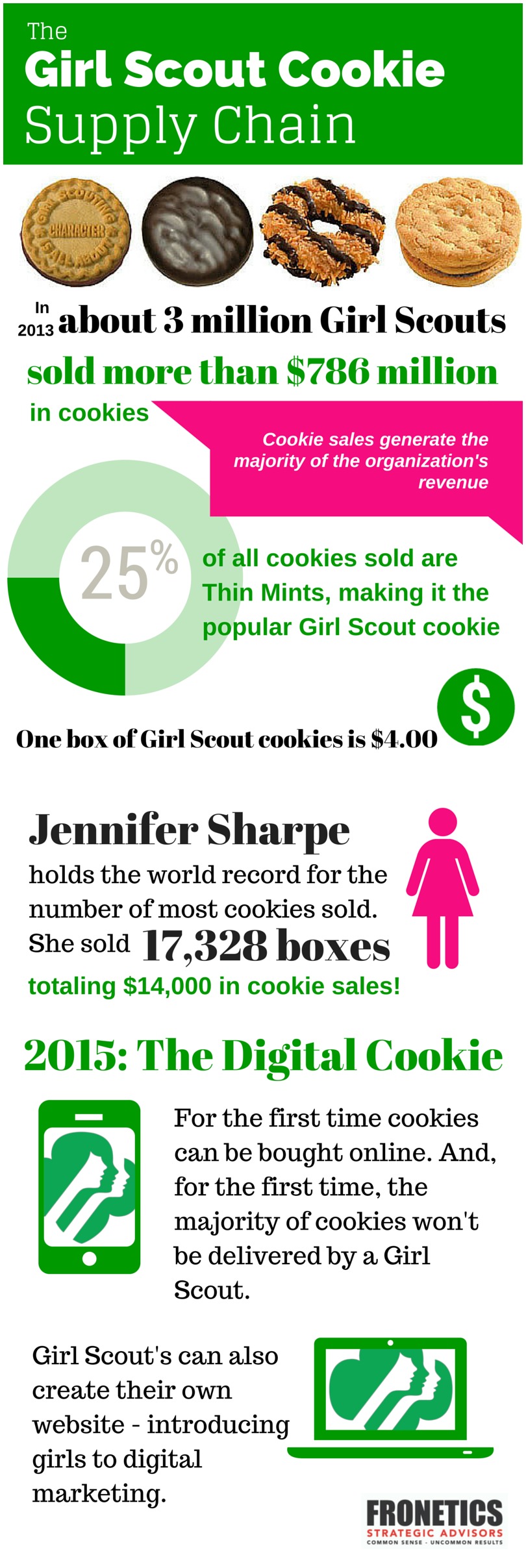
In 2015 The Girl Scouts launched the “Digital Cookie.” How will this impact the Girl Scout Cookie Supply Chain?
When the Girl Scouts of America began selling their now ubiquitous cookies way back in 1917, their operations were simple: cookies were baked in the ovens of troop members and sold in a high school cafeteria. On a mission to raise enough funds to cover the activities of their Muskogee, Oklahoma-based troop, these first cookie salesgirls unknowingly set the stage for a century-long operation that now includes over 2.8 million Girl Scouts and tops $700 million annually.
Throughout the program’s history, the Girl Scouts have made significant changes to the way they do business. To understand the evolution of their supply chain you have to look not only at the physical growth of the program, but the societal factors that have shaped their manufacturing, distribution, marketing and sales functions throughout the years.
From the cookie program’s modest beginnings in the late 1910s through the 1920s, operations were kept small and simple. Cars weren’t yet pervasive in American cities and towns, and door-to-door sales and delivery of goods were the norm. As such, each local troop of Girl Scouts baked, packaged, and priced their own cookies and then combined marketing and sales functions by going door to door. The 1930s saw the Girl Scouts professionalize their manufacturing operations by partnering with and licensing their first commercial bakery – a move concurrent with the rise of automated and commercial bakeries across the United States.
During World War II, flour, sugar, and butter shortages caused a brief stoppage of Girl Scout cookie production. In the post-war boom though, the Girl Scouts were back in the cookie business, setting up shop outside the shopping malls that had sprung up in the suburbs.
As membership rapidly grew, cookie flavors were narrowed to four types in order to standardize their product for greater manufacturing efficiency. Meanwhile, advancements within the packaging industry proved to be a boon for the marketing and sales of Girl Scout cookies as it brought extension to the shelf-life of their products. The most dramatic shift in operations came in 1978. By that time, the number of commercial bakeries involved in the manufacture of GirlScout cookies had swelled to an unmanageable amount. That year officials made the decision to limit operations to only four bakeries, showing a commitment from the organization to uniform quality, packaging, and distribution (a practice even further evidenced today by their licensing of only two bakeries).
From the 1950s through 2014 the sales and marketing strategy of Girl Scout cookies has remained almost unchanged. Each year, between January and April, thousands of girls and their parents have sold cookies by going door-to-door or by hawking their wares outside local supermarkets.
In 2015, in a move that has significant implications for their supply chain, the Girl Scouts have unveiled a new strategy that is directly influenced by yet another societal shift. “Digital Cookie” enables Girl Scouts to market and sell cookies online.
With Digital Cookie, girls are able to create personalized cookie websites and invite customers to visit their website via an email invitation. Digital Cookie also allows girls to take in-person cookie orders (at a local cookie booth for example) via mobile app.
Additional features of Digital Cookie include: campaign advertising, inventory tracking, and shipping management.
Kelly Parisi, Girl Scouts of the USA chief communications executive, points out that these changes are essential in terms of building leadership skills: “It is all about the girls and building future business leaders. They are learning about e-marketing, managing money and additionally creating their first websites.”
The Digital Cookie will have a significant impact on the organization’s supply chain. Not the least of which is that this year, for the first time, the majority of customers will have cookies delivered directly to them – the option of having a Girl Scout deliver the cookies is only available in select markets.
Hungry? Connect with your local Girl Scout or Girl Scout Troop, or try the free mobile Cookie Finder app for your iPhone or Android phone.

by Elizabeth Hines | Jan 13, 2015 | Blog, Logistics, Marketing, Social Media, Strategy, Supply Chain
In December 2014 Fronetics Strategic Advisors conducted a survey to learn the favorite social media accounts of the logistics and supply chain industries.
Here are the Facebook accounts which survey respondents identified as favorites:
Cerasis is a top North American third party logistics company offering logistics solutions with a strong focus on LTL freight management.
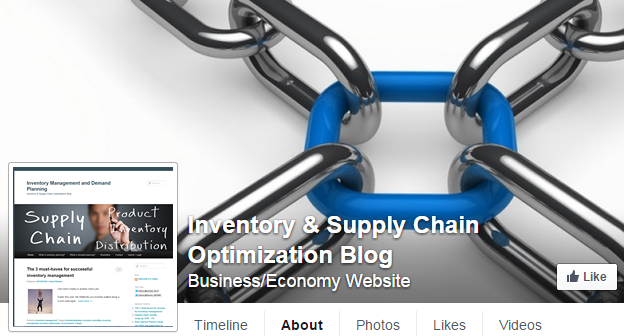
The Supply Chain Blog covers the top trends surrounding the topics of inventory and supply chain optimization. It also provides a weekly news summary for the supply chain industry.
Transplace is a non-asset, North American based third party logistics provider offering manufacturers, retailers and consumer packaged goods companies the optimal blend of logistics technology and transportation management services.

by Elizabeth Hines | Jan 12, 2015 | Blog, Logistics, Marketing, Social Media, Strategy, Supply Chain
LinkedIn is a must for companies and for professionals.
Profiles, company pages, and LinkedIn groups each serve a purpose, and each are tools which can be used and leveraged by both companies and individuals. With more than 3 million company pages, more than 332 million users (and with an average of 2 users joining every second), and close to 2 million LinkedIn groups determining “the best” can be challenging.
In December 2014 Fronetics Strategic Advisors conducted a survey to learn which LinkedIn company pages and LinkedIn groups are the favorites within the logistics and supply chain industries. The results are in.
LinkedIn company pages
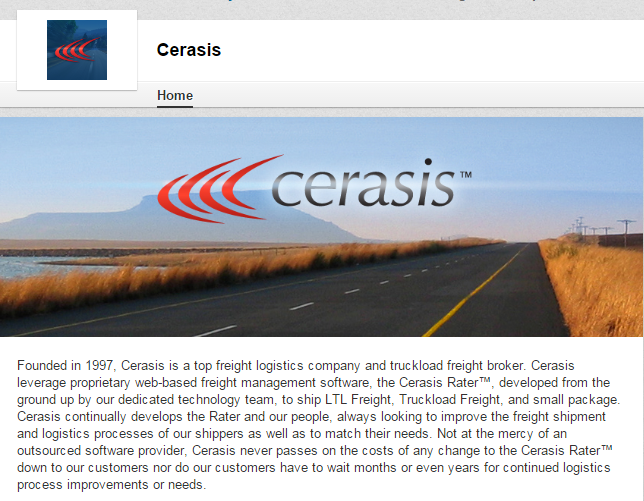
Cerasis is a top freight logistics company and truckload freight broker. The company consistently distributes valuable industry content via their LinkedIn page.
Note: Cerasis was also named the best blog of the logistics and supply chain industries.
Quintiq’s vision is to transform the world’s supply chains. One way the company does this is through their LinkedIn company page. The company’s LinkedIn page is updated regularly with content that is valuable and relevant to the logistics and supply chain industries.
Quintiq also uses LinkedIn to attract and identify new talent. There are currently 12 open positions posted via LinkedIn.
Note: Quintiq was also named a “must-follow Twitter account for those within the logistics ans supply chain industries.”
Transplace is a North American 3PL and technology company committed to helping manufacturers, retailers and distributors reduce costs and improve service. The company’s LinkedIn page is a wealth of information for those within the logistics and supply chain industries.
C.H. Robinson is one of the world’s largest 3PL providers. The company provides freight transportation and logistics, outsource solutions, produce sourcing, and information services to over 45,000 customers through a network of offices in North America, South America, Europe, and Asia.
The company’s LinkedIn page is a great resource of industry news and insight.
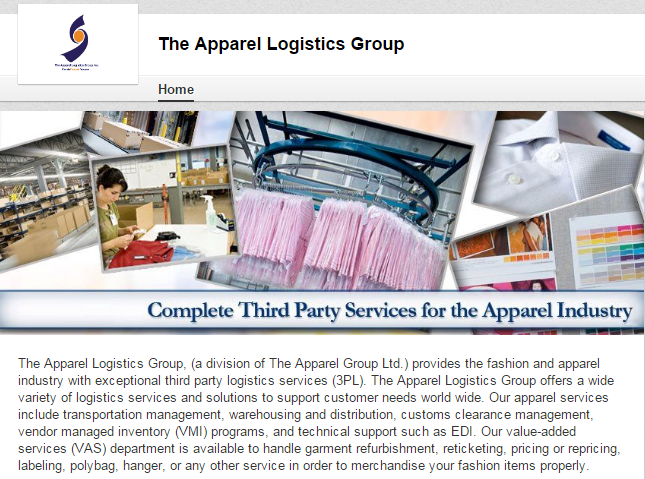
The Apparel Logistics Group, (a division of The Apparel Group Ltd.) provides the fashion and apparel industry with 3PL services . The Apparel Logistics Group offers a wide variety of logistics services and solutions to support customer needs world wide. The company’s apparel services include transportation management, warehousing and distribution, customs clearance management, vendor managed inventory (VMI) programs, and technical support such as EDI.
LinkedIn groups
Procurement Professionals is an open networking group. The group has more than 290,000 members and is one of the best and largest international networking group for all executives, directors, CFO’s, CPO’s, VP’s, procurement professionals, head hunters, job seekers, recruiters, consultants, financial managers, supply chain and sourcing specialists, and buyers and purchasers.
The Supply Chain Optimization Group is a global community, uniting all Supply Chain, Procurement, Logistics, Warehouse, Scorecard, SCOR, Auditors, Continuous Improvement experts, Management Consultants, Program Managers, Executives, Business Owners, Students, Professors, and Engineers.
The group is a central hub for authors books, articles, white papers, podcasts, blogs, events and conferences. Consultants, and thought leaders are visiting regularly to support members in projects, productivity, training, skills development, coaching, mentoring, financials, statistical software, simulation, teams, organizational development, and more.

The Reusable Packaging Association (RPA) is a collaboration between supply chain partners, including manufacturers, poolers, distributors, retailers, educators, and policymakers, to promote the environmental, safety, and economic benefits of reusable packaging.
The RPA leverages its collective voice of industry leading knowledge to advance the adoption of reusable packaging by clearly demonstrating supply chain efficiencies, environmental benefits, ergonomic improvements, and cost advantages to end users in all industries.
The LinkedIn group is a private group.

by Elizabeth Hines | Jan 7, 2015 | Blog, Leadership, Marketing, Social Media, Strategy, Supply Chain
The majority of companies within the logistics and supply chain industries are realizing benefits by participating in social media. The social network that provides the greatest business impact: Twitter. A survey found that 95% of respondents believe Twitter to be either “somewhat impactful” or “very impactful” on their business.
What are the must-follow Twitter accounts for the logistics and supply chain industries?
In December 2014 Fronetics Strategic Advisors conducted a survey to learn which industry Twitter account is your favorite. The results are in.
The number one must-follow Twitter account for the logistics and supply chain industries is: Quintiq
Quintiq’s vision is to transform the world’s supply chains. The company’s Twitter account speaks to this vision by sharing and providing industry knowledge and news. Additionally, Quintiq uses to Twitter to engage with others within the industry.
Other must-follow Twitter accounts include:

by Elizabeth Hines | Jan 5, 2015 | Blog, Content Marketing, Internet of Things, Logistics, Marketing, Social Media, Strategy, Supply Chain, Talent

Here are the top supply chain and logistics blog posts of 2014
2014 is over and a new year has begun. We look back at the content we created and shared in 2014.
Looking at content focused on the supply chain and logistics industries, there are three topics which garnered the most interest:
- The use of social media and content marketing;
- Supply chain talent;
- Technology.
Here are the top ten supply chain and logistics blog posts of 2014 based on pageviews. #1 receiving the most pageviews.
The Internet of Things trend is quickly approaching and will impact the way we live and work through increased productivity and efficiency. Supply Chain Management will continue utilizing these advanced technologies to improve factory workflow, increase material tracking, and optimize distribution to maximize revenues. Read the full blog post.
Within the past five years companies within the logistics and supply chain industries have begun to see social media as a strategic tool and have begun to actively use and leverage social media. A survey conducted by Fronetics Strategic Advisors looks, broadly, at the use of social media within the logistics and supply chain industries. The report discusses use, motivations, preferences, benefits, and challenges. Read the full blog post.
Santa’s supply chain was the first to run “in the cloud.” Read the full blog post and check out the infographic.
Looking at the manufacturing, supply chain, logistics, transportation, distribution and freight industries there are a few companies that have emerged as leaders – companies that exemplify the business value of creating and executing digital, social media, and content marketing strategies. Cerasis, a freight logistics company, is one of these companies. Read the full blog post.
The supply chain industry has a talent crisis. The question is: how can we solve this crisis? To answer this question I turned to Rodney Apple, founder of the SCM Talent Group. Apple has worked as a supply chain recruiter for the majority of his 19+ year career within the staffing industry and he has filled more than 1,000 positions within the industry ranging from executive-level in Fortune 500 headquarters settings to leadership and staff-level roles across large networks of manufacturing and distribution facilities within North America. Apple’s role affords him the ability to witness the talent crisis from the perspective of the industry, the company, and the job seeker. Read the full blog post.
The purpose of this series of blog posts is to give others in our industry and especially those in the manufacturing industry, a guide to create an effective digital, social media, and content marketing strategy which will produce results for your company. If you have followed the Cerasis blog since its launch in March 2013, you have noticed that we work really hard at executing our strategy. The reason we work so hard is because we are passionate about educating the marketplace on information that matters to them. In that way, we want to be the de facto expert in the manufacturing and logistics industries. If we can help those who are our customers and potential customers (manufacturers and distributors) with best practices around logistics and freight, as well as manufacturing industry news, we are continuing our mission of driving long term value (even if we give the information away for free). The result (we hope and have seen) is that people view us as the expert and will want to engage us in a long term relationship as their logistics services provider. We hope this is helpful and you learn something from it! Read the full blog post.
3PL provider Coyote Logistics is one of the fastest growing companies in North America. The company’s incredible growth (five-year growth: 3,585 percent) and tenacious spirit has not gone unnoticed. Forbes included Coyote in its list of Most Promising American Companies; Supply & Demand Chain Executive listed Jeff Silver, Coyote CEO, as one of their “Pros to Know;” and the company was listed as one of the best places to work by the Chicago Tribune. There are undoubtedly many factors that have contributed to the success of the company. Coyote’s approach to social media is likely one of the company’s keys to success. Read the full blog post.
Here’s the thing – the supply chain industry is perceived by those outside the industry as having no “wow” factor whatsoever. If the supply chain industry is going to attract new and qualified talent, it needs a face lift. It is time for the supply chain industry to re-brand itself. Read the full blog post.
Without a comprehensive social media strategy, your message may be getting lost in the chatter. There are a number of tools that will help you monitor your online influence and, effectively, make the necessary adjustments to ensure your efforts are paying off. Here are 10 free tools to help you measure your social media ROI. The basic features of each of these tools are free. Read the full blog post.
Regularly tracking your relationship with your suppliers and their performance toward your expectations is critical to ensure the success of your business. One mechanism for tracking this is the supplier scorecard. A scorecard is in essence a report card for your supplier. Supplier scorecards when used effectively can help maintain a healthy supply chain and will benefit both parties. If not used effectively supplier scorecards can damage the supplier relationship and hurt both businesses. Read the full blog post.

by Elizabeth Hines | Jan 1, 2015 | Blog, Content Marketing, Marketing, Strategy, Talent

93% of B2B marketers use content marketing. However, less than half (42%) of B2B marketers say that they are effective at content marketing. One of the reasons these marketers are ineffective: bad content.
All content is not created equal. There is good content. There is bad content. Good content drives profitable customer action. Bad content does not drive profitable customer action.
You need good content.
What is good content? Here are 3 elements of good content:
1. Good content is original
Good content is content that is unique. It is not content that is copied and pasted. It is not regurgitated content. Not only is original content SEO friendly, original content is customer-friendly. 70% of consumers prefer to get to know a company through original articles.
2. Good content stands out
There are more than 27 million pieces of content shared each day. If you want your content to get lost, create bad content. If you want content that stands out you need content that differs from that of the rest of the pack. You can make content stand out by using winning headlines, graphics, images, infographics, and with great writing.
3. Good content attracts and engages current and prospective customers
Every single piece of content that makes it onto your website and blog needs to be content that is created with your current and prospective customers in mind.
Content that attracts and engages is not a sales pitch. Rather, it is content that communicates valuable information to customers and prospects so that they have the knowledge to make better informed decisions. Moreover, it is content that establishes your business as a reliable source of knowledge – as the thought-leader within the industry.
Good content excites customers and prospects and makes them want to reach out to you.
You get what you pay for
Content creation takes time. However, time is often hard to come by. 69% of content marketers feel a lack of time is their greatest challenge. Moreover, almost 50% of marketers struggle with producing enough content, and producing content that engages.
Faced with constraints of time and volume, quality often takes a hit. In some cases the company itself creates and distributes content of poor quality. In other cases, the company chooses to outsource content creation, but does not do their due diligence with respect to the outsource partner and the quality of content that is created.
Good content is not inexpensive. That being said, good content is worth its weight in gold. This is not something I just say, this is something I know. I gave several low cost content options a try.
I began by conducting a search for companies that offered low-cost content (content that costs less than $20 per blog post). I then narrowed the field down even more by researching which of these companies had the highest rankings and customer satisfaction rates. I then selected two companies and decided to give it a go.
The results were dismal. The content was not good content.
If you want content that is good content and will drive profitable results you need to invest. You need to either invest in someone in-house, or you need to conduct your due diligence and find an outsource partner that can create good content for your company.
Interested in learning more about content? Check out these articles:
Or simply,