by Elizabeth Hines | Feb 10, 2015 | Blog, Content Marketing, Marketing, Strategy
You’ve likely heard it before – your business should be blogging. It’s understandable if it isn’t. Given the finite nature of a single workday, we all face daily pressure to prioritize projects and streamline strategies. But isn’t it true that our priorities should align with activities that have the most significant impact on performance? When data becomes the guide to choosing where to focus marketing efforts, it becomes clear that blogging is the powerhouse of digital marketing activity.
Blogging positively impacts a number of typical objectives for businesses. It makes it more likely for companies to be found in search engine results, produces higher quality leads, establishes industry expertise, and shortens sales cycles. To understand exactly to what degree blogging is affecting these outcomes, let’s take a look at the data.
Blogging generates high-quality leads and increases sales.
Practically all marketing activities ultimately seek to drive one objective – to increase sales. Many businesses are tying big sales wins to their blogging efforts. In a 2013 publication of Marketing Benchmarks, HubSpot reported companies that blog once or twice per month generate 70 percent more leads than those who don’t blog at all. Further, companies nearly double their sales leads by increasing blogging frequency from 3-5 times per month to 6-8 times per month.
Blogging drives increased website traffic.
Increased website traffic can almost always be linked to an increase in leads and sales. Companies with 51-100 pages on their website generate 48 percent more traffic than those with 1-50 pages according to the same HubSpot report. Consistent blogging activity builds the number of website pages and consequently the number of opportunities for your company to connect with customers, leads, and industry peers. Publishing frequency matters, too. Companies that blog at least 15 times per month get five times more traffic than those that don’t blog. Small businesses with 1-10 employees see the largest gains by posting more often.
Blogging links businesses and customers.
Business websites with blogs have 434 percent more indexed pages and 97 percent more indexed links based on the findings of a 2013 Social Media Today report. If search engines can easily find your business, prospective customers will find you easier, too. Building links ensures existing and potential customers can connect and engage meaningfully with your company.
Blogging seeks to educate and establish expertise.
Crafting and publishing quality blog content builds credibility and trust. Social Media Today reports a full 70 percent of consumers learn about companies through articles rather than ads and that 61 percent of consumers have made a purchase based on a blog post.
Data makes it clear that relevant and engaging blog content is a valuable marketing asset and sales driver for many businesses. In fact, marketers who have prioritized blogging are 13 times more likely to enjoy positive ROI. Is your company taking full advantage of this powerhouse marketing activity or is it missing opportunities to attract leads and delight customers?

by Elizabeth Hines | Feb 4, 2015 | Blog, Data/Analytics, Marketing, Social Media, Strategy

Inbound marketing costs less than outbound marketing. And it works.
The internet has empowered customers. It has provided customers with new methods for finding and researching companies. It has also provided customers with new methods for finding, researching, and buying products.
The internet has changed marketing from a one way street to a two way street.
Customers no longer rely solely on TV/newspaper/magazine ads, billboards, direct mail, email, banner ads, and other traditional outbound marketing channels to learn about new products. These methods are now viewed as too intrusive, especially among younger consumers who regularly tune out the tactics.
Customers want to find YOU (not the other way around)
A study conducted by the Corporate Executive Board’s (CEB) Marketing Leadership Council found that the average customer progresses nearly 60 percent of the way through the purchase decision-making process before engaging with a sales rep. How are they able to do this? By going online. Customers are using websites, blogs, and social media.
A study by Pardot found that 72 percent of B2B buyers begin their research with Google. Other starting points for research: personal networks (15.58%), Yahoo (5.53%), Bing (2.76%), LinkedIn (2.51%) and social networks (2.01%).
What is inbound marketing?
Inbound marketing focuses on consumers finding you.
Inbound marketing meets your customers and prospects where they are, with the information for which they are looking, and at the right moment. Inbound marketing provides value, builds trust and authority, which ultimately result in increased leads and higher conversion rates.
The components of inbound marketing are pretty simple: Create and distribute fresh, relevant, targeted content specifically designed to reach a target audience.
Strategies include:
- Social media marketing
- Blogging and content marketing
- Podcasts
- White papers
- ebooks
- Infographics
- Search engine optimization (SEO)
- Case studies
What is outbound marketing?
In contrast, outbound marketing focuses on paying to broadcast your message to find consumers who will listen to you.
Outbound marketing is a value-driven numbers game. The more banner ads, print ads, and direct mailings you pay for, the more people see your product, and the more sales you’ll make. However, it is costly. Outbound marketing costs 38% more than inbound marketing. The average cost per lead using outbound marketing is $373. The average cost per lead using inbound marketing is $143.
Outbound marketing strategies include:
- Print ads
- TV ads
- Banner ads
- Telemarketing
- Cold calling
- Press releases
- Trade shows
- Email marketing
- Direct mail
Inbound marketing makes sense
Inbound marketing just makes sense. It is a proven methodology and it costs less. Isn’t it time to meet your customers where they are? Get online. Create content. Distribute content. Engage with customers. Optimize your website.
Fronetics Strategic Advisors is a management consulting firm focused on strategy and inbound marketing. When it comes to inbound marketing we take a different approach than other firms. This is because of our business experience and background. We know ROI is important, so our approach is data driven and produces results.
We understand that developing and implementing an inbound marketing strategy can seem daunting. We are here to help. We are happy to take a few minutes and look at your current strategy and give you ideas on how to start, or suggestions on what you can do to make your current strategy more successful. We are also happy to talk with you about what we can do.
We’d love to talk with you about how you can grow your business through inbound marketing.


by Elizabeth Hines | Jan 28, 2015 | Blog, Marketing, Social Media, Supply Chain, Talent

Strategies for attracting and retaining Millennials for the supply chain industry.
This is part one of two in a series examining the role of Millennials in the supply chain industry. Part one highlights strategies for attracting and retaining top Millennial talent.
For the college graduating class of 2015, Jimmy Carter has always been a smiling elderly man who shows up on TV to promote fair elections and disaster relief. Electric cars have always been humming in relative silence on the road. American tax forms have always been available in Spanish. There has always been an Internet ramp onto the information highway.
Since 1998 Beloit College has released its ‘Mindset List’, giving us a look at the “cultural touchstones that shape the lives of students entering college.” The List for this year’s graduating class represents a singular profile of students born in 1993 who are part of a larger, increasingly more influential generation – Millennials. With supply chain industry leaders lamenting a growing talent gap, tapping the Millennial generation may be key to filling that gap.
Who are Millennials?
To help us understand how to attract Millennials and why they could give new life to a graying profession, let’s examine who they are and what motivates them. Millennials, those born after 1981, are generally highly educated – though often saddled with debt and underemployed – digital natives who are decidedly collaborative by nature. They’re delaying marriage and parenthood and instead engaging in pursuits of higher education and travel, fueling their strong sense of optimism. Supply chain companies should be actively seeking to attract these Millennials and leverage their strengths to build a strong supply chain industry outlook.
Attracting Millennials
A growing number of university program offerings reflects a strengthening partnership between academia and the supply chain industry, a strategy many companies are relying on to attract and recruit top candidates. Joining existing programs and supporting the establishment of new programs, such as smaller supply chain certification programs, are effective ways to draw top talent. Further support of academic programs through joint curriculum building and offering internship opportunities help to build strong early relationships with students and will have a positive effect on recruitment efforts come graduation time.
Consider non-traditional channels to promote job openings. The frequent use of social media by Millennials has been well documented. Social media can be used to attract great supply chain talent. Furthermore, using social media for the promotion of job announcements establishes brand awareness and allows for more informal candidate engagement, something Millennials find particularly attractive. Similarly, creating visually appealing job descriptions will help to get more out of job postings.
Compensation plans should reflect motivations by which Millennials are incentivized. Different from their older counterparts, Millennials prioritize flexibility and work mobility over salary when considering a job offer. And, with total outstanding student loan debt topping $1 trillion in 2014, Millennials are favoring companies who offer tuition reimbursement programs.
On-Boarding and Retaining Millennials
Of importance to Millennials are an employer’s social values. They seek employers who they believe are endeavoring to accomplish meaningful work. The ability of a company to articulate, promote, and authentically operate by its core values will determine its success in retaining Millennials.
Millennials seek work environments that foster professional development and growth. In fact, according to the Young Entrepreneurs Council, almost a quarter of Millennials believe training and development to be the most valued benefit from an employer. Creating and implementing mentoring programs for Millennials allows companies to leverage the experience of more seasoned employees while creating growth opportunities for Millennials.
When asked about traditionally structured performance reviews, 80% of Millennials said they would rather receive feedback in real-time, making it clear they desire immediate feedback on job performance. Structuring projects in smaller portions and planning frequent check-ins on progress will keep Millennials on task and allow for more nimble operations.
The high percentage of Millennials reporting their desires to work abroad presents a notable advantage for international supply chain companies. Actively promoting and encouraging international work opportunities ensure the protection of human capital investments long after training ends.
The second part of this series will move beyond attracting and retaining Millennials to examining the supply chain application of Millennial skill sets and will paint the landscape for future significant Millennial contributions within the supply chain industry.
![Why you need to understand what B2B buyers think about content [Infographic]](https://fronetics.com/wp-content/uploads/2024/10/content-B2B-buyers-643x675.png)
by Elizabeth Hines | Jan 27, 2015 | Blog, Content Marketing, Marketing
If you want to attract B2B buyers with content, you need to understand what B2B buyers think about content.
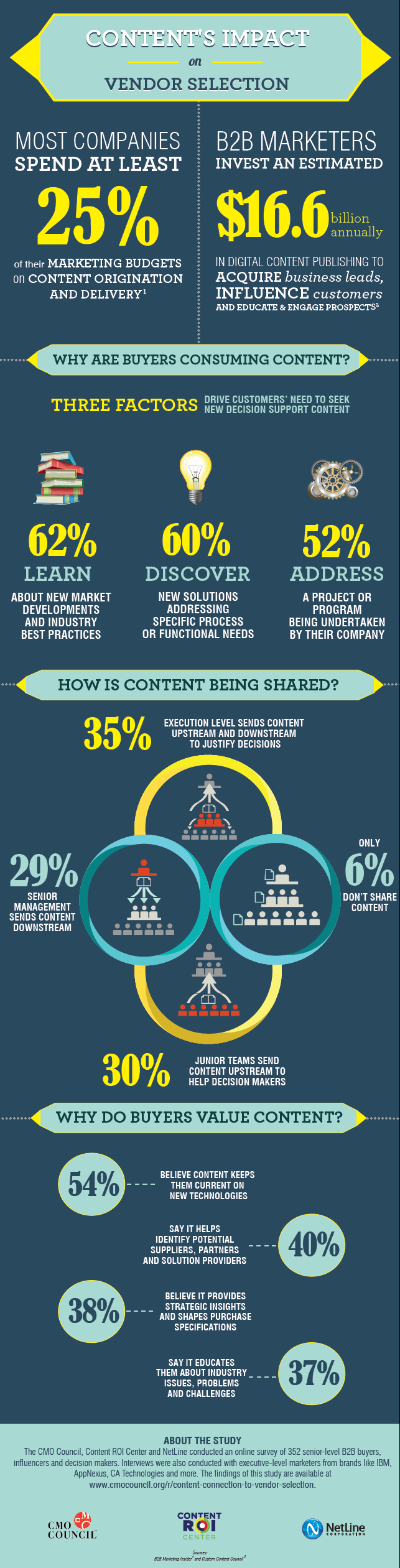
93% of B2B companies use content marketing. If you want your content marketing efforts to be effective you need to understand why B2B buyers consume and value content. When you understand what B2B buyers think about content you can create and distribute the right content – content that will help you grow your business by driving profitable customer action.
The CMO Council, Content ROI Center, and Netline conducted a survey of 352 senior-level B2B buyers, influencers, and decision makers with the objective of determining content’s role in influencing B2B buyers in the purchase process.
Why do B2B buyers consume content?
B2B buyers turn to content for a number of reasons including to:
- Learn about new market developments and industry practices;
- Discover new solutions to address a specific problem;
- Address a project or a program being undertaken by their company.
Why do B2B buyers value content?
B2B buyers value content because it:
- Keeps them current on new techniques;
- Provides strategic insights and shapes their purchase specifications;
- Educates them about industry issues, problems, and challenges.
Source: CMO Council
Understanding what B2B buyers think about content and why they use content will enable you to create, curate, and distribute content that speaks to B2B buyers and attracts new customers and engages current customers.
If you consistently create, curate, and distribute content that B2B buyers find valuable, you will realize results.
![Get SMART about your marketing goals [Free Marketing Goals Template]](https://fronetics.com/wp-content/uploads/2024/10/marketing-goals.jpg)
by Elizabeth Hines | Jan 22, 2015 | Blog, Leadership, Marketing
Want to reach your marketing goals? It’s time to get SMART.
Do you know what it is you’d like to see your business achieve this year? It’s likely you do. In fact, most people know generally what they’d like to see happen over the course of a year because they plan. But don’t be fooled, SMART goal setting is far more than just planning.
If you aren’t yet familiar with the SMART Goal concept, it’s essentially a roadmap to success. It makes our goals Specific, Measurable, Attainable, Realistic, and Time-Bound. SMART Goals are a tool that can be applied in many settings. For example, SMART Goals can be used to reduce costs associated with order fulfillment as well as to increase your website’s monthly visits and visitor to lead conversation rate.
Let’s take a look at how one marketing manager, we’ll call him Sam, might apply the SMART goals framework to his marketing efforts.
Specific – Here Sam will describe his goal in detail. He knows he wants to increase website traffic this year, but that’s not enough, so he gets specific. Sam sets a goal of increasing website traffic by 15% by the end of this fiscal year.
Measurable – How will Sam track his progress? In order to keep Sam on track to meet his goal by target date he set, he decides to use the website performance indicators he already tracks monthly.
Attainable – Sam’s goal should be challenging, but not impossible to reach. He reviews his company’s digital media strategy and prior year website traffic reports. After reviewing those, he decides that his current goal to increase sales by $250,000 by the end of this fiscal year is challenging yet achievable.
Realistic – Sam’s company expanded its product line at the beginning of the fiscal year, so it’s likely the company will experience increased marketplace exposure – an ideal situation for his goal of increasing website traffic.
Time-Bound – Sam plans to reach his goal by the last date of this fiscal year. He will track his progress monthly using website performance indicators.
By setting a SMART goal, Sam gives himself a specific focus and builds structure to his general plan of increasing website traffic. Breaking it down into more manageable parts will give him the motivation he needs to reach his goal.
What are your marketing plans for this year? Do you have a SMART goal guiding you? Increase your chances of success by downloading our free Marketing Goals Template.


by Elizabeth Hines | Jan 20, 2015 | Blog, Content Marketing, Marketing, Social Media
Content and social media are integral to business growth
Editor’s Note: This is a guest blog written by Kecia Gray, Vice President, Corporate Marketing & Communications, Transplace. Transplace is a premier provider of transportation management services, intermodal, truck brokerage, and SaaS TMS solutions. Transplace successfully leverages social media and content to expand the company’s brand awareness and thought leadership. The company’s LinkedIn page, Facebook page, and blog were named as “favorites” in a survey conducted by Fronetics.
At Transplace, social media has become an integral part of our marketing and communications strategy and key to expanding our brand awareness and thought leadership in the logistics and transportation space. Our marketing and communication team has had the opportunity to utilize multiple social channels, including:
While we consistently post content to all of these channels, what has been and continues to be important to our social strategy is creating our own original content and utilizing it within a more aggressive approach on Facebook, Twitter and LinkedIn. Sharing content on these channels has allowed our newest blog to achieve fast success in under a year’s time.
Content Is King…
Within any industry, there is always significant opportunity to create original thought leadership content that is informative and insightful. When developing a social media strategy, our foremost goal was to establish a thought leadership blog resource for the market, in addition to providing engaging and personalized content across social channels that was easily sharable. Our main objectives focus on connecting with customers, and creating content that resonates with the members of our industry and provides value to their businesses. By distributing this content across our social channels to foster sharing, conversation and engagement, we’ve continued to gain influence with our targeted audiences.
…And Metrics Are Key
Because of the rapid pace of developing content, it’s important to track and report on levels of engagement to optimize and repurpose information. We created a social plan that included a comprehensive calendar to capture the topics and content items we’d be working on throughout the year. For maximum integration, we purposely aligned new pieces to marketing campaigns and corporate objectives such as events, transportation services and current industry issues. In addition, we established benchmarks and metrics that were important for us to track, such as followers and level of engagement. Analyzing the data allowed us to regularly monitor and evaluate our program, maximize what worked and adjust areas that did not meet expectations.
Incorporating Talent for Quality Thought Leadership
We have also taken advantage of the significant opportunity for Transplace employees at all levels to contribute quality thought-leadership posts across a number of channels. We’ve learned that the best place to utilize this content is on the company’s logisticallyspeakingblog.com. Some of the posts we’re most proud of turned out to be the most popular of 2014, including:
- A motivating guest blog post highlighting our dedication to our customers – from George Abernathy, our president and CCO.
- An insightful commentary on the growth of Transplace in light of a recent acquisition – from Frank McGuigan, president of transportation management at Transplace.
- An informative infographic recap of our signature event, the annual Transplace Shipper Symposium, highlighting some amazing speakers.
To ensure we always stay up-to-date and focused, our team holds quarterly meetings in which we share key highlights, metrics and snapshots of the program quarter by quarter. The time is used to plan for what’s coming up in the future, brainstorm new ideas and make changes as needed. We always make the utmost effort to continually update our program and assess our short and long term goals – an important aspect to any social program!
How is your organization utilizing social media and thought leadership content?