by Elizabeth Hines | Dec 31, 2014 | Blog, Content Marketing, Marketing, Strategy
Content marketing is among the hottest topics in marketing and media. However, most companies should stop their content marketing efforts – immediately. The reason these companies should stop is because, despite the hipness of content marketing, they will not realize a positive ROI and will not grow their business through content marketing. In short, many companies are just plain wasting their time and money.
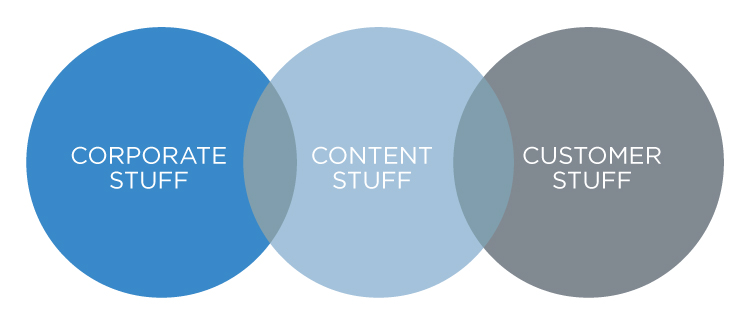
Everybody – companies and customers – has stuff. Joe Pulizzi, Founder of the Content Marketing Institute, discusses the importance of not only recognizing this reality, but also the importance of acting on it.
Pulizzi defines three categories of stuff:
- Corporate stuff;
- Content stuff; and
- Customer stuff.
The majority of companies fall prey to focusing on content stuff within a vacuum. But, as Pulizzi points out: “For content marketing to work, we need to link the corporate stuff with the customer stuff through content.”
What does this mean? This means that in order for content marketing it be effective you need strategy. Strategy is what enables you to link what you know as a brand (corporate stuff) with customers’ needs (customer stuff) through content.
The importance of strategy is underscored by the results of a 2014 study. The study found that 93% of B2B marketers use content marketing. 60% of companies who have a documented content strategy in place consider their efforts to be effective as compared to 11% of companies with no documented content strategy in place. Similarly, the study found that companies who put a person in charge of content marketing were more likely to be successful than those who did not (86% vs. 46%).
If your company is employing content marketing and does not have a strategy in place, stop. Create a strategy, put someone in charge, then re-start your efforts. With a strategy in place, content marketing will drive profitable customer action.
by Elizabeth Hines | Dec 30, 2014 | Blog, Logistics, Manufacturing & Distribution, Marketing, Social Media, Strategy, Supply Chain
 I wrote a guest blog for freight logistics company Cerasis in October which discussed how companies within the manufacturing, supply chain, logistics, and industrial industries can increase their B2B visibility on LinkedIn.
The catalyst for writing the blog were results from a recent survey focused on the supply chain and logistics industry. 58% of respondents rated LinkedIn as “very impactful,” and 37% rated LinkedIn as “somewhat impactful.” At the same time, respondents reported challenges associated with strategy (33%) and a lack of understanding about the application of social media (24%).
Leveraging LinkedIn
There are over 3 million LinkedIn company pages. Being present on LinkedIn is critical, but is not enough. To maximize your LinkedIn presence you need to take steps to increase your B2B visibility. Here’s how:
-
Create a compelling company page
Your company page is an extension of your company. Make sure that the page is compelling, informative, and presents your company as a leader within the industry.
-
Be active
In addition to keeping your company page up-to-date, you need to be active on LinkedIn on a daily basis. LinkedIn groups are great. Actively participating in LinkedIn groups will allow your company to: 1) gain business and market intelligence; 2) introduce you to new, interesting, and relevant topics; 3) help you increase brand awareness; and 4) position your company as an industry leader.
-
Distribute content
If you want your content to be seen you need to get it out there; you need to distribute your content. Distribute your content and curated content via your company page and (when relevant) within the LinkedIn groups to which you belong.
-
Employee engagement
Your employees are your brand ambassadors. Empower your employees to be active within LinkedIn groups as representatives of your company. Encourage employees to share your content and industry content with their connections. Additionally, encourage employees to share open positions with their LinkedIn connections, and to identify great talent within their network.
-
Prospect for leads
LinkedIn is an effective prospecting tool. Use LinkedIn to prospect for leads and to build your sales pipeline.
-
Optimize your profile
Every employee is a reflection of the company. Encourage employees to optimize their personal LinkedIn profiles.
-
Don’t be annoying
You will fail if you take a “me, me, me attitude.” Constantly self-promoting is bad for business.
If your company is not using LinkedIn you are missing out on opportunities and revenue.
by Elizabeth Hines | Dec 25, 2014 | Blog, Content Marketing, Marketing, Strategy
Fronetics Strategic Advisors is a management consulting firm focused on strategy and inbound marketing. When it comes to inbound marketing we take a different approach than other firms. This is because of our business experience and background. We know ROI is important, so our approach is data driven and produces results.
What is inbound marketing?
Inbound marketing is very different from traditional, or outbound, marketing. Inbound marketing focuses on creating quality content that attracts people to your company and product. By aligning the content you publish with your customer’s interests, you attract the right traffic – traffic that you can then convert, close, and delight over time. Outbound marketing, in contrast, uses methods including: buying ads, buying email lists, and cold calling.
Inbound marketing works
Research conducted by HubSpot found that inbound marketing is more effective than outbound marketing:
- 200% average ROI;
- 62% lower cost head;
- 15% increase in top line revenue.
Freight logistics company Cerasis decided to make the switch from outbound marketing to inbound marketing. Within 25 months the company gained 98 new customers and increased revenue by 14%.
Our approach
Strategy matters. A 2014 study of B2B marketers found that companies who have a documented content strategy in place are more likely to consider their efforts to be effective than companies who do not have a documented strategy in place (60 percent vs. 11 percent). We work with our clients’ to develop a strategy that is right for their company. We then work with our clients’ to implement the strategy.
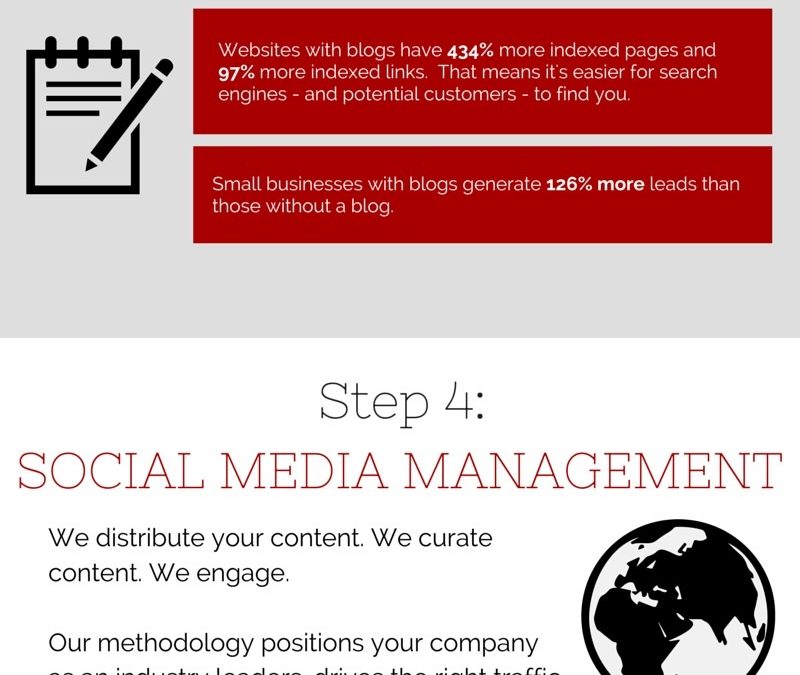
Here’s what we do:

What now?
We understand that developing and implementing an inbound marketing strategy can seem daunting. We are here to help. We are happy to take a few minutes and look at your current strategy and give you ideas on how to start, or suggestions on what you can do to make your current strategy more successful. We are also happy to talk with you about what we can do.
If you are, like many other people, stretched for time and also struggle with strategy and execution, we can also talk to you about what Fronetics does and how we can help. We know some people prefer to do it themselves, and others prefer to outsource.
We’d love to talk with you about how you can grow your business through inbound marketing.


by Elizabeth Hines | Dec 24, 2014 | Blog, Marketing, Social Media, Talent
LinkedIn is the largest social network for professionals. There are more than 332 million users – and this number is growing rapidly. An average of 2 users joins LinkedIn every second.
There is the perception that LinkedIn is only for job seekers, and that a red flag will be raised if those who are employed update their profile. Neither is accurate.
Here are 6 reasons you need to be on LinkedIn even though you have a job:
Your personal brand matters
People are looking at your LinkedIn profile to learn more about you. And it isn’t just recruiters or potential employers looking on LinkedIn. Clients, colleagues, and even your current employer look to your LinkedIn for information on who you are, what you have done, and what you do.
Because your personal brand matters, take the time to optimize your LinkedIn profile.
Network, network, network
Networking is often thought of as a (dreaded) job search action item. However, thinking about networking in this manner will leave you at a disadvantage. Networking is an action item necessary for your professional and personal growth.
LinkedIn is an incredible network building tool. Leverage it and “Network your face off.”
Industry groups
Being involved in relevant LinkedIn groups will help you grow your network. It will also help you stay up-to-date on what is happening within your industry, and give you the opportunity to get involved in the conversation.
News
Company and individuals are posting content, and having conversations on LinkedIn every day. These conversations and the content posted are chock full of relevant news.
Be a brand ambassador
Is your company hiring? Share the posting with your connections. Also, take the time to look through your connections; is there anyone who might be a good fit for the position? If so, reach out to them. Bonus: your company may compensate you for referring a candidate if they are hired.
Opportunities
You may not be looking for a new position, but what if the perfect position fell into your lap? If you are active on LinkedIn and have optimized your profile, you may find that people begin reaching out to you and present you with opportunities.
Have a job? Be active on LinkedIn. Not being active is more likely to raise a red flag.
by Elizabeth Hines | Dec 18, 2014 | Blog, Marketing, Social Media, Strategy
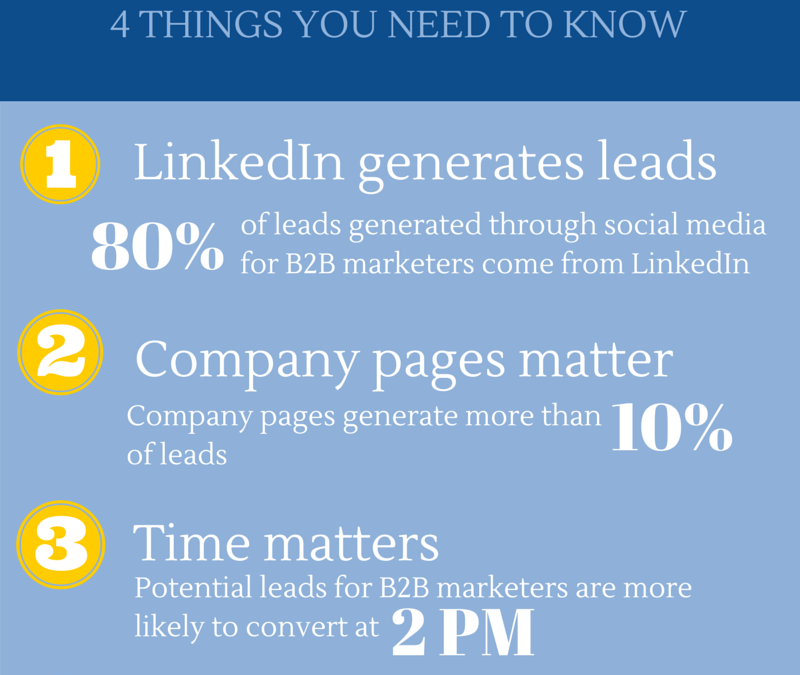
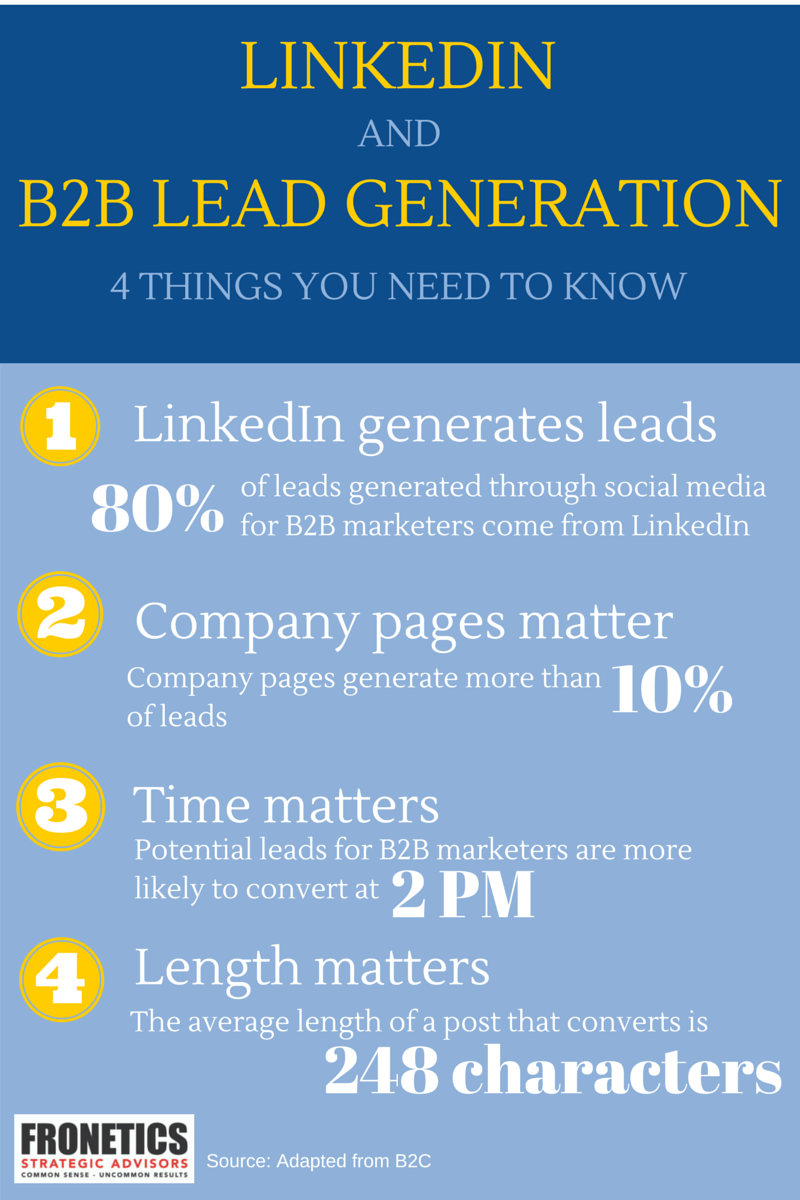
Oktopost, a social media marketing platform, analyzed over 100,000 posts on four different social networks (LinkedIn, Twitter, Facebook, and Google+) and found that LinkedIn is the most effective social network for B2B.
Oktopost found that more than 80% of B2B leads were generated through LinkedIn. Lead generation through other social networks paled in comparison:
- Twitter: 12.73%
- Facebook: 6.73%
- Google+: 0.21%
We’ve put together an infographic that outlines four things you need to know about LinkedIn and lead generation.

by Elizabeth Hines | Nov 27, 2014 | Blog, Leadership, Marketing, Strategy
The Dunkin’ Donuts in Boston’s Back Bay Station is a well-oiled machine. The whole process – ordering a cup of coffee, paying, and receiving said coffee – takes seconds. The experience is something reminiscent to Seinfield’s Soup Nazi.
For customers who frequent this Dunkin’ Donuts expect this. They have timed their commute down to the minute and they know that if they can move through a line of 30 or so people in seconds – and make the train. For customers who don’t frequent this Dunkin’ Donuts the experience can be jarring.
On the other hand, there is a small coffee shop I visit in Maine. It takes minutes (think two digit numbers) to get a cup of coffee, and then more minutes to pay. Customers who frequent this coffee shop savor this time that it takes to get their coffee. The minutes waiting allow for conversations or quiet meditation.
Watching someone new enter the coffee shop is always interesting. There are those that start to wait in line and then leave when, after minutes, they are no closer to getting coffee. There are others who wait it out, checking their watch or smart phone every few seconds as if this will speed up the process. These people generally leave in cloud of frustration.
These two businesses know their customers. They have taken the time to understand what the needs are of the customer and they have tailored their business to address these needs.
To grow your business you need to take the time to determine who your target customer is, what their needs are, and how you can address these needs and bring value to the customer.