by Elizabeth Hines | Sep 8, 2015 | Blog, Data/Analytics, Marketing
The profile of marketing has definitely been raised lately. With a full 63% of businesses planning to increase their marketing budgets this year, its clear business leaders are looking directly to their marketing departments to drive growth. Along with expanding budgets and more pressure to produce results, marketing metrics are being more heavily scrutinized by executives; marketing departments are being asked to prove the worth of the increased investment in their marketing efforts. And with an enormous amount of potential data to track, marketing can seem more like big data. The good news is it doesn’t have to. Successfully presenting the value of your marketing efforts means showing your boss the metrics that will resonate and prove that you’re moving the needle where it really counts.
Do you know which metrics actually matter to your boss? Rather than talking about per-post Facebook engagement and other “soft” metrics, can you tell your boss, for example, if your company is spending more money this year to acquire new customers than it did last year? Let’s take a look at how you can calculate your company’s Customer Acquisition Cost (CAC) and why your boss actually does care about it.
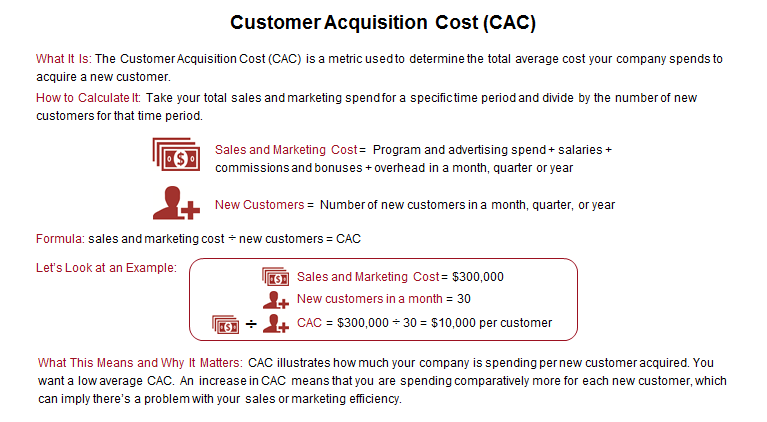
Reporting on measurements that link your marketing efforts to the company’s bottom line, such as Customer Acquisition Cost (CAC), will put your marketing team in a much better position to make the case for executive support of current and future budgets and strategies. For more metrics that matter, download our guide to The Six Marketing Metrics That Your Boss Actually Cares About. Our 10-page guide lays out the six marketing metrics that will prove the value of your marketing efforts, along with formulas and examples to help you calculate your own metrics and explanations of why your boss finds these metrics so important.


by Elizabeth Hines | Sep 7, 2015 | Blog, Strategy, Supply Chain
Multi-channel distribution is likely to fuel the demand for on-demand packaging as companies continue their search for more cost-effective solutions.
Only 7% of companies are making their boxes on demand. However, that figure is set to grow quickly. The explosive rise of e-commerce and all the uncertainties it entails in terms of order fulfillment will likely prompt a growing number of companies, especially those serving multiple sales channels, to seek the answers in on-demand packaging.
The potential savings of always getting the right-sized box at just the right time should speak to all those multi-channel distributors. In a Peerless Research study, distributors were asked to name the areas where fulfillment costs have gone up. The three most popular answers were transportation, labor, and packaging and materials.
A corporate manager at an e-commerce business said about trends in packaging automation, “We are able to consolidate multiple orders from one customer into as few boxes as possible. This saves on time and shipping costs.”
That study talks of the “ripple effect” felt throughout the supply chain as packaging optimization drives down the number of cases on a pallet, as well as storage space requirements and shipping costs, and ultimately has the power to increase a company’s sustainability rating.
In numbers, some of the advantages cited by on-demand packaging proponents include:
- A 28% reduction in the quantity of corrugate
- An 80-90% reduction in filling material
- Savings of 20-35% over conventional supply chains
- A 75% reduction in footprint required by two laborers to pack dunnage, seal, and label a box
Packsize, one of several companies behind the new automated technology, says it actually takes less time to make packaging on demand than going the conventional route of locating and moving packaging purchased from a vendor. Stockouts and obsolete inventory also become relics of the past when boxes can be made minutes before they are needed. In an industry chasing next-day or even same-day delivery, any gain in timely execution counts as a victory.
Though 80% of the 322 top materials handling, logistics, and supply chain managers surveyed by Peerless still purchase and store their corrugated boxes, the trend is pointing in favor of the new solutions. Industry familiarity with on-demand packaging is increasing while the desire for new packaging solutions continues to grow. “We currently have to order in advance custom size boxes for upcoming orders, and it would be better to make them on the fly, adapting to changes,” an engineering manager said. “We are considering some form of on-demand packaging to prevent the storage of cartons,” another said. “We can use the space better.”
It all sounds promising, but is it the way of the future?
Fronetics Strategic Advisors is a leading management consulting firm. Our firm works with companies to identify and execute strategies for growth and value creation.
Whether it is a wholesale food distributor seeking guidance on how to define and execute corporate strategy; a telematics firm needing high quality content on a consistent basis; a real estate firm looking for a marketing partner; or a supply chain firm in need of interim management, our clients rely on Fronetics to help them navigate through critical junctures, meet their toughest challenges, and take advantage of opportunities. We deliver high-impact results.
We advise and work with companies on their most critical issues and opportunities: strategy, marketing, organization, talent acquisition, performance management, and M&A support.
We have deep expertise and a proven track record in a broad range of industries including: supply chain, real estate, software, and logistics.


by Elizabeth Hines | Sep 3, 2015 | Big Data, Blog, Data/Analytics, Logistics, Strategy, Supply Chain
Big data is, well, big. The term has gotten lots of buzz the past few years. But it’s big in other ways as well. According to McKinsey big data is defined as “datasets whose size is beyond the ability of typical database software tools to capture, store, manage, and analyze.” A 2014 Forbes article has 11 other helpful definitions.
With current technologies, there are increasing amounts of information to be gathered and exchanged in the world, creating more opportunities for businesses to harness that information and chart a course or tweak processes based on that information. According to an Accenture study, “97% of executives report having an understanding of how Big Data analytics can benefit their supply chain, but only 17% said that they have implemented it in at least one supply chain function.”
In a Boston Consulting Group article, Making Big Data Work: Supply Chain Management, the authors suggest three high-potential opportunities for supply chain management to take advantage of big data. Their suggestions help parse through the complicated, overwhelming network of big data. As they suggest, “with so much available data and so many improvable processes, it can be challenging for executives to determine where they should focus their limited time and resources.” Let’s have a look at the authors’ ideas, as gathered through research, on how to “increase asset uptime and expand throughout, engage in preventive maintenance of production assets and installed products, and conduct near real-time supply planning using dynamic data feeds from production sensors and the Internet of Things.”
Visualizing Delivery Routes
Big data, in the form of geoanalytics, can be used to better manage supply chain routes and help reduce transportation costs by 15-20%, especially when other partner companies are trying to coordinate deliveries. “The companies learned that they shared similar patterns of demand. Vehicle-routing software also enabled rapid scenario testing of dozens of route iterations and the development of individual routes for each truck. Scenario testing helped the companies discover as much as three hours of unused delivery capacity on typical routes after drivers had covered their assigned miles.” Real-time data from live traffic feeds, combined with past data helped to create new forecasts and eliminate wasted time.
Pinpointing Future Demand
In today’s volatile marketplace, relying on sales predictions can be risky and inaccurate, at best, a disaster at worst. According to the BCG article, advanced languages can now work together to create a most accurate forecast, freeing up sales people and their precious time to combat other issues and convert leads. “Advanced analytical techniques can be used to integrate data from a number of systems that speak different languages—for example, enterprise resource planning, pricing, and competitive-intelligence systems—to allow managers a view of things they couldn’t see in the past.”
Simplifying Distribution Networks
The European consumer goods company profiled in the BCG article, used advanced analytics to downsize from 80 factories across 10 countries, down to 20 factories. The distribution network shrunk, and efficiency and savings increased, the latter by 8%. Working with big data can help examine a diverse amount of information never before analyzed. Taking complex data and knowing how to handle the data can turn complexity into simplicity.
Marcelo Simiao, Lean Manager— Operations at Munters, seems to concur with the findings, and believes big data can make sweeping changes.
“Companies are struggling with today’s greater demand volatility. The Order-to-Delivery processes have been the focus of many improvement projects and lean initiatives that aim to reduce costs and improve response times. But most of today’s organizations have their supply chain functions fragmented into several different departments, creating process improvement projects that have results limited to the data they have at hand. This approach often doesn’t deliver value to the end customer. Big Data is changing this scenario by integrating the voice of the customer, sales and the entire supply chain. This integration and thorough data analysis allows organizations to align all of their focus on key projects that are not limited by functions, will improve customer satisfaction, and deliver results directly into the company’s bottom line.”

by Elizabeth Hines | Sep 2, 2015 | Blog, Marketing, Social Media, Strategy, Talent

92% of businesses use social media as a recruitment tool – and 75% of hiring managers say they check out candidate’s social media profiles. With hiring managers and recruiters using social media to post jobs and identify great talent, it is obvious that you need to use social media in your job hunt. What isn’t as obvious is how to do so without your current employer finding out.
Here are 4 tips for conducting a successful and stealthy job hunt:
1. Check/change your settings
Before you do anything check and change the settings on your social networks.
By default, social networks are set up to notify your connections of: changes made, connections made, and groups you join. Change this. Go into your settings on each of the social networks you are on and change your settings so that you can fly under the radar.
2. “Dress” professionally
You only have one chance to make a first impression. Your social media profile may be the first impression hiring managers and recruiters have of you. Your profile is also part of your professional brand. It’s therefore important to:
- Use a professional picture (no pets, no cropped arms)
- Remove party pictures and anything else that is not professional
- Be consistent with your personal branding across your profiles.
3. Optimize your social media profile(s)
Optimize your social media profiles to match the job you want. I’m not saying you should make up experience or skills, rather I am saying that you need identify the skills hiring managers and recruiters will be looking for, and highlight your applicable skills and experience. You want to optimize your profile so that your profile will not only showcase your qualifications, but will also ensure that your profile will show up when hiring managers and recruiters are searching for the ideal candidate for your dream job.
How do you do this? Start by defining your target industry and position. As you research companies and job descriptions that match your target make note of keywords (not buzzwords), skills, and qualifications that are recurring. Optimize your social media profile(s) to include these keywords and to highlight your relevant skills and experience.
4. Research, research, network
Research with the objectives of: identifying target companies and networking.
Use the keywords you identified in defining your target industry and position and search social networks for these keywords. (Don’t forget to search groups. LinkedIn groups, for example, are essential in your social media job hunt.) When your search turns up a company that looks to be a good match, look through your connections to learn if there is someone who can introduce you to an employee at the company (just remember not to use your employer or colleagues to make the connection). A connection is an opportunity to learn more about the company – the culture, opportunities, and challenges.
Employing these 4 techniques will help you use social media to find a job – without getting fired.
One thing to remember – a social media job hunt will prove much more successful if you have a strong network. Creating and building a network when you start your job search will leave you at a disadvantage. Networking is an action item necessary for your professional and personal growth. If you view networking as more than just a job search must, you will gain a competitive edge and will be in a much better place when it is time to start your search. So, get out there and “network your face off.”

by Elizabeth Hines | Sep 1, 2015 | Big Data, Blog, Data/Analytics, Strategy, Supply Chain
Many organizations that jumped on the big data bandwagon have struggled to turn their new, boundless collection of data into actionable business information. As consultant Rich Sherman of Athena IT Solutions puts it, today’s businesses are struggling with “the transformation of data into information that is comprehensive, consistent, correct and current.”
Enter data governance programs, and, consequently, the data steward. Technology cannot always extract the most useful data, but the data stewards can, meaning the success of the data governance program rests to a large degree on their shoulders. But data stewards can be viewed with suspicion by other employees and nothing can kill the spirit of hard work more than distrust or a feeling that management is snooping and ready to pounce at the sign of even the slightest misstep.
Some business users are under the impression data stewards have been tasked to play dual roles, championing the organization’s data governance program while also using their position to crack down on anyone stepping out of line. To some, the data steward is really a data cop who “police” rather than manage the organization’s critical data elements. They believe anyone can be caught in the net cast by the data stewards as they fish for out-of-compliance data and bring it into line with policy or regulatory obligations. This can create needless friction within the organization and threaten the effectiveness of data efforts altogether. We can’t ignore concerns caused by the growing presence of data stewards at many organizations; in fact, it makes it even more important to show why such concerns are generally unfounded.
While it is true data stewards are indeed tasked with ensuring compliance with the policies and processes of the data governance program, critics need to bear the end goal in mind – to turn massive amounts of data into a useable corporate asset. And data stewards themselves can actually play a role in the effort to help “to take the view of data governance from police action to harmonious collaboration,” as another expert, Anne Marie Smith of Alabama Yankee Systems, LLC, put it. It won’t hurt for the data stewards – or the data governance managers – to acknowledge some employees will initially question their intentions. However, by reaching out to each business unit and explaining how data governance works and why improved data management will benefit the organization, the distrust can dissipate. Similarly, if the data steward is recruited from within the organization, it will alleviate some concerns since business users are more likely to trust a familiar face.
The complexity of data governance comes with a host of pitfalls – fears of data cops shouldn’t be one of them. What’s been your experience with data stewards in the supply chain? Do they play an important role in your organization?