![How to Keep Your Company Data Safe in a BYOD Environment [Infographic]](https://fronetics.com/wp-content/uploads/2015/09/BYOD-policy-checklist-800x675.jpg)
by Elizabeth Hines | Sep 16, 2015 | Blog, Data Security, Data/Analytics, Marketing, Social Media, Strategy
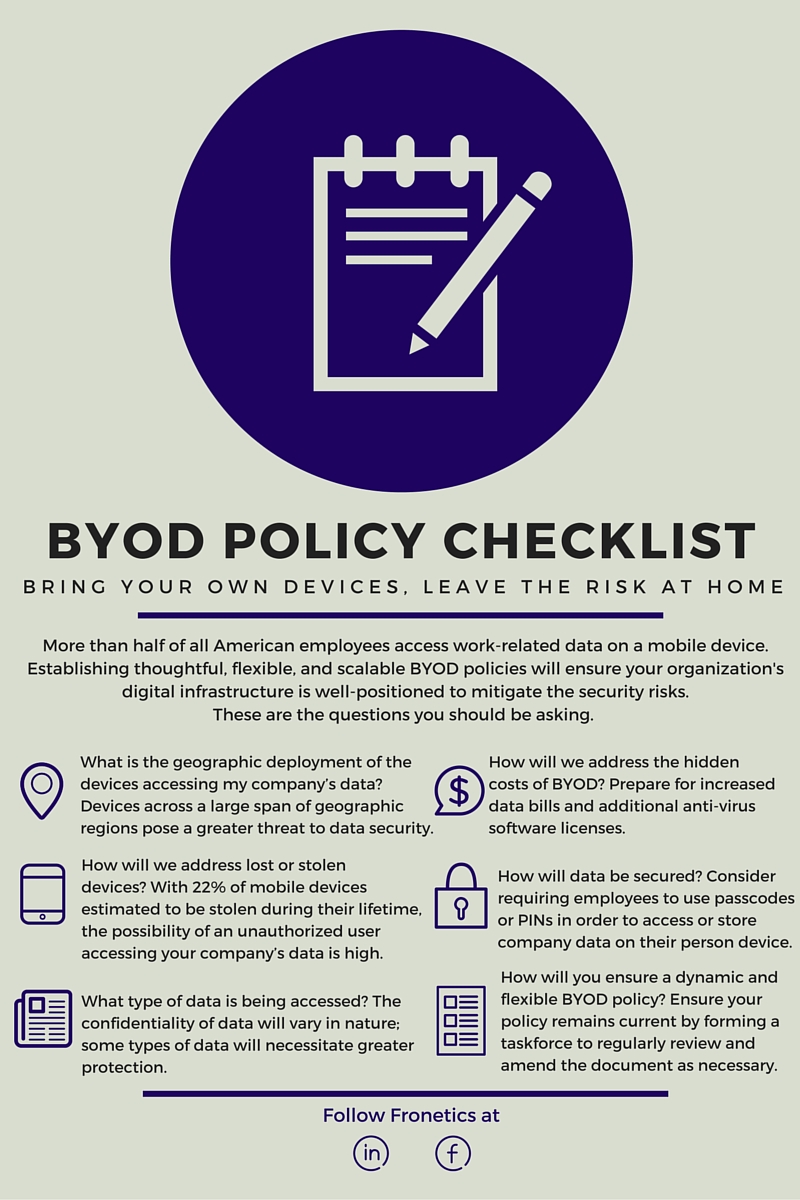
While the Bring Your Own Device (BYOD) concept has quickly gained traction in the business world, many companies have been slow to address its threat to their data privacy. Even for companies that have recognized the need to prioritize digital security, many have struggled to establish policies that support personal device use while protecting their data. And that’s risky given the high level of connectedness many employees now enjoy – with or without formal guidelines or policies. It leaves businesses open to enormous potential for data leaks.
To avoid the potential leak of data, your company should establish policies on the use of personal and mobile devices such as tablets, smart phones, and laptops that may be used to access your company’s computing and communications systems. Here are six crucial items to consider as you set out to mitigate the risks of your own BYOD culture.

by Elizabeth Hines | Sep 15, 2015 | Blog, Data Security, Data/Analytics, Marketing, Social Media, Strategy
Personal connected devices – our laptops, cell phones, and tablets – are arguably the most complicit tools in the recent blurring of the parameters between personal and work life. And while most businesses have generally recognized the benefit of allowing employees to use their personal devices for work purposes, the bring-your-own-device (BYOD) revolution has certainly thrown a curve ball to those responsible for safeguarding company data. Although corporate finance groups are singing the praises of the trend due to its inherent reduction in costs, it’s not all rosy in the BYOD world. That’s why it’s crucial to format a corporate strategy policy that will protect your company from a potentially dangerous data-leak train wreck.
Here’s why: Employees are now widely accessing corporate data from their own computer, a tablet, even their mobile phone. With so many of us bringing more and more smart devices inside our office environments and hooking them to our corporate networks, the potential for data leakage grows exponentially. When anti-virus and digital security software company BitDefender set out to explore the connectedness of typical American workers last year, they found that over half stored work-related data on their personal devices. Shockingly, almost 40 percent of them had nothing in place to prevent unauthorized access to their device. Further, in a study conducted by the University of Glasgow, 63 percent of used smart devices purchased through second-hand stores and eBay-like marketplaces still had data on them. This data included personal information as well as sensitive business information.
The problem is there’s no chain of custody in the BYOD world. Think about it. When the corporations owned your cellphone and your PC or laptop, they controlled its issue to you, how you used it, what software you put on it, and when and how it was turned in and destroyed. A solid internal tracking of electronic assets coupled with a solid electronic asset disposal solution provider meant that, for the most part, the corporate digital assets were safe. In the BYOD world, the corporation does not own the IT equipment. Personal smart devices are being linked to corporate IT environments. This mating of personal and professional equipment and data is happening everywhere. Your corporate data is being commingled with secure and non-secure access points to the Web, cloud, etc. Not to mention the fact that those devices metaphorically walk in and out of your office every day, and you have no control.
Companies are scrambling to address this issue in a number of ways. Some have addressed the problem via software solutions at the enterprise level (think Blancco or BlackBerry enterprise), some at the device level (think solutions like Apple Find My Device, etc.), and some at the human resources and legal levels with policies and procedures that prohibit users’ use of corporate information. But the truth is, without a chain of custody model incorporated with these solutions, once the corporate data is accessed or downloaded, it’s already gone — you just don’t know it yet.
The reality is that it’s going to take some time for the corporate world to catch up with what some have called the “semi-private information revolution” like the cloud, Facebook, or social media. Secure file sharing, essential for an organization’s BYOD guidelines, is one of the best options available. Services are now available to help with cloud encryption and it’s changing the way we share and monitor files. Encrypting data is crucial and minimizes the risk of sharing sensitive data and having it tampered with. Rely on your electronic asset disposal provider to help your company develop a strategy and process that is aligned with your corporate information sharing guidelines. Right now, your corporate data is only as safe as the process that you create.
Fronetics Strategic Advisors is a leading management consulting firm. Our firm works with companies to identify and execute strategies for growth and value creation.
We advise and work with companies on their most critical issues and opportunities: strategy, marketing, organization, talent acquisition, performance management, and M&A support.

by Elizabeth Hines | Sep 14, 2015 | Blog, Content Marketing, Marketing, Strategy

Selling certainly isn’t like it used to be. Take the requisite childhood lemonade stand, for example. Every summer thousands of entrepreneurial youths take to their neighborhood streets with pitchers of homemade lemonade to offer passers-by a cool drink for a small fee. For decades now these business startups and their transactions have generally been straight-forward. Recently, though, the owners and operators of these businesses, almost all children, have faced increasing complexity in their business environment. Local authorities have been cracking down on lemonade stands without proper city permits or food handling licenses. Potential customers have grown more mindful of product ingredients. These new idiosyncrasies have everyone wondering, “When did selling become so complex?”
Successful companies have adapted to these new selling pressures by placing emphasis on a strategic selling process. MHI Global suggests that these strategic selling processes “significantly improves the odds of [a business] winning complex sales opportunities by defining a process for pursuing sales opportunities and establishing common criteria for allocating resources.” Those companies are then able to determine when to walk away from resource-intensive deals with a low probability of success, giving salespeople the time and energy to focus on the opportunities most likely to become profitable, long-term customers.
There’s little doubt that the role of strategic selling is one of the toughest in any organization. It’s also one of the most expensive line items for most companies – so getting it right is important. There are a lot of great strategic sales teams out there, to be sure. But there’s an equal amount of selling teams that could use some advice.
Here are five ways to optimize your strategic sales teams and, in turn, increase their revenue-producing effectiveness.
Devise a Process
Strategic selling is a process. Like any process, discipline and milestones mark the way. Only through uniform use, iteration, and formal improvement will your organization, the sales team, and the salesperson become more effective. I don’t care what the process looks like…yet. Get a process that everyone can track inside your organization and stick to it. No loose cannons or end around players….they devalue the process.
Refine Your Process
Once you have an established process, take the time to refine it. The most successful strategic selling processes include some iteration of the following items:
- Assessing the selling opportunity
- Developing a competitive strategy
- Identifying the key decision makers and their motives/agendas
- An action plan
- Sales plan testing and improvement
- An organization implementation process
Create a Compelling Event
If your sales process relies solely on responding to RFPs, you are not strategically selling….you are responding to opportunities that every qualified organization will see and compete for. Create a compelling event inside your target customer. The easiest sale is the one that your competitors never knew about in the first place. Creating a sense of urgency and need inside a customer is hard work and takes time, but that’s what makes it valuable to your client and your organization. Knowing your customers’ needs and how your solution fits makes you more valuable than a traditional “RFP responder”. Be there first, be relevant, and be action oriented and your customers will rely on your solutions more often.
Make the Most of Your Resources
Time is money and both are scarce resources. Make the most of these precious resources and never fall in love with an opportunity unless it meets the following criteria. If it fits, engage fully and engage to win. No half efforts. Ask yourself these questions:
- Is there a true opportunity that has been clearly identified and agreed to within your customer’s organization? Said another way, is there a “compelling event” as mentioned above that everyone involved is aligned around?
- Can you compete to win? Does your solution or unique business differentiator align to produce customer benefit? Can it be aligned?
- Can you win? Are there any commercial obstacles that would stand in the way to your winning? These can be politically driven, relationship driven, or even solution driven.
- Is the opportunity worth winning? Does it have the desired ROI for the investment of selling resources? Does it contain enough profit to engage your organization? Is it too risky a fit (a force fit to your solution) or does the risk and reward balance? Can your customer pay for the service? Have they allocated funds?
Avoid ‘Work for Free’ Promotions
Stay away from “free trials” or “free pilot” engagements. In fact, run from them. If your customer is headed down that path, revisit number four above. It could be that they do not completely understand your solution and how it fits, or simply that they have no funds to undertake the engagement. In either case, time is money and it’s time to move on.
Make no mistake, the strategies listed above are not easy to instill in a sales organization. But by doing so, true opportunities will increase, they will have greater value, and your chances of success will soar. No hard work goes unrewarded.

by Elizabeth Hines | Sep 10, 2015 | Blog, Marketing, Social Media, Strategy, Supply Chain
Are you ready to harness some of the $1 trillion dollars social media can bring the value chain yearly?
There are over 3 billion internet users on Earth, or nearly half the world’s population. The growth of worldwide internet users from 2000- 2015 was 753%. In developing economies the percentages are much higher: Africa’s users grew by 6958.2%, the Middle East’s users grew by 3,358.6% and Latin America/Caribbean’s grew by 1684.4%. There are 1.5 billion social media users worldwide.
Many people use social media for personal purposes, but more and more people and companies are using social media for business purposes. Leveraging social media makes sense: customers, leads, competitors, partners, and employees are using it. Is your company? When browsing Facebook you’ve noticed that the power drill you were researching from Home Depot online is popping up on the edge of the page, or maybe it’s the latest version of a cell phone, or a pair of shoes. It feels like these items are following you. They are. These companies are following you. They’re using social media to entice you, to engage with you, to connect with you.
Facebook saw 1.49 billion active users in the second quarter of 2015. They highlight some of the success stories on their website, pointing to small, local companies and large, international companies. One such large company, Europe’s largest consumer electronics retailer and German behemoth, Media Markt, engaged in a cross-media campaign for nearly a month in 2013 in order to “boost brand resonance and anchor its message firmly in people’s minds.” They used Facebook’s newsfeed to promote and highlight a specific television ad, and they also purchased various kinds of Facebook ads. According to Facebook, “Media Markt reached nearly half of Germany’s online users with their ‘Germany’s craziest flat share’ campaign on Facebook, with the platform being 2.4 times more efficient than all other media used.”
Doing a campaign and buying ads on Facebook are not necessary for you to achieve marketing goals. Here are some ways in which supply chain managers should be using social media:
Communicate
Communication through the senses are what humans crave. Social media allows leaders to communicate using several of the senses to reach a broad community. Companies can use language, images, and sound. Even touch is involved. Click here, scroll over here. Advertise your blog posts, highlight your latest news, announce a new product launch, indicate arrivals and departures of shipments, share small or sweeping changes in service, supplies, practices, locations, etc. Are you concerned that weather may impact deliveries? Update customers to potential delays, interruptions or threats to service.
Social media creates a community. Comments and feedback allow for a certain sense of intimacy. Allowing for a two-way street can help employees, clients, and partners to feel engaged and invested. It might also end up being fun! UPS is a logistics company that has used social media by using both humor and human interest stories to accrue followers and gain loyalty. Its focus on employees heroes who go above and beyond encourages other employees and endears followers.
The best part of social media communication is that it’s live and active, it’s bright and visual. There’s room for humor and gravity, information and emotion, objectivity and subjectivity, facts and anecdotes. Social media reaches both males and females, with 73% of males engaging with social media, and 80% of females.
Educate
Education is one form of communication, and a very important one for your current or potential B2B and B2C clients, your employees, as well as others in your field. Do you have a lecture you want to share from an industry conference? Do you have a new product launch? Have you found a more efficient process that can benefit the industry or attract attention from potential clients? Social media is fantastic platform for education, and establishing your knowledge and credibility.
Monitor
Keeping an eye on your supply chain peers and competitors is a smart. Monitoring is its own form of self-education. What are your competitors’ areas of strength? What appear to be their challenges? Have they missed a pocket of social media that you can fill? Do they seem to be tailoring to a certain customer, or courting a potential business partner? Additionally, researching the reputations and electronic footprints of potential clients, suppliers, prospective employees and business partners could teach you a lot before signing a contract.
The supply chain makes the world go round. In order to be one of the leaders in the chain, it’s important to remember that internet users make up nearly half of the world’s population and that social media is on the rise. Don’t miss that boat.
You may also be interested in:
![Unlocking Your Marketing ROI with Analytics [infographic]](https://fronetics.com/wp-content/uploads/2015/09/Fronetics-Marketing-ROI-800x675.png)
by Elizabeth Hines | Sep 9, 2015 | Blog, Content Marketing, Data/Analytics, Marketing
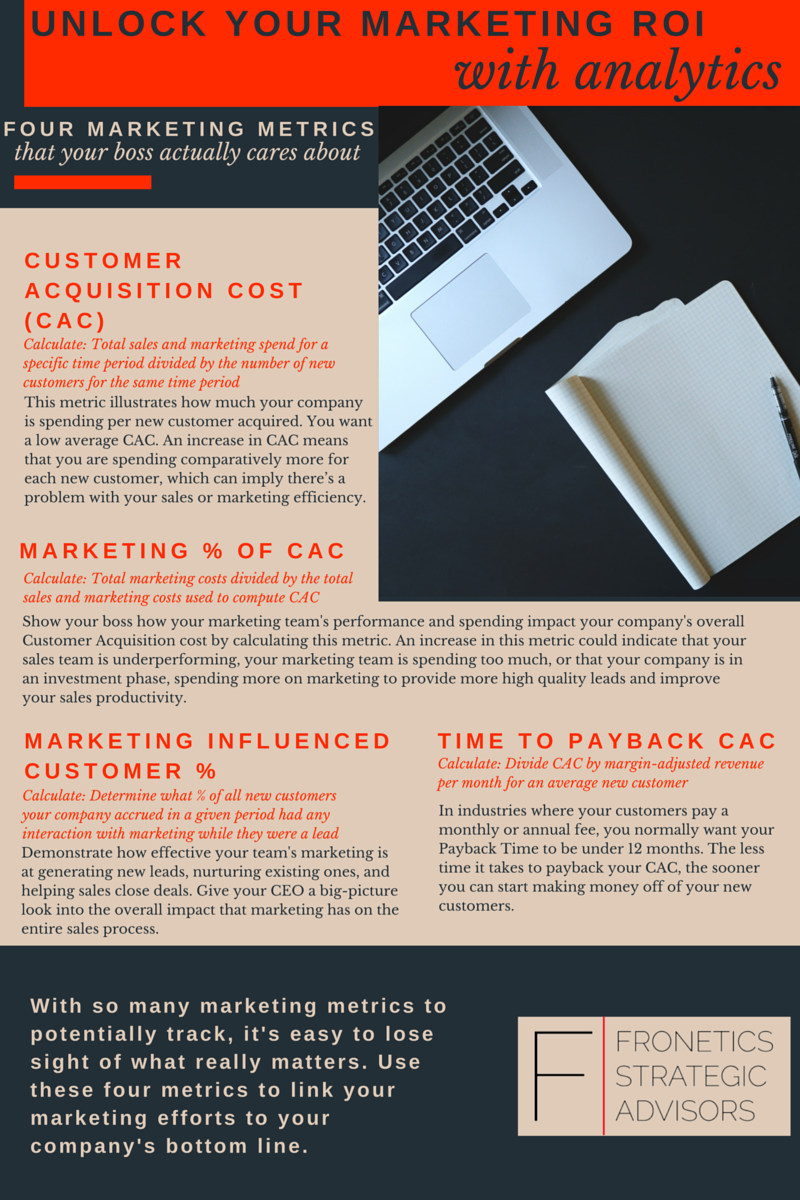
In the age of big data, everything in marketing is measureable – and that’s not necessarily a good thing. As Dimitri Maex of Ogilvy Consulting puts it, “marketers are drowning in numbers because they are focused on what they can measure rather on what they should measure.” Unfocused efforts to evaluate the success of your marketing activities can lead to a host of problems. Central to these problems, though, is the failure to measure and report activities in a way that clearly demonstrates the link between marketing and your company’s bottom line. Check out our infographic that details four marketing metrics guaranteed to resonate with your CEO (and our guide to the 6 marketing metics your boss really cares about).
You might also be interested in:
When it comes to marketing we work with our clients to create and execute strategies that drive success and elevate their brand position within the industry. Unlike other firms, we align marketing programs with business objectives and, through a data driven approach, are able to deliver results with a targeted ROI. Our team is comprised of strategists, marketing professionals, writers, designers, and experts in social media. Together we leverage our experience to increase brand awareness, position our clients as thought leaders, drive meaningful engagement with prospects and customers, and help businesses grow.