by Elizabeth Hines | Aug 31, 2015 | Blog, Strategy, Supply Chain, Warehousing & Materials Handling
Going green in the warehouse is no longer an afterthought, but a necessity to boost the bottom line. With the US Green Building Council reporting nearly 172,000 gross square meters being certified LEED (Leadership in Energy & Environmental Design) every day in the U.S., it speaks volumes about the widespread industry acceptance of sustainable design.
Once an afterthought, the “greening” of warehouses and distribution centers has emerged as one of the most effective tools to boost the bottom line. With so many external pressures on profit margins, energy savings have the potential to provide that much sought-after way out. Needless to say, we have moved well beyond simply dimming or turning off the lights (although not to be neglected).
If you have not considered such increasingly common green features such as white roofs to reflect sun light, prismatic lenses for skylights, solar panels, and high-efficiency lighting, you should know others are moving ahead.
A one-million square-foot distribution center in Fort Worth, Texas, for example, where temperatures frequently hit triple-digits, hardly needs to turn on the HVAC since the company installed an integrated fan control system, which uses 26 networked warehouse fans 24 feet in diameter. Designed to move high volumes at low speeds to cool indoor temperatures, it operates to the tune of 12% to 50% savings in heating and cooling costs.
Another example is the corporate campus of Somerset Tire Service in Bridgewater, N.J., which is constructed as a net-zero facility, by using a roof-mounted, 1.2 megawatt photovoltaic array. In less than five years, the system will have paid for itself.
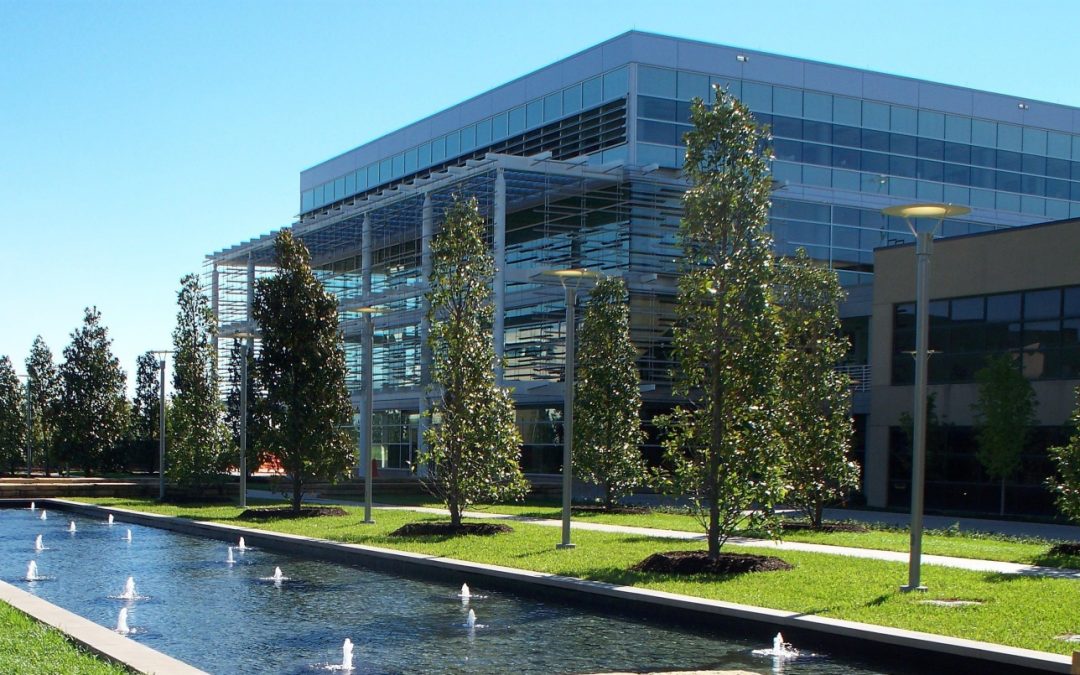
And, to cite a third example, consider a recently completed building for Coca-Cola where clear glass brings in an abundance of natural light. In combination with integrated daylight tubes, which automatically reduce or turn off when the sensors determine there is enough ambient light, the facility can frequently operate without any artificial lighting.
Optimizing the building envelope and lighting solutions can yield as much as 40% in energy savings. Lighting is indeed the low-hanging fruit of going green, especially if your lighting system is pushing 20 years. Other common strategies such as dimming, occupancy sensing, and scheduling can be combined with more advanced lighting control strategies such as daylight harvesting (as in the Coca-Cola example), task tuning (light is adjusted depending on the needs of the space), demand response (light is adjusted at peak times based on signals from electric utilities), and specific software for energy management. These strategy combinations can save up to 70% in energy costs.
But let’s not forget that the good-old “location, location, location”. It’s ever-important as well.
One analyst put it this way: “Anytime you can reduce transportation distance, time, and costs for your network, you are also providing a green benefit… While there is much that can be done within a warehouse to save energy, optimizing the network is where some of the biggest bang for the buck can be found.”
When it comes to cutting energy costs in warehouses and distribution centers, where do you see the greatest potential for savings?
Fronetics Strategic Advisors is a leading management consulting firm. Our firm works with companies to identify and execute strategies for growth and value creation.
Whether it is a wholesale food distributor seeking guidance on how to define and execute corporate strategy; a telematics firm needing high quality content on a consistent basis; a real estate firm looking for a marketing partner; or a supply chain firm in need of interim management, our clients rely on Fronetics to help them navigate through critical junctures, meet their toughest challenges, and take advantage of opportunities. We deliver high-impact results.
We advise and work with companies on their most critical issues and opportunities: strategy, marketing, organization, talent acquisition, performance management, and M&A support.
We have deep expertise and a proven track record in a broad range of industries including: supply chain, real estate, software, and logistics.


by Elizabeth Hines | Aug 27, 2015 | Blog, Content Marketing, Marketing, Social Media, Strategy
Content marketing has become a key marketing strategy for many businesses. Statistics show that content marketing generates three times more leads than traditional marketing methods – and those leads cost an average of 62% less. At Fronetics, we’ve built our content marketing services around one goal – helping our clients grow. We’re harnessing the power of content to help our clients connect and engage with leads and prospects in meaningful ways. And our clients are enjoying faster growth and higher profits because of it.
How do we use content to support our clients in their business growth?
We create quality content that helps our clients connect with leads and customers in a number of ways. First, we appeal to and engage potential customers by creating relevant content that’s aligned with the needs of our client’s target audience. Then, we nurture those leads into customers by proving the value of our clients’ products and services. Even after they become customers, we work to create positive customer experiences that make it easy for them to recommend our clients to others.
Services offerings
Here’s a quick breakdown of some the service offerings included in our comprehensive approach to content marketing:
Content strategy
Research has shown that B2B and B2C companies with a documented content strategy in place are more effective than those without one.
At Fronetics, we work with our clients to create a content strategy individualized for their specific situation and needs. We learn about our client’s business, target customers, industry, and competition. We also conduct an audit of current content and digital assets. All of this information is used to create an effective content strategy.
Content creation
There is a lot of content out there. If you want your content to stand out and drive profitable customer action you need quality content. At Fronetics, we create quality content that is keyword-optimized. Also, unlike other firms, we don’t outsource content creation. By keeping all content creation in-house we are able to ensure a quality product.
Lead generation
Once we’ve helped our clients draw visitors to their website, we work to identify potential customers and manage their leads. We create and couple high-value content like white papers and eBooks, with strategic calls-to-action that direct visitors to landing pages expertly designed to convert website visitors into leads.
Lead nurturing and customer acquisition
We work closely with our clients to develop a lead nurturing strategy to convert leads into paying customers using email and marketing automation. By segmenting leads and sending them targeted content designed to catalyze engagement, we help our clients build relationships – and importantly, trust.
Social media
Social media is an incredible tool; however, for it to be effective it must be driven by strategy, be consistent, and must have someone managing the execution. At Fronetics, our social media strategists distribute content, curate content, engage your target audience, and monitor your social networks. We develop a social media strategy that aligns with your company’s goals. We analyze your competition, classify your target audience & cultural attributes, identify the influencers in your industry, recommend platforms, detail best engagement practices, create social media schedules, and identify specific tactics that deliver results. Through the proper execution of social media, your brand is given a voice and personality, and becomes more accessible to your target audience.
Analytics and reporting
At Fronetics we take a comprehensive data driven approach to marketing. Metrics measure success, drive strategy, and demonstrate ROI. We provide our clients with monthly marketing reports.
In short, our content marketing strategies drive success for our clients. The Fronetics team is comprised of strategists, marketing professionals, writers, designers, and experts in social media. Together we leverage our experience to increase brand awareness, position our clients as thought leaders, and drive meaningful engagement with prospects and customers – all with the goal of helping our clients grow.
Get in touch with us today for a free consultation to find out if our retainer services, full or half day workshops, or a personalized service offering is right for your business. See how Fronetics can help your business grow.

by Elizabeth Hines | Aug 26, 2015 | Blog, Consumer Electronics, Strategy, Supply Chain
Image Source: University of Wisconsin – Madison
In 2014 the global consumer electronic market was valued at $1,224.8 billion. Future Market Insights projects that the market will reach $2,976.1 billion by 2020, reflecting a CAGR of 15.4% during the forecast period, 2015 – 2020. As the industry grows, driven by our desire for new technology, so does the amount of electronic waste (e-waste).
Right now 70% to 80% of our old gadgetry goes straight into landfills. According to research firm MarketsandMarkets, the global volume of e-waste generated is expected to reach 93.5 million tons in 2016, up from 41.5 million tons in 2011 at a compound annual growth rate of 17.6%. This waste contains hazardous materials which are harmful to human health and to the environment and are both non-renewable and non-biodegradable.
Semiconductor chips are one of the contributors to the hazardous materials found in e-waste. Researchers at the University of Wisconsin recently announced that they have created a new computer chip – one that is biodegradable and one which reduces the amount of semiconducting material used in manufacturing by a factor of up to 5,000. In spite of these changes, the new chip performs at the same level as traditional chips.
The new computer chip retains the active components of traditional chips, but in the base layer the new chip replaces silicon with cellulose nanofibril (CNF), a flexible, biodegradable material made from wood. This change means that the computer chip can decompose in nature.
In a press release Zhenqiang “Jack” Ma, research lead and UW-Madison electrical and computer engineering professor, says this about the new chips: “Now the chips are so safe you can put them in the forest and fungus will degrade it. They become as safe as fertilizer.”
While these new chips are game-changing with respect to human health and the environment, they are also poised to transform the consumer electronics industry. The transformative nature of the chips, and the one that will likely be the tipping point to adoption, is their transparency and flexibility.
Ma’s new chips are ready for commercialization.
![Content marketing for the logistics and supply chain industries [Download]](https://fronetics.com/wp-content/uploads/2024/10/About-Fronetics.jpg)
by Elizabeth Hines | Aug 25, 2015 | Blog, Content Marketing, Logistics, Marketing, Supply Chain
Earlier this year, when Fronetics Strategic Advisors set out to explore the role of content within the logistics and supply chain industries, a full 86% of the companies we surveyed reported using content as a marketing tool – their primary goals being to build brand awareness and generate leads. Remarkably, more than three quarters of these companies told us that content was an effective tool for their business. However, a top challenge identified by respondents was the execution of a structured and effective content strategy.
In response, we’ve developed a content marketing guide specifically for companies within the logistics and supply chain industries. This guide has been designed to not only get your content strategy off the ground, but also to supercharge your route to success. In it you’ll find step-by-step instructions, templates, lists, and samples that’ll walk you through building your own content strategy – from proven best practices to advanced techniques. Download your free content marketing guide to get started today.
When it comes to marketing we work with our clients to create and execute strategies that drive success and elevate their brand position within the industry. Unlike other firms, we align marketing programs with business objectives and, through a data driven approach, are able to deliver results with a targeted ROI. Our team is comprised of strategists, marketing professionals, writers, designers, and experts in social media. Together we leverage our experience to increase brand awareness, position our clients as thought leaders, drive meaningful engagement with prospects and customers, and help businesses grow.
We have deep expertise and a proven track record in a broad range of industries including: supply chain, real estate, software, and logistics.
![Drowning in big data, parched for information [Infographic]](https://fronetics.com/wp-content/uploads/2024/10/big-data-2-1000x675.jpg)
by Elizabeth Hines | Aug 24, 2015 | Big Data, Blog, Data/Analytics, Strategy

Big data is big. Over the past two years alone more than 90% of the world’s data has been created. Each day more than 2.5 quintillion bytes of data are created. For those who are more numerically inclined that is more than 2,500,000,000,000,000,000 bytes per day.
Companies are spending big money to determine how they can harness the power of big data and drive actionable, practical, and profitable results. The International Data Corporation (IDC) recently forecasted that the Big Data technology and services market will grow at a 26.4% compound annual growth rate to $41.5 billion through 2018, or about six times the growth rate of the overall information technology market.
Weatherhead University Professor Gary King notes that: “There is a big data revolution, but it is not the quantity of data that is revolutionary. The big data revolution is that now we can do something with the data.” Herein lies the problem. Even as the quantity of big data being generated increases, and even as the money spent on big data increases, the majority of companies find themselves struggling to do something with the data. Companies are drowning in data while at the time being parched for information.
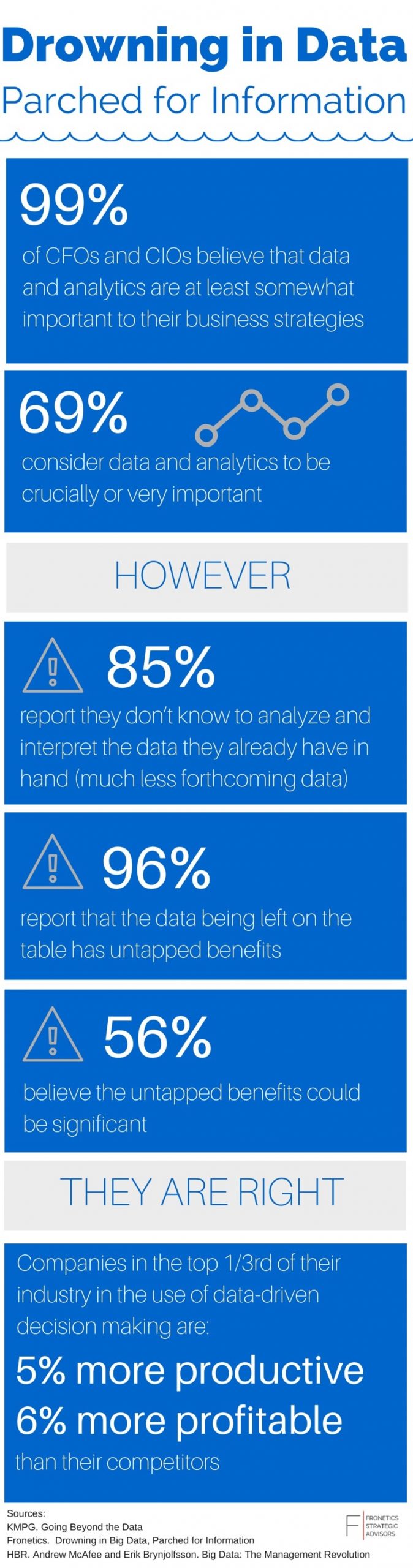
KPMG recently conducted a survey of 144 CFOs and CIOs with the objective of gaining a more concrete understanding of the opportunities and challenges that big data and analytics present. The survey found that 99% of respondents believe that data and analytics are at least somewhat important to their business strategies; 69% consider them to be crucially or very important. Despite the perceived value of big data, 85% of respondents reported that they don’t know to analyze and interpret the data they already have in hand (much less what to do with forthcoming data).
Moreover, 96% of survey respondents reported that the data being left on the table has untapped benefits. 56% of respondents believe the untapped benefits could be significant.
Research conducted by Andrew McAfee, co-director of the Initiative on the Digital Economy in the MIT Sloan School of Management, supports this belief. McAfee’s research found that “the more companies characterized themselves as data-driven, the better they performed on objective measures of financial and operational results.” Specifically, “companies in the top third of their industry in the use of data-driven decision making were, on average, 5% more productive and 6% more profitable than their competitors.”
Looking forward, companies that are able to effectively collect, analyze, and interpret data will gain a competitive advantage over those companies who are not able to do so.