
by Elizabeth Hines | Jun 27, 2019 | Blog, Current Events, Marketing, Social Media
Also this month in social media news: Facebook releases details of its forthcoming cryptocurrency, and Instagram Pushes IGTV With Horizontal Video LinkedIn updates ad features.
Highlights:
- Facebook is removing several Information sections from business Pages, while also testing a feature that lets users preview posts.
- LinkedIn is increasing transparency for native advertising and boosting its data personalization capabilities with the acquisition of Drawbridge.
- Facebook’s new cryptocurrency, Libra, will enable fee-free fund transfers.
This month, Facebook is dominating the headlines when it comes to social media news. On the heels of its annual F8 developer conference last month, the social media giant is making several changes to its Business Pages, removing certain info sections and reportedly working on a new “Preview” option.
Meanwhile, LinkedIn is updating its ad features in several important ways for businesses. In addition to bringing more transparency to native ads, the social media site has acquired data personalization platform Drawbridge in a push to improve its ad targeting. In the world of Instagram and video, IGTV will now support horizontal video, as the platform seeks to make its IGTV feature increasingly appealing for users. Keep reading for more on these social media news items from June 2019.
Facebook makes key changes to Business pages
Facebook marketing has always been full of constant changes, but lately, as the platform responds to the fallout from Cambridge Analytica and other confidence-shaking scandals, it’s becoming increasingly more challenging for businesses.
Information sections are being removed
This month, changes to business Pages include the removal of certain information sections, effective August 1, including Company Overview, Biography, Mission, Affiliation, and Personal Interests. Prompts to Page admins inform them of the removals and encourage them to “consider adding this info to your Page’s description.” Theories abound as to why the social network is making this change. We think it’s likely that, as Social Media Today posits, Facebook is attempting to “reduce any unnecessary data collection in order to lessen its potential tracking and targeting issues.”
New “Preview” option is being tested
Meanwhile, Facebook is reportedly also testing a new “Preview” option for business Page posts, enabling marketers to see what a post will look like before hitting “Share,” with options to view in mobile or desktop format. In the flurry of more dismal news for businesses on Facebook, this feature would be a welcome bit of good news for social media managers. Being able to see exactly what your content will look like before you post it can help optimize your efforts on the platform and give you an extra failsafe when it comes to catching errors and typos before content goes live.
Instagram announces that IGTV now supports landscape videos
It’s been just over a year since Instagram rolled out its IGTV feature, making tweaks along the way, most notably allowing users to publish previews of IGTV content in the main Instagram feed. Instagram reports that since the launch of the improved publishing feature, “We’ve seen viewers spending more time with IGTV and a surge of new original content from creators of all sizes.”
IGTV is getting another makeover, as the platform responds to user requests to be able to upload landscape videos. Horizontal videos will now be supported in addition to vertical videos, both in the Instagram app and the IGTV standalone app. Viewers will be able to turn their devices sideways and view the content full screen. This is good news for marketers, as publishing video content on IGTV just got a little easier and more flexible. Rather than needing to adapt videos for the vertical format, marketers will now have an easier time integrating content straight from YouTube, for example.
Facebook releases details of its new cryptocurrency, Libra
This month, after extended speculation, Facebook has released the official outline and documentation for its forthcoming cryptocurrency, Libra. There aren’t a lot of surprises in the release. Libra will enable fee-free transfer of funds through Facebook’s “Calibra” crypto subsidiary.
According to Facebook, “From the beginning, Calibra will let you send Libra to almost anyone with a smartphone, as easily and instantly as you might send a text message and at low to no cost. And, in time, we hope to offer additional services for people and businesses, like paying bills with the push of a button, buying a cup of coffee with the scan of a code, or riding your local public transit without needing to carry cash or a metro pass.”
LinkedIn makes two updates to its ad features
In an effort to provide to bring more transparency to ads on LinkedIn, engendering trust among users, the network is introducing a new Ads tab on LinkedIn Pages. According to the platform’s announcement, “In this tab, members will be able to view all Sponsored Content (native ads running in the LinkedIn feed) that advertisers have run on LinkedIn in the past six months.” Clicking on the ads through the new tab won’t charge advertisers, and these engagements also won’t impact campaign reporting.
LinkedIn is also upping its game when it comes to data personalization. To help businesses better reach their audiences on the platform, LinkedIn is acquiring Drawbridge, Inc. “We believe Drawbridge’s team and technology will allow us to accelerate the capabilities of our Marketing Solutions platform, helping our customers better reach and understand their professional audiences and measure the ROI of their campaigns across mobile and desktop,” says LinkedIn’s Tomer Cohen.
What social media news are you following this month?
Related posts:

by Elizabeth Hines | Jun 25, 2019 | Blog, Leadership, Marketing, Social Media
The intersection of leadership and social media is receiving growing attention. A leadership expert has identified 3 surprising ways social media can create more effective leaders.
Highlights:
- Very few Fortune 500 CEOs are personally engaged in social media.
- Corporate leaders can get valuable unfiltered information through social media use and encourage a culture of free-flowing information.
- Social media’s transformative leadership effects can only come into play when leaders are personally engaged.
Social media is a nearly ubiquitous presence in our lives, both personal and professional. As the influence of these platforms extends, the connection between leadership and social media is increasingly gaining attention.
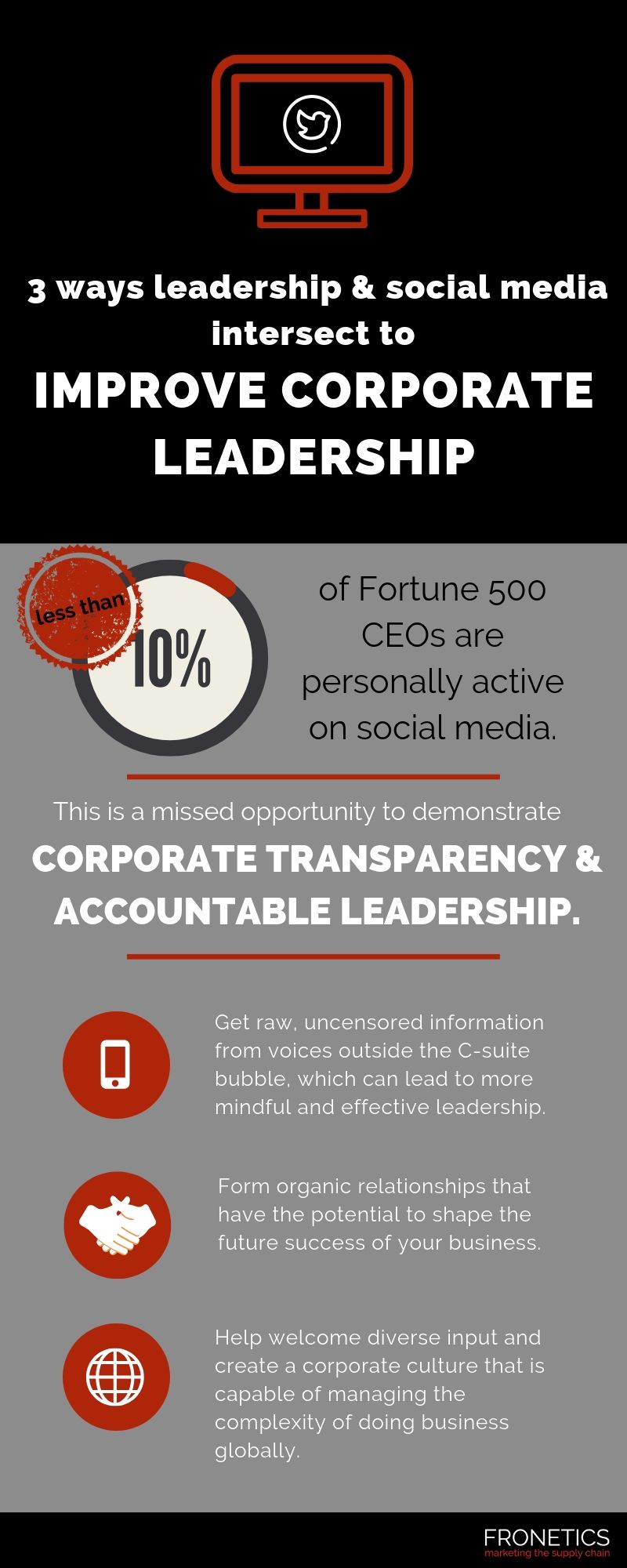
A recent report from Chief Executive found that the vast majority of American CEOs have no personal presence on social media, relying instead on ghostwriters or marketing staff to post on their behalf. Less than 10% of Fortune 500 CEOs are personally active on social media, despite growing public demand for corporate transparency and accountable leadership.
Engagement Leadership expert Céline Schillinger, in exploring the relationship between leadership and social media, has identified more than just the practical benefits (like strengthening brand, managing crises, and presenting a human face to the public) of CEOs on social media. Schillinger has identified three key ways that social media can actually create better leaders.
3 ways leadership and social media intersect to improve corporate leaders
(Made with Canva)
1) Access to unfiltered information
One of the biggest changes that social media has wrought on modern society is the widespread, unfettered dissemination of information, directly from its source. Boiled down to its essence, social media gives everyone a voice. For today’s corporate leader, access to unfiltered information comes at a premium: “Be it competent and well-intended, or self-protective and risk averse, CEOs’ entourage form a distorting bubble,” writes Schillinger.
What better way than social media to burst the bubble and get the raw, uncensored information that leads to mindful and effective corporate leadership? It’s an ideal way to combat the gap in perception between employees and managers, for example, or the service gap between customer expectations and the customer experience. Using social media gives leaders access to real-time, accurate information from the people their businesses serve.
Schillinger says that the informational benefits of leadership and social media extend further. “By role modelling curiosity for unfiltered information and by exchanging thoughts and ideas directly through social media, leaders give symbolic ‘permission’ to their organization to do the same,” she writes. Social media can help leaders create a corporate culture that encourages the free flow of accurate, uncensored information.
2) Relational engagement and enhanced business performance
Best-selling author Brian Solis, who explores the effects of technology on business, marketing, and culture, writes, “Brands are co-created by consumers through shared experiences.” That’s actually a pretty radical message. Particularly for those of us in the marketing world, it’s easy to get caught up with the idea that brands are purely created through the careful work of marketing teams, designers, and image consultants.
But, in fact, what Solis is saying is that thanks in large part to social media, the totality of what makes up a brand identity no longer fits in the frame of what businesses create themselves. Brands are relational. For this reason, corporate leaders need to embrace the idea that effective leadership is “contextual and relational.”
“Relationship building is now a required core competency for all professionals — and for senior leaders in particular,” writes Schillinger. Social media gives leaders the opportunity to form the kinds or organic relationships that have no less than the potential to shape the core of their brands. These are “connections that arise within communities, born from a shared sense of belonging, acknowledgment of emotions, and co-creation of work.”
3) Transformation through mindset change: where leadership and social media intersect
Social media usage has transformational potential: it leads to new modes of interaction and relating to others. As Schillinger points out, “This is why it is fundamentally experiential and cannot be delegated without dampening its impact.” For corporate leaders, social media can help welcome diverse input and create a culture that is capable of managing the complexity of doing business in a global economy.
Schillinger identifies a powerful example of the transformative power of social media on corporate leaders, resulting in unmatched improvement in output. Corporate leaders at Sanofi Pasteur, a vaccines manufacturer, chose to personally involve themselves in an internal online community, interacting on a weekly basis with their employees. Their “asking questions, sharing insights, recognizing achievements, and ‘liking’ posts… had a huge positive impact on their own perception, their leadership, and the flows of knowledge between employees.”
The connection between effective leadership and social media participation is a topic that we’re really only beginning to understand. But what’s clear at this point is that when leaders commit to personal engagement in social platforms, information flows are enhanced, brands are strengthened, and the businesses unlock the kind of transformative potential that leads to unprecedented success.
Related posts:

by Elizabeth Hines | Jun 20, 2019 | Blog, Content Marketing, Logistics, Marketing, Social Media, Supply Chain
Participating in social media is increasingly important for businesses in the supply chain. Here are the 3 steps to proving social media ROI.
Highlights:
- It may seem obvious, but too many businesses approach social media marketing with vague goals or none at all.
- Once you’ve set your goals and identified your key metrics, it’s time to implement a system that will track and measure your metrics.
- Once you’ve calculated ROI for your social media platforms, it’s time to think strategically about optimizing your content marketing resources in terms of allocation and timing.
Video transcript:
I’m Elizabeth Hines, Creative Director at Fronetics, and today we’re talking about three steps to prove social media ROI.
Participating in social media is increasingly important for businesses in the supply chain. But many clients tell us they have a hard time getting approval for the expense because it’s notoriously difficult to measure the return on investment.
Well it’s true that many of the benefits of social media — like greater brand awareness and improved communication with customers — are difficult to quantify, there are some ways to prove the ROI of your participation in social media.
Here are the 3 steps to proving social media ROI:
1. Set goals
I’m not talking “grow your business” or other vague benchmarks like that. I mean “increase web traffic from social by 10% over the next 90 days.” Really specific benchmarks and goals are important in measuring success.
2. Track and measure
Make sure you have means to accurately measure how you’re doing against your goals. All the social platforms have excellent analytics tools to help with this. We also use tools like Google Analytics and HubSpot.
3. React
Look at your metrics in the context of your goals. Once you figure out what’s helping you meet those objectives and where you’re falling short, you can tweak your efforts to be more successful and to make sure that you’re actually achieving your ROI.
For more information on social media and all things digital marketing, visit our website at Fronetics.com
Related posts:

by Elizabeth Hines | Jun 19, 2019 | Blog, Content Marketing, Current Events, Logistics, Marketing, Supply Chain
As the internet is increasingly dominated by visual content, social media analytics are failing to keep up.
Highlights:
- Most social media analytics tools are purely text-based.
- Even tools that analyze images are costly and offer limited insights.
- We predict that machine learning capabilities will improve and the gap between analytics capability and brands’ needs will close.
Here’s an interesting conundrum: social media, and the web at large, is becoming increasingly visual, and social media marketing relies on increasingly sophisticated analytics. However, most of the analytics tools out there are woefully unable to make sense of the visual content that is dominating social media. The alarming truth is that social media analytics are failing to capture invaluable data on visual content.
How social media analytics are failing to keep up
Big data and artificial intelligence expert Kalev Leetaru describes the shortfalls of social media analytics by detailing what they can — and can’t — do. While the capabilities of visual analytics have grown in the past several years, as Leetaru points out, most analytics tools that claim to analyze visual images are in fact based on textual or structural aspects of the image, not the visual content itself.
“The overwhelming majority of production social media analytics research relies primarily on hashtags and associated caption text, rather than the actual contents of the images themselves,” writes Leetaru. Instead, “from simplistic bag of words counting algorithms through advanced deep learning approaches, it is text that forms the lens through which we see social media.”
It’s important to note that this text-based approach is true not only for social media analytics, but for search engine algorithms. At Fronetics, we are constantly advising our clients to make use of visual content, from images to infographics to video, in their digital marketing efforts. But we always advise that marketers optimize their images for search engines, both by tagging all visual assets and publishing transcripts to go along with video or infographics.
In essence, we’re advising our clients to take advantage of the increasingly visual nature of the internet, while also hedging against the ways in which algorithms and social media analytics are failing to assess visual content. As Leetaru points out, even in the rare cases when an analytics tool offers image analysis, it “typically offers only a few basic lenses through which to analyze that content, such as logos and a small number of topics.”
Of course, analyzing visual content is no easy task, and it’s also not cheap. “Images don’t capture reality, they construct it,” observes Leetaru. Not only are there all kinds of variables, like framing or lighting, that come into play, but there is a tremendous amount of non-visual context that determines how an image will be received. And the fact is that “current deep learning approaches are largely unable to incorporate such external world knowledge into their assessments.”
The problem with analytical failure
It’s important for marketers to recognize that, at the current moment, there is a gap between the capabilities of analytics tools and the analytics needs for modern digital marketing. As we as a society “increasingly express ourselves exclusively through visual forms,” brands desperately need insights about this visual expression.
Leetaru sums up the problem with sobering simplicity: “As social media becomes more visual, it becomes less accessible to our data-mining algorithms. In turn, as social media is less and less data minable, we are less and less able to understand it.”
Perhaps even more alarmingly, he cautions that “given that visual expression skews towards the younger and influencer demographics of greatest interest to many brands, this transition is especially damaging to their ability to extract useful insights from social media.”
Essentially, what Leetaru is recognizing is that we’re at a perilous moment for digital marketing. Just when the possibilities for content creation and dissemination seem endless, social media analytics are failing to offer up the insights needed to shape these processes in an increasingly visual climate.
“In the end, as social platforms rush towards a visual-first world, the vast landscape of social analytics is getting less and less representative of what we’re really talking about,” concludes Leetaru.
What does the future hold for analyzing visual data?
While you may be thinking that the future looks pretty bleak in light of how social media analytics are failing us, there’s a silver lining. If there’s one constant when it comes to social media marketing, it’s that when there’s a demand, sooner or later, supply will catch up.
It’s true that the current visual analytics capabilities of most platforms are far behind what’s needed. But at Fronetics, we predict that deep machine-learning capacities will start to catch up, and increasingly sophisticated analytical capabilities will become available to a wider segment of the market.
Currently, social media analytics can recognize text, faces, and brand logos within images. While these capabilities are, at present, too costly for most companies to take advantage of, we’re keeping our eye on some emerging technologies. For example, analytics provider Scraawl has recently released a tool called Scraawl PixL, which will allow users to run object and face detection, as well as Optimal Character Recognition, which extracts text from images.
Expect to see more tools like PixL on the market, offering increasing sophistication. While social media analytics are failing to keep up with the onslaught of visual data at the moment, we predict that they won’t be behind for long.
Related posts:

by Elizabeth Hines | Jun 18, 2019 | Blog, Content Marketing, Logistics, Marketing, Strategy, Supply Chain, Website Development
The percentage of visitors that stay on your site is key to lead conversion and search engine rankings. Here are our top tips to reduce your website bounce rate.
Highlights:
- A high bounce rate will compromise your site’s search engine rankings.
- Slow website load times are a major cause of bounces.
- Publish high-quality, visually appealing content with relevant keywords and meta data.
When it comes to evaluating the performance of your website, bounce rate is a key indicator. But what does this term really mean for supply chain marketing? After we take a deeper dive into what a bounce rate is and why it’s important to track, we’ll offer 10 ideas to reduce your website bounce rate.
Bounce rate defined
Simply put, your website’s bounce rate is the percentage of users who enter your website and immediately leave, or “bounce,” without visiting any additional pages on your site. Bounces happen when visitors click the back button, navigate to a different URL, close their browser, or leave a page open without taking action.
Having a high bounce rate can be an indication that your site failed to convince the visitor to explore further or act on your call-to-action (CTA). Of course, no website, no matter how effective, has a 0% bounce rate. Some users are bound to leave your website without taking any action. But a healthy bounce rate is a key indicator of website success.
While bounce rate ranges vary based on industry and page type, the general ranges are:
- 80% or higher: bad
- 70%-80%: poor
- 50%-70%: average
- 30%-50%: excellent
- 20% or lower: likely a tracking error
However, the truth about good versus bad bounce rates is more nuanced than these ranges. Bounce rates can vary widely based on website type, channel, and the device visitors are using.
For example, blog posts typically have a high bounce rate (between 60% and 90%), simply because an effective post will give a user what he or she came for, and there’s no further need to explore your site. This doesn’t mean your blog is performing poorly, as bounce rate is just one in a list of metrics needed to assess the overall performance of a site.
Why does bounce rate matter?
Aside from the fairly obvious fact that a high bounce rate means that visitors aren’t being converted into customers on your site, there’s another serious ramification to your bounce numbers: search engine results. According to a recent study from SEMRush, “Bounce rate is the fourth most important ranking factor on search engine results pages.”
Every time a visitor bounces from your page, it signals to search engine algorithms that your site isn’t what the searcher was looking for, and your ranking will suffer. Having a handle on your bounce rate will help you form a clear picture of how your website is performing, as well as give you understanding of one of the key factors in determining your search engine ranking.
10 ways to reduce your website bounce rate
1) Keep an eye on your page load times.
A major cause of bounces is long loading times, particularly on mobile devices. If your page load time is slow, consider switching to HTTP/2.
2) Make sure navigation is easy.
For your website to entice visitors to stick around, it needs to be clearly labeled and easy for prospects to find and get to what they’re looking for.
3) Evaluate your first impression.
You only get one first impression. When it comes to your website, this means clear navigation menus, engaging headlines, easy-to-read text, subheadings and bullets, and minimal pop-ups or auto-play videos.
4) Publish high-quality content.
Perhaps this goes without saying, but there’s no substitute for high-quality content when it comes to keeping visitors engaged on your site.
5) Optimize your meta data.
A meta description is the text that appears below your website’s URL in search engine results. This text should accurately represent what the page contains, which helps ensure that visitors find what they’re looking for when they click.
6) Create a quality design.
Clean, compelling design is important for keeping users on your page. Ideally, your site’s design should not only be functional and intuitive, but aesthetically pleasing.
7) Optimize mobile experience.
Bearing in mind that mobile users typically have even less patience than desktop users, your site’s mobile version should have a quick load speed, clean design elements, and easy navigability.
8) Use relevant keywords.
The keywords you choose should not only be relevant to your audience’s search queries, but they should reflect what visitors will actually find on your site. If your site ranks high for a keyword that doesn’t relate to the majority of your content, then users searching for that keyword will quickly leave.
9) Write good calls-to-action (CTAs).
A good CTA is key not only to converting leads but also to reducing your website bounce rate. Ideally, your CTA should be clearly visible within the first few seconds of being on a page, and it should be compelling.
10) Use images and videos.
We live in a visual world, so naturally, this type of content connects best with users. Statistic after statistic supports the idea that visual content is dominating the internet. To reduce your website bounce rate, include visuals that keep your audience interested.
What tricks are you using to reduce your website bounce rate?
Related posts:
Is your business making the most of its web presence?
Get a free website audit
Discover untapped opportunities and places you may be losing leads with our free website audit.