by Elizabeth Hines | Jun 13, 2019 | Blog, Content Marketing, Leadership, Logistics, Marketing, Supply Chain, Talent
A new LinkedIn post takes a refreshing look at achieving a work-life balance for working parents. The article has been shared all over social media begging the question: does your office need to know?
The New York Times reported that more and more couples are choosing to have smaller families due to economic factors. Let’s face it: kids are expensive. Most families have to balance wages with the exorbitant cost of childcare.
And that doesn’t even begin to look at finding harmony between your career and your family. In a recent post on LinkedIn, Ian Sohn, a single father and president of Wunderman Chicago, takes a clever and honest look at creating a work-life balance, a juggling act many of us know all too well.
“You should never apologize for having a life.”
The post was a list of things this Chicago-based boss ‘never needs to know’ about his employees, including:
- I never need to know you’ll be back online after dinner.
- I never need to know that you’re working from home today because you simply need the silence.
- I never need to know why you chose to watch season 1 of “Arrested Development” (for the 4th time) on your flight to LA instead of answering emails.
- I never need to know you’ll be in late because of a dentist appointment. Or that you’re leaving early for your kid’s soccer game.
- I never need to know why you can’t travel on a Sunday.
- I never need to know why you don’t want to have dinner with me when I’m in your town on a Tuesday night.
The sentiments of Sohn’s post hit home with a lot of working parents — the post has almost 2,000 comments to date. So why does this list ring true for so many working mothers and fathers?
“Like any modern business … there’s an additional need to respect other people’s lives and environment you work in, and everyone is accountable for getting their job done,” says Sohn in USA Today.
As businesses have become more digital, the ability to do you work remotely has increased. Ask any employee who works remotely, and they’re very likely to tell you that working from home makes them happier and more productive. And they aren’t necessarily wrong. There’s certainly evidence to suggest that with today’s technology, there’s essentially no downside to working from home, and it does often enhance productivity.
Here at Fronetics, we believe, much like Sohn, in the balance between work and home life. As individuals, we strive to excel at our jobs through accountability. Have a doctor’s appointment? Need to attend a school performance? We don’t need to know.
Has your office implemented policies to encourage flexibility? Has it been successful?
Related posts:

by Elizabeth Hines | Jun 11, 2019 | Blog, Content Marketing, Logistics, Marketing, Social Media, Supply Chain
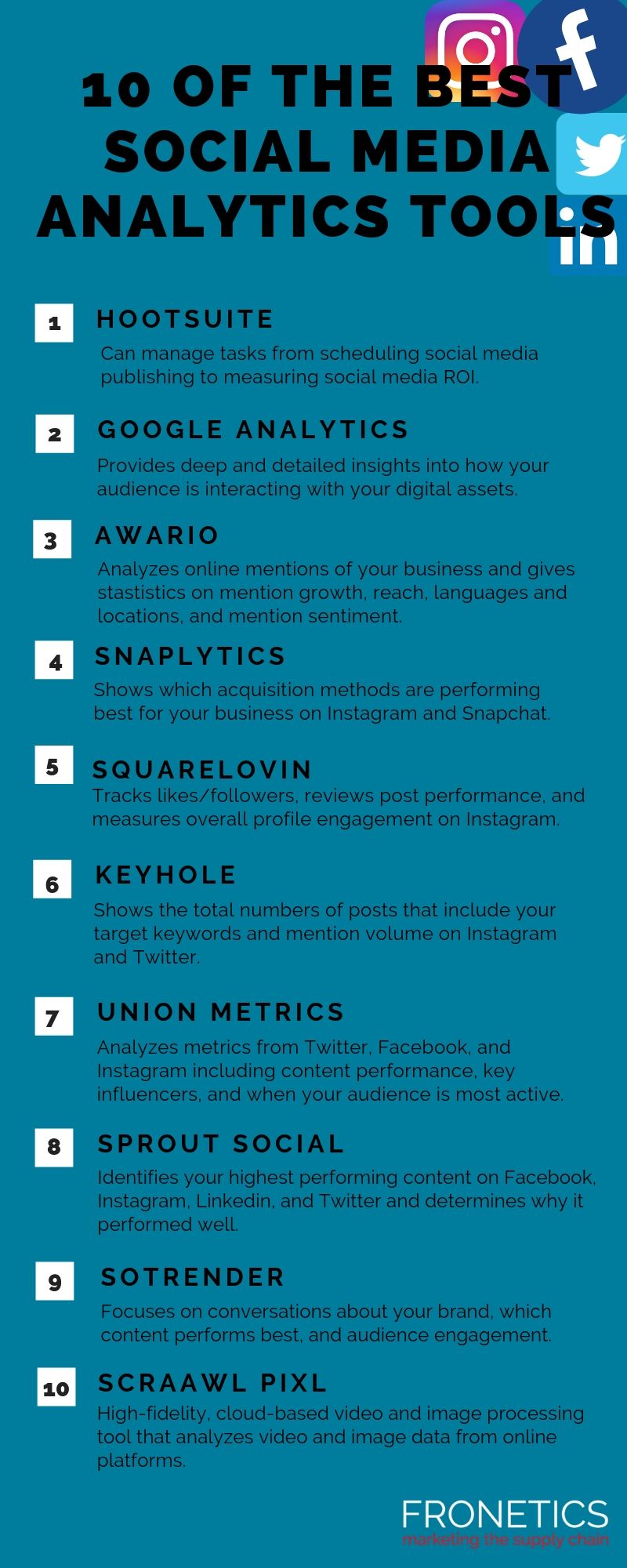
An effective social media strategy requires data. Here are our 10 favorite social media analytics tools to empower you with insights that will boost your social media game.
Highlights:
- Hootsuite and Sprout Social are all-around social media management tools that offer analytics.
- Google Analytics is an overall powerhouse tool to track the performance of all your digital assets.
- Newcomers to the list include Awario, Squarelovin, Keyhole, and image analytics tool PixL.
At Fronetics, we believe in a data-driven approach to digital marketing. A solid analytical framework has the potential to offer insights that will shape and refine your strategies, increasing your ability to generate, nurture, and convert leads. We’ve pulled together 10 of the best social media analytics tools to help you determine what’s working and what’s not — and to empower you to develop a data-driven strategy.
Our 10 favorite social media analytics tools
(Made with Canva)
1) Hootsuite
There are so many tools out there, and our internal list of the best social media analytics tools often shifts. But there are a few platforms that always make the list, and Hootsuite is one of them. It’s one of the most popular social media management tools for a reason – it’s a powerhouse that can manage tasks from scheduling social media publishing to measuring social media ROI.
Hootsuite gives you key metrics from Twitter, Facebook, and Instagram with audience and post insights, as well as performance data. It packages all the data in approachable charts and graphs. One of our favorite features is the AutoSchedule tool, which lets Hootsuite determine the optimal time to post or tweet based on when similar content performed well in the past.
2) Google Analytics
Another of our perennial favorites, Google Analytics is a robust platform that can provide deep and detailed insights into how your audience is interacting with your digital assets, including social media. This is one of the best social media analytics tools out there, and we’ve written extensively about how to get the most out of it.
For social media analytics, we particularly recommend three custom reports: Best Days to Post on Social Media, Best Time to Post on Social Media, and the Social Media Traffic by Date and Hour. These three reports offer real-time data, along with the in-depth insight you need to help your business optimize its social media strategy.
3) Awario
Awario analyzes online mentions of your business and gives you statistics on mention growth, reach, mentions’ languages and locations, mention sentiment, and where on the web mentions are occurring. We particularly appreciate that the tool also identifies social media users who have used your keywords and provides you with a list of social media influencers in your specific area.
Benchmarking your social media marketing strategy against your competitors is key to understanding how you’re doing. Awario lets you create alerts for your main competitors and offers you a step-by-step comparison of your social media performance against theirs.
4) Snaplytics
While all-inclusive tools like Hootsuite and Google Analytics are excellent for evaluating your overall social media strategy, we also recommend a few tools that focus on specific platforms. Snaplytics hones in on Instagram and Snapchat, including offering insights on Instagram Stories.
For both networks, Snaplytics shows you which acquisition methods are performing best for your business, as well as what precipitates rises and falls in engagement levels. Snapchat can be a tricky platform for brands, and Snaplytics provides the kinds of insights you need to make inroads on this millennial-dominated network.
5) Squarelovin
We’ve written extensively about how supply chain companies can make the most of Instagram and Instagram Stories. Squarelovin is an analytics tool specifically for Instagram that provides you with the data you need to optimize your strategy. It tracks likes and followers, reviews post performance, and measures overall profile engagement.
One of the best social media analytics tools for Instagram out there, Squarelovin highlights the best times to post, ideal filters to use, and most popular hashtags. It also gives you a history of engagement with your posts, broken down by hour.
6) Keyhole
This social media monitoring tool offers up deep analytics for Twitter and Instagram. Keyhole will show you the total number of posts that include your target keywords, as well as how mention volume has changed over time. It displays engagement data, hashtag usage trends, sentiment metrics, and reach statistics.
Influencers are key on Instagram and Twitter, and influencer marketing should be part of your social media strategy. Keyhole provides insights into influencers and trends in your specific niche, along with audience demographics and locations.
7) Union Metrics
Union Metrics analyzes a range of metrics from Twitter, Facebook, and Instagram. Like Hootsuite, it lets you know which content is performing best across each platform, the times when your audience is most active throughout the day, and who your key influencers are.
What really sets Union Metrics apart is in its potential for optimizing content creation. The tool goes above and beyond by tracking relevant trends to help you generate ideas for new content, based on hard performance data.
8) Sprout Social
Sprout Social is probably Hootsuite’s biggest competitor, and it’s another of our frequent favorites. Like Hootsuite, it’s an all-around social media management tool that provides key analytics as well. It measures performance and engagement across Facebook, Instagram, LinkedIn, and Twitter and benchmarks your data against competitors.
Sprout Social also helps you identify your highest performing content and determine why it has performed well. It can also show you how your paid ads are performing through a comparison of paid versus organic impressions and followers gained.
9) Sotrender
This formidable social media analytics tool shows you where conversations about your brand are happening, which of your content performs best, and how your audience engages with your social media content. Sotrender analyzes Twitter, YouTube, Facebook, and Instagram and makes it easy for you to benchmark your efforts against your competitors.
We like any tool that not only offers data but gives you advice for improving your strategy. Sotrender offers customized tips on where your marketing strategy needs improvement, based on the analysis it performs.
10) Scraawl PixL
As the internet, and social media in particular, becomes more visual, experts have pointed to a dearth of analytics tools with the capability to perform rich analysis on images. Scraawl PixL is a relatively new kid on the block, and it’s attempting to fill the void when it comes to image-based analytics.
This high-fidelity, cloud-based video and image processing exploitation tool offers an easy-to-use interface, as well as workflows for analyzing video and image data from online digital platforms. It relies on machine learning-based algorithms that enable face detection and recognition as well as object detection, tracking, and classification.
What are your favorite social media analytics tools?
Related Posts:


by Elizabeth Hines | Jun 6, 2019 | Blog, Content Marketing, Leadership, Logistics, Marketing, Supply Chain
Here are 5 books for supply chain professionals to gain insights about the industry and leadership practices.
Highlights:
- There’s no substitute for the in-depth analysis and explanation made possible by the long-format of a book.
- Leadership and professional growth means learning from the perspectives and insights of others.
- This year’s list includes works by Richard J. Sherman, Steven Bowen, and Edward H. Frazelle.
There’s no question that we live in a digital age, with information on almost any topic quickly accessible at our fingertips. But even in this age of short soundbites and reductively simplistic explanations, there’s no substitute for the value of sustained analysis and critical insight. To that point, we’ve put together a list of five books for supply chain professionals.
The supply chain leaders and analysts whose books are on this list each bring unique skills, perspectives, and approaches to the table. Being your best professional self means learning from the successes, failures, and insights of others. Add these five books to your summer reading list, and let us know how they make an impact on your professional life.
5 books for supply chain professionals
1) Strategic Supply Chain Management: The Five Core Disciplines for Top Performance, Second Edition
Co-authored by Shoshanah Cohen and Joseph Roussel, this classic guide to supply chain strategy has been re-created to help business leaders gain an advantage in today’s volatile, globalized arena. The global landscape has changed dramatically since the first edition of Strategic Supply Chain Management established itself as the authority on creating value and achieving competitive advantage from the supply chain.
This second edition is your answer to gaining a strategic advantage in the face of these challenges. Drawing on dozens of new company examples as well as cutting-edge benchmarking research, it shows you how to make your supply chains more agile, flexible, and resilient.
2) Supply Chain Transformation: Practical Roadmap to Best Practice Results
Much is being written about global supply chain and sourcing options emerging in today’s marketplace. Transforming supply chain management to achieve operational excellence is a mandate for many companies globally. Supply Chain Transformation, written by Richard J. Sherman, walks you through this potentially difficult process and gets you started on the journey.
Much more than just a how-to book, it’s a why-to book that is as compelling for any business person as it is for supply chain management professionals. This book provides an invaluable road map to companies looking to transform their supply chains and organizations to achieve best practice results, beginning with guidance on how to make the case for change. Change is inevitable; growth is optional.
3) Total Value Optimization: Transforming Your Global Supply Chain into a Competitive Weapon
Today’s corporate leaders are under increasing pressure to deliver differentiated, lasting performance, fast. New business models are continuously cropping up, with competitors becoming more numerous, more formidable, and more global. This puts profitability at risk as whole supply chains shift in industries.
Steven Bowen provides a clear pathway to transforming supply chains into the ultimate competitive weapons. Bowen’s method, which he calls Total Value Optimization, places customer value at the heart of the business-model, through a demand-driven digital supply chain. Grounded in data analytics, Total Value Optimization is essential for companies looking to survive and thrive in today’s fast-paced and ever-changing business environment.
4) Designing and Managing the Supply Chain – Third Edition
Designing and Managing the Supply Chain provides state-of-the-art models, concepts, and solution methods that are important for the design, control, operation, and management of supply chain systems. In particular, authors David Simchi-Levi, Philip Kaminsky, and Edith Simchi-Levi attempt to convey the intuition behind many key supply chain concepts and to provide simple techniques that can be used to analyze various aspects of the supply chain.
Topical coverage reflects the authors’ desire to introduce readers to those aspects of supply chain management that are critical to the success of a business. Although many essential supply chain management issues are interrelated, the authors strive to make each chapter as self-contained as possible, so that the reader can refer directly to chapters covering topics of interest.
5) Supply Chain Strategy, Second Edition: Unleash the Power of Business Integration to Maximize Financial, Service, and Operations Performance
The industry standard in supply chain management, Supply Chain Strategy’s Second Edition is fully revised and updated to provide today’s logistics solutions. The proven pillars of success in logistics and supply chain management introduced in the first edition of Supply Chain Strategy now guide the supply chains of many of the world’s most successful organizations.
Written by Edward H. Frazelle, Supply Chain Strategy includes up-to-date case studies showing how some of the world’s most successful companies meet supply chain goals and helps you overcome your own challenges with the latest supply chain innovations, including big-data analytics, supply chain command and control centers, large-scale supply chain optimization, integrated supply chain planning, and real-time global supply chain visibility.
Bonus read: “First: Sandra Day O’Connor”
No, Evan Thomas’ bio of Justice Sandra Day O’Connor doesn’t specifically relate to the supply chain. But if you’re looking for inspiring reading on leadership, overcoming adversity, and empowering women in the workplace, this newly released biography of the first female Supreme Court Justice is an excellent read.
What books for supply chain professionals have you read recently?
Related posts:

by Elizabeth Hines | Jun 5, 2019 | Blog, Content Marketing, Logistics, Marketing, Robotics & Automation, Social Media, Supply Chain
When it comes to digital marketing, social media is here to stay. Here’s our four-step guide to leveraging social media for the robotics industry.
Highlights:
- Having a documented strategy is key to reap the benefits of social media marketing.
- Define your audience and establish concrete goals for social media campaigns.
- Set metrics and use data to adjust your strategy consistently over the long term.
The demand for high-performance robotic systems is growing steadily and showing no signs of slowing down. In fact, New Equipment Digest predicts that the robotics vertical within the materials-handling-equipment sector will grow by over 8%, reaching $20 billion by the year 2024. To capture the benefits of the sector’s growth, robotics companies need to invest in digital marketing. Social media for the robotics industry holds tremendous potential — if it’s leveraged properly.
In our work with clients across various verticals in the supply chain, including robotics, we frequently hear that they have been skeptical about the potential of B2B social media use. While social media management does require time and resources, robotics companies should absolutely be reaping the benefits of social media marketing.
Read on for tips on how to create a strategy and leverage social media for the robotics industry.
4 steps to developing a strategy for social media for the robotics industry
1) Define your audience.
For supply chain companies, one of the biggest predictors of success in a social media marketing campaign is a clearly documented strategy. A big part of that is defining your target audience. Chances are, you have some target buyer personas already. Keep these top of mind as you create your social media strategy.
What are the unique needs and challenges faced by your audience? Where do they go online for information? What are their goals? What do they value from you? The more you ask and answer questions about your audience, the better positioned you are to create a strong and effective social media strategy.
2) Determine your goals.
Next, consider what your goals are on social media. You’d be surprised how often this step gets skipped. Marketers are often pressed for time or resources and think of social media marketing itself as a goal, rather than defining specific, measurable objectives for their social media campaigns.
When it comes to social media for the robotics industry, common goals often include increasing brand awareness and authority, generating leads, or establishing thought leadership. But before you embark on a social media strategy, consider what your company specifically needs to achieve.
3) Define your metrics.
One of the best things about having documented goals for your social media strategy is that it helps you define what metrics you should be using to track your progress toward those goals. Measuring social media ROI is no easy task, but there are plenty of tools and strategies that can help. While your full list of metrics will be determined by the goals you set, robotics companies should be tracking at least these four metrics:
- Where traffic is coming from
- Revenue derived from posts
- Visitor behavior on your site
- Social media conversions
In addition to the analytics tools offered by social media platforms like Facebook, Twitter, Instagram, and LinkedIn, Google Analytics can give you a bird’s eye view of your social media efforts, as well as delving into detail on the metrics that matter most to you. For more, be sure to check out our guide to getting the most out of Google Analytics.
4) Choose your platforms.
Not all social media platforms are created equal. When it comes time to choose your social media platforms and create a strategy for each, it’s important for robotics companies to consider where their audience spends their time online (see step 1).
As you identify what social media channels are the best fit for your company, keep in mind that the characteristics of each platform should inform what content and how often you should be posting. Twitter, for example, lends itself to short-form, pithy content or links and frequent posting, while a more visual platform like Instagram only requires 1-2 posts per day.
Going forward: using your metrics to stay agile
Once your strategy is established, you can simply put it into place, start posting content, and forget about it, right? Wrong. Effective use of social media for the robotics industry requires ongoing evaluation and adjustment.
If you’ve defined the right metrics to track, the data you collect should help you determine where your efforts are successful and where your methods need to be adjusted. As you refine your strategy and learn the needs and preferences of your target audience, you’ll find that social media is an extremely effective tool for capturing leads, broadening your brand’s reach, and building your reputation.
Related posts:
by Elizabeth Hines | Jun 4, 2019 | Blog, Data/Analytics, Marketing
There is a lot marketers can learn from data collection that can be helpful in the buyer’s journey. However, with all this information comes challenges. Here’s how to overcome the challenges of data-driven digital marketing.
Highlights:
- Data is a key component in driving decisions when it comes to digital strategies.
- Try using analytics tools that take into account all of your data activity and tracks it through all of your channels and platforms.
- The key to using data to optimize your marketing efforts is the ability to collect and analyze the data.
Video transcript:
I’m Jennifer Yim, the Director of Strategy here at Fronetics, and today we’re going to be talking about how to overcome the challenges of data-driven digital marketing.
Data is a key component in driving decisions when it comes to digital strategies. And there are a lot of things marketers can learn from data collection. Those can be helpful in identifying opportunities along the buyer’s journey. But all this information comes with its own set of challenges.
Here are the three of the biggest challenges of a data-driven strategy and how to overcome them.
1. Finding the right data and KPIs
There is no point in tracking data if it can’t be used to serve a purpose. Digital marketers need to give the data meaning by utilizing the numbers they’re collecting.
Once you finalize a strategy, start tracking the specific data points that contribute to those KPIs. Some of the most important KPIs are website traffic, engagement rates, and conversions. And remember, time is a key factor in analyzing data.
2. Having the right platforms and tools
As a marketer, you need the right tools to determine what’s working and what isn’t. Try using analytics tools that takes in all your data activity and tracks it through all of your channels and platforms. This will give you a full picture of what is happening throughout the buyer’s journey and will also help you make more informed decisions about tweaking your strategies.
3. Bringing it all together
The key to using data to optimize your marketing efforts is the ability to collect and analyze the data. Keep consistency in how you report and organize your results and use this insight to drive your marketing strategy. What’s working? What can you improve? Constantly be working to make your marketing plan to align with your top performing digital marketing efforts.
You can learn more at Fronetics.com.
Related posts: