by Elizabeth Hines | Jul 16, 2019 | Blog, Content Marketing, Current Events, Logistics, Marketing, Supply Chain
With the ubiquity of mobile phones and the ease of SMS messaging, text-based marketing holds plenty of potential for supply chain marketers.
Highlights:
- Many of marketers’ hesitations about text-based marketing are based on misconceptions.
- Research shows that text outperforms email in open and click-through rates.
- Currently, there’s a competition vacuum as business have been slow to adopt this channel.
Text-based marketing presents something of a quandary for supply chain businesses. Many marketers are understandably reluctant to make use of this communication channel, fearing the possibility that it will be perceived as intrusive and cause leads to turn away.
But, in fact, many of the fears about text-based marketing are actually misperceptions. As Ardath Albee, CEO of Marketing Interactions, Inc. puts it, “When done strategically, respectfully, and in a contextually relevant way, the profitable benefits of SMS marketing easily supersede the most common pitfalls of this unique channel.”
Here are some common misconceptions about text-based marketing.
4 popular misconceptions about text-based marketing
1) SMS marketing means sending out unsolicited text messages.
Most of us have gotten them: the text from a random number — perhaps advertising health insurance, warning of a compromised bank account, or congratulating you on winning a gift card. This kind of spam is what many marketers think of when they hear “text-based marketing.” No legitimate business wants to be associated with this sort of tactic.
You may be surprised to learn that legitimate text-based marketing doesn’t work this way at all. According to Justin Mastrangelo, founder of JA.TXT text message marketing software platform, “Not only is sending unauthorized text messages terribly ineffective, it’s illegal and could lead to lawsuits and penalties.” Instead, your contacts will need to opt in to receive text messages, so they will be expecting them.
2) I need my own shortcode.
Many small and mid-sized businesses shy away from text-based marketing based on the hassle and expense of obtaining their own shortcode. While it’s true that for large brands, obtaining their own shortcodes can be worthwhile, most moderately sized businesses don’t actually need a shortcode of their own.
Most SMS marketing providers furnish their clients with their shared shortcodes, meaning that your business would likely not need to spend the time or money to obtain and set up a shortcode.
3) Text-based marketing doesn’t engage leads.
When many of us think of text-based marketing, we imagine it to be a one-way street, with businesses seeking to grow a massive list of numbers and blasting them with texts. Because we all have experience with SMS spam, we naturally assume that texts from businesses will be ignored.
But the reality is that since prospects need to opt in to receive texts from your business, they are quite likely to engage with them, as texts are immediate and easy to react to. Businesses “often overlook the two-way capabilities of SMS,” says Mastrangelo. “Many organizations have captured email addresses, ZIP codes, survey responses, product numbers, and more through text message.”
4) My audience doesn’t want texts from my business.
Because text-based marketing inherently feels more intimate and immediate than other forms of digital marketing, marketers are often leery of taking the leap, believing that prospects will just be annoyed to receive texts.
But, as it turns out, text-based marketing is not unlike other forms of digital marketing: your audience absolutely wants to receive it, on one condition – you need to be providing value.
7 reasons to consider text-based marketing
Now that we’ve cleared up some of the most widespread misperceptions about text-based marketing, here are six reasons why we think you should consider it.
1) Your audience prefers it.
You’ll probably be surprised to learn that recent research shows that 85% of mobile device users prefer a text from businesses over phone calls or emails.
2) Texting is what people do most on their phones.
While email and social media marketing generally capture most of the buzz, users actually spend more time texting than doing anything else on their mobile devices.
3) Get ahead of the competition.
Since B2B businesses have generally been hesitant to integrate text-based marketing, there’s currently a competition vacuum.
4) It works throughout the buyer’s journey.
As with email marketing, text-based marketing can be effective at every stage of the buyer’s journey, and the highly personal nature of the medium fosters better relationships and customer experience.
5) SMS marketing is interactive.
Text-based marketing is actually an excellent way to promote engagement, since users opt in to initiate it, and responding to and interacting with texts is extremely easy.
6) It’s an ideal precursor to chatbots.
We’ve written a lot about chatbots, and how they can be a great tool for the supply chain. Text-based marketing is the perfect testing ground to see how your content will fare with chatbot marketing.
7) Text-based marketing outperforms email.
You read that right. By two of the most important metrics, open and click-through rates, text-based marketing actually outperforms email. While email has an average open rate of 22% and a click-through rate of 6%, texts have a whopping 97% open rate and a 36% click-through rate.
The bottom line: give text-based marketing a try
Digital marketing is a many-headed hydra, with new channels opening up all the time, like text-based marketing. This channel holds tremendous untapped potential for businesses, thanks to the immediacy of the medium, the ubiquity of mobile devices, and the high engagement rate. Savvy marketers will jump on text-based marketing now and get ahead of the competition.
Related posts:

by Elizabeth Hines | Jul 11, 2019 | Blog, Content Marketing, Current Events, Logistics, Marketing, Social Media, Supply Chain
Here are our most-viewed supply chain and logistics blog posts from this year as of July 1, 2019.
Throughout the year, we regularly write blog posts to help our readers stay on top of the latest news and trends happening in the supply chain and logistics industries, particularly in regards to digital marketing. We hope these posts provide insight, tips, and insider information on how to stay ahead of your competitors with the consistent publication of quality content.
We’ve covered some great stuff this year, from new trends in automation to the best places to distribute your videos. Here’s a look at our most popular posts so far this year.
Top supply chain and logistics blog posts from 2019 (so far)
1. Top 3 Logistics and Supply Chain Blogs of 2019
You voted, and the results are in! Cerasis is your number one blog of the year, with Women in Trucking and Hollingsworth coming in second and third. Read more
2. Digital Marketing for the Supply Chain and Logistics Industries
Today’s B2B buyers are researching, evaluating, and coming to conclusions about companies without a single contact with a team member or salesperson. This kind of B2B buying landscape requires cutting-edge marketing strategies to showcase nut-and-bolt industries that have survived without them for many years. Read more
3. Send in the Drones: How PINC & Amazon Have Optimized Inventory Management
It’s been five years since Charlie Rose interviewed Amazon CEO Jeff Bezos on 60 Minutes about new innovations that Amazon was working on. Bezos revealed that Amazon was on the brink of a supply chain revolution involving octocoptor drones transporting parcels: Amazon Prime Air. Read more
4. 4 Examples of AI for the Supply Chain
Artificial intelligence is not simply affecting supply chain management; it is revolutionizing it. With the power to drastically increase efficiency in all areas of the supply chain, McKinsey estimates that firms could gain $1.3 trillion to $2 trillion a year from using AI in supply chain and manufacturing. Read more
5. Infographic: 10 Companies that Are Getting Instagram for B2B Marketing Right
Instagram now boasts over 1 billion monthly active users, making it one of the most popular social media platforms out there. It’s a tremendous opportunity for businesses. In fact, recent research has shown that 66% of brands now use Instagram. But many B2B marketers are still struggling to find their footing on this highly visual platform. Read more
6. B2B Digital Marketing Trends, Budgets, and Benchmarks: Highlights for 2019
The Content Marketing Institute has published its ninth annual survey, giving insight into the most significant digital marketing trends and priorities for 2019. We’ll get into some key takeaways in detail, but perhaps the most striking finding was one that we’ve been talking about for years. Read more
7. Video: 4 Best Channels for Video Distribution
Knowing the right video distribution channels can go a long way toward driving traffic and getting your content to your target audience. Bottom line is using the right distribution channels helps you get the most out of your video marketing efforts. Here are the 4 best channels for distributing your videos. Read more
8. Video: 6 Digital Marketing Trends for the Supply Chain 2019
Digital marketing has become essential for creating brand awareness, educating audiences and building trust and credibility with your customers. Supply chain and logistics companies increasingly see the value in digital marketing. They’re increasing their budgets, and it’s important to understand what the trends are for the upcoming year. Read more
9. How Rogue Ales is Leveraging IoT to Revolutionize the Beer Brewing Industry
Rogue Ales believes that its “Ground to Glass, Grow your Own Revolution” is a key tenet to its success. The company leverages the Internet of Things (IoT) to ensure that the supply chain is able to deliver the highest-quality ingredients to its breweries just in time. Read more
10. 6 Content Marketing Trends for the Supply Chain in 2019
Content marketing is no longer optional. It’s essential in creating brand awareness, educating audiences, and building credibility. Here’s a look at the biggest digital marketing trends for 2019. Read more
Related posts:

by Elizabeth Hines | Jul 10, 2019 | Blog, Content Marketing, Current Events, Marketing, Social Media
Knowing when and how often to tweet is just as important what you post. Here’s how often your business should be tweeting.
Highlights:
- Be consistent with your tweeting frequency, while keeping content fresh.
- To determine how often to tweet for your business, experiment with different posting frequencies, and use analytics tools to track your results.
- As with any digital marketing endeavor, quality is more important than quantity.
It’s a perennial question we get from our clients: how often should business be posting on social media? The answer varies widely from platform to platform, and the answer for how often to tweet has proved a controversial one.
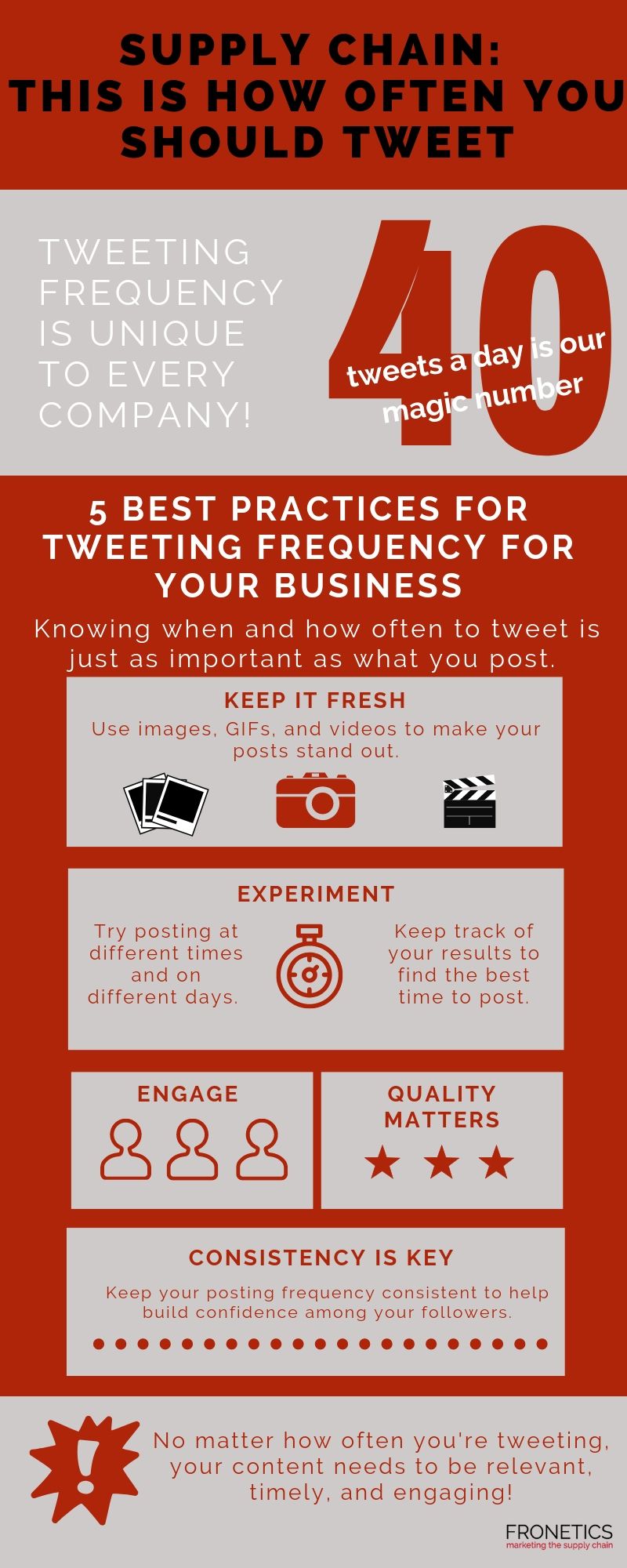
Back in 2016, in response to a Socialbakers study that suggested that posting to Twitter three times a day is an ideal frequency for brands, Fronetics conducted a study of our own. We determined that for our business, tweeting around 40 times a day is optimal.
What these radically divergent results demonstrate is that the answer to how often to tweet is not a simple one. While the bottom line is that optimal tweeting frequency is unique to every brand, there are 5 best practices your business should be aware of.
5 best practices concerning how often to tweet for your business
(Made with Canva)
1) Consistency is key
Whether you’re tweeting once a day, or a hundred, being consistent about posting frequency will serve you best. Keeping your posting frequency relatively consistent lets your followers gain confidence that you will set and expectation and meet it. As social media algorithms become less friendly to businesses, it’s all the more important that you bring your followers to you.
2) Keep it fresh
It’s important to point out that consistency is key only when it comes to how often to tweet – not the content you’re publishing. Particularly on Twitter, varying your content is the best way to keep your audience engaged. Use images, GIFs, and videos to make your posts stand out, or ask questions to promote conversation and engage your followers.
3) Experiment
When it comes to how often to tweet for your business, you’ll find all kinds of divergent ready-made answers. But the truth is, there’s no magic number. Your business or your marketing partner needs to determine what works for your unique brand and audience. The best way to do this is to experiment with posting at different times and keep track of your results. In addition to Twitter’s internal analytics, these five tools can help you track and evaluate the results of your experiment.
4) Engage
As with any social media platform, publishing content shouldn’t be your only focus. Engaging with your followers, from comments to retweets, is crucial for generating an active and loyal audience.
In addition, using social media to interact with your audience can help inform your decisions about how often to tweet. When are your followers most active? What kind of content do they want to see from you? Having a conversation with your followers is one of the best ways you can answer this question.
5) Quality matters
There’s no amount of posting frequency that makes up for posting poor quality content. If your content is bad, you’d likely be better off not posting at all. Publishing content that doesn’t interest your audience will lose you followers and leads. No matter how often you’re tweeting, your content needs to be relevant, timely, and engaging.
Related posts:

by Elizabeth Hines | Jul 3, 2019 | Blog, Current Events, Logistics, Supply Chain
U.S. Consumers will shell out $6.78 billion on food for cookouts and picnics for the Fourth of July 2019.
Highlights:
- Holiday food spending is projected to be down slightly from recent years.
- More Americans than ever (48.9 million) are planning to travel this Fourth of July.
- Men are expected to spend about $10 more on average than women.
As Americans get ready to celebrate the nation’s 243rd Independence Day, the National Retail Federation is making its annual list of projections for spending. Holidays have a big impact on the supply chain, and the Fourth of July is no exception.
Who’s spending what?
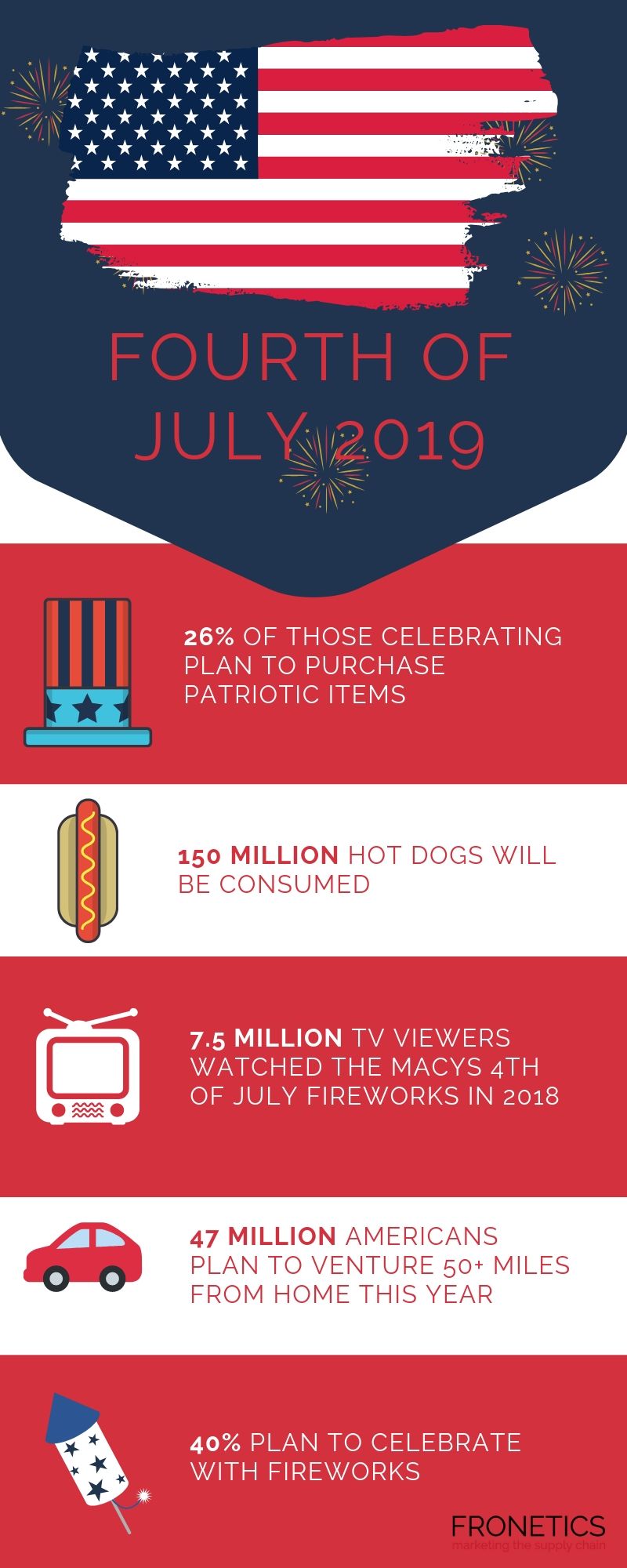
This year, 86% of Americans are planning to celebrate the Fourth of July. That number is down very slightly from recent years, with 87% celebrating in 2018 and 88% in 2017. Consequently, the average expected spending is down by just a few dollars this year, coming in at $73.33 per person, as compared with $75.35 last year.
Interestingly, while men and women are planning to celebrate in just about equal numbers (86% and 85% respectively), women plan to be significantly more frugal than men when it comes to purchasing food. Men are expected to spend $78.68 on average, while women plan to spend $68.20 each.
What’s everyone doing for the Fourth of July?
Cookouts, BBQs, and picnics are in most people’s plans (61%), with 40% planning to attend fireworks or other community celebrations, and 11% are attending parades. 26% of Americans are expected to purchase patriotic merchandise for Independence Day this year.
Even though overall spending is expected to be slightly down this year, AAA estimates that a record-breaking 48.9 million Americans are planning to travel this Fourth of July. This is a 4.1% rise over last year, with 1.9 million more people planning to get on the road this year. AAA credits the record numbers to lower gas prices, strong economic fundamentals, low unemployment, and rising disposable incomes.
Hot dog stats
Americans eat hot dogs better than just about anyone, and this Fourth of July, we’re expected to chomp down on roughly 150 million. It’s worth remembering that a year ago, Joey Chestnut set the record for the number of hot dogs eaten in 10 minutes, working his way through an impressive 74. Hot dogs are best washed down with a patriotic toast, and Americans are expected to spend upwards of $1.6 billion on beer and wine.
However you plan to spend the Fourth of July, Fronetics wishes you and your family a fun-filled and safe weekend.
(Made with Canva)
Related posts:

by Elizabeth Hines | Jul 2, 2019 | Blog, Content Marketing, Marketing, Packaging, Supply Chain
Looking for ways to make your morning commute more productive? These 4 podcasts for packaging and supply chain professionals are on our must-listen list.
Highlights:
- Download podcast episodes for on-the-go access to innovations, insights, and analysis from leading industry figures.
- Talking Logistics with Adrian Gonzalez is both highly approachable and insightful.
- SupplyChainBrain’s episode on Trends in Packaging is a must-listen for packaging industry professionals.
It wasn’t all that long ago when the options for the morning commute were limited by what CDs you had in your car (or Walkman) or what was playing on the radio. With the rise of podcasts, we’re no longer stuck choosing between rowdy drive-time radio hosts or NPR. We’ve chosen 4 podcasts for packaging and supply chain professionals that offer top-notch industry analysis, insights, and conversations.
Podcasts are a series of digital audio files that enable users to subscribe and download, so listening on the go doesn’t mean using up your data plan. There are all kinds of podcasts out there on essentially every topic you can imagine. These 4 podcasts for packaging and supply chain professionals will feed your mind, expand your insights, and some might even make you crack a smile!
4 podcasts for packaging and supply chain professionals
1) Talking Logistics with Adrian Gonzalez
We love supply chain and logistics analyst Adrian Gonzalez’s conversational podcast. Listen to a few episodes, and you’ll feel like you’re in on a conversation with your brightest professional contacts. Gonzalez’s easy-to-follow format on Talking Logistics gives it a friendly, casual feel, but it’s bristling with keen insights. The podcast features interviews with industry thought leaders and newsmakers, including supply chain and packaging executives from leading retail companies, academics, authors, and executives from 3PLs.
Recent must-download episodes:
2) SupplyChainBrain
SupplyChainBrain is a series of in-depth conversations with industry leaders, consultants, academics, and experts from every aspect of supply chain management, including packaging. Always current, the podcast has been producing weekly episodes since its launch in 2013. It covers topics like retail shifts, blockchain innovations, labor shortages, and the Internet of Things, and its excellent overview episode “Trends in Packaging: The State of the Art” is a must-listen.
Recent must-download episodes:
3) LogicalLogistics
Though the episodes are older, Bellair Expediting’s podcast is worth listening to, particularly for the packaging industry. It features interviews with executives and experts in transportation, logistics, packaging, and more.
Must-download episodes:
4) Straight Talk with Supply Chain Insights
Research and advisory firm Supply Chain Insights hosts its weekly podcast, Straight Talk, which covers topics from global thinking to trends in data and packaging. Most episodes take the form of conversations and interviews with executives and experts, sharing supply chain and logistics insights.
Recent must-download episodes:
What podcasts for packaging and supply chain professionals have you been listening to lately?
Recent posts: