by Elizabeth Hines | Sep 10, 2014 | Blog, Data/Analytics, Marketing, Strategy
Metrics matter. Metrics allow you to measure success, drive strategy, and demonstrate the ROI of your marketing efforts. Conversions are one of the most important metrics to monitor.
Why conversion rates matter
What is a conversion? A conversion means action. It means that someone took some action that entered them into your funnel or moved them further down your funnel. Examples of conversions are: downloading a white paper, filling out a form, requesting information, opening an email, and becoming a customer.
By monitoring and tracking conversions you can determine what marketing efforts are paying off. Additionally, by monitoring and tracking conversions you can identify which efforts need to be re-evaluated or even discontinued. In short, conversion rates can help you measure your ROI.
Why conversion rates don’t matter
Conversion rates are not the Holy Grail of metrics. Your website should be a magnet. It should attract and engage prospective customers and current customers. Your website should serve to educate and to establish your business as an industry leader. Eighty to 90 percent of prospects are not ready to make a purchase when they first engage with your company. Conversion rates don’t capture the amount of time people spend on your website, learning, exploring, and getting to know your business. Conversion rates also do not capture the amount of time current customers spend on your website – valuing your company as a resource.
While conversion rates are an important metric to measure, remember that they are not the end all be all.
Tracking conversion rates
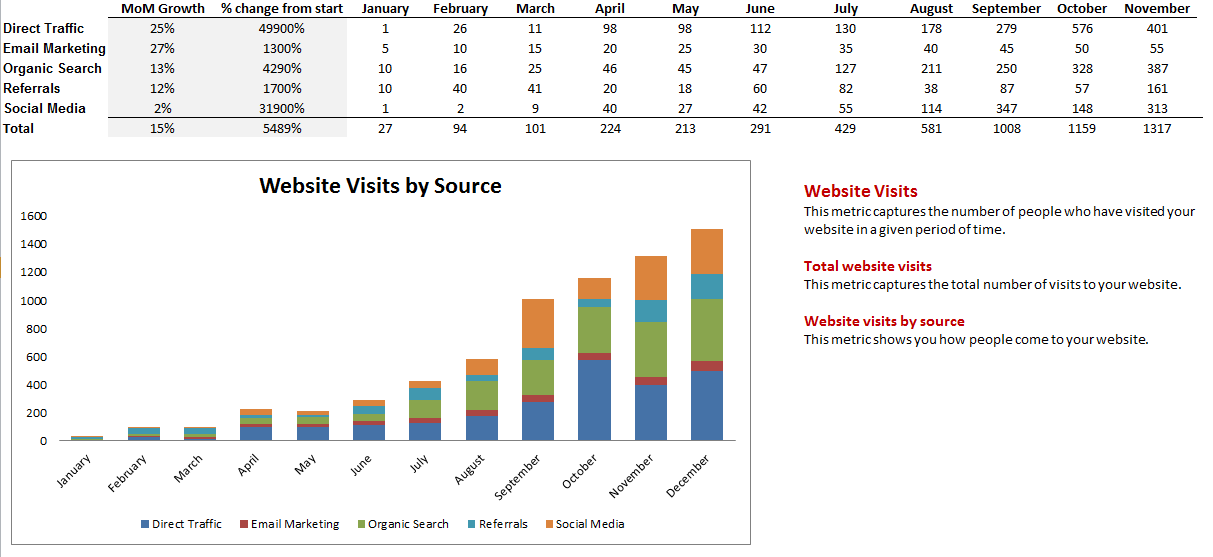
We created a template that you can download and use to track conversion rates and other critical metrics. While the template captures visitor-to-lead and lead-to-customer conversion rates, you can easily modify the template to include additional conversion rates that are useful to your business.


by Elizabeth Hines | Aug 13, 2014 | Blog, Marketing, Social Media, Strategy, Supply Chain
Leads are essential to the growth of your business. Social media is an effective way to find new leads.
Social media allows you to find new leads by doing something called social prospecting. Social prospecting is the art of searching the social web, identifying potential prospects for your business, and engaging them in a manner that draws them to your company’s website and through your funnel.
Social prospecting
At the core, social prospecting is about listening. It is about listening to social media conversations in order to generate leads for your business. It’s beyond monitoring keywords. It’s about engaging people that may or may not know what your business can do for them.
Workbook
We’ve identified the quickest way to find potential prospects on Twitter, Facebook, LinkedIn, Pinterest, and Google+ and compiled them in a workbook. Every worksheet includes: a short preparatory work to make the actual prospecting easy; visual instructions on how and where to find prospects; pro tips that will help you get the best results; prescriptions (Marketing Rx) for success; and take-home exercises for follow-up prospecting
Get started
Want to get started? Simply download the workbook.
by Elizabeth Hines | Jul 31, 2014 | Blog, Data/Analytics, Strategy, Supply Chain
Want to have a better-run business? Define clear metrics and use them as a launch pad to move your organization forward.
Metrics enable you to operate more effectively and efficiently because they provide you with valuable information on how you can drive improvement and how you can apply resources (people, time, money) to the activities and programs that will get you to where you need to go.
Critical metrics for effective business are ones that focus on the strategic goals of your organization. Here are five metrics every business can benefit from using:
Financial metrics
Make sure you have, at the very least, a quarterly plan in place. A yearly plan is ideal, but a quarterly plan is a good starting point. Track against your plan. Looking at financials in aggregate is not a helpful exercise. Rather, look at your financials on a granular level.
Business metrics
Determine what makes your customers happy and what enables your organization. Track these. Soon, you will know what you should do more of and what should be cut back.
Customer metrics
Determine the who, what, when, and why of your customers. Knowing what matters to them will help you understand how to serve them better.
Vendor metrics
Determine the who, what, when, and why of your vendors. Relationship management and partnering can only be built on a strong foundation.
Quality metrics
When it comes to quality it is important to look at anything and everything. That is, the quality of your products, the quality of your relationships with your clients, the quality of work your employees produce… Start tracking all of this.
Track the data
Develop tracking methods for each of these five metrics. Archive the data. Learn by studying the results on a regular basis. You’ll start understanding how to drive the direction of your organization. You’ll develop a focus for your organization and your performance. You’ll be able to make better decisions and drive performance.
Although most (if not all) of the material will be used internally, you should make sure that it is “external facing ready.” What you are creating is a database that you can query when you need it. In the end, you’ll have, at your fingertips, a decision database to run a better business.

by Elizabeth Hines | Jul 30, 2014 | Blog, Marketing, Social Media, Strategy, Supply Chain, Talent
Source: www.social-hire.com
Great talent is out there. The question is – where? With more than 73 percent of online adults and 89 percent of job seekers using social networking sites the answer is clear – online.
Many companies employ a strategy of “post and pray.” That is, they post the job on their website and then they sit back and wait for the applications to pour in. If you want to attract top talent, you need to move away from post and pray and instead use an active talent acquisition strategy.
Here are the components of an active strategy– one that will enable your company to attract and land top talent.
Post
In addition to posting the job description on your company’s website, post it on industry job boards and on LinkedIn.
Share
LinkedIn, Twitter, and Facebook are great places to share that your company has an opening and is looking for great talent. When using social media to share the job posting remember that, for example, the lifespan of a Tweet is about 18 minutes. Given this, it is necessary to share the job opening more than once so that it doesn’t get lost in the chatter.
Explore
Go out and look for talent. Look to the LinkedIn groups to which you belong. Are there individuals who, given their contributions to the group, seem like they would be a good fit for the position? If so, reach out to them and let them know they caught your attention. Share the position with them, and go from there.
Similarly, look to Twitter and to blogs. When looking at blogs to identify a potential candidate, look not only at the author, but also at people mentioned within a blog post.
Network
Use your network and your employee’s networks to share the position and to identify potential candidates.
The next time you have a job opening, try an active strategy. You’ll be amazed – an active approach to talent acquisition will yield a stronger pool of candidates.

by Elizabeth Hines | Jul 29, 2014 | Blog, Marketing, Social Media, Supply Chain, Talent
Do you remember Schleprock? Schleprock was the character in The Flintstones who always had a raincloud over his head; things just never seemed to turn out right for him. Given the large (and growing) number of job openings within the supply chain industry many companies are starting to get Schleprock-syndrome. Companies with Schleprock-syndrome are convinced that the supply chain talent crisis will prevent them from finding great talent and filling open positions. Here’s the problem with this: it just doesn’t add up.
In a recent interview, Rodney Apple, founder of the SCM Talent Group, shared that there are companies who are out there – right now – finding and hiring great talent. How are these companies succeeding where others fail? Apple:
“Many companies haven’t taken the initiative to develop best-in-class talent acquisition resources and programs. Companies that perform the best are the ones that treat the recruiting department like a strategic, value-added program versus a low-level, tactical HR cost center.”
Is your recruitment strategy failing?
Be honest. How does your company approach talent acquisition? Is it viewed as a cost center or is it viewed as a strategic department, crucial to the success and growth of your business? If your answer is the former, it is time to rethink your approach.
Fix it
Apple’s role within the supply chain industry gives him a unique perspective on the talent acquisition and recruitment. Want to fix your recruitment strategy? Here are 10 things Apple suggests your company should do to create a successful recruitment strategy:
- Write job descriptions that attract supply chain talent
- Be more flexible when it comes to hiring requirements
- Invest in a best-in-class talent acquisition strategy and program
- Upgrade career branding materials
- Create a supply chain leadership development program
- Consider talent from other fields
- Develop a program for employing Veterans, candidates with disabilities and long-term unemployed.
- Invest more into job training and mentoring programs e.g. supply chain certifications and tuition reimbursement.
- Establish an employment brand
- Be active on social media