by Elizabeth Hines | Dec 16, 2014 | Blog, Supply Chain
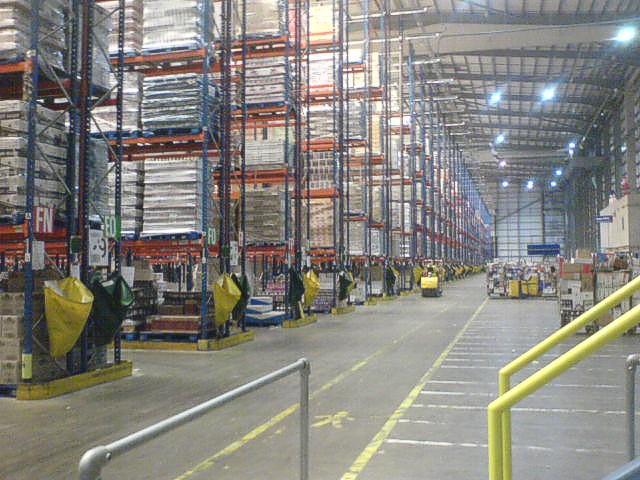
Is your distribution center proving to be a cost center? Looking to increase profits while reducing cost? Here’s how you can transform your distribution center into a profit center.
Synchronize
Anemic communication and fractured messaging within and across departments can be very costly. Build a culture in which exceptional communication in and between departments is a central component. Establishing clearly defined expectations and promoting openness will benefit your employees and your bottom line.
Optimize space
Take advantage of your distribution center. Every single inch should be used in a strategic manner. Empty or poorly used space will quickly transform your distribution into a cost center. Inspect your distribution center with a fine-toothed comb and a healthy dose of honesty. Identify obsolete inventory and work to eliminate it. Inventory that’s not necessarily obsolete, but might not be ideal for your company, should be matched with channels that will generate revenue for these products. Ensuring the optimization of space by eliminating unused and/or outdated inventory will play a significant role in turning your distribution center into a profit center.
Embrace technology
While the cost of purchasing technology may seem insurmountable, often the cost of not adopting specific technologies is even greater. Technology can serve to increase productivity, reduce error, and improve safety. Your customers will notice and appreciate it, too.
Invest in your employees
Attract excellent employees and cultivate them. Be willing to devote time and resources to your employees. Employee turnover is expensive. The cost of replacing an employee can range from 50 to 400% of their annual salary; it will serve you well to create an environment in which your employees want to stay.
Be flexible
Flexibility isn’t just essential to growth, it’s one of the vital elements to ensuring efficient day-to-day operations of your distribution center. When your distribution center is equipped to be able to process a wide variety of goods and SKUs, your distribution is more likely to be a profit center than a distribution center, which can process only a limited number of SKUs.
Scrutinizing every aspect of your distribution processes – from the buildings to what’s in them, and from the workers to how they work – will prove to be worth the investment of time and effort as all your hard work begins to pay off, and pay out.
Let us know what strategies have worked for you.

by Jennifer Hart Yim | Dec 11, 2014 | Blog, Supply Chain
Note: This is a guest post written by Barbara Jorgensen, managing editor, Electronics Purchasing Strategies.
Barb has more than 20 years’ experience as a journalist, working for leading electronics industry publications such as Electronic Business, Electronic Buyers’ News and EDN. As a freelance writer, Barb wrote and managed an award-winning custom publication for Sager Electronics; was a leading contributor to Avnet Global Perspectives magazine; was a regular columnist for the National Electronics Distributors Association monthly newsletter and wrote for industry associations such as IPC. Barb was also a featured blogger on the B2B Website Allbusiness.com and helped launch Electronics Sourcing North America, a start-up magazine serving purchasing professionals in the Americas.
Prior to her freelance career, Barb was a senior editor at Electronic Business, the pre-eminent management magazine for the electronics industry, featuring world-class manufacturing companies such as Dell, Hewlett-Packard, Cisco and Flextronics International. Before joining EB for the second time, Barb spent 6 years with Electronic Buyers’ News as managing editor, distribution, winning several awards for coverage of the distribution beat. A graduate of the University of Binghamton, Barb began her journalism career with the Gannett newspaper chain. She has worked for a number of local newspapers in the Greater Boston area and trade journal publishers Reed Business Information and UBM.
Barb can be reached at [email protected].
Why supply and demand remain unbalanced, even in the connected world
With the advent of the internet and social media, it would seem that the supply chain has more opportunity than ever to collect and disseminate information. In the electronics industry, component makers, distributors and OEMs communicate in traditional ways: EDI, Excel, the internet, extranets, MRP/ERP systems and good old-fashioned e-mail; along with cloud-based platforms, Twitter, Facebook and other social media. It’s impossible to NOT be connected.
Yet, component suppliers and contract manufacturers say that that OEMs’ ability to forecast is worse than it has ever been. OEMs still can’t predict their customers’ demand. Component suppliers—many of which have a minimum of 16-week lead times for production – often end up with too much product. Distributors pick up the slack, but as soon as inventory starts to build in the channel alarm bells go off. With so many opportunities for communication, how is this possible?
There are a couple of industry dynamics that could explain this. First, it’s been at least a decade since the electronics industry has seen any kind of significant shortage. Spot shortages cropped up following the Japan tsunami and Thailand floods of 2011, but nothing that could be termed industry-wide. Buyers have become accustomed to getting what they want when they want it. Moreover, the internet has made inventory and pricing information available to anyone with a search engine. Components appear to be available 24/7, 365 days a year. The urgency to forecast has diminished.
Then there is lean, just-in-time and build-to-order. All of these practices have effectively shortened the time between order and fulfillment. In practice, OEMs are working with an actual order – not a forecast – and the correct number of components is stored nearby. Lean has diminished the levels of inventory in the pipeline, so as long as everything is flowing as planned, there shouldn’t be any surprises.
Finally, the supply chain has figured out that it has to be more responsive and nimble regarding last-minute changes. In order to respond to JIT and BTO, inventories have to be maintained closer to manufacturing sites. Instead of single mega-hubs, suppliers and distributors have warehousing in key regions of the globe, and utilize third-party logistics when necessary. The ability to respond within 24 hours is a reality in most parts of the world.
So why are supply and demand in a state of perpetual imbalance? It’s not a dearth of data. Partners don’t necessarily trust the information they receive. Distributors routinely compare customer forecasts to historic orders to see if something is out of whack. Certain types of information are still withheld from partners: OEMs don’t share their preferred-pricing agreements with EMS. Online inventory is treated with a grain of salt: depending on how often data is refreshed, parts may or may not available at the price at which they are listed. Social media seems to be best used during disasters and for taking the pulse of market—what is trending and what is not.
Not sharing certain types of information is considered strategic by companies in the supply chain; and double-checking forecasts is a responsible business practice. However, these practices mean the supply chain may never be transparent. Information may be more available than ever, but visibility of data is an entirely different matter. Yet, even lack of information is no longer a problem in the supply chain, but full visibility remains elusive.
![The Santa Supply Chain [Infographic]](https://fronetics.com/wp-content/uploads/2024/10/Santa-Supply-Chain-Infographic-799x675.png)
by Elizabeth Hines | Dec 2, 2014 | Blog, Logistics, Strategy, Supply Chain, Transportation & Trucking
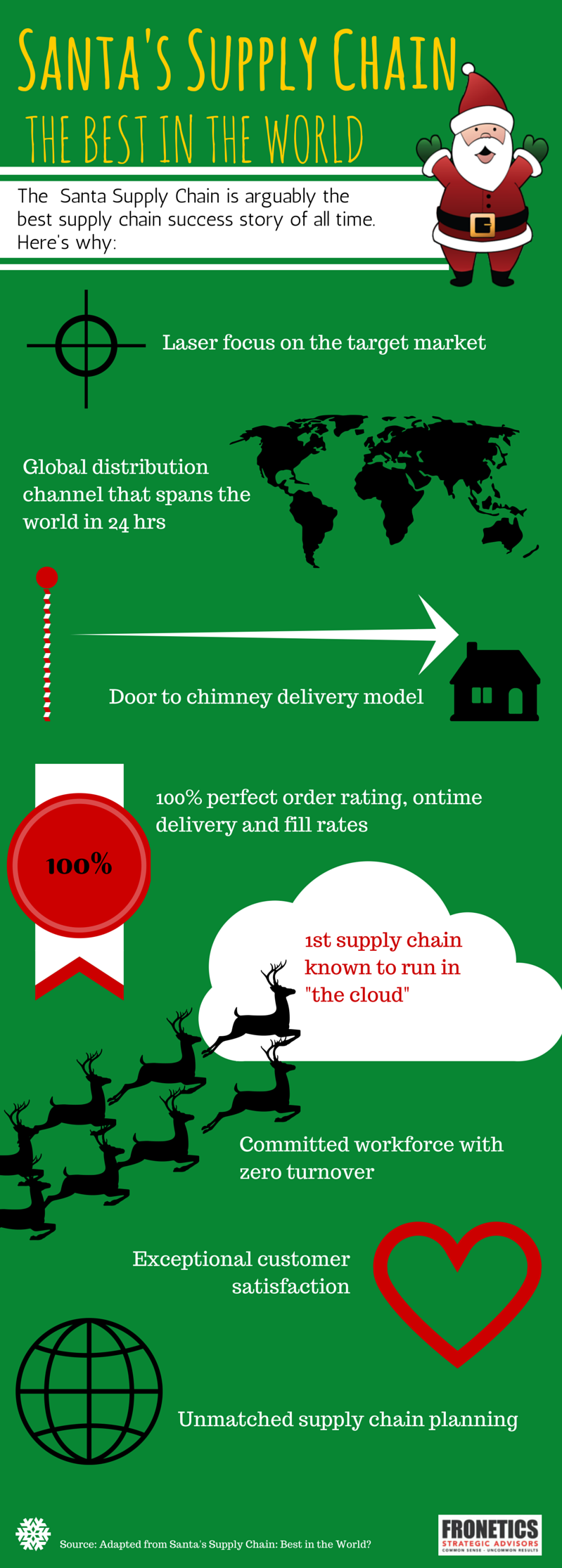
“Gartner likes to publish the Top 25 Supply Chains every year. Unfortunately, there’s one supply chain the esteemed analyst firm continues to overlook. And it just so happens to be the greatest supply chain success story of all time. I’m talking about The Santa Claus Supply Chain.”
Richard Howell’s 2011 article proposing that Santa’s Supply Chain is superior to those on Gartner’s list leaves little room for argument. Let’s be honest, is there another supply chain that can (using just one sleigh) deliver orders to 822 homes per second and has a:
- Committed workforce with a 0% turnover rate (Dasher, Dancer, Prancer, Vixen, Comet, Cupid, Donner, and Blitzen are loyal and long-serving);
- 100% order rating; and
- 100% on-time delivery?
I think not.
Check out Howell’s article for more interesting facts, and our Santa Supply Chain infographic for holiday fun.
by Elizabeth Hines | Oct 23, 2014 | Blog, Supply Chain
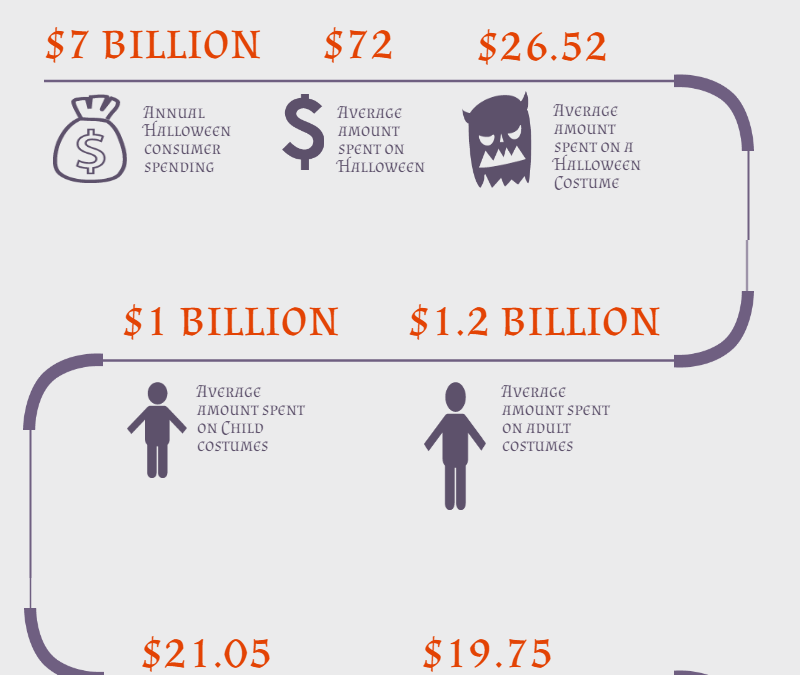
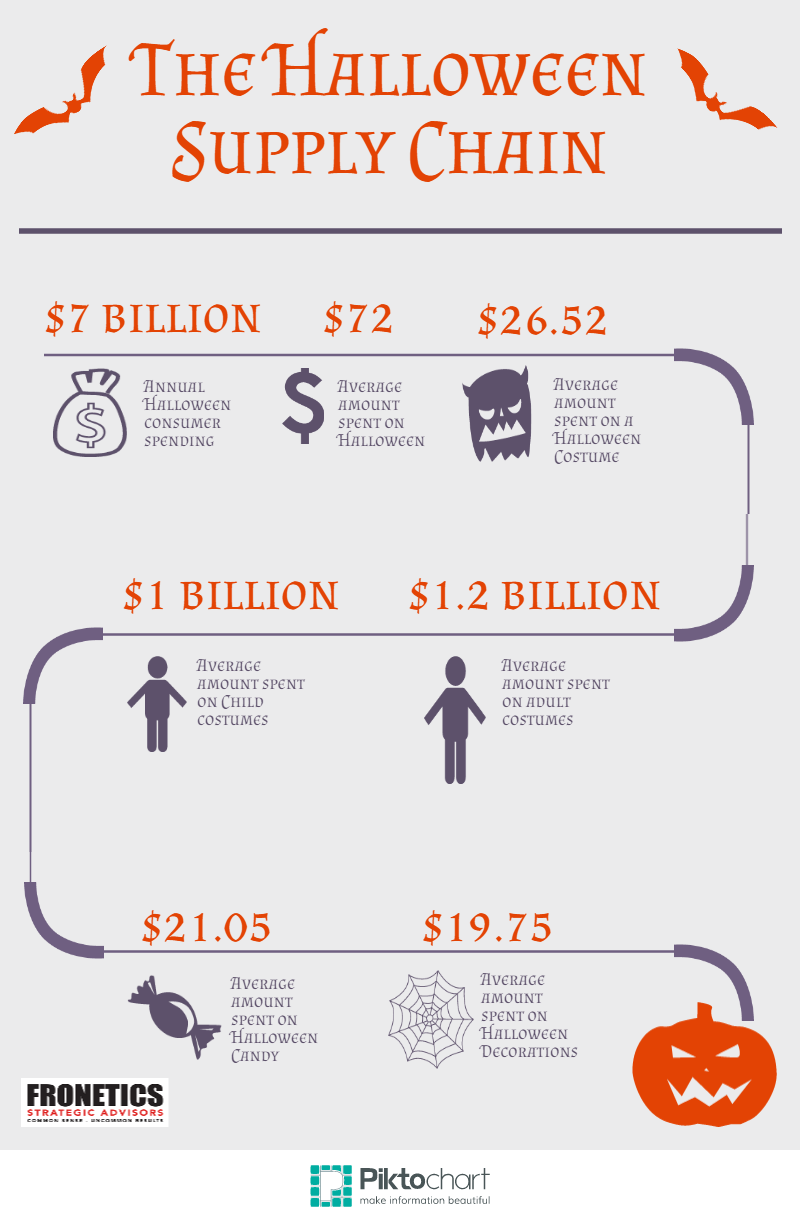
This year 68.5 percent of Americans plan on celebrating Halloween. To celebrate, Americans spend – a lot. Consumer spending for the day tops $7 billion.
During the week of Halloween 90 million pounds of chocolate will be purchased, and a total of $1.9 billion will be spent on candy alone. $2.1 billion will be spent on Halloween costumes (the most popular adult costume is a witch and the most popular costume for children is a princess), and consumers will spend an average of $19.79 on Halloween decorations.
For the supply chain and logistics industry, Halloween is big business. Here’s Halloween supply chain by the numbers.

by Elizabeth Hines | Oct 21, 2014 | Blog, Data/Analytics, Marketing, Social Media
Individuals within the logistics and supply chain industries want to learn more about social media ROI. A recent survey conducted by Fronetics found that 81 percent of respondents reported that information on proving social media ROI would be helpful to their company.
Proving social media ROI can seem impossible, but it is not if you put the right framework in place. Here’s how to put that framework in place, and prove social media ROI:
Set goals
Support your goals with SMART objectives. This allows you to track and measure your progress towards meeting your goals.
- Specific: Describe your objectives specific to the results you want. Go deeper than “gain leads” to “achieve a visitor to lead conversion rate of one percent.”
- Measurable: Metrics are essential. You can’t assess your progress towards your goal without metrics.
- Achievable: Make your goal achievable. A visit to lead conversion rate of 10 percent may not be realistic. Your goal of a visitor to lead conversion rate may be more plausible. When setting your objectives, keep reality in check.
- Realistic: As with any job, you need to have the right tools. Make sure that you have the resources, tools, and talent to meet your objectives.
- Timed: Be specific with your objective and incorporate a time frame.
Track and measure
Once you have set your goals and objectives and have identified your key metrics, put a system in place that will track and measure your metrics. At the very least, your metrics should be tracked on a monthly basis.
React
Tracking metrics is not enough. You need to react. Look at your metrics in the context of your goals and objectives. Which efforts are moving you towards your objectives and goals? Which efforts are not supporting your goals and objectives? Can these efforts be tweaked? Should you scrap them and try something new?
Taking a data driven approach is critical to proving ROI.
Wash. Rinse. Repeat.
This process is not static. When you achieve your goals and objectives, set new ones. If you are really struggling to meet your goals and objectives, you may need to revisit them to determine if they need to re-worked.
Proving social media ROI is possible. But it needs to be supported by a framework. Take the time to put a solid framework in place for your business.
