by Elizabeth Hines | Aug 5, 2014 | Blog, Content Marketing, Marketing, Strategy

The amount of content on the internet is tremendous – and is growing by the second. With 93 percent of B2B companies using content marketing, and with more than $16.6 billion dollars being invested annually by B2B companies in digital content publishing – how can your content and your business stand out?
The CMO Council, Content ROI Center, and Netline conducted a survey of 352 senior-level B2B buyers, influencers, and decision makers with the objective of determining content’s role in influencing B2B buyers in the purchase process. The results of the survey can be used as a guide for creating content that will help you grow your business by driving profitable customer action.
Why do buyers consume content?
Sixty-two percent of B2B buyers turn to content in order to learn about new market developments and industry practices. Sixty percent turn to content to discover new solutions to address a specific problem. 52 percent look to content to address a project or a program being undertaken by their company.
Why do buyers value content?
Fifty-four percent of B2B buyers report they believe content keeps them current on new techniques. Forty percent say that it helps identify partners and solution providers. Thirty-eight percent of B2B buyers believe content provides strategic insights and shapes their purchase specifications. Thirty-seven percent of B2B buyers report that content educates them about industry issues, problems, and challenges.
Content that will grow your business
Content that will draw customers to your website and to your business is content that educates, informs, and addresses specific needs.
So that your business does not get lost in the clutter, you need to create and curate content that educates consumers about the industry, technology, and new market trends. Moreover, your content should address the needs and pain points of your target customer. Therefore, your content should answer questions, provide solutions, and provide strategic insight.
If you consistently create and curate content that B2B buyers find valuable, you will realize results.

by Elizabeth Hines | Jul 15, 2014 | Blog, Marketing, Social Media, Strategy, Supply Chain, Talent
If the supply chain industry is going to attract new and qualified talent, it needs a face lift. The industry needs to be proactive. It needs to communicate what it is, what is currently happening within the industry, and what is in store for the future.
Who is responsible for making change possible? You.
Job seekers turn to the Internet for information. Job seekers not only use the internet to search for job openings, they also use the Internet to research industries, companies, and key players. The information job seekers gather by looking at websites, blog posts, articles, and social media shape their opinion and knowledge. According to the 2013 CareerBuilder Candidate Behavior Study 63 percent of job seekers turn to social media to learn about the employment brand of a company. Specifically, job seekers look to social media to learn about the culture of a company, to learn if the company is a thought leader, and to determine the authenticity of the employment brand.

Job seekers are likely seeing sensational headlines like this recent one from Forbes: Wanted: 1.4 million new supply chain workers by 2018. But what do they find when they move forward with their search for information on the supply chain industry and on your company?
The reality is that the supply chain industry has been slow to participate in social media and has been remiss when it comes to blogging. Even more basic, many companies within the supply chain industry do not recognize the value of their website and have created sites which provide little to no helpful information, are difficult to navigate, and are not up to date.
According to the CareerBuilder Study, 91 percent of candidates believe employment brand plays a role in their decision whether or not to apply.
If your company is going to attract great supply chain talent you need to step up to the plate. Make changes to your website, create and curate great content, and get active on social media.
Great talent is on the Internet. If you want to attract great talent you need to be there too.
by Elizabeth Hines | Jul 1, 2014 | Blog, Content Marketing, Manufacturing & Distribution, Marketing, Strategy, Supply Chain
Think like a manufacturer
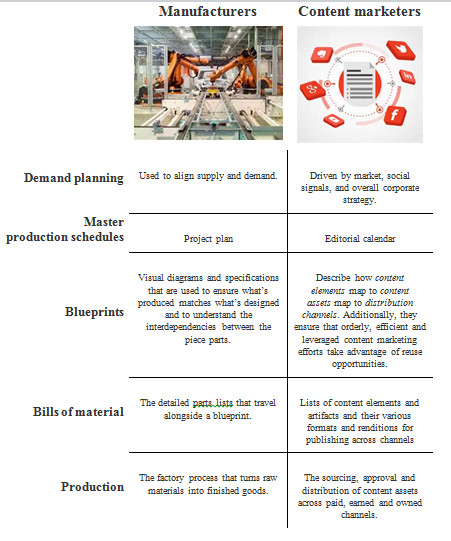
Gartner’s Jake Sorofman wrote a great piece about building a content supply chain. His advice for understanding what it takes to use content as a tool to grow your business: think like a manufacturer.
Why? Sorofman connects the dots:
Manufacturing is actually an instructive example for what it takes to scale and sustain a content marketing program. Why? Because content marketing requires a replenishing pipeline of engaging content—a content supply chain—that helps feed the beast every day.
The following table (adapted Sorofman’s article) further illustrates the parallel between manufacturing and content marketing.
How can you successfully replenish your content supply chain and grow your business?
Strategy. As in manufacturing, strategy is essential when it comes to content. Without a strategy in place your content efforts will fall flat and will not help you grow your business. Want to learn more about creating a content strategy that will drive profitable customer action? Download our eBook: Grow your business with content: 12 steps to a content strategy.

by Elizabeth Hines | Jul 1, 2014 | Blog, Content Marketing, Marketing, Strategy
Content can grow your business.
How can content such as blog posts, white papers, eBooks, newsletters, infographics, podcasts, webinars, and video grow a business? Content can grow your business by increasing your search engine ranking, positioning your company as an industry leader, attracting new customers, and helping you retain current customers.
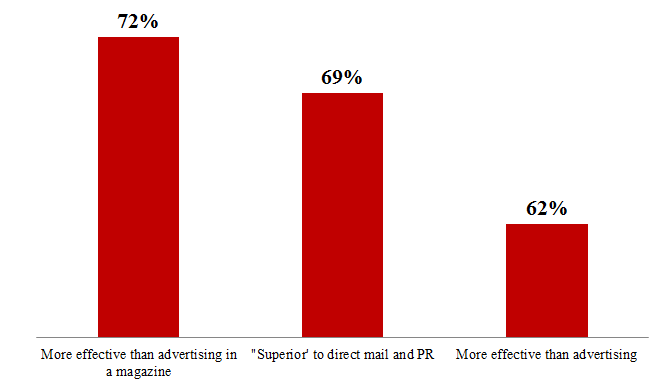
Not convinced? B2B companies with an active blog generate 67% more leads per month than those who don’t. What’s more, a study by the Custom Content Council found that 72% of marketers believe branded content is more effective than advertising in a magazine, 62% believe it is more effective than advertising, and 69% believe it is ‘superior’ to direct mail and PR.
Not all content is equal. Not all content will help you grow your business.
Content that will move the needle for your business is valuable content. It is content that is informative, educational, interesting, and speaks to your customer’s emotions and speaks to their pain points. Valuable content is not a sales pitch. Furthermore, valuable content is content that is delivered consistently over time and at the right time.
Strategy is vital
A 2014 study of B2B marketers found that companies who have a documented content strategy in place are more likely to consider their efforts to be effective than companies who do not have a documented strategy in place (60 percent vs. 11 percent).
The 12 steps to creating a content strategy that will help your company drive profitable customer action are:
- Put someone in charge
- Define your goals
- Define your audience
- Define your metrics
- Identify the right distribution channels
- Create a publishing calendar
- Create content
- Curate content
- Distribute content
- Engage with customers and prospects
- Track and analyze metrics
- Make adjustments as necessary
Want to learn more about these 12 steps and creating an effective content strategy? Download our eBook.


by Elizabeth Hines | May 21, 2014 | Blog, Talent
According to R.J. Bowman, author of The Secret Society of Supply Chain Management, demand for supply chain professionals exceeds supply by a ratio of six to one. Looking forward, it appears that demand for supply chain professionals will only increase. The U.S. Bureau of Labor Statistics estimates that demand for supply chain talent will increase by 26 percent between 2010 and 2020 – a growth rate that is twice as fast as 14 percent of all occupations.
In response to the demand for supply chain professionals, universities have introduced undergraduate majors, M.B.A. concentrations and even entire degree programs dedicated to procurement, inventory management and global supply-chain strategy. The Wall Street Journal has even gone so far as to declare supply chain management the “hot new MBA.”
The University of New Hampshire Peter T. Paul College of Business and Economics is one university which offers MBA courses focused on supply chain management. This semester Fronetics has had the opportunity to work with students in one of the school’s supply chain management courses. Students in the school’s Supply Chain Management MBA course learn how to design, plan, and operate supply chains for competitive advantage; develop an understanding of how the key drivers of supply chain operations can be used to improve performance; and develop knowledge of logistics and supply chain methodologies and the managerial context in which they are used.
Over the next several weeks Fronetics will share topical supply chain management articles written by several of the MBA students. The students are inclusive of full-time graduate students and professionals who attend the MBA program part-time. The articles point to the diversity of this group of students as well as the student’s breadth of knowledge on supply chain issues.
A full list of the students’ articles follows below: