Content marketing is a long-term solution. Here’s why it takes so long to see results.
You are committed to your content marketing program. You’ve created blog posts, uploaded videos, and collaborated with industry leaders. You may have started noticing an increase in web traffic, social reach, and other engagement metrics like time on page. You’re on the right track!
The problem is your lack of leads or sales. Your boss is pressuring you for results, and you’re starting to question your efforts. Are you doing something wrong?
The answer is NO.
In fact, you’re doing everything right. Now you need to give your investment time to deliver on your return. But I know you’re asking, “Why does content marketing take so dang long to work?”
Content marketing is a long-term solution that helps businesses build brand awareness, grow their audience, and generate new leads and sales. But it takes time and effort to achieve results. You don’t want to give up before you see the fruits of your labors.
Just how long will it take for your content marketing strategy to yield results? Well, that really depends on your business and your goals, but you can count on at least six months. Content marketers Neil Patel and Carol Ann Tan both write that content marketing strategies take at least six to nine months to start seeing results.
But that doesn’t mean you should throw in the towel. Here are 4 reasons content marketing doesn’t show results overnight but is still well worth your time and investment.
Video: 4 reasons why it’s NOT time to give up on content marketing
Please don’t give up on content marketing before it’s had time to play out. We understand you want to see the fruits of your labor. But if you pull the plug too early, you’ll lose out on your initial investment, not to mention the leads and sales that are eventually coming your way.
A webinar is an excellent content medium to generate leads to or nurture those already in your sales funnel.
Maybe you’ve taken a webinar to enhance your professional skills. Did you know that webinars can be beneficial not only to the students, but also to the business providing them?
In content marketing, we consider a webinar content that your target audience will find valuable. You can leverage this value to move them through the buyer’s journey — whether it’s becoming a lead by providing their contact information in exchange for attendance, or by using the webinar strategically in the lead-nurturing process.
Porterfield suggests that live online workshops and pre-recorded courses sell well in a webinar, whereas physical products are less effectively sold in this format. “So before you choose a webinar to sell your product or service, think about how the thing you’re selling is or isn’t like a webinar experience.”
How is a webinar different from my other content?
What separates your free content (like blogs, social media, podcasts, etc.) from paid content like a webinar?
Porterfield emphasizes that, while free content explains the “What” of your products and services, “your paid content explains the How.” She suggests that a successful webinar will “paint a picture using images and really powerful words and stories.”
Your attendees should leave the webinar feeling that they’ve learned something valuable, and that they are ready to take the next step — which should be considering your product or services. “When you begin selling in your webinar, focus on how your paid program, online product, consulting, or coaching helps attendees achieve the opportunity, transformation, or result you’ve just explained,” says Porterfield.
She also suggests bringing your target audience’s obstacles to the forefront of the conversation. “Clearly articulating the obstacles lets your audience understand them on your terms and creates a well-defined pathway for your product or service to help them overcome the obstacles. Essentially, you want to provide enough information so that your product is the next logical step.”
Focus on what you do best — and save time and money — by parceling off these 6 marketing tasks to outsource.
If you’re anything like me, you’re busy — not-enough-hours-in-the-day busy. We find that supply chain and logistics marketers are some of the most overworked professionals in the industry. One person (or a very small team) is often responsible for all marketing and sales efforts for an organization. So I want to let you in on a little secret: Outsourcing is your solution to being too busy.
Outsourcing marketing tasks allows you to focus on insourcing your core competencies. In other words, you can start focusing on what you do best and delegate specified tasks to external experts.
The content marketing landscape is constantly changing. There are more and more marketing tasks to cover: social media, videos, blogs, emails, etc. How can you truly focus your attention on any one area when you have so many balls in the air?
Don’t work harder. Work smarter.
Outsourcing marketing gives you the opportunity to remove some of the time-consuming and laborious tasks from your desk, so you can get back to the core of your marketing efforts.
That doesn’t mean you have to outsource all your marketing tasks, or even half of them. Choosing several areas beyond your staff’s expertise, or tasks that are particularly tedious, can help you improve your marketing efforts and take stress off an overworked internal team.
Here are six areas you should consider outsourcing.
Video: 6 marketing tasks to outsource
Final thoughts
Finding the right partner is key when you choose to outsource marketing tasks. You have to trust the people to whom you are delegating tasks, so that you know the work is getting done the way you want while you focus your attention on other tasks.
The right partner will work with you to develop a strategy that closely aligns with your business goals. Your partner can even execute the strategy for you and provide regular updates on how it’s working. This kind of results-driven approach will ensure you’re stretching your marketing dollars to the fullest extent and getting the kind of results that will grow your bottom line.
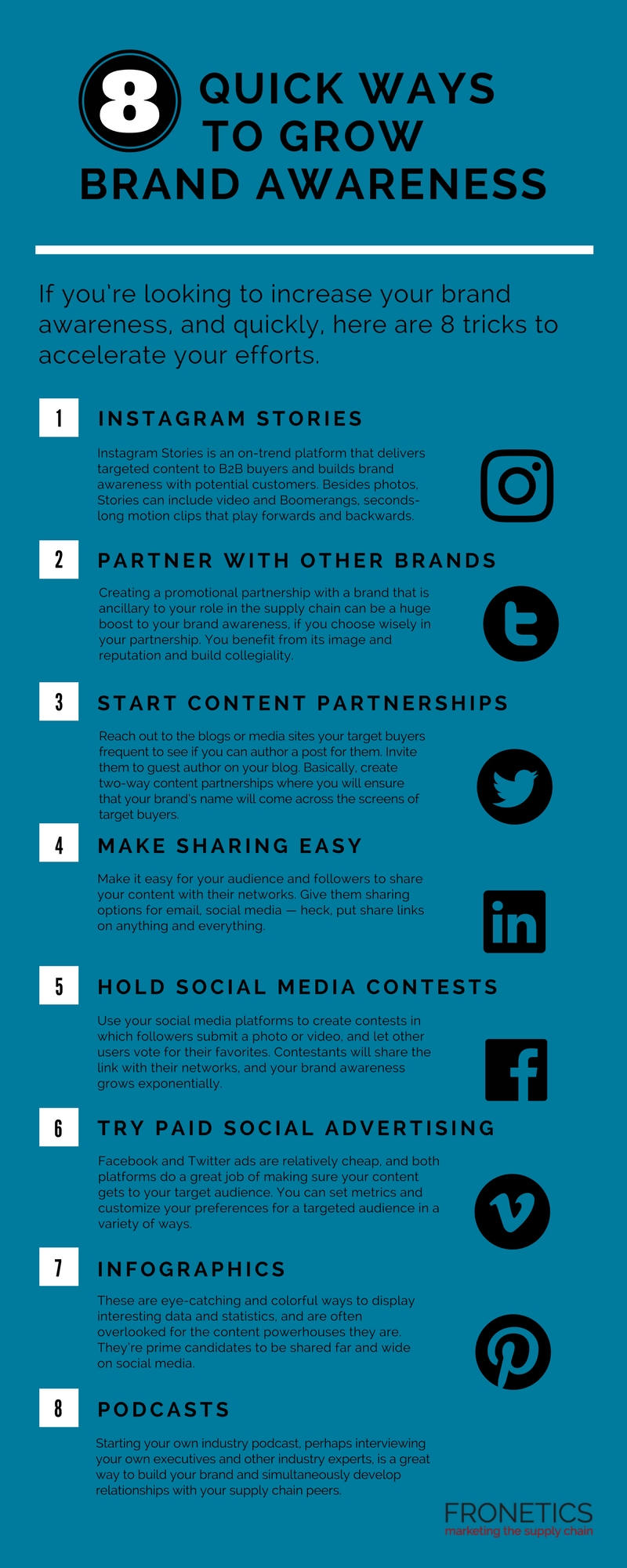
If you’re looking to grow brand awareness fast, here are 8 tricks to boost your efforts.
Have you ever noticed how some brands seem to have crept into popularity overnight? You’ve never heard of them, and then, all of sudden, they’re everywhere.
Their brand awareness has sky rocketed, and they’re achieving every company’s ultimate goal: Customers know about them. So what’s their secret?
Here at Fronetics, we don’t believe they have a secret. We believe that they took advantage of content marketing and its many benefits — growing brand awareness included. They were able to scale their growth in a short amount of time, a true success story for the digital era. Companies like Uber and Yelp have used these tips to implement small changes that yielded large results.
Remember, in order to grow brand awareness, you need to be proactive. It’s time to steer away from some of the traditional marketing methods, which don’t take into account how modern B2B buyers research vendors. Start putting your content marketing strategy to the test.
If you’re looking to increase your brand awareness fast, there’s no better place to start than with content marketing. Check out these 8 tips for using content marketing to grow your brand awareness fast.
Use these three steps to calculate content marketing ROI to show the value of your investment.
As supply chain and logistics businesses are finally recognizing the merits of content marketing, many are looking into it. But it doesn’t take much research to realize what an enormous investment it is. And how difficult it can be to calculate content marketing ROI.
Many companies we talk to need help convincing management that it’s a worthwhile investment. To that we say, use data!
But what data should you use? How do you quantify certain benefits, like growth in brand awareness? And do you really have to keep track of all the hours you spend writing blog posts, managing social media, etc.?
Here arethree basic steps for how to calculate content marketing ROI.
3 steps to calculate content marketing ROI
1) Set up your ROI measurement.
It’s important that you measure content marketing ROI at the initiative level. This means calculating the ROI of your blog, your webinar series, your Facebook marketing, etc. individually.
After calculating the ROI of each initiative, you can aggregate that data to determine your overall content marketing ROI for your business.
2) Know as much detail as possible.
“To measure ROI, you have to know, in as much detail as possible, the R (return) and the I (investment) of your content initiative,” says Jay Baer, president of Convince & Convert. Baer walks his readers through the example of figuring out ROI for a podcast, including calculating total investment in the project (including preparation and execution), and calculating total return.
Content marketing is about creativity. By the same token, think creatively about every measurable avenue of return in each of your initiatives.
3) Calculate your ROI.
The formula for ROI is universal: return minus investment, divided by investment, expressed as a percentage.
And there’s some good news for supply chain and logistics content marketing: “Content marketing ROI calculations are indeed easier for B2B companies because they almost always have visibility at the transaction layer,” writes Baer.
Once you’ve calculated ROI for each of your major initiatives, it’s time to think strategically about optimizing your content marketing resources, in terms of allocation and timing. Having hard data helps you answer questions about which initiatives are most fruitful, what language engages your audience best, when your efforts are most likely to pay off.
Ultimately, this data-driven approach lets you continually adapt to the needs of your audience, ensuring an ongoing, robust ROI.