
by Jennifer Hart Yim | Jun 4, 2018 | Blog, Content Marketing, Current Events, Logistics, Manufacturing & Distribution, Marketing, Supply Chain
3-D printing opens up new revenue opportunities for supply chain, helping companies meet demand in real time, manage inventory without limiting products they offer, and increase lead time.
This article is part of a series of articles written by MBA students and graduates from the University of New Hampshire Peter T. Paul College of Business and Economics.
Spring has finally arrived in New England. However, with spring comes every vehicle’s most dreaded enemy, the pothole! My coworker Will recently fell victim to one such nemesis. His part-sourcing saga has me wondering how soon the narrative may change.
On what started as a normal morning, Will soon found himself calling a tow truck to get his car to the shop and a coworker to get himself to work. An unavoidable pothole caused one of his ball joints to fail, and limping anywhere was not an option. The silver lining of the day was that his very accommodating mechanic agreed that Will could source his own parts.
A sourcing saga ensued.
The layers of research he had to do was frustrating. Which manufacturers make the quality of product he wants? Then which distributors can provide him the quantity he needs when he needs them at the best price?
This meant calls to local auto part stores, price checking against online distributors, verifying brands & model numbers, accounting for lead times, stockouts, shipping and handling fees to determine how to get the best total value of quality, cost, and delivery.
Complex decisions like this are common in many sourcing scenarios.
But does it have to be?
What if distributors could better manage their inventory without limiting the products that they offer or increasing the lead times to their customers?
With 3-D printing, that may soon be attainable.
Rather than holding inventory from various manufacturers, a distributor could have license agreements with manufacturers to print parts on demand.
Revolutionary though this sounds, it’s not an unfamiliar model. Not so long ago, buying music meant going to a physical store to purchase or order an album. Now streaming services have license agreements with record companies to meet consumer demand in real time.
Jay Leno has been 3-D printing parts for his fleet of classic cars for nearly a decade. He admitted that initially the costs were prohibitive for most people. However now that 3-D printers are available at a wide range of price points, it is becoming more economical to print products on demand.
Printing parts with low inventory turns on demand would reduce inventory costs within the entire supply chain, having a positive impact on a company’s bottom line. High-value, low-volume parts like those of late model vehicles are the perfect candidates. In fact, BMW, Porsche, and Mercedes-Benz Trucks have begun 3-D printing spare parts older models and freight trucks.
3-D printing and logistics
The next logical progression to reduce overall supply chain cost is to move production as close to the customer as possible. Logistics companies are positioning themselves to be ready to integrate into this production model.
Both UPS and DHL have recognized the potential for end-of runway 3-D print capabilities and local 3-D “print shops.” UPS has partnered with SAP and Fast Radius to launch its On-Demand 3D Printing Manufacturing Network, which leverages 3-D printing technology, analytics and UPS’s global network to execute production at the location where capacity and logistics are optimum.
This summer, BMW Motorrad will provide spare-part printing capability directly to customers with BMW Motorrad iParts, a mobile 3-D printer designed to travel with you on the back of your BMW Motorrad motorcycle. Customers will use a mobile app to download a part file from the cloud-based library and print parts on the go. Although limited by the size of the printer, Motorrad rides will be able to replace small parts in nearly any location. Customers can even preload files so, no matter where they are — the side of a mountain or the middle of a desert — they can make spare parts.
These companies are not alone in seeing the value of 3-D printing on the go. Amazon made headlines when it first filed for a patent on a 3-D printing delivery truck. That patent was granted at the beginning of this year. Although a launch plan has not been announced, a major player with that capability is a definite catalyst for more innovation at the intersection of 3-D printing and logistics.
The future
It’s clear that change is coming, logistics and inventory management will not look the same 10 years from now. The question is: when and where it will be economical to print parts on demand? Will it be at an end-of-runway distribution center, a local multipurpose 3-D printing shop, or on-site at repair shops? Will AAA be able to print a new ball joint in a roadside truck and change it out like it was no different than the services they offer for tires and battery today? I can’t wait to find out.
In the meantime, Will had to deal with today’s sourcing options. After many phone calls, dozens of emails, and multiple carpools to work, his car is back on the road. And he believes he got four new ball joints at a good value.
About the author
Ruth DeMott is a quality engineer at Pratt & Whitney currently pursuing an MBA at the University of New Hampshire. She holds a BS in Industrial Engineering from Worcester Polytechnic Institute (class of 2010). She has held roles of increasing responsibility in the manufacturing and quality engineering departments since joining Pratt upon completion of her undergraduate degree. She is involved in the New Hampshire Youth Rugby program, enjoys traveling, putting things together, and spending time with friends and family.
Related posts:


by Elizabeth Hines | May 29, 2018 | Blog, Content Marketing, Current Events, Data Security, Data/Analytics, Manufacturing & Distribution, Marketing, Strategy, Supply Chain
While information-heavy companies employ entire teams dedicated to cyberattacks, American factories have quietly been growing more and more susceptible.
It’s been eight years since the widely publicized Stuxnet virus was released to wreak havoc on its unsuspecting victims. Are we in a better place now to deal with a highly sophisticated next-generation Stuxnet-style attack?
Most experts say no. In fact, studies suggest that manufacturers, in particular, are increasingly vulnerable to cyberattacks. While information-heavy companies have grown to employ entire teams dedicated cyber defense, American factories have quietly been growing more and more susceptible.
Time to Pay Attention
Ransomware attacks, in which hackers use malware to encrypt data, systems, or networks until a ransom is paid, are alarmingly common. According to a recent report from Radware, 42% of global companies have dealt with this kind of attack. That number has been steadily rising. The number of companies reporting financially motivated attacks has doubled in the last two years.
Manufacturers — if you haven’t been paying attention yet, it’s time. This summer, about half of the organizations targeted by the sweeping Petya ransomware cyberattack were manufacturers. The recent WannaCry virus actually forced a Honda plant in Japan to halt production.
And there’s a bit more: The Wall Street Journal recently reported on what they call a new type of cyberattack that targets factory safety systems. Hackers who attacked a petrochemical plant in Saudi Arabia last year specifically focused on a safety shut-off system.
Is the WSJ right? Is this a new trend? Will hackers begin targeting control-system computers that manage American factory floors, chemical plants, and utilities on a more regular basis? Maybe.
There are plenty of theories that even the most crippling ransomware attacks like Petya and WannaCry are, at their core, motivated by something other than money, namely sheer pleasure in chaos and disruption. The potential damage to factory production and safety systems is growing. Now is the time to wake up and pay attention.
Factories Growing More Susceptible
Factories and manufacturers are at a heightened risk for a few coinciding reasons.
The complexity of our supply chains is a liability. With parts and materials from diverse and sometimes changing sources, as well as networks that can span all phases of production, our supply chains are large and constantly adapting and, because of this, extremely vulnerable.
The intensity of the manufacturing schedule raises a second issue. Many manufacturing facilities run around the clock, and halting factory production for testing is often cumbersome and costly.
The third reason is, of course, the byproduct of a manufacturing sector that has become steadily more data-driven and dependent on information technology. As manufacturing has steadily merged with technology to create the Industrial Internet of Things, we too have unknowingly created a space in which hackers see the potential for massive amounts of under-protected data, equipment, networks, and intellectual property.
How Can We Prepare
We’ve all heard the mantra, “The first step to solving any problem is admitting you have one.” A core concern has been the manufacturing sector’s inability or unwillingness to face this growing threat.
A report summary issued through a joint venture between MForesight and the Computing Community Consortium warned, “There’s a widespread failure to reckon with the risks.” The report recognizes that solving the issue will be long-term and complicated, but offers a few suggestions, including wide-reaching efforts to increase awareness, collaboration with trusted third-party partners, and cybersecurity research and development.
In the shorter term, maybe this can help. Last year the National Institute of Standards and Technology (NIST) released a Cybersecurity Framework Manufacturing Profile that provides a roadmap to managing cybersecurity and reducing risk to your manufacturing systems.
But I think Sridhar Kota, professor of engineering at the University of Michigan, hit the nail on the head in his article entitled A Plan for Defending U.S. Manufacturers from Cyberattacks, when he wrote: “Cybersecurity needs to become a deeply ingrained part of every manufacturing company’s culture — embedded in management decisions, workforce training, and investment calculations.”
The risks to manufacturers are growing from all-too-common ransomware attacks to sophisticated Stuxnet-style assaults targeting our safety systems. Its’s time that we in the manufacturing sector think of cybersecurity, and cyber defense, in absolutely every decision we make. To do otherwise is reckless.
Related posts:


by Elizabeth Hines | May 24, 2018 | Blog, Content Marketing, Current Events, Logistics, Marketing, Social Media, Supply Chain
Influencer marketing capitalizes on the relationship between popular influencers and their followers to help your organization reach your target audience.
By now you’re aware of the latest marketing trend: influencer marketing. For decades, Hollywood elite have been used to promote everything from make-up to movies and now this trend is taking over the most popular social media sites.
Influencer marketing is a form of marketing in which marketers identify individuals that have influence over potential buyers and create marketing campaigns and activities around these influencers. Why is this so effective? Because buyers trust influencers talking about your products and services more than they trust you talking about yourself.
Is influencer marketing here to stay?
Linqia’s latest report, The State of Influencer Marketing 2018, shows that companies are already taking full advantage of this marketing trend. The report shows that 86% of marketers used influencer marketing in 2017, and 92% of marketers that tried it found it to be effective.
But don’t just take our word for it. Here are some statistics that prove you should pay close attention to this trend.
Infographic: Influencer Marketing and the Supply Chain
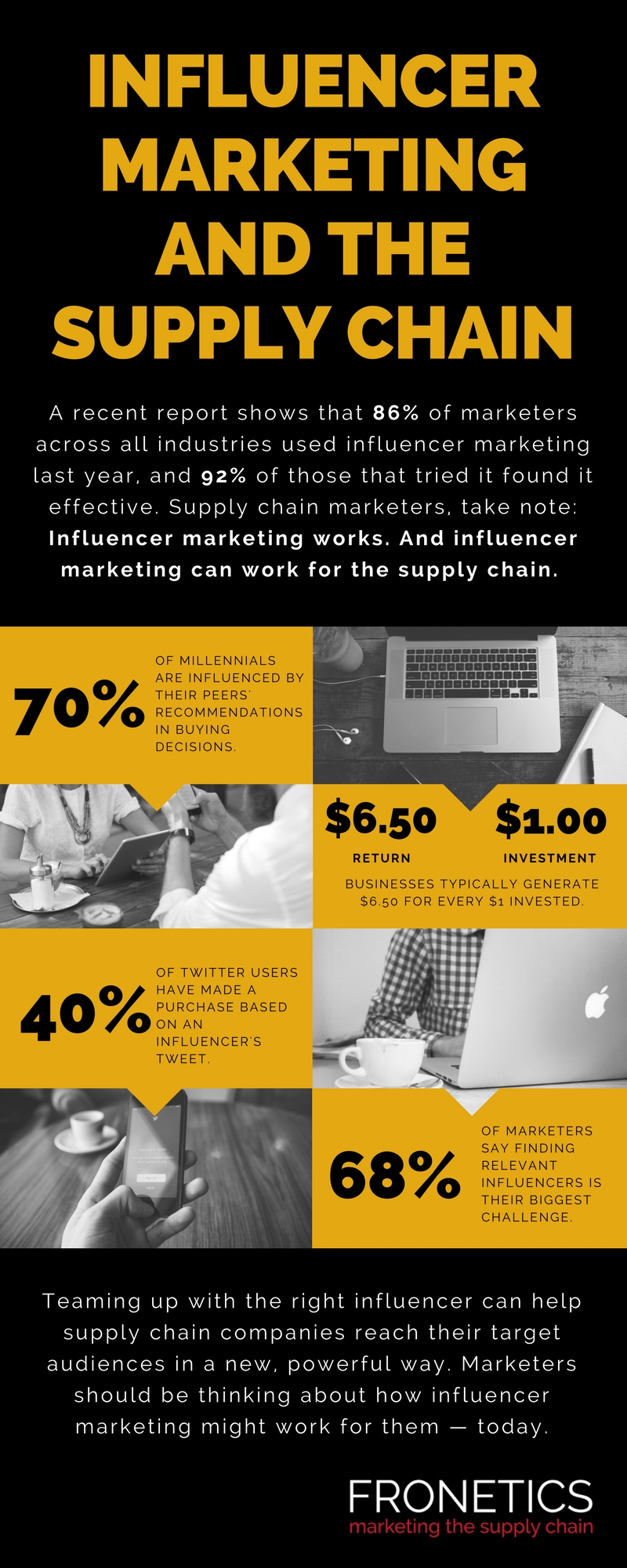
(Made with Canva)
With 39% of marketers planning to increase influencer marketing budget this year, B2B companies are quickly seeing the leverage that influencers can have over their target audiences. By teaming up with the right influencer, marketers can easily reach thousands of potential consumers, increasing website traffic and leads.
The bottom line: influencer marketing can be an extremely effective aspect of a B2B business’ content marketing strategy.
Have you tried influencer marketing? How was your experience?
Related posts:


by Elizabeth Hines | May 23, 2018 | Blog, Content Marketing, Logistics, Marketing, Strategy, Supply Chain
If you’re hoping to generate more leads on your website, you’re going to have to develop a holistic content strategy and create many strong calls-to-action.
You may have read part one of this mini-series about the importance of having a solid website if you’re going to invest in content marketing. Essentially, there’s no point in pouring a bunch of time, money, and resources into a robust content marketing program if the website that you’re driving traffic to stinks.
Be thoughtful about the role your website plays in the lead-generation process. It’s a really important piece of the puzzle that companies often overlook.
Consistently producing quality content and distributing it through various channels, like social media, will help attract your target audience to your website. But unless you provide them with a good user experience while they’re there — and give them plenty of opportunity to opt in to learn more about your business — you’re not going to move them down the sales funnel. And you’re not going to generate more leads on your website.
So how do you ensure your website is a lead-generating machine? Here’s what I know.
5 tips to generate more leads on your website
1) Create a holistic content strategy.
I can’t overstate the importance of creating a content marketing strategy, documenting it, and then designating someone to lead it if you want your content marketing to be successful. As part of that strategy, you should outline the role your website will play in assisting the conversion of leads.
Ask yourself these questions:
- Do different pages of my website suit prospects at different stages of the buyer’s journey?
- Where do I want traffic to go from each page (so prospects move further down the funnel)?
- What calls-to-action can I add to each page to assist them in that move?
- Which pages are ripe for lead conversion, and which are better for providing information?
- If you’re using the topic cluster model (which you should be!), where are my pillar pages and corresponding topic cluster pages?
Also, make sure your messaging is consistent across your website and your regularly published content (like blog posts).
2) Think about the user and how s/he experiences your site.
Hopefully in creating a holistic content strategy that includes your website, you’re thinking primarily about how the user will be interacting with your site and each page. That means organizing pages in a way that makes sense for the prospective customer, rather than internal politics.
That sounds easy, but I have helped many organizations for whom this is incredibly challenging. Often, one department (or person) feels strongly that something very important to them deserves real estate on the homepage or in the main navigation. But, if it’s not something that is meaningful to a prospective customer, you’d best not cave. Doing some usability testing with prospects is a good way to collect data to support your reasoning.
Also to consider: think about the language your buyers are comfortable with, and avoid any overly jargony or technical wording. Make sure to lay things out in a way that is approachable for them. And aim to provide the information they seek, rather than trying to sell them at every step.
3) Publish original, quality content.
Along those same lines, the best way to convince today’s B2B buyer to choose you as a vendor is to win them over with your content. Content marketing is all about positioning yourself as an expert in the industry, after all, the business that knows the most about your product/service.
Instead of promoting your business on every page, use each as an opportunity to showcase your expertise. Create resources that will help buyers better understand how to solve their pain points. And make sure everything you publish is well-written, offers value to prospects, and is completely original. You want people to want to read what you have to say.
Consider incorporating various content formats to cater to different learning preferences:
- In-depth blog posts and articles
- Infographics for visual learners
- Short video tutorials or explainers
- Podcasts for those who prefer audio content
4) Strategically place strong, visible calls-to-action.
I’ve hinted at this one already, but it bears further explanation. Make sure your website is full of calls-to-action, or buttons/links/forms that ask visitors to do something further. After all, how do you expect someone to take an action (like providing their email address) if you don’t ask them to do it?
You can generate more leads on your website by asking visitors to become leads more often.
Make sure these calls-to-action stand out on the page so that visitors’ eyes naturally go there. Be very clear about what you’re asking for and/or what the user will get in return when they complete the action. And, again, be strategic about what you’re asking people to do on which page. You won’t have much luck, for example, asking visitors to call a sales rep on a page that is designed to assist them with initial information-gathering.
Pro tip: Use A/B testing to optimize your CTAs. Try different colors, copy, and placements to see what resonates best with your audience.
5) Offer value with your calls-to-action.
Sometimes it might take a little convincing to get visitors to provide their contact information. The best way to persuade them? Give them something they want in exchange.
We call this high-value content. Examples might include:
- Case studies
- White papers/industry reports
- Webinars
- Tutorials or how-tos
- Demonstrations
- Sneak peaks or previews
- Guides or ebooks
- Podcasts
Ask visitors to download your high-value content by completing a form, which asks for their email address. Set up your marketing automation to email the content to them, then send a series of lead-nurturing emails following up at strategic intervals to keep them moving down the sales funnel.
If you want to generate more leads on your website, follow these five steps. Above all, just be thoughtful about the role your website plays in the lead-generation process. It’s a really important piece of the puzzle that companies often overlook.
Related posts:


by Elizabeth Hines | May 17, 2018 | Blog, Content Marketing, Data/Analytics, Logistics, Marketing, Social Media, Supply Chain
These metrics to benchmark marketing performance will give you insight into how your brand stacks up against your competition.
A few months ago, the winter Olympics were in full swing, and Mikayla Shiffrin became the youngest slalom champion in Olympic alpine skiing history. Shiffrin achieved this incredible record, not only working to beat her best personal performance, but also that of her biggest competitors. After all, you don’t become a two-time Olympic gold medalist without the knowledge — and drive — to beat out the world’s best athletes.
You have to know how your competitors are performing to be the very best at what you do. That goes for Olympic athletes and supply chain companies alike.
We call this benchmarking performance. For we marketers, it’s important, albeit difficult, to find metrics to benchmark marketing performance. We tend to turn inward to focus on key performance indicators (KPIs), like website traffic, social engagement and conversion rates. But it’s time to start looking outward, as well.
Competitive benchmarking gives brands the ability to compare themselves against a number of competitors using a set collection of metrics. These metrics allow you to benchmark marketing performance against that of your competitors. This will give you the knowledge and drive you need to improve your performance and chance of success.
Here are four metrics to benchmark marketing performance against your competitors.
4 metrics to benchmark marketing performance against your competitors
1. Content
Benchmarking your content allows you to compare the differences and similarities between you and your competitors’ types and relevancy of content. Are they focusing on video content or blog posts? Are they creating infographics? How often are they posting content?
2. Social activity
Knowing what social media platforms your competitors are using is critical in today’s digital marketing world. Are they having success on a specific platform? Are you using the same platforms? And how often are they posting on social media? How do you compare? Knowing when and where to post on social media can help get you in front of your target audience.
3. Social engagement
You’re posting and tweeting, but are audiences interacting with your content? Benchmarking your social engagement against your competitors lets you see if and how audiences are interacting with your posts and videos. How many likes and shares are you receiving? And how many are you competitors?
4. Keywords and topics
We talk a lot about the importance of keywords and topics. After all, that’s how audiences are searching for — and finding! — your brand and your competitors. Using online tools like SERPS, you can easily determine how you and your competitors rank for specific keywords and topics.
Analyze and adjust
Use these metrics to benchmark marketing performance. Once you have collected data, you can start analyzing your results. How does your marketing strategy stack up against your competitors and industry leaders?
Benchmarking allows you to see strategic opportunities — what you’re doing well and what you need to improve. You’ll gain valuable insight into what your competitors are doing better than you. Use this knowledge to improve your strategy. After all, action is key!
Which metrics to benchmark marketing performance do you use?
Related posts: