by Elizabeth Hines | Nov 4, 2015 | Blog, Content Marketing, Marketing, Supply Chain
3 things supply chain hiring managers should look for when hiring a copywriter.
Since 94% of domestic B2B buyers conduct research online to make purchase decisions, maintaining high-quality content on your company’s website is crucial for attracting new business. But who has time for web upkeep, much less for the generation of new blog posts, emails, and various other content? Enter the copywriter.
An effective copywriter can help drive consumers to your website, convince them of the quality of your products/services, and ultimately help convert those leads into customers. A lot of writers can do one of these functions. The gold standard, of course, is a copywriter with a proven track record in all three functions.
How do you know if a copywriter will be effective for your business? Here are a few specific skills and experiences supply chain hiring managers should look for in a potential hire:
Someone who understands SEO.
An SEO-savvy copywriter can impact your business by increasing the number of visitors (i.e., potential customers) to your site. That’s because 77% of today’s buyers use Google to research information about products.
A copywriter trained in search engine optimization (SEO) knows how to write and format your site so it gets prioritized by Google in web queries for your products. Three of four people will click on the top five search results. So the closer you can be to those top five results, the better your chances at driving a buyer to your site. That’s a crucial first step in converting that lead into a new customer.
Look for SEO training or experience on a potential copywriter’s resume. And ask for any metrics illustrating how his/her search-engine-optimized content has increased organic traffic to a client’s website. A copywriter who understands SEO can help achieve the same result for you over time.
Someone who understands branding.
Sure, it’s great if you can find a copywriter with experience in the supply chain — the vocabulary and industry knowledge are already in place. But, likely, a solid writer who has developed content for a variety of industries has the technical skills and resourcefulness to get up to speed quickly.
Consider the value of a candidate who also has marketing writing and branding experience. This person has the know-how to create content driven by your business objectives and a mind for strategy that can promote your image among consumers and other businesses.
A 2015 global study on B2B branding has shown its positive impact on the perceived quality of a product and creation of new market opportunities. Branding instills confidence and trust among consumers.
The marketing copywriter can craft a consistent, compelling brand narrative across all of your digital channels. That means your website, blog posts, white papers, social media, emails, etc., will work together to solidify and enhance your business’s reputation in the marketplace, which will serve you beyond any individual campaign.
Someone who understands user experience.
User experience plays a vital role in conversion: the more positive the customer’s interaction with your business, the more motivated s/he will be to purchase from you. Additionally, Gartner Research estimates that by 2020 customers will manage 85% of their relationship without talking to a human. That means your web content will bear most of the user-experience burden.
A copywriter who understands user experience anticipates what buyers are seeking at any given point on your website and adjusts the copy so that the answer is clear and easy to find. Paragraphs of dense, technical copy on a product page could easily turn a buyer away, for example. A well-placed, well-written call-to-action, however, could lead to a purchase.
To find a copywriter who understands user experience, look for content that is not only polished, but also helpful, persuasive, and, above all, accessible. Writing samples should reflect where in the sales cycle a user would encounter it. That candidate could play a vital role in helping you convert leads into customers.
Hiring a copywriter represents an opportunity to bring someone on board who can do more than produce content: they can help achieve your business goals.
Related posts:


by Elizabeth Hines | Oct 21, 2015 | Blog, Content Marketing, Marketing, Strategy, Talent
If you watch enough romantic comedies, you’ll start to recognize a pattern. It goes something like this: Boy meets girl. Girl meets boy. Movie follows antics of girl + boy, winding its way through the (oftentimes hairy) narrative. Throughout the movie we see the main characters discover what’s attractive, appealing, or annoying about the other. Eventually, these main characters end up together at the end – well versed in one another’s attributes, nuances, and idiosyncrasies.
If you think about it, the storyline of our main characters’ isn’t that different from the parallel storyline that could be drawn about lead nurturing activity in B2B marketing. When you first meet your lead, chances are they won’t be ready to purchase right away (a Marketo benchmark survey says that half aren’t). But if you spend time establishing a relationship and building trust, the moment your lead is ready to purchase, you’ll be miles ahead of your competition.
As more and more buyers are engaging with brands before they are ready to purchase, an essential function of any marketing department is lead nurturing. That is, moving leads through the sales funnel by leveraging what’s known about their needs and online behavior. Congruently, marketing software company Marketo describes lead nurturing as being “personalized, adaptive, and able to listen and react to buyer behavior in real-time.” Using a true multi-channel approach allows us to accomplish this. In a recent publication, Marketo endorsed the use of this multi-channel strategy:
“A typical buyer moves quickly from email, to social media, to your website and then back to social media, in the blink of an eye. Marketers need to prepare their lead nurturing strategy for multi-channel engagement. Buyers need to see an integrated experience across every single channel.”
Considering the multi-channel digital activity of buyers, building a multi-channel lead nurturing strategy is essential for companies that are looking to create an optimal end-user experience. Here are four tools that will help you deliver a series of targeted messages across multiple touch points and platforms to help move your leads through the buyer’s journey.
Email
Presuming that your B2B leads are derived online, email seems like a natural channel to use to connect with and nurture your leads. And it is. Create opportunities to educate your leads by sending them targeted emails that contain informational content. You’ll have to take it further than that though, or your emails will come across as spammy and annoying. Build trust with your leads by reminding them they’ve met you before – use personalization tokens (contact name, job title, etc.) within your emails. Similarly, don’t just blast the same email to your entire contact database; take the time to segment your leads based on where they stand in the buyer’s journey. A lead nurturing email you send to a lead that has only downloaded a top-level white paper should look vastly different than the email you send to a lead that has downloaded a case study, a product brochure, and a pricing guide. Above all though, make certain that the content you’re sending is valuable, relevant, and of excellent quality.
Phone
“No other interaction is more influential in the path to purchase than a phone call.” – Invoca Call Intelligence Survey
Call intelligence company Invoca has strong feelings for the telephone – and for good reason. Their analysis of 32 million phone calls found that phone calls made after parties had first engaged online had an average conversion rate between 30% and 50%. Sure, a rejection by email is less painful, but when the conversion rates are that high, you can’t afford not to pick up the phone. There are some ways to make it easier, though. Start by promoting your phone number. It sounds simple, but for those of us who work largely in the digital world, it can be easy to forget. Display your phone number in your company’s website header and throughout your site’s landing pages and blogs posts. Ensure simplicity for mobile users by making your phone number clickable on your mobile site.
Social Media
It’s not enough these days to simply post and pray, particularly on social media networks. Social media lead nurturing includes monitoring, listening, and engaging. Give your leads some love. Look for opportunities to favorite, like, or retweet the content of your leads. Monitor LinkedIn, Twitter, and Facebook for mentions of your company, similar products, or industry and then respond with activated content using both social media and a longer form of correspondence, like email. Finally, don’t discount lead nurturing activities that use paid social media ads. These ads can be particularly successful when you are nurturing leads based on specific attributes such as geographic location or company size.
Dynamic Website Content
Displaying personalized web content for visitors helps to keep leads moving forward in their buyer’s journey. Let’s say you’d gotten a great email response from a lead when you shared your product brochure earlier in the week. Displaying complementary web content, like a pricing guide, to your lead the next time he’s on your website assures alignment between your content and your lead’s proximity to purchasing. You can also use dynamic web content to target various verticals, organizations, or buyer personas.
Multi-channel lead nurturing is really about using all the tools at your disposal to meaningfully connect with your leads in order to build trust and establish credibility as you guide them on their journey to becoming a customer. Building a winning strategy does require attention to detail as there are many moving parts, but at the end of the day, if your messaging is credible and consistent it becomes less about channel and more about content. And ultimately, high-converting lead nurturing campaigns are only as good as the content they’re built around.

by Elizabeth Hines | Jul 9, 2015 | Blog, Data/Analytics, Marketing, Social Media
In what seemed like a curious social experiment, KLM Royal Dutch Airline harnessed the popularity of social media and launched their “Meet and Seat” program in 2012. The service gives passengers the option to link their social media profiles to their boarding information during the ticket purchase process. Once a traveler’s profile is linked, they gain access to other social profiles of travelers that have also opted in to the service. Underling the concept is the notion that travelers will choose seatmates based on the profiles of users with similar business or leisure interests. While KLM reports that over 50,000 flyers have utilized the service since its inception – enough for KLM to deem the program successful – what’s discernable from KLM’s efforts is that social media has become a major player in today’s business world.
With a reported 8 out of 10 businesses using social media in the communication between their brand and their audiences, companies are spending more marketing dollars on social efforts with increasing regularity. But with its fairly recent introduction to the business world, many companies are struggling to determine whether their efforts, and their investments, are paying off. Fortunately, by focusing on a few key metrics, your company can start to understand which of your social efforts are adding value and, just as important, which ones are not.
Here are the 4 social metrics that matter:
Source Reports
The most common remark about measurement you’ll hear social media marketing experts say is that social media efforts shouldn’t be solely measured in likes and follows. It’s hard to connect the number of likes and follows to financial business metrics, so thinking about the success of your channels in different terms gives a more insightful report about how your social channels are performing. HubSpot recommends tracking the network source of your web traffic, leads, and customers to determine how your social platforms are performing.
Track: # of visits, leads, and customers for each of your social channels
Engagement and Amplification
“No man is an island,” wrote John Donne in his poem. His summation about the nature of humans is quite evident in social media. Indeed, one of the greatest benefits of social media is that it is by its very nature, social. For companies, social media exponentially expands the reach of its content by playing on the communal nature of these networks. If a company has 2,000 followers on Twitter, and each of them shared that company’s content with 200 of their followers, the amplification of its content has expanded to 200,000 users. Your business can leverage these immense networks by maintaining consistency in the quality and value of your content as this strategy will naturally inspire followers to share and repost your content. Track the types of content that drives the most amplification and identify trends in popular publishing times, then refine your efforts based on your analysis. Remember, as a business using social media, your end goal is action, not eyes. In other words, what’s important to your efforts is engagement. Pay close attention to how your followers are interacting with your content.
Track: # of Facebook Post Shares, # of Retweets, # of Twitter Mentions
Lead Generation
Put simply, lead generation activity lets you know whether your social content is generating leads and creating opportunities for your business. At the end of the day, your social efforts don’t matter if they aren’t playing a part in driving new business. Of particular value to your business is your conversion rate. Knowing how often content consumption results in a new lead will help you to build a more successful overall content strategy. Is your new infographic converting visitors to leads at a higher rate than your verbose Facebook posts? That might be a sign that your audience responds better to image-heavy content.
Track: # of form submissions, # of email subscribers, conversion rate
Return on Investment
If one of your company’s objectives for its social media participation is to drive growth, your company’s ROI calculation is one of the most important measurements of your social efforts. This measurement determines what impact your social content is having on customer acquisition and sales. Just as you would for all other marketing efforts, you need to know whether or not the investment you’re making in social media is producing a positive return for your business. To find your investment, start by calculating the total of your investment, your overhead factor, and your miscellaneous costs. To calculate your return, you’ll need to know your leads per month, your lead conversion rate, your average lifetime customer value, and average profit margin. Let’s take a look at how those factor into your ROI calculation in the example below.
To Calculate Investment
- Multiply the hours per month needed to create the content by the hourly rate of the employees used to create the content.
- Multiply the result by the overhead factor, taking into account rent, insurance, utilities, etc. (typically 50%)
- Add all other costs, such as design fees, hosting fees, subscriptions, software, etc. You may choose to allocate them to a specific piece of content or amortize them monthly and spread the costs evenly across each piece of content.
Calculation: At 40 hours/month at $40/hour to produce a corporate blog, multiplied by a 50% overhead factor. Add in $1k/month for design, $100/month for hosting, and $100/month for miscellaneous fees.
Total Investment in Monthly Blog = $3,600
To Calculate Return
Multiply your leads per month by your lead conversion rate, average lifetime customer value, and average profit margin.
Calculation: You collect 25 leads a month from your blog. At a 20% lead conversion rate, you’ll generate five new customers. Assume a $3,000 average lifetime customer value and a 30% average profit margin.
Total Monthly Blogging Return = $4,500
To Calculate Return on Investment
Subtract the investment from the return. Then, divide by the investment.
Calculation:
$4,500 – $3,600 = 900
900/3,600 = .25
ROI = 25%
Nearly 70% of communications professionals report dissatisfaction in how they’re measuring their social efforts. That’s understandable, social can be cumbersome to analyze. But looking at activity through the lens of your business objectives should really get to the heart of why your company participates in social media. In your work to distinguish your company from the thousands of others in the sea of social, seek to create rich and robust social experiences for your followers by connecting them with relevant and valuable content. Then measure that user activity and engagement to see how it is helping grow your business.
Fronetics Strategic Advisors is a leading management consulting firm. Our firm works with companies to identify and execute strategies for growth and value creation.
Whether it is a wholesale food distributor seeking guidance on how to define and execute corporate strategy; a telematics firm needing high quality content on a consistent basis; a real estate firm looking for a marketing partner; or a supply chain firm in need of interim management, our clients rely on Fronetics to help them navigate through critical junctures, meet their toughest challenges, and take advantage of opportunities. We deliver high-impact results.
We advise and work with companies on their most critical issues and opportunities: strategy, marketing, organization, talent acquisition, performance management, and M&A support.
We have deep expertise and a proven track record in a broad range of industries including: supply chain, real estate, software, and logistics.

by Elizabeth Hines | Jul 3, 2015 | Blog, Leadership, Strategy, Talent

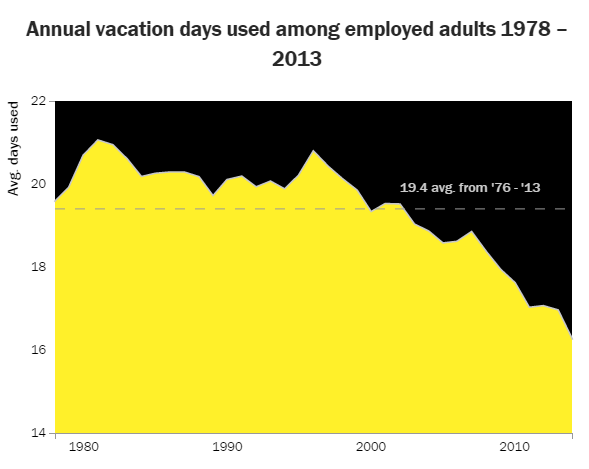
In 1983, the year that Chevy Chase loaded his movie family into the Griswold’s station wagon in National Lampoon’s Vacation, Americans took an average of 20 vacation days. Now, the youngest member of the Griswold family is back on the big screen in 2015, this time taking his own family on a vacation. If Americans’ recent use of paid time off is any indication, reports suggest he’ll see a more open road than his father. Plummeting to an average of 16 vacation days in 2013, the time that Americans spend away from work has fallen precipitously over the past decade. And neither workers nor employers are benefiting from this marked decline.
Source: Project Time Off, Oxford Economics, 2014
You Need a Vacation
Occasionally escaping daily routine is central to both the physical and mental health of employees, and taking time off has been proven to boost work performance and productivity. A 2011 Harvard Medical School study found that sleep deprivation costs American companies $63.2 billion a year in lost productivity. Ernst & Young conducted an internal study of its employees in 2006 and found that for each additional 10 hours of vacation employees took, their year-end performance ratings from supervisors (on a scale of one to five) improved by 8%. What’s more, retention rates were significantly higher among vacationers.
Wish You Were(n’t) Here
Given that the Center for Economic Policy and Research reports that the United States is the only advanced economy in the world that does not guarantee its employees paid time off, it’s unlikely the use of vacation days will increase without some type of policy reform. With American employers not legally required to give workers either paid vacation time or paid holidays, a high number – 77% of private sector companies offer paid time off and paid holidays as part of employee compensation packages. Not surprisingly, though, as employee wage increases, so does the likelihood that they will receive time off; half of low-wage workers typically receive paid time off whereas more than 90% of high-wage workers receive paid time off.
Unplug and Unwind
Harris Interactive reports that people like the idea of more time off. Specifically, 50% of workers who receive paid vacation time in the top 10 cities in the US say they would be willing to sacrifice a workplace benefit for more paid time off. Ironically, although employees say they want more time off, 57% don’t take off the time they already receive. Each year there are 175 million vacation days which American workers are entitled to which are not taken. Even when employees actually do use their time off, they don’t spend the time unplugged. 47% of respondents in a recent survey by Pertino reported that they feel less stressed on vacation if they can stay connected to the office. The same study found that 59% of Americans regularly work, check email, take a phone call, and do other work related tasks while on vacation. But, aside from increased productivity upon their return, employers have another incentive to encourage employees to unplug while away. The Pertino survey found that 77% of those who work on their vacation do not have access to their office network. Because of this, employees use unsanctioned or unsecured cloud services (32%) and/or bring their work computers and files with them on vacation (35%). Public Wi-Fi hotspots are commonly used by vacationers, creating an opportunity for company data and/or log-in credentials to be stolen.
While there are certainly many factors at play in the 2013 job satisfaction study published by the non-profit research group Conference Board, it’s worth noting that back in 1987, when the average American worker took 20 days of vacation, job satisfaction stood at over 61%. Now that Americans have cut back on days away from the office, job satisfaction hovers slightly above 50%. There’s no definite way to tell if Americans could move the needle of job satisfaction by loading up their cars and hitting the open road, but it’s a good start. Let’s start making vacations work for us.
Fronetics Strategic Advisors is a leading management consulting firm. Our firm works with companies to identify and execute strategies for growth and value creation.
Whether it is a wholesale food distributor seeking guidance on how to define and execute corporate strategy; a telematics firm needing high quality content on a consistent basis; a real estate firm looking for a marketing partner; or a supply chain firm in need of interim management, our clients rely on Fronetics to help them navigate through critical junctures, meet their toughest challenges, and take advantage of opportunities. We deliver high-impact results.
We advise and work with companies on their most critical issues and opportunities: strategy, marketing, organization, talent acquisition, performance management, and M&A support.
We have deep expertise and a proven track record in a broad range of industries including: supply chain, real estate, software, and logistics.

by Elizabeth Hines | Jun 23, 2015 | Blog, Logistics, Marketing, Social Media, Strategy, Supply Chain, Transportation & Trucking
Drew McElroy, founder of the start-up Transfix, is no newcomer to the trucking industry. McElroy was born into the business; his parents owned and operated the freight brokerage Andrew’s Express, affectionately naming it after McElroy.
“I remember listening to my father structure deals. As a kid, it was all utterly confusing to me,” recalls McElroy. “I finally started to get my head around the economics of the business in my teens. From that point on, I became increasingly aware of the industry’s inefficiencies.”
Not long after McElroy graduated college, his father passed away unexpectedly. McElroy, already working for the family business, took over as president. In that time, McElroy successfully increased annual revenues from $4 million to $12 million. While impressive, McElroy still struggled with how the industry traditionally operated. “It was clear that our family business wouldn’t be the platform for world domination,” laughs McElroy. “But I believed that, fundamentally, there was a better way to get things done.”
Determined to build a new foundation based on his belief in “a better way,” McElroy left the family business and set out for San Francisco. He would spend the next year and a half couch surfing and networking in order to gain the expert business and tech insight he needed to plan what would become Transfix. “I knew logistics and I knew trucking, but I knew nothing about venture capital, or how to move from idea to implementation,” says McElroy. “I decided I should try – and try big. If I fail, I fail, but at least I tried.”
In 2013, McElroy was introduced to Jonathan Salama. Salama was among Gilt’s early engineers, and was pivotal in building the flash sale giant’s infrastructure and inventory software. McElroy knew Salama would be key in taking his idea to the next level; Transfix had claimed its co-founders, and its recipe for industry-leading success.
Transfix is a fully automated marketplace that is all about getting things from one place to another. What sets Transfix apart is the company’s platform and approach is vastly more efficient than the traditional approach, and it is much more user-friendly.
Transfix takes the industry’s inefficiencies head on. Transfix is a digital on-demand freight marketplace. It provides industry-leading mobile technologies and location-based jobs offers for independent over-the-road truck drivers, as well as cloud-based management platforms for small carriers and shippers
Here’s how it works:
A customer logs into the Transfix TMS and enters a new shipment. The platform automatically identifies the best driver depending on location, size of truck, etc., sending a load offer alert to the driver or company dispatcher by mobile SMS message or email. The load is accepted by electronic signature, at which point the customer receives automatic notification and the driver becomes fully visible within the customer’s real-time dashboard. Load management from that point on becomes “as simple as Tinder.” Transfix geofences the driver with a five mile radius, immediately alerting Transfix of any issues. Once the load is delivered, the driver is paid within 24 to 48 hours, significantly faster than the industry standard.
Transfix just launched an app (iOS and Android) that is focused on truck drivers. Transfix’s app integrates with the company’s digital marketplace and is driver-centric. The app gives drivers the ability to manage loads, map their itinerary, and manage payments. The app also provides truck drivers with trip planning essentials including the location of showers, ATMs, weigh stations, fuel prices, and weather. The app is free and can be used by anyone with a valid motor carrier number – the driver does not have to associated with Transfix. “Developing this app and making it freely available to all drivers is just the right thing to do,” says McElroy. “Without drivers, this industry would not exist. We need to do right by drivers by making their lives easier.”
Things are moving fast for McElroy and Transfix. Within 15 minutes of updating his LinkedIn profile, McElroy got a call from a logistics Manager at Barnes & Noble and, before he hung up, had freight loads to manage. Fast forward a few months – with Transfix, Barnes & Noble has realized improvements in their processes and has seen their deadhead runs (times driving without cargo) cut by at least 50%.
Transfix has raised close to $2.5 million to date and is already generating several thousand a month in revenue.
McElroy and Transfix are poised for world domination – mind you, a win-win benevolent hegemony – a la Uber.
Fronetics Strategic Advisors is a leading management consulting firm. Our firm works with companies to identify and execute strategies for growth and value creation.
Whether it is a wholesale food distributor seeking guidance on how to define and execute corporate strategy; a telematics firm needing high quality content on a consistent basis; a real estate firm looking for a marketing partner; or a supply chain firm in need of interim management, our clients rely on Fronetics to help them navigate through critical junctures, meet their toughest challenges, and take advantage of opportunities. We deliver high-impact results.
We advise and work with companies on their most critical issues and opportunities: strategy, marketing, organization, talent acquisition, performance management, and M&A support.
We have deep expertise and a proven track record in a broad range of industries including: supply chain, real estate, software, and logistics.