Trying to pass your sales pitch off as content will only hurt your content marketing efforts.
Think your blog is a refreshing new way to highlight your products or services? Do your posts include verbiage like “one-stop-shopping,” “innovative,” or “industry leader?” Stop right there. Everyone you reach probably knows right away that you are trying to sell them something, and they will quickly move on.
As counterintuitive as it may sound, being “salesy” will make potential customers look elsewhere, or run in the opposite direction — perhaps to your competition. The best way to win customers is to stop boasting about yourself and to stop trying to sell. Content that answers your customer’s needs is what will grow your business.
Nobody welcomes a sales pitch
Admit it: you tune out anyone that comes across as trying to sell you something. You get emails, voicemails, and social media updates with “information” that is really a not-so-cleverly disguised sales pitch. What do you do? Most likely you hit delete, or you do not read past the first sign of a sales promotion.
So you know deep down that “salesy” does not sell. Yet, according to a recent study of 500 global marketers from the Economist Group, many B2B content marketing programs are doing just that: promoting products throughout their content efforts. In fact, 93% of the marketers surveyed said they directly connect content to a specific product or service.
Customers see right through this trick. The same study found the majority of B2B customers are annoyed by pitches. In fact, 71% of B2B executives reported that content they didn’t like seemed more like a sales pitch than valuable information.
Focus on your customers to increase sales
So what should you content be doing? Rather than forcing your products on your prospective customers, take time to answer their questions. Be the expert advice they are seeking. You do this by:
Keeping content informative and educational. Your content should hold value for your readers.
Letting your content demonstrate market expertise. It should give the reader a favorable impression of you and your business. They should walk away thinking that you know what you are talking about.
Write as if you are speaking to a business peer. You are approachable and intelligent. Speak the language of the customer, and bring something new to the table, in terms of information.
Focus on topics and questions of crucial importance to your target audience. What do they care about or want to know more about?
The philosophy of content marketing is to offer help, to educate, and, at times, to entertain your target audience. This is accomplished by focusing on the customers’ needs and interests, not your company’s latest product. When you form this online relationship with your audience, you gain their trust and respect, and that is what brings in sales.
Take a moment to let that sink in. After Google, people are searching YouTube for content. Strike that: Over one billion people are searching YouTube for content.
This has raised the eyebrows of content marketers across many industries, including B2B businesses, who recognize the enormous potential for reaching customers through this medium.
If you haven’t considered distributing content through YouTube, you may soon find yourself scrambling to catch up with your competitors who are. For those who don’t know much about YouTube or are clueless about how it can work for business, here are a few basics to get you started.
What is YouTube?
YouTube is a free video-sharing website and social media platform that allows users to view, upload, share, rate, and comment on content. It was launched in 2005 by three former Paypal employees and purchased by Google in 2006. It now operates as a subsidiary of Google.
You do not have to be a registered user to view content, but you must be registered to upload content. Registered users can also subscribe to content providers’ channels to receive updates when something new is available, and can create playlists of favorite videos to view at any time.
In addition to being available on the YouTube website, YouTube videos can be embedded, shared, or uploaded to other sites (such as Facebook).
Why is it good for business?
YouTube has massive potential for businesses. Here are just five reasons to participate.
Users watch around 3.25 billion hours of video every month.
Videos with over 1 billion views: 10,113
80% of views are from outside the U.S.
More than half of views are from mobile devices.
You can navigate YouTube in 76 different languages.
2) Improved search rankings
YouTube videos are included in Google’s search results, ranking above web pages in certain searches. Potential customers searching for products and services like yours will be more likely to find you in such instances.
3) User experience
Video has become so popular for a reason: People like consuming it. By producing content in this medium, you are offering a user experience that is in high demand.
4) Build your brand
Video is the ideal storytelling platform, and it’s also perfect for how-tos, product demonstrations, and other content that demonstrates your company’s expertise. Show your brand personality and engage your audience while building your reputation as a thought leader in your industry.
5) Track performance metrics
YouTube Analytics makes it easy to see who is watching your videos and how they are engaging with them. Run reports on audience demographics, revenue, engagement, traffic sources, and more.
How do I get started?
There are two avenues for businesses who are looking to reach YouTube’s more-than-3-billion users.
For one, businesses can buy ads that run before other videos, beside playing videos, and in search results. Video ads are not covered in this post, but you can learn more about them here.
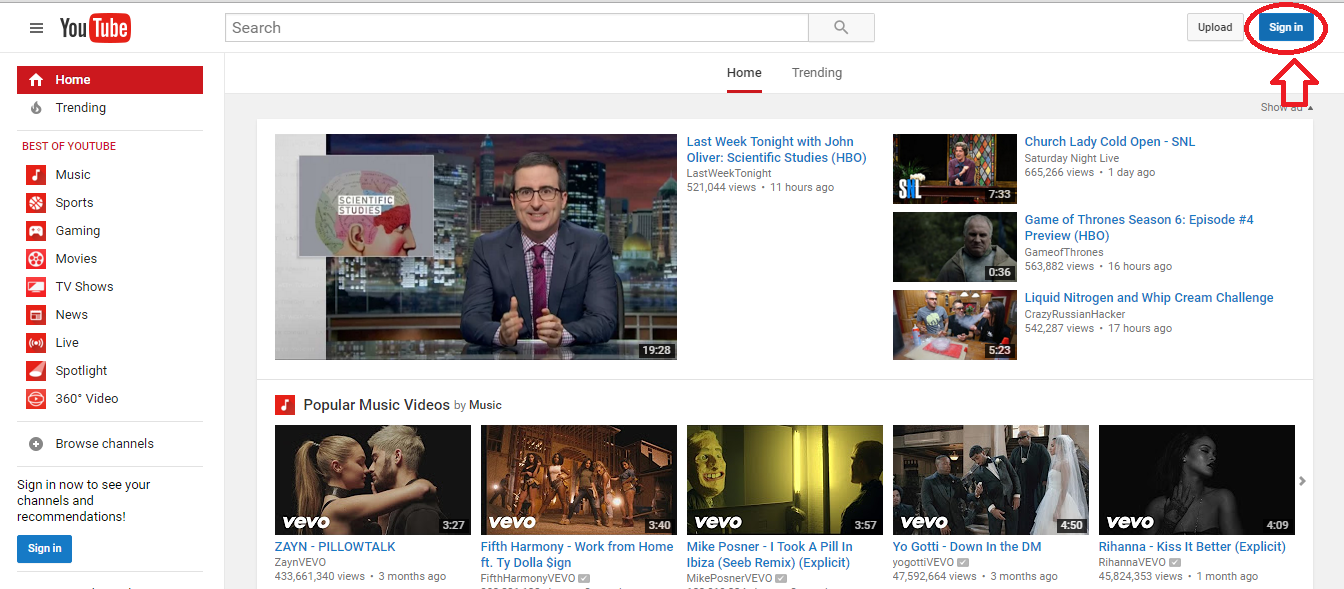
Secondly, businesses can create their own YouTube channel and upload original content as part of their inbound marketing programs. To get started, you will need to sign into your business’ Google account or create one. Find the sign in button at the top-right corner of the YouTube homepage.
With your account, you will own your very own “channel,” on which you will post your content. Branding your channel is an important step, as this will be the face of your company on this platform. Below are some tips.
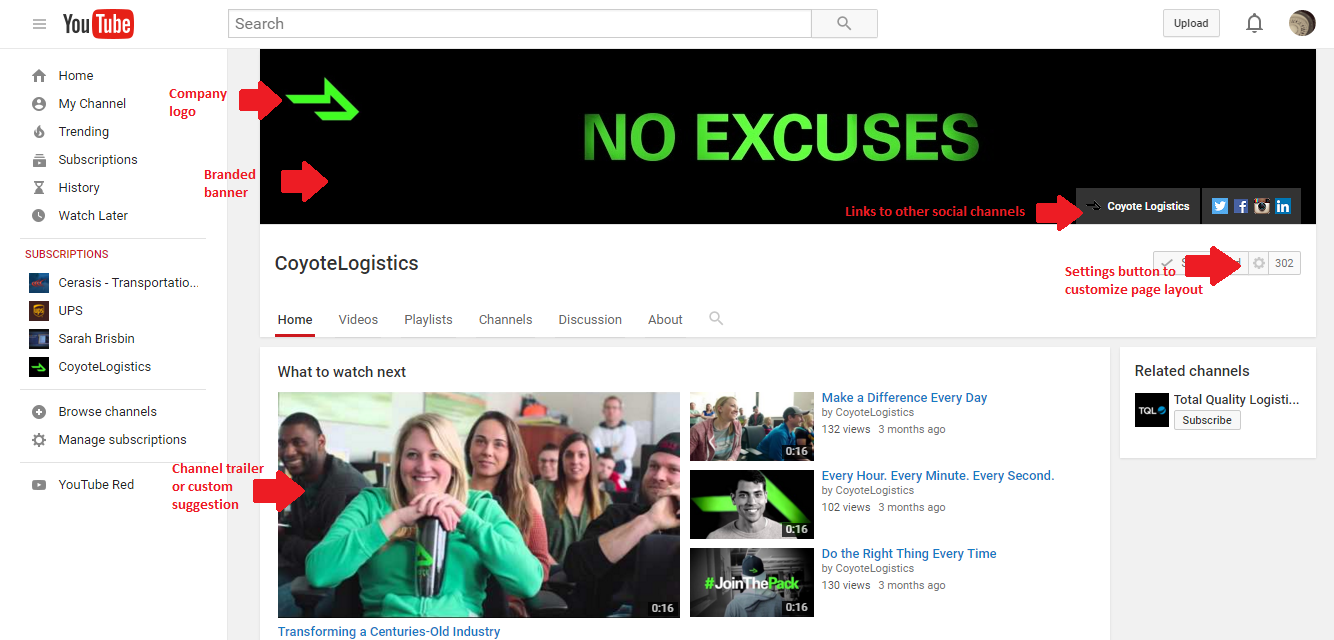
Anatomy of a branded YouTube channel
Coyote Logistics, a 3PL provider, has done an excellent job of branding its YouTube channel.
Company Logo
Upload your company’s logo by hovering over the channel icon and clicking the pencil icon when it appears.
Branded Banner
Upload an image that represents your brand and what users will find on your channel. Hover over the channel art, click the “Add channel art” button or the pencil icon in the upper-right corner and select “Edit channel art.” Coyote Logistics makes a bold statement (very representative of its brand personality) here. For the best results on all devices, YouTube recommends uploading a single 2560 x 1440 px image.
Social Icons
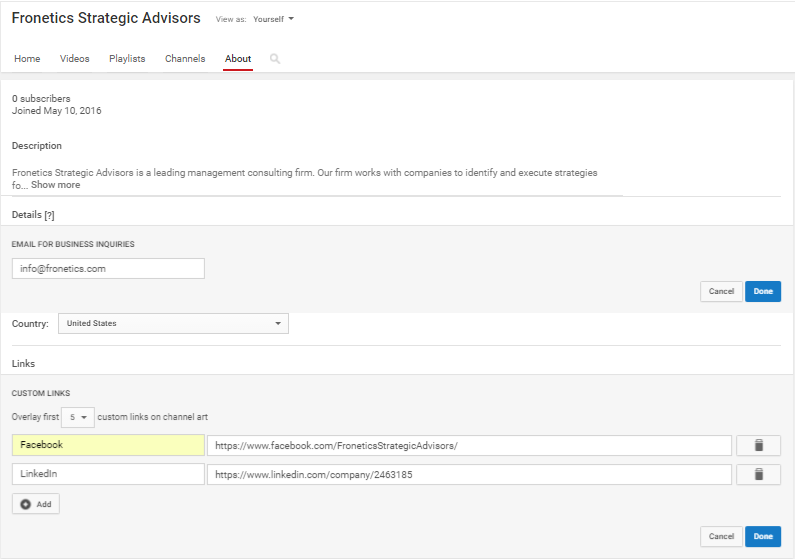
Provide links to your other social channels by hovering over the channel art, clicking the pencil icon in the upper-right corner, and selecting “Edit links.” Add the URLs for each of your channels under “Custom links.”
Customize Layout
Click the customize button to create a layout for your channel. You can add up to 10 “sections,” which allow you to group videos in a particular way. For example, you could add sections of recent uploads, popular uploads, playlists, etc.This helps visitors to decide what to watch — and lets you promote content you wish for visitors to see.
About
Navigate to the About section to add a channel description, business email address, country, and social links (if you haven’t already).
Uploading videos
Once you have your channel set, you’re ready to start adding your original content. YouTube Help has a wealth of resources to help you get started, problem-solve, and learn more. The below video offers an introduction to uploading videos in just a few quick steps.
Other terms to know
Playlist: Playlists let you organize your videos into different categories, like interviews, tips, product demonstrations, etc. Learn more.
Channel trailer: A short video, like a movie trailer, that gives visitors an idea of the kinds of videos they’ll find on your channel. Learn more.
YouTube Red: This is the premium subscription option that allows you to view videos without ads, watch videos offline, and more.
A cross-departmental social media team will improve your company’s social presence.
At a former job, I was part of a team pushing for expanding access to our company’s social media pages. The accounts were administered by a handful of marketing managers, who did not want to relinquish control. After all, weren’t we using social media for marketing purposes? Why would the content or sales teams need access? Wouldn’t that cause chaos and anarchy?
No. In fact, giving access to key people in various departments could actually help your company get more out of social media.
Businesses can use social media for everything from generating leads to gaining market intelligence. And today’s customers expect a brand’s social media accounts to answer all sorts of different needs, from product inquiries to problems with their orders. If only one team is responsible for operating your pages, they need to be able to perform multiple functions, to liaise effectively between customers and internal stakeholders, or to forego some of the valuable benefits of social media.
For example, say your customer does not receive part of a shipment and posts on your Facebook feed to say as much. The marketing person managing your social media either has to 1) also be trained in customer service, 2) reach out to someone on your customer service team (or someone who can locate the shipment) and act as a go-between with the customer, 3) ask the customer to contact someone else in your company, or 4) ignore the post. Any way you slice it, it’s not efficient or a good use of anyone’s time.
That scenario is more common than you might think. Research shows that the number of customers who expect a response through social media has doubled in the last three years, and that seven of eight messages to companies go unanswered for 72 hours. Imagine if your customer service department didn’t respond to emails or pick up the phone for three days!
My former company suffered enormously from problems like these. The marketing managers administering our social accounts were spending hours each week tracking down various employees in other departments to help them problem-solve. They didn’t have time to strategize about content distribution. And even the best communicators were so overloaded with other tasks that leads were going cold before being handed to the sales teams.
If each department identified an employee responsible for overseeing social media, we could have functioned so much more efficiently and effectively. The marketing manager would be responsible for marketing messaging; the content person for generating and distributing content; the sales team for identifying leads and building relationships; and customer service for handling customer inquiries and problems.
Develop a social care team that can address all areas of social information efficiently and effectively. Identify policies and software systems needed for implementation.
Organize departmental responsibilities in the social care team. Clearly define roles and responsibilities among marketing, customer service, public relations, sales, corporate communication, human resources, etc.
Assign specific employees from each department to social media tasks. Set up social media accounts and give employees access to social media systems.
Create brand guidelines for standards, tone, and style of social media communication. Ask legal and human resources to provide a list of do’s and don’ts for real-time consumer engagement.
Define specific goals based on key performance indicators such as response time, sentiment analysis, engagement, views and shares, and other important metrics.
With the right planning and people in place, a cross-departmental social media team is better suited to interact with customers and business partners on these platforms, and it can help your business get the most out of its social media accounts.
Engage your leads early in meaningful dialogue to improve your chances of conversion.
Your strategic marketing plan is generating a steady influx of quality leads, so closing sales should be easy, right? Only if you are contacting your leads early enough in the sales cycle.
Leads become sale opportunities if they are approached like a garden. Care is needed from the start to cultivate and produce the desired results. So, when is the perfect time to begin nurturing leads? It is earlier than you might think.
When a potential customer first shows interest in a blog post, opens an email, or shares your company’s post on social media, this is the first point of positive contact. You needs to keep that contact going and develop it into a conversation. And we are not talking about starting out with a sales pitch, either. Leads become sales when they are cultivated and grown like a trusted relationship — and the earlier after first contact the better.
According to a study published in the Harvard Business Review, most companies are not responding nearly fast enough to their sales leads. The authors audited more than 2,200 businesses and measured their response time to web-generated leads. While only about a third (37%) responded within an hour, the average first response time was 42 hours. Surprisingly, 23% of companies never responded.
Google and Corporate Executive Board’s white paper on lead follow-up offers some insight on why quick responses are so important. For one, a reported 35% to 50% of sales go to the vendor that responds first. That is largely because today’s B2B customers are nearly 60% through the sales process before they first engage a sales rep. By the time you hear from them, they are close to buying and want answers in a timely fashion to make their decision.
So, how fast of a response is ideal? A study conducted by Franklin Covey found that contact ratios improve 900% if web leads had some form of contact by the company within five minutes of submission. Now, it is probably not possible for your sales team to act upon every lead with that kind of velocity, but it is vital that they utilize proactive sales strategies, rather than reactive.
Reactive is leaving a message and, if they hear back, responding to it. Proactive is going after the sale with confidence and commitment to engaging the lead in real dialogue.
Early dialogue: What it is, and what it’s not
Early on in the sales cycle, you are not pushing to close the sale, but rather you are building a relationship through conversations. You are creating dialogue, not a sales monologue. Be there first, be relevant, and be action-oriented, and your customers will rely on your solutions more often.
You begin this dialogue by asking great, open-ended questions, essentially taking the time to get to know the potential customer. This helps you determine what will best suit this prospect’s needs, and it builds confidence and trust and will very often help the prospect consider issues they may never have thought of.
When you get that potential customer thinking outside the boundaries of their initial issue, it provides a bigger opportunity for you to showcase how your services or products can solve several of the customer’s dilemmas. It is also important to consider your products or services in terms of how they benefit the customer; your presentation will then be customer-focused, and that builds trust and respect in the relationship.
There many moving parts to an effective lead-nurturing campaign, and often there are many steps required to cultivate those leads into sales. From the start of the sales cycle, your company should:
Take the time to discover and understand the potential customer’s needs and wants first, then advise and offer information. Make the move to match and sell the appropriate solution your company can offer.
Have the ability to listen and offer viable solutions. Your sales team needs to be well informed about the products, services, and solutions that they are selling.
Your sales team must be able to follow up quickly, consistently, and with an open dialogue to turn leads into customers.
Studies show that the faster you begin dialogue with a lead, the better your chances of conversion into a sale. This means that when cultivating a qualified lead, you don’t want your sales reps to make one phone call and simply leave a voicemail. You want real conversations to happen. If you don’t, your lead-generation efforts were for naught.
Employ a content and social marketing strategy to nurture leads you meet during MODEX.
Hundreds of potential customers will be heading to Atlanta next week for MODEX, and you’re gearing up to gain lots of new business. That is, you and over 800 other exhibitors are hoping to gain lots of new business. So how do you plan to stand out among the competition?
Using content and social marketing to nurture leads surrounding the event will help maximize the benefits of attendance. You can bring more attention to your presence, which will help you find more new potential customers, and then you can increase your chances of converting them if you use these tools properly.
Here are some tips for before, during, and after MODEX for using content and social media to gain new business.
Before the show
1) Define your goals.
A trade show represents an opportunity to spread brand awareness, find new leads, and, of course, make sales. Decide what is most important to your business, and strategize around those goals. For example, if one of your goals is to increase your social following, make sure every handout, landing page, and face-to-face interaction includes a request to like you on Facebook (or elsewhere).
2) Promote your attendance.
With the trade show hashtag (#MODEX2016), use Facebook, Twitter, and LinkedIn to let your followers know that you will be attending and when and where they can find you. Engage with other attendees who are using the event hashtag. Offer teasers — such as photos of the freebies you’re bringing — to entice visitors, and provide any longer-form information (e.g., an excerpt from a presentation you’ll be giving) in a blog post, distributing it through your social channels.
3) Set up a landing page/landing pages.
Create an event-specific landing page that includes a call to action (CTA), like reserving a time to speak with you at the conference or downloading a coupon to redeem a free sample. Make sure to ask for some information (such as a name, company, or contact information) in exchange. Monitor traffic and keep a running list of leads who visit and provide their information.
4) Research the attendees.
Perform prospect research using the list of attendees, paying special attention to those who have provided their information on your landing page or connected with you on social media about the event. Check out their social pages to see what they’re saying about the event, and like or follow them. Connect with high-value prospects on LinkedIn and try to arrange a time to meet up during the show.
5) Prepare to nurture.
Draft content that you can distribute during and after the show. Examples include lead-nurturing email templates, slides from presentations you are giving, and other offers you plan to provide visitors. Create another landing page, which includes a special offer or specific information you’ll be providing during the show, to drive attendees to during and after the event.
During the show
6) Keep chatting.
Reach out to the people you meet during the show on their social media handles. A nice-to-meet-you tweet and/or an invitation to connect on LinkedIn shows that you remember and appreciate the potential customer. Send the lead-nurturing emails you prepared in advance.
7) Monitor social media.
Continue using the show’s hashtag to monitor the conversations that are happening online, and see if anyone is talking about your company. Like or reply to anyone who does to show you’re listening.
8) Generate content.
Trade shows are a great place to generate content. Post photos of your booth and attendees from your company, and create videos of product demonstrations, presentations, or customer testimonials. Share your thoughts on the issues being discussed, and keep track of those themes, as well as any recurring questions that attendees ask, for future content.
After the show
9) Plan out your editorial calendar.
Develop posts for your company’s blog over the coming months around the questions and issues that were raised during the show.
10) Keep up the conversations.
Continue to engage the people you met on Facebook, Twitter, and LinkedIn. Follow and like their pages, and invite them to connect.
11) Offer your leads something of value.
Make event presentation or speaking materials part of your lead nurturing activities by sharing them with prospects using Slideshare or email. Remind leads with whom you shared your special-offer landing page to visit. Make sure to segment your contacts based on their interests and send them only relevant offers.
How do you nurture leads around trade shows? Will you be attending MODEX this year?