![The State of Supply Chains: The Supply Chain Has Gone Digital [Infographic]](https://fronetics.com/wp-content/uploads/2017/01/virtual-reality.jpg)
by Jennifer Hart Yim | Jan 23, 2017 | Big Data, Blog, Data/Analytics, Logistics, Strategy, Supply Chain
2016 was the year of the digital supply chain — here’s a look at how things changed.
This guest post comes to us from Adam Robinson, director of marketing for Cerasis, a top freight logistics company and truckload freight broker.
2016 marched onward with a drive to improve the use of digital technology throughout the supply chain. In our first supply chain trends post, we surmised the previous year’s trends would continue. However, this prediction proved to only touch on how important the digital supply chain would become.
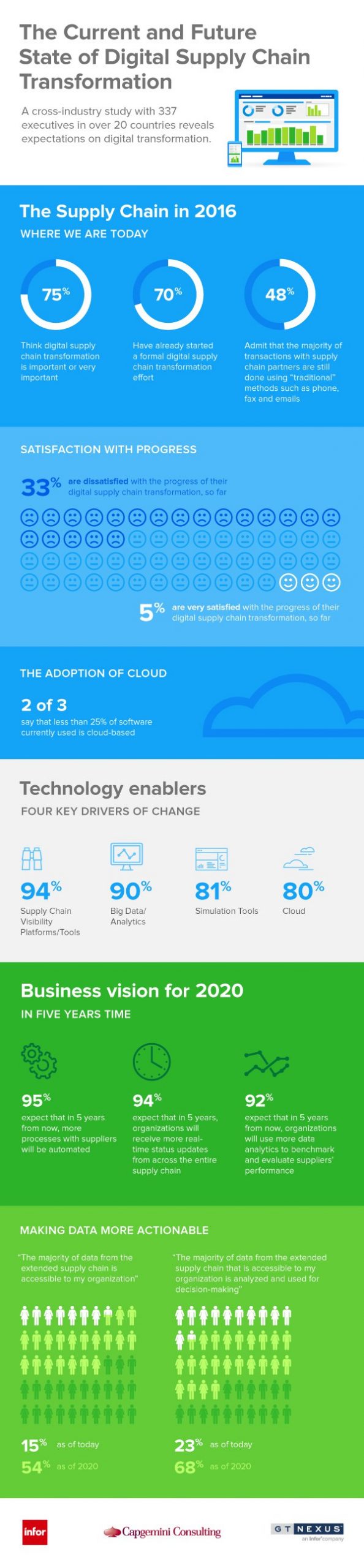
Within four months, the digital transformation had already reached most supply chain organizations. Per GT Nexus, 75% of executives surveyed recognized the digital supply chain as an important factor for the next five years. Meanwhile, 70% have also started processes to implement digital supply chain technologies throughout their companies.
Unfortunately, many supply chain entities continue to hope for a better tomorrow. In other words, the digital supply chain transformation has only been rated as very satisfying for 5% of respondents. In addition, just less than half (48%) of respondents report continued use of traditional technologies exclusively, which include the following:
- Fax machines
- Manual order entry and review
- Land-line phones, not voice over internet protocol (VoIP), which reduces overall costs and downtime
- Email, although beneficial, is susceptible to internet connectivity issues, security breaches and other problems
- Chaotic picking protocols
This infographic, created by GT Nexus, also shows other ways the digital supply chain evolved in 2016.
(Made with Canva)
Essentially, the digital supply chain is essential to gaining and maintaining competitive advantage. Digital technologies, reports Richard Howells of Forbes, including Big Data, analytics, the Internet of Things, social media, and point-of-sale reporting, enable business to know more about consumer needs and wants than ever before. Consequently, they can more accurately respond to changes in product demand across large distances and within infinitesimally small time frames.
Supply chain execs retained fundamentals throughout change.
Innovation is the driving force behind change and improvement in the modern world. Supply chains must evolve to meet an increasing number of omnichannel sales, and technologies must be integrated within existing systems to reach maximum efficiency and productive value.
As explained by Grant Marshbank of VSC Solutions, “The rate of change is not going to slow down. Technology will only delivery […] if it’s implemented with strategy and operations that adhere to best practices.”
Marshbank’s words highlighted the need to focus on fundamental concepts while responding to changes and improvements in the supply chain. For example, an optimized supply chain is good, but it opens more opportunities for errors. Simply putting all an organization’s proverbial eggs into one basket may be risky if appropriate auditing and review measures are not undertaken to ensure continued compliance and accuracy in all orders.
Change is a necessity for businesses, including the supply chain, to grow and expand. Yet many destructive forces can severely undermine a company’s progress. Bad weather, poor hiring practices or inefficient maintenance of consumers’ financial data can decimate a company. However, the response to hindrances in 2016 continued to showcase the importance of fundamental concepts, asserts Ryder, which include the following:
- Continually seeking the fastest, most cost-effective means of transporting products to consumers, including enhanced delivery optins.
- Expansion of global footprint while adhering to local, state, federal and international requirements
- Keeping companies accountable and focused on giving back to their domestic partners through reshoring or nearshoring
- Working with more outside agencies, also highlighted by Samantha Carr of Business 2 Community, including crowd-sourced logistics, warehouse optimization and outsourcing, and greater use of cloud-computing
Augmented reality found its place among consumers.
Augmented reality sounded amazing and far-fetched early in 2016, but the year has shown it to be one of the most successful product in existence. There tends to be more acceptance of technologies in the workplace once consumers can identify how they work.
For example, new hires are likely to pick up tablet-based systems more easily since they have been using them recreationally for some time. Essentially, the virtual-reality (VR), which is the precursor to augmented reality, hype of the 2016 Christmas shopping season is making more people excited about this new way to “see the world.”
While the VR hype may seem like it only emerged for Christmas, think about one of the hottest games of 2016, Pokémon Go! This app was built on augmented reality, combining the digital and physical worlds into one interactive environment. This technology, reports JOC.com, will be a key to practically eliminate extensive training courses and repair time requirements throughout the supply chain.
Ultimately, it translates into greater use of augmented reality in supply chains, which is growing by 100% annually, reports Barcoding Incorporated.
What’s next?
Clearly, technology dominated the conversation for 2016, but there are also changes in how supply chains operate that require a more in-depth discussion as well. In the next post of this series, we discuss the impact of artificial intelligence, agile processes and procurement expansion on the supply chain of 2016.
Related posts:

by Elizabeth Hines | Nov 22, 2016 | Blog, Content Marketing, Marketing, Strategy
By repurposing and thoughtfully packaging the content you have already published, you can assist your sales force in closing deals.
How many of your sales force’s calls turn into appointments? Probably very few. More and more of today’s buyers don’t want to speak with sales reps about products.
But, then, who will buyers speak to? A LinkedIn survey of 1,500 purchasers and influencers found that 86% of buyers will listen if sales professionals provide insights about their business. What’s more, 92% of buyers engage with a professional if that person is a known industry thought leader.
So, what if your sales force approached prospects not as a sales representative, but as a source of information, insight, and thought leadership? What if you already had the tools to help your sales staff achieve this reputation? If you are publishing original content, then you do.
Let them have content
Arm a sales rep with targeted content to share with prospects during specific moments in the purchase process, and it will advance his or her reputation as a source of knowledge. That can be the key to getting a foot in the door, advancing through the final stages of a purchasers’ decision, or closing the deal.
Here are four easy ideas for repurposing the content you have already created to assist your sales force.
1. Simply share.
Encourage sales representatives to follow your company and its content producers on social media and to share relevant articles with their networks. They can repost both your original content and curated articles as well.
2. Get visual.
Turn your evergreen content into easy-to-read infographics or another visual format. Send with the sales representatives to meetings with prospects, or encourage them to email the content to certain contacts as a lead-nurturing exercise.
3. Gather news.
In planning your content, you likely consider industry news, trends, and happenings. Keep a list of these points and supporting articles, and have the sales team distribute to their contacts on a regular basis, like a newsletter, to demonstrate knowledge of the business landscape.
4. Build case studies.
Develop several case studies from your company’s success stories. Organize them around specific pain points that your buyer personas face. Provide these to the sales team with a list of key points from each study to use as either talking points or to send as follow-up emails to prospects facing the same challenges.
These are a great starting point for bridging the gap between the marketing department and sales force with content. But don’t let it stop there.
Set up a role-playing exercise with your sales team, where you are the customer. Analyze their pitch and see how content can fill the holes. It’s likely you have built a lot of content around many of the reps’ talking points, which they can use to further inform their pitches and to use as lead-nurturing collateral.
Related posts:

by Elizabeth Hines | Oct 13, 2016 | Blog, Content Marketing, Marketing, Social Media
Here’s a summary of what’s been happening on all of your favorite social media platforms lately.
Social media platforms change so frequently, it’s often hard to keep up. But, since social media is a crucial part of any effective content marketing strategy, it’s important to know what tools are available to your business and how you might gain value from using them.
That being said, we’ll be regularly summarizing any updates, changes, additions, or otherwise noteworthy goings-on in the social media world in this space. Feel free to send me an email if you want more information about any of these tools or if you’d like to see us cover something new in social media that we haven’t.
Facebook combats fake stories in Trending Topics
After letting its news curation staff go this summer, Facebook is working to find a solution to combat sensational news stories from creeping into its Trending news section, now run completely by algorithms. The company announced that it will implement a technology similar to that used by the news feed feature. Read more
Longer tweets come to Twitter
As of September 19, Twitter has changed the kind of content that counts toward the 140-character limit in tweets. Media attachments, quote tweets, and @names in replies no longer count toward the limit. Read more
Snapchat becomes Snap Inc., launches video sunglasses
In September, Snapchat launched a new line of business, video-enabled sunglasses (called Spectacles), and rebranded with a new corporate name, Snap Inc. CEO Evan Spiegel said in a blog post that the rebranding reflects the company’s diversification. Read more
Facebook launches Messenger Day to Poland, and it looks a lot like Snapchat
Facebook Messenger users in Poland, where Snapchat is not yet popular, can now share illustrated photos and videos that disappear within 24 hours. The platform says it often tests new features before rolling them out to other markets, but it is not yet clear if or when Messenger Day will come to the U.S. Read more
Twitter rolls out Moments to all members
Moments are a collection of tweets that focus on the same subject. Previously available only to specific partners, all members are now able to use this feature. Read more
Facebook enhances Canvas’ capabilities for brand advertising
New metrics, templates, and upcoming features like 360 videos are all ways Facebook is expanding the advertising feature’s utility for all businesses. Read more. Relatedly, brands can now create custom audiences based on users who have viewed their Canvas ads on Facebook. Read more
Pinterest launches Promote button
Brands can now promote their pins when creating it or when viewing it on their profiles with the new Promote button. Read more
Vimeo rolls out Vimeo Business
Video streaming platform Vimeo officially announced its business-focused membership option, Vimeo Business. The subscription includes unlimited bandwidth, analytics tools, and lead-generation mechanisms. Read more
Related posts:

by Elizabeth Hines | Oct 12, 2016 | Blog, Content Marketing, Marketing
Make sure you’re not making these seven common mistakes when starting your B2B blog.
So you’ve started a B2B blog for your business and are standing at the ready, waiting for those leads to start rolling in. But you’ve only gotten three views so far (you, twice, and one by your mother). It’s not working out exactly how you pictured.
For one, it takes time — and patience — to build up readership for any blog. The more content you publish, the greater its quality, and the more consistently you post, the more quickly that success will happen.
But, chances are, you’re making one (or more) of the rookie mistakes that prevent B2B blogs from driving traffic, leads, and sales. Take a look at the seven common blogging errors that are holding you back.
7 common blogging mistakes for new B2B blogs
1) You’re promoting your products, services, and/or business.
Believe it or not, your sales pitch is bad for business. While your blog seems like another avenue for advertising your products, that’s actually counterproductive. Today’s consumers have no tolerance for overt, interruption-based marketing. They can smell a sales pitch from a mile away and purposefully avoid them. There is plenty of content available on the internet that they have the ability to do so.
Here’s another way to think of it: When have you ever changed channels while watching TV to find a commercial? If you’re flipping around, it’s probably because you’re looking for content that is appealing to you, not seeking advertisements. Blog readers feel the same way.
Solution?
Your posts should provide information, value, and/or entertainment relevant to your area of expertise for your target audience. They will read it — and, ideally, subscribe — because they regard you as a trusted source of knowledge. When they are ready to purchase, you will be top of mind because of the rapport you’ve built through your content.
2) You write about anything and everything.
While it’s important to publish content that is meaningful to you and relevant to your area of expertise, your B2B blog shouldn’t be a dumping ground for every thought that crosses your mind. It’s not a forum for you to discuss what seems interesting to you on a given day. Unless you’re a celebrity whose lifestyle is your brand, your blog is not the place to make it about you.
Solution?
On the contrary, your blog is all about your target audience. Your posts should answer their questions, satisfy their needs, or cater to their interests. You should put considerable thought and planning into what you write to ensure it aligns with their expectations. An editorial calendar can help you map out content for your blog and make sure you are evaluating your posts from the 1,000-foot view as well.
3) Your writing stinks.
Writing a blog is different than writing an academic thesis, a business proposal, or a product catalog. If your content is boring, stuffy, error-filled, unintelligible, or otherwise difficult to read, people are going to move onto the billions of other content available on the internet.
Your readers need to understand what you’re saying, and, what’s more, they need to connect with your content. Of course, that’s easier said than done. It’s ok if you’re not a great writer — the first step is admitting that and then deciding what to do about it.
Solution?
Hire someone to write it for you. At the very least, have a colleague glance over your posts for errors and clarity.
4) You’re a copycat.
There are so many good ideas and well-written articles out there that some people might be tempted to copy and paste without fear of retribution. Unfortunately that will only hurt your B2B blog.
Firstly, discerning readers can tell when something’s not quite right. It’s easy for them to find the original source with a quick Google search, and even easier for them to never trust your blog again. Further, search engines can penalize your site if you’re caught plagiarizing content, which can dramatically impact your potential growth.
Solution?
Make sure your blog contains original content and ideas. If you use information or images from another site, make sure to properly cite them.
5) You’re not posting frequently enough.
Blogging frequency impacts factors like search engine rankings and audience engagement. Posting rarely or without any kind of regularity will negatively affect both, and thus your readership.
Solution?
How much is enough? A recent analysis of the top business blogs found that 90.5% blog at least once a week. Figure out the blogging cadence that allows for the most posts with your available resources, and stick to it.
6) You don’t have the option to subscribe (or you’re not pushing it).
A blog is an excellent way to gain organic traffic. But part of your goal should also be to establish a regular readership. After all, you want to build a rapport with potential customers, who come to trust your expertise because they regularly read your content.
Now, people like to do what’s easy. It’s possible that your biggest supporters type in your blog’s web address everyday to see what you’re saying. But it’s more likely that more people will read your content if it arrives in their inboxes on a regular basis.
Solution?
Make sure the option to subscribe to your blog is easy to find and easy to do. Most content management systems make this simple to set up right on your blog. But you can also encourage people to subscribe by adding a call to action to your emails, your social media accounts, etc.
7) You’re not distributing it.
Don’t let your content live in a vacuum. Certainly readers will find your B2B blog through organic search. But you don’t have to just post and pray.
Solution?
Distribute your content through whatever channels you have available to you: social media, email newsletters, paid content-promotion platforms, sites like Reddit and Quora, and more. And don’t just tweet about it once and consider distribution done. Keep distributing it whenever it’s relevant to do so.
Related posts:


by Elizabeth Hines | Oct 4, 2016 | Blog, Content Marketing, Logistics, Marketing, Social Media, Supply Chain
This list of social media articles includes useful information for both people who rarely use social networking sites and for more advanced users.
We’ve been using this space to write about social media a lot lately. That’s partly because so many exciting new developments and enhancements keep popping up. It’s also because we can’t underscore enough how important it is for companies in the supply chain industry to participate in social media.
I thought it would be helpful to revisit some of our recent information, guides, and tips and tricks regarding social media use for B2B marketers. The following list encompasses both general, how-to-type instruction and more detailed advice for more advanced users.
I’ve segmented articles by platform and included a catch-all category at the bottom as well. Don’t see what you’re looking for? Shoot me an email to let me know what social media-related content you’d like to hear about on our blog.
LinkedIn
LinkedIn is the most popular social network for B2B companies. Here’s what you need to know to get started.
Learn about the free and paid methods LinkedIn offers to help you find and recruit new employees.
LinkedIn’s 433+ million member base presents an enormous opportunity for your company to earn new business. Start attracting those members to follow you.
Twitter
One of the top social media sites for B2B marketers, Twitter can help businesses spread brand awareness and communicate with customers.
You may find yourself frequently strapped for quality tweeting material. Here are some ideas to not only fill your feed but to keep your followers interested and engaged.
Leverage insights from Twitter’s analytics dashboard to improve audience engagement, reach, and content development.
We did an experiment to determine the ideal frequency for posting on Twitter. The resulting numbers were abysmal. But that means the experiment worked.
Add stickers to your photos on Twitter to join in on real-time conversations about trending topics and to grow your audience.
Twitter is changing its rules on the 140-character limit for your tweets. Learn what’s going to be different.
Facebook
Facebook Live offers businesses a new, creative platform for engaging customers. This article describes what marketers need to know about it and how to use it.
YouTube
YouTube is a useful engagement tool for B2B marketers who want to reach the social network’s more-than-3-billion users. Learn how to get started in this article.
Get started creating YouTube videos for your business with these easy-to-use tools and ideas for content.
Learn how to improve the reach of your YouTube videos with these strategies for distribution.
Reddit
Reddit is a gold mine for relevant, engaging content to share with your social media followers. Here’s how it works and how you can get started.
Other resources
Fronetics has developed this training specifically for business owners, marketers, and employees looking to learn more about social media and how they can contribute to their company’s success through these networks.
Fronetics has developed a comprehensive report exploring social media use in general and, specifically, within the logistics and supply chain industries.
Businesses are using social media as a strategic tool. This article explains the top three benefits companies in the logistics and supply chain industries can enjoy from participating on social platforms.
Your business should be on social media showing buyers that you know what they want and that your business can provide it.
A cross-departmental social media team can help your company get more out of social networking sites.
Participating in social media is not about earning followers; it’s about building relationships with your current and future customers.
If your social media strategy doesn’t align with your business objectives and target audience, your marketing budget is probably better spent elsewhere.