by Elizabeth Hines | Jan 29, 2019 | Blog, Content Marketing, Logistics, Marketing, Social Media, Supply Chain
Knowing the right video distribution channels can go a long way toward driving traffic and getting your content to your target audience.
Highlights:
- An effective video distribution strategy is key to success.
- Choose video distribution channels that match your marketing goals.
- Paid ads can give video an extra boost.
Video transcript:
I’m Christy Lemire, the Director of Video Marketing here at Fronetics. Today we’re going to be talking about the four best distribution platforms for video.
Here are the four best platforms for distributing your marketing videos.
1. Your network
Don’t underestimate the power of your own existing network. Send your videos, via email, to your primary contacts and everyone in your current database.
2. Social media
Platforms like Facebook, Instagram, Twitter, Snapchat, and of course YouTube are great to reach your target audience. Of course within the category of social media, you want to consider what platforms suit your content best. YouTube is a great place to start, but there are also many industry specific online forums and social groups that can benefit you as well.
3. Blogs
Promote your video on your own blog to reach your followers and boost your SEO. It’s also a good idea to distribute your video on other industry specific blogs to overlap your target audience.
4. Paid ads
While the first three channels of distribution we discussed are organic, sometimes it is well worth it to use paid ads to give your content a significant boost, such as Google Adwords and AdSense.
Bottom line is using the right distribution channels helps you get the most out of your video marketing efforts. For more information about video marketing, visit Fronetics.com.
Related posts:

by Elizabeth Hines | Jan 22, 2019 | Blog, Content Marketing, Logistics, Marketing, Social Media, Supply Chain
Social media is an ideal way for supply chain and logistics companies to reach their audience. But too many businesses are still making these basic social media mistakes.
Highlights
- Social media only works as a marketing tool if you have a documented strategy.
- Don’t try to use every popular platform. Find where your target audience spends their time and focus on that platform.
- Don’t promote your brand. Engage with customers to build long-lasting relationships.
Video transcript:
I’m Kettie Laky. I’m the director of social media at Fronetics, and today we’re going to be talking about the basic mistakes that companies still make with social media.
As of 2019, there are approximately 2.8 billion social media users around the globe. So there’s no denying social media is a powerful tool for businesses to create brand awareness and generate leads. But it’s not going to be effective if it’s not done correctly.
There are three mistakes that businesses tend to make on social media still.
The first one is using objectives instead of strategy to drive their social media. Social media platforms are making updates and changes all the time to improve the customer experience. To weather those changes and to keep your customers engaged, it’s important that you have a strategy behind what you’re doing. The strategy should include content, the frequency of posts, and pillar content. A strategy’s also going to help you prove ROI.
The second mistake that companies tend to make is using all the most popular social media platforms. Social media platforms have differentiating qualities that appeal to different audiences. So get to know where your audiences are spending their time. For instance, if you’re marketing to millennials, you’re going to want to be on Twitter.
The third mistake companies tend to make on social media is by promoting rather than engaging. The companies that are having success with social media are finding innovative and creative ways to relate to their customers. So get your customers engaged, get them involved in your story, and you’re going to create long-lasting relationships with them.
If you need help with your social media strategy, give us a call or visit us at Fronetics.com.
Related posts:

by Elizabeth Hines | Jan 3, 2019 | Blog, Content Marketing, Logistics, Marketing, Social Media, Supply Chain
Live video streaming helps businesses promote transparency, good communication, and relatability.
Live video is one the biggest trends in social media marketing right now. According to the 2018 Social Media Marketing Industry Report, 77 percent of marketers plan to increase their use of video this year and 68 percent want to start using live video.
It’s really no surprise video has gained such traction. Platforms like YouTube made the transition from watching TV in your home to watching videos on your phone seamless. And live streaming fits in with today’s emphasis on corporate transparency and putting a real, human face to business social media accounts. It allows brands to drop their corporate façade and connect to users in a more human way.
Before you ask, let me say it again: Yes, video can work for the supply chain.
Starbucks and live streaming
You don’t have to take our word for it. Look at the success of Starbucks. Back in 2016 the coffee giant tried their first live feed at an event in Queens, New York, to promote National Voter Registration Day. The live video showcased Starbuck’s involvement in the community and their dedication to social events. It was a huge success. The streaming content allowed viewers who wouldn’t otherwise be able to make the event learn about the cause and its importance.
Still not convinced? Check out this infographic with 4 reasons why the supply chain needs to try live video.
Infographic: 4 reasons the supply chain needs live video
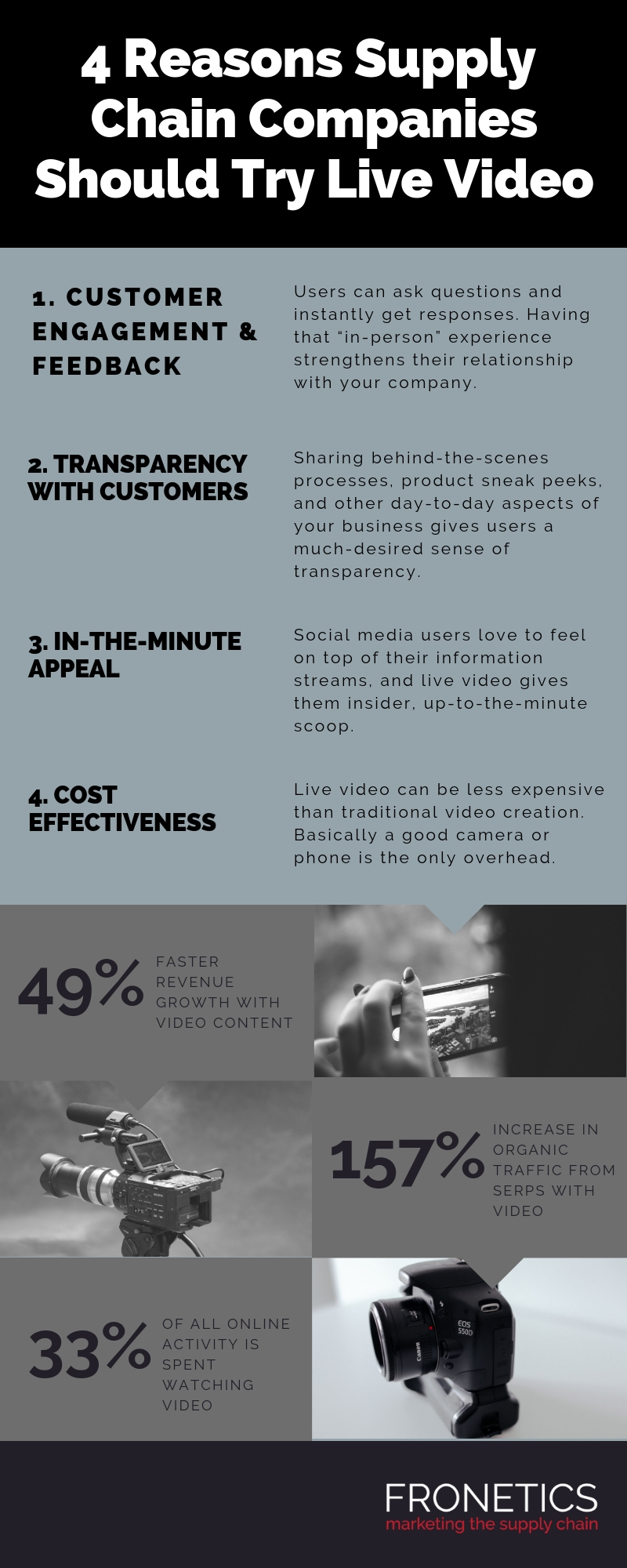
(Made with Canva)
Live streaming platforms
Want to dive into live video, but don’t know where to start? Here’s a few of the most popular platforms.
- Facebook Live: Facebook Live lets you broadcast in real time for up to 90 minutes per session. Users who have recently engaged (or who frequently engage) with your page will receive a notification that you are streaming live, and they can go to your page to view the video. Viewers can comment and react during the course of your broadcast, allowing you to read their remarks and respond immediately.
- Periscope: Twitter-owned and run, Periscope is a standalone platform but integrates seamlessly with Twitter. It has more than 10 million users, more than two million of whom log in daily. The service lets users live stream from their mobile devices and push out those streams on Twitter.
- YouTube Live: YouTube Live enables YouTube to utilize its expansive creator and advertising network to generate even more video to be hosted and monetized. YouTube makes it incredibly easy to aim, shoot and post live video.
Related posts:

by Elizabeth Hines | Dec 19, 2018 | Blog, Content Marketing, Leadership, Logistics, Marketing, Supply Chain
Our most-viewed leadership posts from this year discuss the characteristics of effective leadership, point out industry trends, and provide resources for leadership growth.
Our top leadership posts from 2018 examine what makes a good leader, as well as what makes a bad leader, and the ramifications of each. They also look at some executive thought leadership about industry trends, notably corporate social responsibility, and talk about how supply chain leaders can make use of social media.
Here are our top 5 leadership posts from 2018.
Fronetics’ top 5 leadership posts of 2018
1. Why CSR: Four Benefits of Corporate Social Responsibility
Corporate social responsibility is a pretty broad term to describe how a company is working to improve its community. And 55% of consumers are willing to pay more for products from socially responsible companies. What does that mean for you? It means that corporate social responsibility is as good for your community as it is for your own brand. Here are four major benefits of corporate social responsibility. Read more.
2. 5 Must-Read Books for Supply Chain Leaders
Great leaders embody the ability to inspire and empower their teams to succeed. Here are five books that we recommend reading to keep getting the job done: empowering your team, learning about industry trends, updating your management practices, and other key insights. Read more.
3. 5 Social Media Tips for Supply Chain Executives
Supply Chain Management and its related functions (Procurement, Planning, Vendor Management, Logistics, Operations) are on the opposite end of the spectrum from functions like sales and marketing – areas where your brand is everything. But from our perspective, there are still lots of different benefits that Supply Chain and Procurement executives can gain from building their social media brands. Read more.
4. What’s the Cost of Bad Leadership in Procurement?
Everyone knows that a bad hire can be really costly to a business. When you account for hiring, training, and onboarding costs, plus the opportunity cost of not hiring a successful employee – not to mention the impact on workplace culture – hiring the wrong person can set a company back tens of thousands of dollars. Read more.
5. Supply Chain Leaders: Do These 4 Things with Your Social Media
We’ve written many times before about the importance of supply chain leaders being on social media as the face of their brands. Social media presents a huge opportunity for executives to use their relative industry celebrity to be an extension of their organizations. So you are ready to commit to a more active social media presence (or you’re going to be ghost-posting for your executive). Where do you begin? We’ve come up with 4 tips for supply chain leaders to making the most of their presence on social media. Read more.
Related posts:


by Elizabeth Hines | Dec 17, 2018 | Blog, Content Marketing, Data/Analytics, Marketing
Implementing automation can help supply chain marketers become more efficient and more successful in earning and converting leads. Here are our most-viewed automation posts of the year.
Automation is changing the way supply chain marketers do their job. When properly executed, automation can drive efficiency and reduce time spent on repetitive tasks, freeing up marketers to focus on other priorities.
Marketing automation is the process of using software to complete repetitive marketing tasks designed to nurture sales leads, personalize marketing messages and content, and — in the process — save marketers time and effort. Supply chain marketers are using marketing automation to streamline processes and increase qualified leads.
Jumping into marketing automation can be overwhelming. Utilizing the right software and knowing where to implement automation into your marketing processes will help nurture leads and get you back to more pressing tasks.
Here are our top automation posts from 2018 that define how automating your marketing processes can help your efforts.
Top 5 automation posts 2018
1. Our 6 Favorite Marketing Automation Tools for Supply Chain and Logistics Marketers
The term “marketing automation” refers to a variety of tools used to automate the process of personalizing leads’ interactions with your business. The sheer variety of these tools can sometimes be overwhelming — so we’ve pulled a few of our favorites in the categories of email workflows, social media scheduling tools, and customer relationship management. Read full post
2. Increase Leads by 451% through Marketing Automation
Automation is changing today’s supply chain, and not just because robots and autonomous vehicles are scooting around warehouse floors. Supply chain marketers can use automation to drive efficiency and improve our success rates. Read full post
3. Marketing Automation: Social Media Scheduling Tools
Managing your business’ social media accounts might sound like a simple task — a fun one, even. But once it falls on your plate, it won’t take you long to realize: it’s a lot of work. Social media scheduling tools can make your job much easier — and improve your bottom line. Here are some of our favorite tools and some helpful tips for using them. Read full post
4. 5 Tips for Using Automation in Email Marketing
Marketing automation can help you provide more personalized experiences for your prospects through email. It can also save you a significant amount of time, as you won’t have to create individual emails each time a particular prospect takes a particular action.
But not everything can, or should, be automated or scheduled in advance. As you begin to incorporate automation in email marketing, here are 5 tips to get you started. Read full post
5. Marketing Automation: CRM (Customer Relationship Management)
Integrating marketing automation into your CRM strategy can improve efficiency, streamline workflows, and make communications more consistent. Here are a few examples of how CRM and marketing automation can work in tandem. Read full post
Related posts: