by Elizabeth Hines | Dec 3, 2018 | Blog, Content Marketing, Logistics, Marketing, Social Media, Supply Chain
Social media is a valuable tool for businesses, but only if they use it to their best advantage and avoid these three common mistakes.
81% of small and medium businesses use a social platform. And we all understand why. By 2019, it is estimated that there will be around 2.77 billion social media users around the globe. That’s a lot of potential customers.
So, there’s no question as to why companies are jumping on the social media bandwagon. And there’s no disputing social media is an effective way to increase brand awareness and generate leads. But it can be fairly useless if your company isn’t doing it right.
Top three social media mistakes companies make
Mistake #1: Using objectives instead of strategy
Social media platforms are continually making changes and updates to improve the user experience. In order to weather these changes and keep your audience engaged, it’s imperative to have a clear strategy that includes types of content, frequency, and pillar topics.. Posts should reflect your brand, so make sure posts follow style guidelines and reflect your specific tone.
A strategy will also help prove ROI. Social Media Examiner’s 2018 Social Media Marketing Industry Report found that only 44% of marketers agree that they know how to measure social media ROI. That means two-thirds of marketers don’t know whether or how much their marketing efforts are paying off when it comes to the use of social media. A strategy that incorporates defined goals, tracking and measuring will help prove data-driven ROI and improve your social media presence.
Mistake #2: Using the most popular social media platforms
Not all social media platforms are created equal. In fact, all social media channels have a differentiating quality that makes them appealing to specific audiences. Start by identifying where your target audience is spending their time. For example, 81% of millennials view their Twitter account on a daily basis. If your company is looking to capture millennials as leads, your social media efforts should certainly include Twitter.
Once you’ve determined where you should be posting, concentrate on creating content that caters to those specific platforms. Lots of companies post the same content across all of the apps they use. We understand how easy that is for marketers, especially with automation tools. But the foundation of social engagement is authenticity, something that is hard to achieve when posts are the same across all channels. Work to create content — including video and images — that caters to specific platforms to build brand awareness and loyalty.
Mistake #3: Promoting instead of connecting
Social media is all about engagement. Users don’t want to engage with brands that are pushing their products and services. Users want informative, interesting, and yes, even fun content. Companies need to focus on creating content that leaves their users wanting more.
Companies that are succeeding on social media are finding innovative and creative ways to relate to users. When you engage and get users involved in your story, you create long-lasting customer relationships. Storytelling creates an emotional bond with your company and drives brand loyalty.
Greg Hadden, executive creative director of Motive Made Studios, sums up the power of connecting with users: “What often gets lost is the fact that good storytelling is potent stuff. It has the power to make people want to believe and to belong, which is the goal of all storytellers. We’re all selling something, be it an idea, an exploration of the human condition, or say, a vacuum cleaner. It’s no mistake perhaps that good stories often create products.”
Final thoughts
Social media platforms are a powerful resource that can help your business grow. But they have to be used correctly. Creating a documented strategy will help shape your brand’s social media presence and give you milestones to test and tweak your progress. Need help creating a social media strategy? Let us help.
Related posts:


by Elizabeth Hines | Nov 29, 2018 | Blog, Content Marketing, Current Events, Marketing, Social Media
Also in social media news, November 2018: Instagram tests options to promote stories on business pages, Pinterest unveils updates to self-serve ad tools, and Facebook tests advanced analytics for Instagram.
November was the month of social media updates and the development of new tools aimed at helping brands. Though Facebook has vowed to boost content for individuals – think posts from friends and family – they are also making significant strides in helping businesses gain reach and increase engagement after a slow start to the calendar year.
For example, Instagram tested options to help promote Stories on Business pages. What does this mean for your company? Soon brands will have the ability to get Stories in front of new audiences, increasing followers and engagement. Building lasting relationships with prospects on social media means presenting your brand in a visually engaging way while linking them to useful and relevant information.
Here’s your social media news for November 2018.
Facebook announces third-quarter earnings report
Facebook just revealed it has 1.49 billion daily active users in its quarterly earnings report. When you combine Facebook, Messenger, Instagram, and Whatsapp, monthly active users total 2.6 billion. Though these numbers are the highest of any social media platform, Facebook significantly dropped active users in Europe last quarter.
Mark Zuckerberg, Facebook CEO, noted a growing shift in social media engagement including an increased focus on private messaging and stories. Another shift? Video. “We’re seeing video grow dramatically across the ecosystem, and while Watch is now growing very quickly, we’re well behind YouTube and still working to make this a unique people-centric experience.” writes Zuckerberg. Facebook will also continue to improve safety and security measures to address increased threats.
YouTube premieres now available to all users
YouTube premieres is a feature that lets you and your viewers watch and experience a new video together, much like a movie or TV show premiere. Premiering your video allows you to schedule a video upload and to create buzz around the video with a shareable watch page. Premieres originally debuted to specific creators but is now available to all users. Businesses can invite fans to use Live Chat as it counts down to the premiere of a new video that users can watch together while answering questions and responding to comments.
LinkedIn offers new integration tool with Google Campaign Manager
LinkedIn announced a measurement integration tool with Google Campaign Manager, a part of Google Marketing Platform. This new tool allows businesses to see LinkedIn ad performance alongside other paid advertising, and get attribution for LinkedIn ads across all impressions and interactions. “Earlier this year, we launched this integration for a few ad formats, but today – we are launching it for Sponsored Content,” writes LinkedIn.
Instagram tests Promote: a new way to share Stories on business pages
Instagram is giving businesses a new way to share Stories without much effort. Promote, a new ad type, allows admins to “auto-target users similar to their followers, specific locations, or use all of Instagram’s targeting parameters to inject their stories into the queue of more users.” The ads will also link back to a business’s Instagram profile or webpage. Instagram confirmed to TechCrunch that Promote for Stories is similar to Facebook’s Boost option that lets businesses pay to show their posts to more users instantly.
Facebook tests advanced analytics for Instagram
Facebook introduced Instagram Analytics, a new part of Facebook Analytics. With Instagram Insights, businesses can already see how audiences interact with posts and Stories, but what happens next and what does that mean for your business? Now with Instagram Analytics, businesses can track “lifetime value and retention rates for people who do or don’t interact with their content and create audience segments to see if people who commented on a particular post generate more value for them.” They can also analyze how audiences overlap with website visitors and Facebook followers.
Pinterest updates self-serve ad tools
Pinterest is working to make it easier for brands to reach the right audiences with their ads. In October, Pinterest unveiled updates to its Self-Serve Ads Manager to streamline the campaign creation process and give companies tools to track their progress on the app. “Over the past year, we’ve used your feedback to redesign our ad tools so businesses on Pinterest can define and size audiences, create ads and pull reports with ease.” The new features are currently available in English-speaking markets with a Pinterest business profile.
Related posts:

by Jennifer Hart Yim | Nov 28, 2018 | Blog, Content Marketing, Logistics, Marketing, Strategy, Supply Chain, Talent
Great people don’t always focus on expressing their superpowers at work out of a fear of limiting their scope. Here’s how employers can identify and coach employees to work to their fullest potential.
This guest post comes to us from Argentus Supply Chain Recruiting, a boutique recruitment firm specializing in Supply Chain Management and Procurement.
In people management and hiring, we might assume that we’re emphasizing what our employees are best at. “Play to your strengths” is one of the biggest truisms of business, and life in general. If the people we’re managing – or hiring – are talented, we might assume that they’re working to their full potential in their roles. The cream rises to the top in any organization, but how often are we failing to hire and manage talented people based on what they’re truly best at?
A great new article from executive coach Whitney Johnson in the Harvard Business Review details how employers can help their teams play to their strengths. More than strengths, actually: Johnson offers strategies for identifying and coaching employees based on their superpowers – the things that come most easily, the things that those employees are not always willing to boast about.
As Johnson puts it, people sometimes undervalue their own superpowers because the tasks associated with them feel “too easy” compared to hard-won skills. But let people focus on their superpowers and real opportunities for innovation start to spring forth.
Often you can spot superpowers in the wild; some people are such high performers that it’s obvious what they’re best at, and they’ve found their way into a role that utilizes those skills. But the HBR article makes the point that great people don’t always focus on expressing their superpowers at work out of a fear of limiting their scope. It’s rare that you find someone who’ll put what they’re truly a genius at on their resume – either out of a desire not to boast, or to present a more balanced profile.
The article identifies some strategies for managers to identify their team’s “superpowers.” They encourage managers to ask their employees a few key questions:
- What exasperates you? Ask people if there’s anything in their job that frustrates them when other people don’t understand it easily.
- What compliments do you dismiss? The article makes a great point that people tend to downplay the things that they’re best at – the things that come most naturally to them – out of humility or because they feel “easy.” If someone regularly dismisses compliments around a certain task or deliverable, that’s a sign that thing might be their superpower.
- What do you think about when you have nothing to think about? In downtime, our brains regularly come back to the things that stimulate us most – the things our minds gnaw at that we can’t let go. Leaders should try to find out their employees’ fixations, because – through coaching – these can develop into passions and ultimately superpowers.
But why stop at coaching and development? We think that companies should strive to adopt this approach for hiring as well: as much as possible they should hire employees for their superpowers, rather than their ability to carry out an over-wide range of tasks.
For example, in Strategic Procurement: is someone particularly elite at communicating and building relationships? Assign them specifically to build buy-in from internal stakeholders across the business, and act as a point-person between those internal clients and the sourcing group. Leave the sourcing to those whose “superpowers” are evaluating the supplier marketplace, or negotiation, rather than structuring your department around a bunch of generalists.
Does someone have a deep understanding of a particular category, for example marketing spend, perhaps from working on the other side of the fence? Hire them for that category. These are just a few examples of how we think companies can adopt the “superheroes” approach to hiring.
Companies should tailor job descriptions towards key deliverables, and consider including the questions mentioned above in the job interview process, as a means of trying to uncover what comes easiest to job candidates – which also happens to be the areas where they’re most likely to innovate.
Budgets, organizational structure, and directives from senior leadership will often be impediments to this approach, but specialization is the name of the game in improving efficiency, which is after all what Supply Chain Management and Procurement are all about.
Related posts:

by Elizabeth Hines | Nov 19, 2018 | Blog, Content Marketing, Logistics, Marketing, Supply Chain
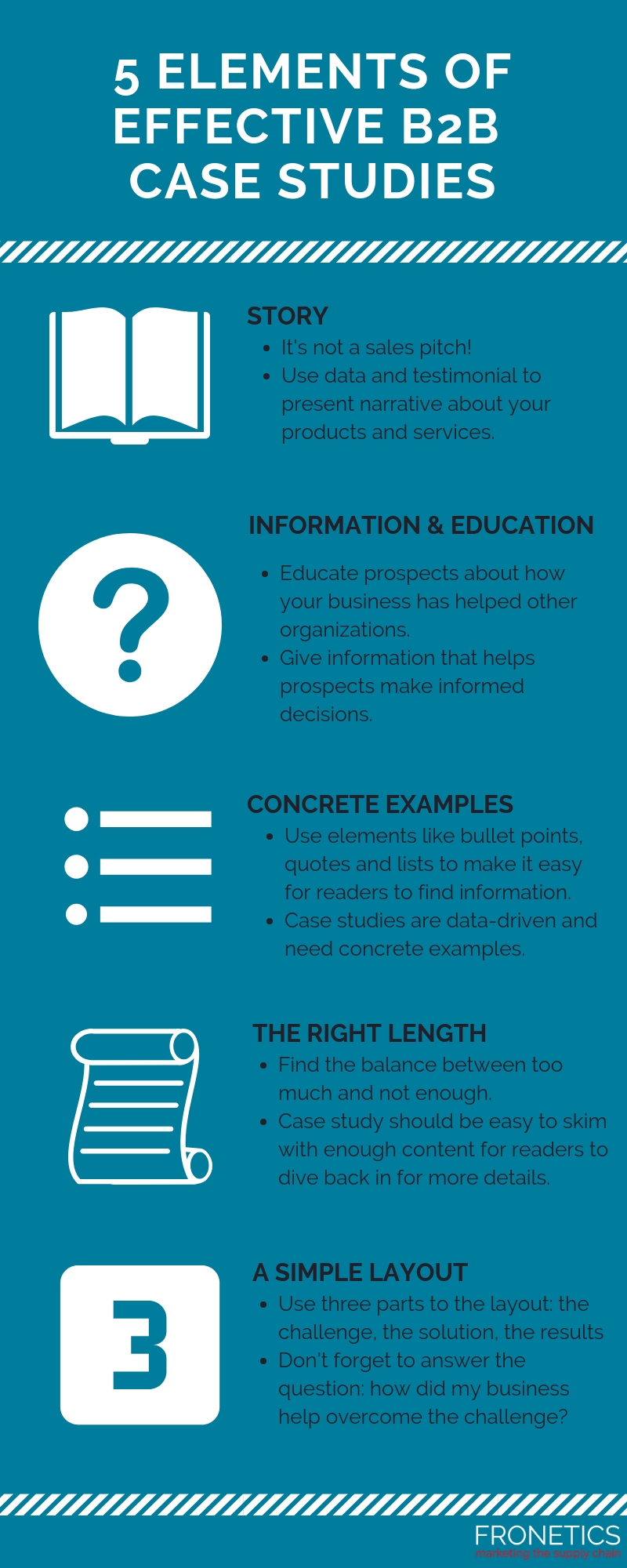
For B2B buyers, case studies are still the most popular type of content. Check out our infographic below to discover the five elements of an effective B2B case study.
Did you know that 89% of B2B marketers consider customer testimonials and case studies to be the most effective kinds of content in converting buyers? A well-written case study engages prospects and generates leads. But what is an effective case study? And how do you create one?
These five elements are the key to maximizing the effectiveness of your case study:
1. Story
While it’s true that case studies are about the data, what makes them attractive to buyers is the story. This isn’t a sales pitch — it’s an opportunity to use data and testimonials to present a narrative to prospects about how your products and services helped another business.
2. Information and education
Think of your case study as an opportunity to educate your prospects about how your business has helped organizations similar to their own. Again, this is not a sales pitch. In fact, case studies that are written as sales pitches tend to be ineffective. A case study gives your prospects information and educates them so they can make an informed decision about what’s best for their business.
3. Concrete examples
Case studies are data-driven and offer concrete examples. This is one of the primary reasons they are a high-performing content type. An effective case study makes it easy for readers to find the information they’re looking for, using elements like bullet points, quotes, and lists to clearly and concisely convey key data.
4. The right length
There’s a delicate balance between presenting complete information, telling a story, and avoiding minutia that’s too specific to matter to your prospects. Ideally, you want your reader to be able to skim quickly and get an overall view, and then dive back in for more details. If your case study leaves your prospect with questions about how your products and services helped another business, chances are it doesn’t include enough information.
5. A simple outline
- The Challenge: What challenge or challenges was your customer facing before working with you?
- The Solution: How did your business address the challenges your customer was facing?
- The Results: How do your metrics demonstrate the immediate and ongoing results of your solution?
(Made with Canva)
The takeaway
Case studies are your opportunity to use your successes to create a narrative, supported by key metrics, that demonstrates how your business successfully addressed the challenges faced by your customers. Telling a compelling story is one of the best ways to engage your prospects and convert leads.
Related posts:

by Elizabeth Hines | Nov 14, 2018 | Blog, Content Marketing, Logistics, Marketing, Supply Chain
Looking to keep up with happenings in the supply chain industry? These are our top five supply chain websites to follow.
One of the best ways to keep up with supply chain trends, innovations, and best practices is by following leading industry websites. In this guide, we’ll explore our top five picks for our favorite supply chain sites.
1. SupplyChainBrain
Website: www.supplychainbrain.com
About
SupplyChainBrain is a comprehensive supply chain management information resource, offering insights from experienced industry professionals and trusted content partners.
Key Features
- Coverage of fundamental supply chain principles
- Identification of emerging trends and strategies
- Over 2,000 videos and regular podcasts
- Extensive blog network and research papers
Why We Like It
SupplyChainBrain stands out for its depth of content and variety of media formats, making it an invaluable resource for both newcomers and seasoned professionals in the supply chain industry.
2. Supply Chain 24/7
Website: www.supplychain247.com
About
Supply Chain 24/7 is an informative online business resource catering to transportation, distribution, logistics, and supply chain professionals.
Key Features
- Webcasts and whitepapers
- Industry-specific news and photos
- Company overviews by industry
- Coverage of trending industry topics
Why We Like It
Supply Chain 24/7 offers a well-rounded mix of content types and industry coverage, making it easy for professionals to stay updated on various aspects of the supply chain world.
3. Supply Chain Digest
Website: www.scdigest.com
About
Supply Chain Digest is a leading online newsletter and website designed for busy supply chain and logistics professionals. It provides a comprehensive platform for news, insights, and solutions in the supply chain industry.
Key Features
- Weekly online newsletter with curated industry information
- News Bites feature for quick summaries of important updates
- In-depth articles and commentary from industry experts
- Webinars and video content on emerging trends and technologies
- User-friendly search function for easy access to specific topics
Why We Like It
Supply Chain Digest excels at distilling complex industry information into digestible formats. Their “News Bites” feature is particularly useful for professionals who need to stay informed but have limited time. The balance between quick updates and in-depth analysis makes this site a valuable resource for all levels of supply chain professionals.
4. Supply Chain Management Review
Website: www.scmr.com
About
Supply Chain Management Review (SCMR) is a comprehensive resource covering the entire spectrum of supply chain management. From sourcing to final delivery, SCMR provides insights on all aspects of the supply chain process.
Key Features
- In-depth coverage of key supply chain activities including sourcing, purchasing, and inventory management
- Articles on emerging trends such as sustainability and digital transformation in supply chains
- Access to both digital and print versions of their magazine
- Podcasts featuring interviews with industry leaders and innovators
Why We Like It
SCMR stands out for its holistic approach to supply chain management. The site doesn’t just focus on individual components but provides a big-picture view of how different elements of the supply chain interact. Their mix of theoretical knowledge and practical case studies makes it an excellent resource for both learning and application. The addition of podcasts also offers a convenient way for professionals to consume content on-the-go.
5. Fronetics
Website: fronetics.com
About
Call us biased, but the Fronetics’ site hosts scores of valuable information about every aspect of the supply chain industry. You’ll find highlights of the lastest industry reports alongside articles that dig into the minutiae of B2B social media strategies.
Key Features
- Well-researched and well-written content covering supply chain trends and news
- Articles and DIY guides for marketing your supply chain business
- Case studies highlighting successful marketing and content strategies
Why We Like It
Fronetics is a leading marketing agency helping supply chain clients to improve and accelerate visibility and revenue growth. Their blog features various Fronetics team members, with occasional guests, and provides insights on today’s supply chain trends, issues, and hot topics.
Staying informed about the latest trends, technologies, and best practices in the supply chain industry is essential for professional growth and maintaining a competitive edge. By following these top supply chain websites, you’ll have access to a wealth of knowledge and insights from industry experts.
We encourage you to explore these resources and find the ones that best suit your informational needs. Don’t forget to bookmark your favorites and check them regularly for the latest updates.
What are your go-to supply chain websites?
Related posts: