The shortage of drivers paired with the continued growth of the trucking industry paves the way for driverless trucks.
This guest post comes to us from Rachel Everly, a writer for Cerasis, a top freight logistics company and truckload freight broker.
The trucking industry has been serving America for many decades, and even today it is the main method by which freight is transferred all over the country. Anyone who says the trucking industry is facing a decline or a reduced demand is way off the numbers. More large trucks are coming on U.S. roads, traveling more miles, and transporting more good than ever before.
We have seen more than 3% increases in the number of trucks, which translates to almost 11 million trucks. Also, trucks are still transporting 73% of almost all cargo weight moved in one year. With all these impressive numbers, surprisingly there is a shortage of drivers. That spells both trouble and opportunity for this industry.
Where is there a shortage of drivers?
The U.S trucking industry is facing a severe driver shortage. One estimate shows that around 48,000 drivers are required to move about 70% of freight.
To improve safety, in December 2015, the U.S. Department of Transportation’s Federal Motor Carrier Safety Administration (FMCSA) announced that driver hours will be recorded via Electronic Logging Devices by 2017. This becomes mandatory by December 18, 2017. This was introduced because the existing systems of time-logging are purposely made very complicated, thus not allowing one to check how many hours is a driver on the road.
This is being introduced to ensure that driver safety is not compromised, keeping fatigued drivers off the road. According to calculations, this will save 26 lives a year and prevent 562 injuries every year. Not just this, the ELD will save companies the hassle of paperwork, eventually leading the trucking industry to save somewhere around $1 billion due to reduced paperwork and time-savings.
However, this means reduced hours per driver, thus increasing the need for more drivers. Small trucking companies will be hit the hardest, but overall the industry will be in a better position thanks to this rule. It is estimated that this new rule would cost the industry $1.8 billion, but cost savings from reduced accidents and paperwork amount in excess of $3 billion.
The way to driverless trucks
Humans are amazing creatures, but we are prone to human errors. Human errors account for the majority of the road accidents. Plus with the new rule in, companies will need more drivers, adding to costs. Uber has been actively working on getting driverless trucks on the roads, with a project already started in Singapore, and now has turned its eyes on the trucking industry.
Uber has recently acquired the start-up Otto. Otto has made great inroads into driverless trucks. Otto currently has 6 working self-driving trucks, with plans to expand to 15. This year Otto is continuously running tests; trucks are hauling random items from the company’s garage to test how the vehicles respond to hauling weight.
The company is confident that soon they will be moving all kinds of goods for shippers. They have already started forging relationships with big names in the trucking industry. The self-driving trucks have shown that they can easily operate on highways, maneuvering off the open interstate is still a work in progress.
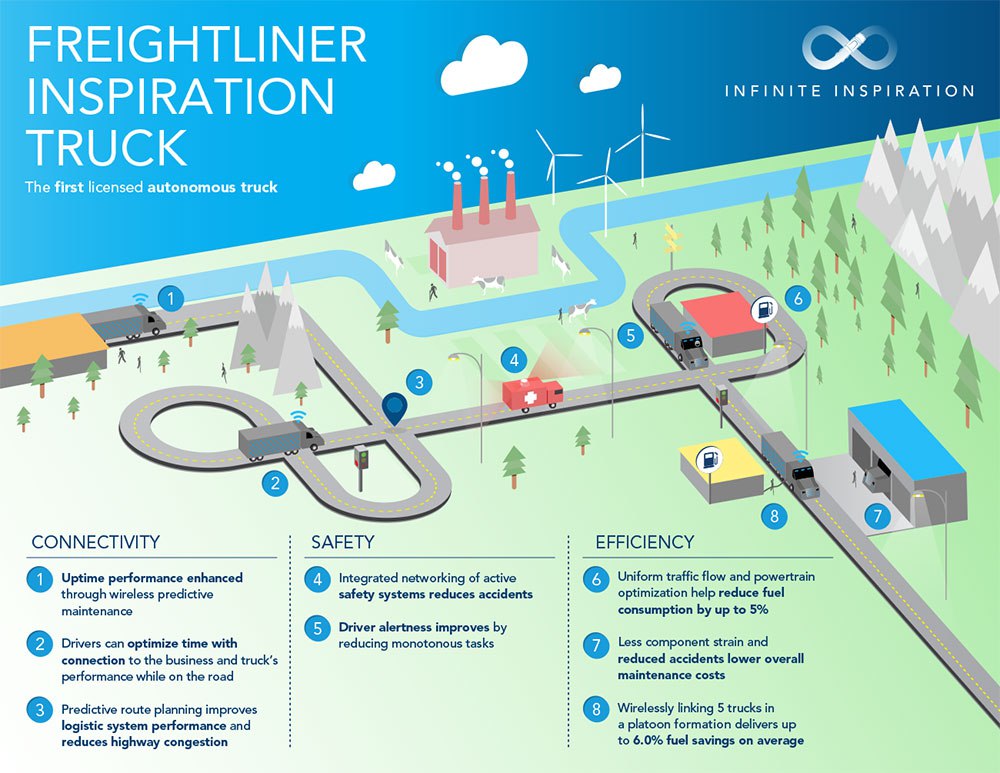
The following infographic outlines some of the benefits of driverless trucks:
People don’t want to read it. It does you no good. So why are you still using your blog to talk about your business?
It seems like a natural use for your company blog. But I’m here to tell you that writing about your products, services, and business is hurting your blog more than it’s helping it.
You shouldn’t write posts to push certain products. You shouldn’t conclude every post with promotional language about your company and what it does. In fact, your business should be virtually invisible in your blog content.
That may seem counterintuitive to some. But it all goes back to basic content marketing principles: Demonstrating expertise and building trust will drive profitable customer action when the customer is ready to purchase.
Why your sales pitch is bad for business
Today’s consumers have no tolerance for overt, interruption-based marketing. You can probably think of examples from your own life to prove this point.
For example: when you’re trying to find something to watch on TV, how often do you stop on a channel to watch a commercial? Probably never, right? If you’re flipping around, it’s probably because you’re looking for content that is appealing to you, not seeking advertisements.
Or, consider this scenario: You are in the market for a new car. You’ve done extensive research on different makes and models and have narrowed your list down to a choice few. You head to the dealership to do a few test drives. Once there, you are greeted by an enthusiastic salesman. Brushing aside your questions, he launches into his pitch about his dealership’s unbeatable prices and repeatedly pushes a model that you that isn’t what you’re looking for. Turned off by his tactics, you make a quick exit.
Remember those two examples when you think about blog readers and internet browsers. They have their pick of the 27 million pieces of content shared on the internet every day. If they sense a sales pitch, they’ll ex out of your website faster than a Google search query.
What’s more, studies show that B2B buyers are about 60% of the way through the purchase decision-making process before ever engaging with a sales person. That means they are actively avoiding sales pitches in favor of their own research. If your blog is just another avenue to pitch your products and services, your content will fall on deaf ears.
Well, then, what should you write about?
DemandGen’s 2016 B2B Buyer’s Survey Report offers some interesting insight on why buyers end up choosing a particular vendor. After timeliness of vendor response (98%), 97% of respondents said that the winning vendor “demonstrated [a] stronger knowledge of the solution area and business landscape.” Not that the vendor had the most modern products. Not that they got the best deal. That the vendor understood the solution area and business landscape.
That’s what your blog should be all about.
Write about the problems your products solve (without mentioning your products). Write about the kinds of businesses you can help (without mentioning your name). Use content to demonstrate your expertise and to inform prospects about the solution area and business landscape in which your clients operate.
See, it’s not about you. It’s about them. They want a vendor who understands their pain points and how their business operates. If you and your content provide value, offer information, and demonstrate expertise, your audience will come to know you as a trusted source of knowledge.
And that’s who buyers purchase from. Vendors who understand their business. Not those that can only talk about themselves.
So, please, don’t use your blog to push your products or your business. Salesy and self-promotional language will only turn buyers off. Instead, use this platform to show your prospects that you understand their situation, and they’ll come running when it’s time to make a purchase, no sales pitch required.
Fronetics is conducting a survey to determine the benefits and challenges of social media for companies in these industries.
Two years ago, Fronetics surveyed a number of individuals working in the logistics and supply chain industries, including those employed by manufacturing, warehousing, and transportation companies. The survey’s goal was to find out how these companies were using social media, and if they were realizing any benefits or encountering any challenges by participating.
Interestingly, 100% of respondents reported having used social media for 5 years or less. Despite this relatively short implementation period, the majority (68%) said that their companies had already realized benefits from participation — primarily increased engagement with customers, increased market intelligence, and increased business intelligence.
As things go in the technology space these days, social media looks quite different than it did two years ago. What’s more, companies in these industries have, presumably, been using these tools for longer. Have a better understanding of social platforms and more opportunities for businesses impacted the benefit to users?
Fronentics is conducting a new survey to find out. We invite individuals working in the warehousing, manufacturing, and transportation industries — or those in other supply chain and logistics fields — to participate.
The survey takes about 3 minutes to complete. Responses will be reported in aggregate, and no identifiable information (individual or company) will be shared.
We look forward to hearing about your experience with social media!
The web search has changed the way businesses shop for products and services — and content marketing is your key to reaching them.
What’s the first thing we all do when we need a gift for Fathers’ Day, can’t think of a song lyric, or want to buy a new kitchen appliance? We Google it.
The world of B2B sales is no different. Demand Gen’s 2016 B2B Buyer’s Survey Report found that 62% of B2B buyers say that a web search was one of the first three resources they use to learn about a solution. In fact, 94% of buyers reported using online research at some point in the purchasing process.
That means businesses must be more than just conscious of their digital presence: They must actively manage their website and digital content assets to accommodate the ways buyers are conducting research.
Seeing opportunity in the new reality
In the pre-internet age, the salesperson’s role began relatively early in the buyer’s journey. Today’s average B2B buyer, however, progresses nearly 60% of the way through this process before making any sort of contact with a sales rep. That means your prospects are forming their early opinions about your business and your products based on what they find on the web.
This new reality may seem daunting, given how much of the purchase decision-making process occurs before you have the opportunity to engage with a potential client. But in reality, this changing climate offers serious opportunities for businesses to demonstrate their expertise, without turning buyers off with overt sales pitches.
Content is king/key
To make the most of the potential purchaser’s experience with your business, content is key.
A robust content marketing strategy builds brand awareness, establishes trust and rapport with prospects, and generates traffic to your website. Thoughtfully generated and curated content catches the attention of buyers and keeps them interested in your business through the time of purchase.
Specifically, 67% more leads will be generated by companies with an active blog in 2016. And content isn’t limited to your website: a vibrant social media presence helps buyers conduct their research, with 57% of consumers reporting that they are influenced to think more highly of a business after seeing positive comments online.
Again, while this new reality may seem like a challenge, it’s actually a golden opportunity for your business to put its best foot forward with potential buyers. By thoughtfully generating and curating focused, informative content, companies can guide B2B buyers through the sales process, and develop an engaged and loyal customer base.
Company X also saw web traffic grow by 180% in 90 days by using Google AdWords and Facebook Ads.
Sometimes our clients can be a little hesitant to try pay-per-click advertising. Take Company X, for example.
Company X’s target customer fits a very particular profile, in terms of geography, income, and age. Because of those specific demographics, the client was not confident that a pay-per-click advertising campaign would be an effective way to reach those target customers. But we thought differently.
When paired with a content marketing program, pay-per-click can be one of the cheapest, in terms of cost-per-lead, and most efficient ways to reach a target audience. Thus, we convinced Company X to try PPC on a trial basis, investing just a small budget.
We developed a strategy for the client, using Google AdWords and Facebook Ads. Over the course of 90 days, the results were phenomenal.
A few key results:
Company X acquired 54 leads.
Traffic from paid search grew by 180%.
The lead-to-customer conversion rate was nearly 3x the industry standard.
Needless to say, Company X will be expanding the use of pay-per-click advertising in the future.
How can pay-per-click help your business?
PPC can seem intimidating to the novice. But, when done right, it can be a highly effective way to reach the very specific kind of customer your business is looking for. A little bit of know-how can be all the difference.
As such, Fronetics has developed a quick training on the basics of pay-per-click advertising: what it is, what platforms are available, etc. If you are interested in learning more about PPC and how it might complement your marketing program, download our free guide below.