by Elizabeth Hines | Feb 9, 2017 | Blog, Content Marketing, Marketing, Strategy
Time can be a blog’s best friend when it comes to gaining leads, but there are a few things you can do to accelerate lead-generation efforts.
Patience is a virtue, but it’s a particularly difficult one to mind when you’re trying to get your business off the ground.
Whether you are just starting out, are trying to turn things around, or are just looking to inject a little energy into things after some slow growth, your company has probably made an investment in your marketing efforts. Now comes the tough part, if you’re on the marketing team: The bosses are going to want to see results in the form of leads and sales.
Fair enough. Blogging is one of the best ways to boost your lead-generation efforts. The trouble is, however, that is normally takes some for those benefits to come to fruition.
I’m not going to say it’s a marathon…
But blogging is certainly not a sprint. Your posts need time to start drawing traffic — and then, from traffic comes leads. So the transitive property tells us that lead generation takes time. Here’s why.
As with many things, blog posts become more credible with age. That is to say, search engines value things that older content has had more time to accumulate, like social shares and referrals from other web pages. The more relevant a blog post proves itself to be to readers over time, the higher it will rank in search engine results.
On the other hand, new blogs without much content don’t have much to tell search engines. Search engines don’t trust them yet — and search engines’ algorithms are designed to avoid leading searchers down a stray path. So posts from new or young blogs are less likely to appear within the first page(s) of search results, which is key to sourcing organic traffic.
So what’s a marketer who is charged with generating leads to do?
Set realistic expectations
Be realistic about how quickly your blog will start generating leads when you first set your content strategy. Consider things like the length of your sales cycle. You can’t expect a reader to hasten down the sales funnel any faster than a normal prospect. And remember that the reader probably won’t catch your post on the first day it’s published. (More on that later.) So, if your sales cycle is 90 days, you might see a lead 90 days after you start publishing. But, in reality, it will probably take a little longer.
Instead of relying entirely on leads to define success, you should spend the first months focusing on the metrics that are precursors to lead generation. Increased web traffic and greater social reach and engagement, for example, are solid proof that the needle is moving in the early days of a new content marketing program. Set goals for these metrics, and communicate with leadership that they are all indicators that your content strategy is working, and that leads should follow in time.
But how can I get my blog to generate leads faster?
If you want to accelerate lead generation, it’s going to take a greater investment. But if you’re willing to commit more time and resources to speed things along, here are two things you can do.
1. Publish more frequently.
Search engines value posting frequency because it shows that your blog is a consistent source of content. The question is, how much can your organization publish without experiencing a decline in quality and relevancy? Those are other factors influencing search engine rankings, not to mention readership, leads, and conversions.
But “more frequently” doesn’t have to mean going from 0 to 60. Even publishing once more per week can make a dramatic impact. This story, for example, shows how publishing one more post per week helped a client’s web traffic increase by 23%, sales leads double, and a prospect convert to a customer — and that was just in just one month.
A HubSpot study showed a tipping point around 400 total blog posts — blogs with 401+ total posts generated twice as much traffic as those that had published 301-400 posts. And more specifically, B2B companies with 401+ total blog posts generated nearly 3X as many leads as those with 0-200 posts. The faster you can reach that 400 mark, the quicker your results.
2. Don’t neglect your old content
It’s important to keep in mind that the majority of your web traffic (aka potential leads) will first encounter your older content. Looking at Fronetics’ most-viewed posts last month, for example, 80% were published at least six months prior. In fact, 50% were more than a year old.
What does that mean? For one, you should keep tending to your already published content, particularly those posts that prove to be a consistent source of traffic. Update information; add links to new related posts or other relevant resources; and seek opportunities to insert or update calls-to-action to current offers and campaigns. Making sure those older, consistently popular posts continue to serve and engage your readers will increase your chances of conversion.
Secondly, it’s crucial that you look beyond how the posts you published recently performed. Something that doesn’t get a lot of views in the first week may be a huge traffic source and lead converter in a little time. Many content management systems, like HubSpot, can generate attribution reports, which tell you which web pages users most often visit before converting to a lead. Compare these pages with your high-traffic pages that don’t make the list to see how you can create more opportunities for lead conversion on the pages earning the most traffic.
Most importantly, if you invest the time and resources to run a blog, you owe it to yourself to see it through to success. Just because you don’t generate hundreds of leads in the first few months doesn’t mean you won’t eventually. It’s just going to take some time.
Related posts:


by Elizabeth Hines | Jan 9, 2017 | Blog, Content Marketing, Marketing, Social Media, Strategy, Supply Chain
Why brand awareness is important to growing your business
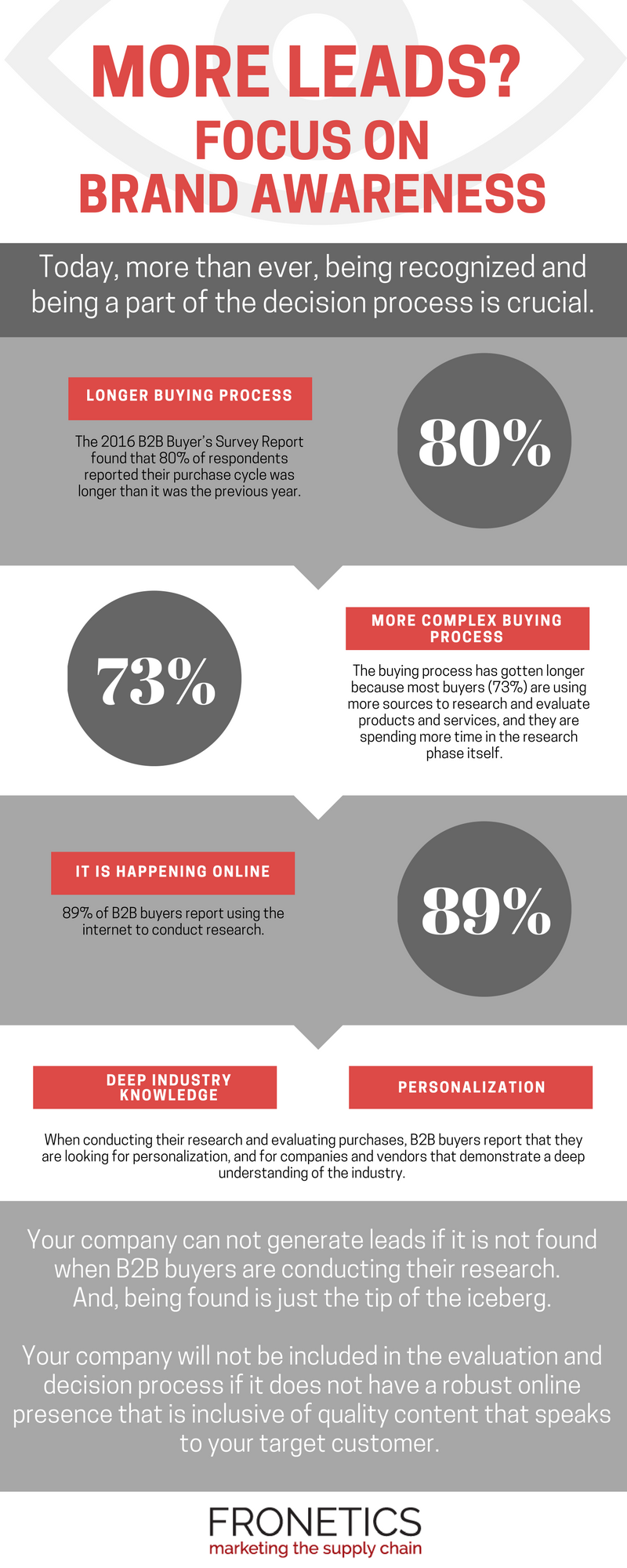
The singular goal of most companies that contact Fronetics is to generate more leads — today. This is not surprising in that leads are necessary to generate sales, and sales are necessary to revenue generation and to growth. What is surprising is the number of companies who do not recognize the critical role brand awareness plays in lead generation.
Brand awareness is the likelihood that your company’s brand, products, and services are recognized by consumers. Simply put, if consumers don’t know your company exists and/or don’t know what your company does or what your company offers, your company won’t be a part of their decision process.
Today, more than ever, being recognized and being a part of the decision process is crucial.
The new B2B buying process
The buying process for B2B buyers has become more complex and longer. The 2016 B2B Buyer’s Survey Report found that 80% of respondents reported their purchase cycle was longer than it was the previous year. The buying process has gotten longer because most buyers (73%) are using more sources to research and evaluate products and services, and they are spending more time in the research phase itself.
When conducting their research and evaluating purchases, B2B buyers report that they are looking for personalization, and for companies and vendors that demonstrate a deep understanding of the industry.
The place they are turning to conduct their research, and to evaluate purchases, is online: 89% of B2B buyers report using the internet to conduct research. Specifically, they are going online to: conduct web searches, look at vendor websites, read reviews, use social media, and participate in online forums.
The importance of investing in brand awareness
Your company can not generate leads if your company is not found when B2B buyers are conducting their research. And, being found is just the tip of the iceberg. Your company will not be included in the evaluation and decision process if it does not have a robust online presence that is inclusive of quality content that speaks to your target customer — that is, content that educates, informs, and identifies how your company can meet the needs of your target customers. It is about positioning your company as a knowledge leader, building trust, and establishing relationships. It is about brand awareness.
Building brand awareness takes time and dedication. Companies that are willing to invest their time and resources to brand awareness are rewarded – not just with leads, but with quality leads.
Too often, I see companies who are unwilling to invest either the time or money in brand awareness. One of the most frustrating things to see is a company that gives up too soon. These are companies who have realized significant gains — they have, for example, increased traffic to the website through organic, referral, direct, and social sources; decreased bounce rates; increased social reach; and increased social engagement. But, because their lead generation has not immediately sky rocketed, they decide to either reduce or eliminate their digital and content marketing activities. It is frustrating because these companies have built a strong foundation, and they are on the tipping point of success.
With the B2B buying process taking longer than ever, with buyers spending more time researching and evaluating their decisions, and with B2B buyers turning to the internet and critically evaluating companies on how they present themselves, investing the time and resources to brand awareness is critical.
As Geoffrey Chaucer said, “Patience is a conquering virtue.”
You may also like:

by Elizabeth Hines | Dec 22, 2016 | Blog, Content Marketing, Marketing
At Fronetics, we work with companies in the logistics and supply chain industries to create and execute digital and content marketing strategies. Understanding the sales processes of our clients, working closely with sales, and developing effective lead generation strategies is at the heart of what we do.
Here are our 5 most read sales and lead generation posts of 2016.
Sarah Collins, an intern Fronetics and a student at James Madison University, College of Business studying Marketing, writes how aligning sales and marketing helps companies achieve 20% higher annual growth rates and improves deal closings by 67%. Read more.
Leads are only valuable if they convert into customers. So, generating quality leads is only half the battle. You need a sales team that knows how to resuscitate a lead, nurture it, and, ultimately, turn it into a customer. Read more.
B2B sales must recognize and accommodate buyers at various levels of self-sufficiency in the purchasing process. Read more.
The most efficient lead-generation strategy includes a way to capture potential customers’ information. Read more.
If you feel your marketing campaign falls short in generating quality leads, you are not alone. Typically, one in 10 marketing professionals questions the effectiveness of their lead generation methods. While you may have some of the components of a strong campaign in place, it is possible that you are leaving out a very important ingredient for success: a call to action (CTA). Read more.

by Elizabeth Hines | Dec 21, 2016 | Blog, Diversity, Leadership, Logistics, Manufacturing & Distribution, Strategy, Supply Chain, Talent
Women hold just 15% of all executive officer positions within Fortune 500 companies, yet research consistently shows that when women are in positions of leadership, companies perform better. In the supply chain industry, just 5% of top-level supply chain positions within Fortune 500 companies are held by women.
As a woman working within the supply chain industry, I believe that it is important to discuss the lack of gender diversity and point to research highlighting why the industry needs to increase the number of women in all positions, including the C-suite. It is just as important to highlight the incredible women who already are working within the industry.
In 2015 I interviewed Cathy Morris, senior vice president and chief strategy officer at Arrow Electronics, and Mickey North Rizza, vice president of strategic services at BravoSolution. Morris was twice named one of the “Top 50 Most Powerful Women in Technology,” and North Rizza was named a “Top Female Supply Chain Executive.” Both Morris and North Rizza shared how they got started in the industry, and the steps they have taken to get to where they are today.
In 2016 I interviewed Kendrea Durr-Smith, director of global trade compliance at Arrow Electronics, Kelli Saunders, President of Morai Logistics, Hailey McKeefry, editor and chief at EBN, and Barbara Jorgensen, co-founder and managing editor, EPS News. I also invited Tania Seary, founder of Procurious, to share what is happening at her company, and Jennifer Cortez, director of marketing and communications at Transplace, to discuss the role of quality content within the industry.
Here are the most-read women in the supply chain posts of 2016.
It was a “fluke” that Kelli Saunders found the supply chain industry. More than 30 years later, Saunders is president of Morai Logistics Inc., an Authorized Agent of Mode Transportation. Read more.
When Arrow Electronics came across Kendrea Durr-Smith, senior leader of export control audits, training, and communications at Honeywell Aerospace, on LinkedIn, the company was impressed with what she had accomplished in her nine years there. Now Arrow’s Director of Global Trade Compliance for the last four years, Durr-Smith has led a group that is both unique and diverse, and has helped to shepherd in significant changes. Read more.
Data shows that gender equality has improved in recent decades, such as the 15% increase of women working full time in the workforce since 1979. But there is still much progress to be made. As a recent UN Working Group mission to the US to explore discrimination against women found: “In the US, women fall behind international standards as regards [to] their public and political representation, their economic and social rights, and their health and safety protections.” Read more.
Women within the supply chain industry are doing incredible things. Here are some of their stories. Read more.
While there remains a gender gap in the supply chain industry, progress has been made. McKeefry is a clear example of progress. Her internship at EBN in 1990 was a “minority internship,” and today, 26 years later, she holds a leadership position within the company. Read more.
Barbara Jorgensen has more than 20 years’ experience as a journalist, working for leading electronics industry publications such as Electronic Business, Electronic Buyers’ News, and EDN. She is the co-founder and managing editor of EPS News. Read more.
This is a guest post written by Tania Seary, founder of Procurious, the world’s first online social network for supply chain and procurement professionals. Seary shares how she has built Procurious. Read more.
This is a guest post by Jennifer Cortez, Director, Marketing Communications, Transplace. Cortez discusses how Transplace, a North American non-asset-based provider offering manufacturers, retailers, chemical and consumer packaged goods companies the optimal blend of logistics technology and transportation management services, has used content marketing and she offers up 3 tips for creating valuable and compelling content. Read more.


by Elizabeth Hines | Dec 19, 2016 | Blog, Logistics, Strategy, Supply Chain
Fronetics is a boutique marketing firm focused on the supply chain and logistics industries. Not only does our firm have deep roots within these industries, we are also focused on the future.
Here are our top 10 supply chain and logistics posts of 2016.
The buying process for B2B buyers has become more complex and longer. The 2015 B2B Buyer’s Survey Report found that 53% of respondents reported their purchase cycle was longer than it was the previous year. The buying process has gotten longer because the majority of buyers (82%) are using more sources to research and evaluate products and services, and they are spending more time in the research phase itself. A full 80% of respondents reported they spend more time on research alone — this is up from 58% in the previous survey. Read more.
Fronetics names the best of the best blogs in the logistics and supply chain industries. Read more.
Here are 5 more TED Talks from 2016 that companies in the supply chain and logistics industry will want to see. They cover a range of topics, from technology to business strategy. Read more.
Amazon’s ever-expanding foray into the logistics space could turn the industry on its head. Read more.
Culture is not rhetoric for Eimskip. This key player in worldwide reefer logistics has placed a high value on culture since it was founded in 1914. “When identifying where we operate,” says Isfeld, “we look to smaller communities where there are cultural similarities and where we can make connections and be involved.” Read more.
New research shows how supply chain and logistics companies currently are using the Internet of Things and how they plan to expand use in the future. Read more.
If you’re looking for the latest news and information about happenings in the industry, you should have these five supply chain websites on your radar. In no particular order. Read more.
As uncertainty pervades following Brexit, experts speculate about the impact a divorced U.K. and E.U. will have on the global supply chain. Read more.
The Supply Chain industry is changing, while it’s becoming harder for companies to hire at the same time. These supply chain demographics provide a picture of the industry today. Read more.
They are your employees. They are your customers. Pretty soon, Millennials will be the supply chain. Read more.