by Elizabeth Hines | Oct 26, 2016 | Big Data, Blog, Content Marketing, Data/Analytics, Marketing
Big-data insights can help you segment your email database to better target prospects based on where they are in the buyers’ journey.
Most companies these days are swimming in a sea of big data, the great swaths of information they’ve amassed from sales records, social media connections, website leads and contacts, and online analytics.
At first glance it’s a tangle of information that is hard to organize and even harder to learn anything from. That’s a stumbling block that forward-looking businesses need to overcome. Big data can help breathe new life into one of the most reliable yet shopworn tools of the trade: email campaigns.
Embrace Big Data
A study by the executive head-hunting firm Spencer Stuart surveyed 171 companies regarding big-data usage. Just a little over half of the companies used their big data to help guide email, SEO, and SMS marketing campaigns. That’s a fairly low rate, given the potential leg-up that big data can provide.
Consider what Walmart is doing. The company has big-data information on about 60% of all Americans, with which it micro-targets customers based on their individual interests and habits. It’s a powerful strategy that is spreading quickly to businesses of all sizes.
How can you use big data to freshen up your email campaigns?
Be a Collector, Not a Hoarder
Chances are, you are obtaining a lot of data, especially if you have an active content marketing plan in place. Not all of the data you get is equally important. Your focus should be on data that can lead to an actionable and quick response — for example, are you gathering information on your customers’ buying habits? Do you know who they are, where they are, what their interests are, what their email address is, and how your business connects with them?
Collect that relevant data and study it. Much of it will come from the buyer’s journey — the breadcrumbs that potential buyers leave for you in your big data. These pieces of information are keys to your personalized email responses.
Respond In Kind
Most experts agree that a quick and targeted email response is a good strategy for encouraging a new customer to make a purchase. The email needs to respond directly to the buyer’s interests — using information you’ve (hopefully) logged with your big data.
From this point on, it’s crucial to make sure that every email that is sent to that buyer is built around a backbone of big data. Nurture your customers with personalized emails that offer content and deals that line up with their specific interests.
Don’t Mess with the Masses
Mass emails — the generic sales pitch email — used to be the cost-effective and simple way of reaching and converting customers. Now, it’s more than likely they’ll get sent to the trash, or worse, the spam filter. The mass email is your one-way ticket to spam purgatory.
“Traditional methods of mass marketing doesn’t resonate anymore and they’re being ignored by the audience,” said Volker Hildebrand, Global Vice President of Strategy at SAP Hybris, in a recent interview with Forbes. “Data is the fuel for customer engagement, and being able to pull together all the relevant information about in real-time.”
You can do better than the mass email approach. If you’ve collected relevant data and you’ve studied your buyers’ journeys, you have the tools in place to build a smart email campaign. Tailor your campaign to personalize your approach to your customers, and more than likely they’ll open that email.
Related posts:

by Elizabeth Hines | Oct 19, 2016 | Blog, Content Marketing, Marketing, Social Media, Supply Chain
Native advertising is the non-ad-like way to promote your business’ content to users who might be interested in it.
Is your business using native advertising to promote your content with a targeted audience? If not, you’re missing out on one of the biggest upcoming trends in content marketing.
So how can your business use this technique to promote your content and, ultimately, your products and services? Let’s take a look at the basics of native advertising.
What is native advertising?
Native advertising blurs the line between advertising and editorial content. It allows publishers (of content) to get their message to a targeted audience in a format the audience is already using. Think of sponsored updates on LinkedIn, which look just like regular posts, or when a radio DJ promotes a product within the regular broadcast.
Content Marketing Institute founder Joe Pulizzi defines native advertising with the following three qualities:
- “A Directly Paid Opportunity. I hate to bring out the obvious, but native advertising is ‘pay to play.’ If a brand or individual did not pay for the spot, it’s not native advertising.
- “Usually Content Based. The information is useful, interesting and highly targeted to the specific readership. So, in all likelihood, it’s not an advertisement promoting the company’s product or service directly.
- “Delivered In-Stream. To truly be a native ad, the user experience is not disrupted. The advertising is delivered in a way that does not impede the normal behavior of the user in that particular channel.”
Native advertising is not content marketing…
… But it can be an effective way to promote your content.
Remember, content may be king, but distribution is queen, and she wears the pants. That is to say: Publishing valuable and relevant content in a strategic and consistent manner will create demand for your products and services. But content doesn’t go far — actually it goes nowhere — without distribution.
Native advertising is a paid opportunity to distribute your content to more people. It can be more effective than non-native advertising, like banner ads or commercials, because it does not interrupt the user experience but rather complements it. It doesn’t feel like an ad, even though someone paid to have it appear on your screen.
Social media platforms are offering more and more opportunities for businesses to advertise this way through sponsored posts and updates. LinkedIn, Facebook, Instagram, Pinterest — you may have noticed that more and more posts from companies you don’t follow appear in your newsfeeds now. These platforms use proprietary algorithms to help businesses target users might be interested in the content they are promoting.
Here’s what a sponsored post on LinkedIn looks like, for example:
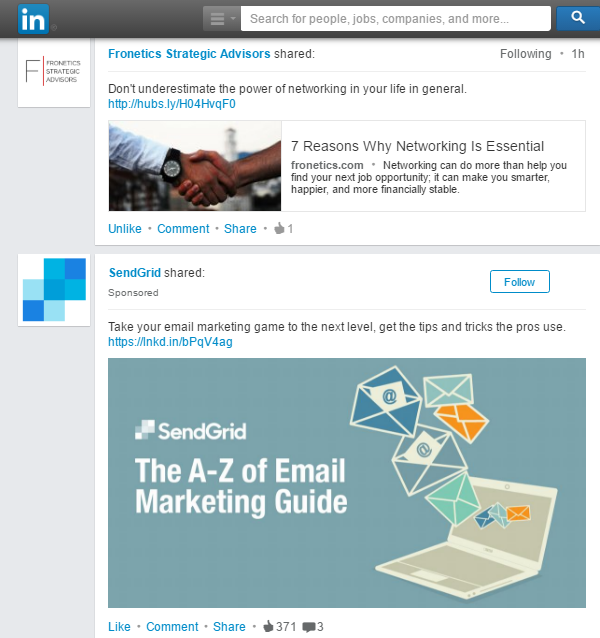
The sponsored post from SendGrid looks just like the other posts in my feed. Another important thing: It’s totally relevant for the kind of content I consume. I might even ignore the comma splice and click on it to get the information about email marketing because that’s what I like to read about on LinkedIn.
Some native advertising facts
The use of native advertising is growing among businesses because it is proving to be so effective. Here are some facts that might interest you.
Doing it right
Because native advertising blurs the line between editorial and advertising, some advertisers have gotten in trouble for violating rules of compliance. In response, the FTC has come out with some official guidelines for native ads in order to prevent confusion and to protect consumers. If your business is launching a native advertising campaign, make sure that you are familiar with these rules and best practices.
Related posts:

by Elizabeth Hines | Oct 17, 2016 | Blog, Content Marketing, Logistics, Marketing, Social Media, Strategy, Supply Chain
Learn the basics of pay-per-click advertising — what it means and which platforms you can use — in this quick training.
Pay-per-click advertising can be an effective complement to a content marketing campaign for companies in the supply chain and logistics industries. Essentially, you can get your business’ name and content in front of people who are searching online for products and services like yours — but you’ll only pay for those who click on your advertisement. Sounds great, right?
But here’s where things get a little complicated: Should you use Google AdWords or Google Display Network? What’s the difference? What about Facebook and Twitter advertising? Is a Sponsored Post on LinkedIn considered pay-per-click?
We at Fronetics have developed a basic training on pay-per-click advertising for supply chain and logistics organizations. Learn more about what it can do for your business, as well as which platforms are available and the differences between them.
This training offers information about:
- Google AdWords
- Google Display Network
- Facebook Ads
- Instagram Ads (photo, video, carousel)
- Twitter Advertising (Promoted Tweets, Promoted Twitter Accounts, Promoted Trends)
- LinkedIn Advertising (Sponsored Posts, text and image ads)
Click the button below to download our free pay-per-click advertising training.

Related posts:

by Elizabeth Hines | Oct 13, 2016 | Blog, Content Marketing, Marketing, Social Media
Here’s a summary of what’s been happening on all of your favorite social media platforms lately.
Social media platforms change so frequently, it’s often hard to keep up. But, since social media is a crucial part of any effective content marketing strategy, it’s important to know what tools are available to your business and how you might gain value from using them.
That being said, we’ll be regularly summarizing any updates, changes, additions, or otherwise noteworthy goings-on in the social media world in this space. Feel free to send me an email if you want more information about any of these tools or if you’d like to see us cover something new in social media that we haven’t.
Facebook combats fake stories in Trending Topics
After letting its news curation staff go this summer, Facebook is working to find a solution to combat sensational news stories from creeping into its Trending news section, now run completely by algorithms. The company announced that it will implement a technology similar to that used by the news feed feature. Read more
Longer tweets come to Twitter
As of September 19, Twitter has changed the kind of content that counts toward the 140-character limit in tweets. Media attachments, quote tweets, and @names in replies no longer count toward the limit. Read more
Snapchat becomes Snap Inc., launches video sunglasses
In September, Snapchat launched a new line of business, video-enabled sunglasses (called Spectacles), and rebranded with a new corporate name, Snap Inc. CEO Evan Spiegel said in a blog post that the rebranding reflects the company’s diversification. Read more
Facebook launches Messenger Day to Poland, and it looks a lot like Snapchat
Facebook Messenger users in Poland, where Snapchat is not yet popular, can now share illustrated photos and videos that disappear within 24 hours. The platform says it often tests new features before rolling them out to other markets, but it is not yet clear if or when Messenger Day will come to the U.S. Read more
Twitter rolls out Moments to all members
Moments are a collection of tweets that focus on the same subject. Previously available only to specific partners, all members are now able to use this feature. Read more
Facebook enhances Canvas’ capabilities for brand advertising
New metrics, templates, and upcoming features like 360 videos are all ways Facebook is expanding the advertising feature’s utility for all businesses. Read more. Relatedly, brands can now create custom audiences based on users who have viewed their Canvas ads on Facebook. Read more
Pinterest launches Promote button
Brands can now promote their pins when creating it or when viewing it on their profiles with the new Promote button. Read more
Vimeo rolls out Vimeo Business
Video streaming platform Vimeo officially announced its business-focused membership option, Vimeo Business. The subscription includes unlimited bandwidth, analytics tools, and lead-generation mechanisms. Read more
Related posts:
by Elizabeth Hines | Oct 5, 2016 | Blog, Content Marketing, Logistics, Marketing, Social Media, Strategy, Supply Chain
It’s time to stop ignoring Snapchat — now Snap Inc. — and start thinking about how to use it in B2B marketing.
You may know Snapchat because your kids use it obsessively. You may still think of it as the “sexting app.” Whatever your thoughts, it’s time to stop thinking it will never be relevant to you and your business.
Founder of the Content Marketing Institute Joe Pulizzi named Snapchat one of the next big trends in content marketing for 2017. He sites the platform’s impressive growth as one reason to pay attention.
Snapchat becomes Snap Inc.
In fact, it’s becoming one of the most popular social media networks available: Snapchat reached 10 billion daily video views, passing Facebook in April 2016, and overtook Twitter in daily usage in June 2016, with an estimated 150 million daily active users.
Celebrities, B2C organizations, and even the White House have jumped on board. Everyone is eager to reach the 41% of American 18 to 34 year olds that Snapchat’s ad division claims are using the platform on a given day.
Snapchat’s success has prompted the company to expand and diversify. In September, it launched a new line of business, video-enabled sunglasses (called Spectacles), and rebranded with a new corporate name, Snap Inc. CEO Evan Spiegel hinted at even more to come in a blog post: “Now that we are developing other products, like Spectacles, we need a name that goes beyond just one product.”
What’s next for the self-proclaimed “camera company” is a mystery, but one thing is for sure: B2B companies should be paying attention.
Behind every B is a C
Gary Vaynerchuk, CEO of Vayner Media, makes a convincing argument in his article Why Snapchat Will Be Great for B2B Companies. He recognizes a pattern among social networks that signals the rise of Snapchat in the B2B space:
“These platforms start off young, start off consumer based, start in a niche, and then go mainstream. It baffles me that people don’t understand that when an app hits 100 million active users, it’s gone mainstream. And what does that mean? It means that the platform can start to mature and start getting deeper into the business world. That’s because once you have the attention of the 35- to 65-year-old world, you now have the potential to cross over into the B2B world.”
Vaynerchuk is also quick to note that “behind every B is a C,” meaning there is a human behind every business making a decision. If a company is able to reach that human with relevant content on the user’s preferred platform, that’s a win.
Perhaps it’s early to start pouring major resources into Snapchat. But Vaynerchuk predicts that it has enormous potential for B2B organizations as early as 2018:
“Snapchat will be an excellent place for B2B players who act like media companies — media companies that create stories to bring value to their end users. Those players will find their niche and their audience, allowing them to disproportionately pick up business. Meanwhile, their competitors will still be debating the ROI of Snapchat. And they’ll be left behind if they can’t adapt and evolve with the evolution of these platforms.”
How could your company use brief video storytelling to bring value to your customers? It’s time to start the wheels turning.
Related posts: