by Elizabeth Hines | Sep 11, 2018 | Blog, Content Marketing, Logistics, Marketing, Social Media, Strategy, Supply Chain
Daunted by the idea of proving social media ROI? These 3 steps will give you the structured framework you need to show the results of your efforts.
We all know social media is effective — but do we really know it?
Social Media Examiner’s 2018 Social Media Marketing Industry Report found that only 44% of marketers agree that they know how to measure social media ROI. That means two-thirds of you don’t know whether or not, or how much, your marketing efforts are paying off when it comes to the use of social media.
Managing your business’ social media is no small task. It can be a time-consuming and laborious process, so you want to make sure you’re doing it right. That means having a systematic framework in place to prove social media ROI. These three steps will get you started.
3 steps to prove social media ROI
1) Set goals
It may seem obvious, but too many businesses approach social media marketing with vague goals or none at all. Deciding that you want to “grow your business” through social media is great — but it does little to set you up for success.
As you think about goals, keep the SMART principle in mind: Your objectives should be specific, measurable, achievable, realistic, and timed. So for example, instead of shooting to “generate more leads,” set a goal to “generate 10% more leads over 30 days.”
2) Track and measure
Once you’ve set your goals and identified your key metrics, it’s time to implement a system that will track and measure your metrics. At the very least, you should be tracking your metrics on a monthly basis.
We’ve created this monthly marketing reporting template just for supply chain and logistics businesses. It can help you measure social media ROI, as well as track your content marketing efforts, all in one place.
3) React
This is your endgame. While proving your ROI is a great outcome of tracking and measuring your metrics, the real object of your efforts should be reacting to what you discover. Look at your metrics in the context of your goals and objectives. Which efforts are moving you forward? What’s not working?
Trying to prove social media ROI is far from impossible when it’s supported by a solid framework. With a data-driven approach, you can prove ROI and use concrete tools to take steps to improve it.
Related posts:

by Elizabeth Hines | Sep 6, 2018 | Blog, Content Marketing, Current Events, Logistics, Marketing, Social Media, Strategy, Supply Chain
Digital natives are changing the landscape for B2B purchasing. Here’s what you need to know about the new B2B buyer.
Long gone are the days of men and women sitting around a conference table listening to a sales pitch over a free lunch. Today’s B2B buyers are younger, more technologically savvy, and more independent — they’re a generation of digital natives. And they’re making waves across the B2B buying landscape and changing how marketers must work to reach new customers.
Who are digital natives?
The term digital native describes a person that grows up in the digital age, rather than acquiring familiarity with digital systems as an adult. So, unlike the previous generation, digital natives grew up understanding how to work a computer and a mobile phone instead of picking up these skills (slowly) in our 20s, 30s, or even later.
Having grown up in a time of rapid technological advancement, digital natives are very comfortable online. These skills have carried over to their professional careers, as millennials descend upon the workforce. Organic searches have become the starting point for researching products and services, instead of looking for specific brands.
Ch-ch-changes
This new reality means marketers trying to reach new customers must make big changes in the way they target and engage today’s buyers. Marketers have had to shift their focus from outbound marketing to inbound tactics, like content marketing, to engage and connect with their target audiences.
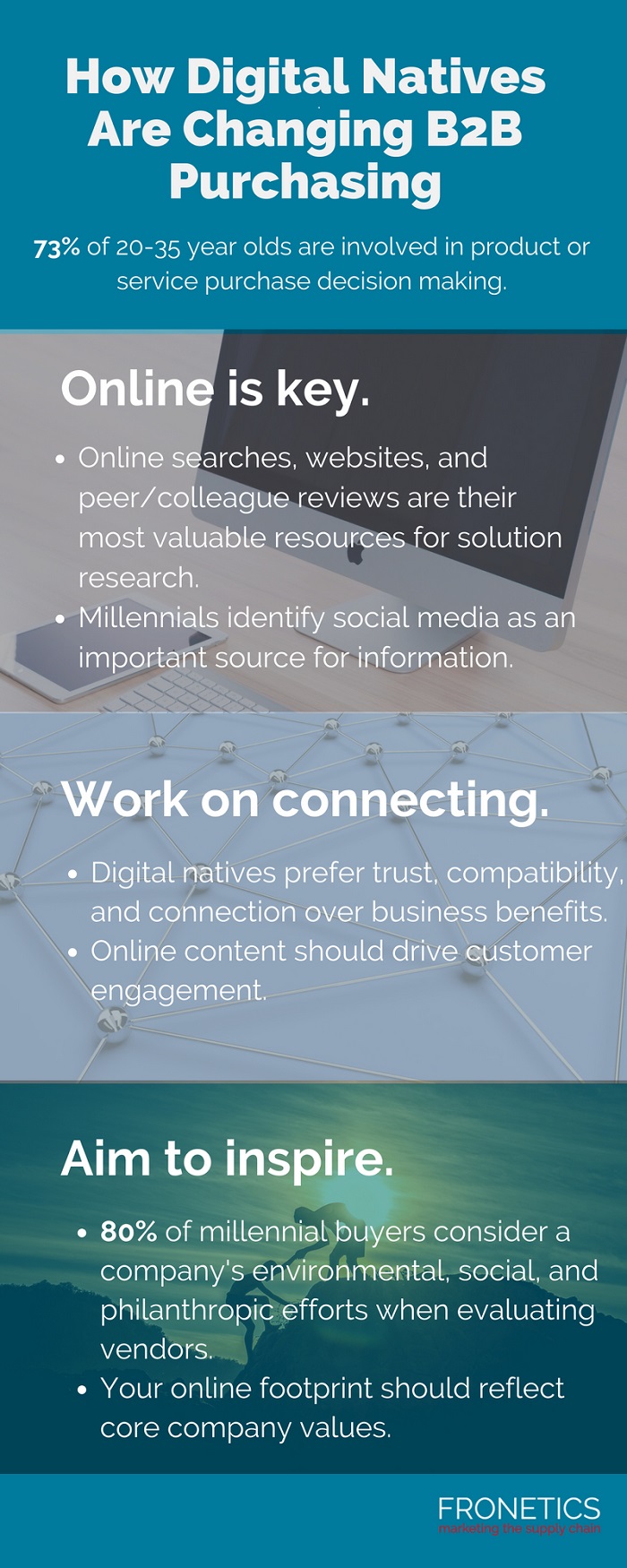
Here’s what you need to know about digital natives and how their tech-savvy ways have changed the B2B purchasing process.
Infographic: How digital natives are changing B2B purchasing
(Made with Canva)
Final thoughts
With so much content available on the internet, first impressions are everything. Your website needs to be informative and visually pleasing. Your social media posts need to be engaging. Your blog posts need to be enlightening. Make sure your online presence accurately depicts who you are as a brand and what you stand for. Digital natives will be more likely to find and connect with you.
Have digital natives had an impact on your business? Tell us about it.
Related posts:


by Elizabeth Hines | Aug 28, 2018 | Blog, Content Marketing, Logistics, Marketing, Supply Chain
Here are our thoughts on how often your company should blog, including challenges and ways to overcome them.
Creating valuable, relevant content in a strategic and consistent manner creates demand for your products and services and drives profitable customer action. Blogging is a large part of the foundation of your content marketing strategy. If it’s not, it should be.
Blogging is a great way to attract traffic to your website, build brand awareness, and interact with new visitors. But, a question we get all the time is, “How often should my company blog?”
Blogging: frequency matters.
Blogging every once in awhile isn’t going to get you results. You need to publish quality content on a consistent basis to attract prospects to your site.
The reality is that the more often you blog, the more traffic and leads you’ll get. Search engines consider posting frequency in their rankings. What’s more, every time you post, you create a new opportunity to be found, to be shared, and to be linked to by other sites.
Blogging: the challenge.
The trouble in publishing more posts is balancing resources so that you’re publishing frequently but maintaining value and quality within your content. We’re big advocates of testing to find your personal sweet spot for the amount of posts your organization is able to publish to maximize traffic and leads.
When you start publishing more frequently, make sure to track your KPIs, calculate ROI, and assess whether increasing blogging frequency is right for your business. You may be surprised at the results.
Here’s Elizabeth Hines, creative/editorial director at Fronetics, to discuss how often your company should be posting blogs.
Video: How often should my company blog?
Final thoughts.
Blogging needs to be a central part of your content marketing strategy. And unfortunately, it can take a while to start drawing traffic (and eventually, leads) from your posts. But the benefits of consistent blogging make it worth it.
And don’t forget, blog posts become more credible with age. That is to say, search engines value older content that has had more time to accumulate, like social shares and referrals from other web pages. The more relevant a blog post proves itself to be to readers over time, the higher it will rank in search engine results.
Have you tried blogging more frequently? Coming up with topics can be one of the biggest challenges. But don’t worry, we’ve got you covered.
Related posts:


by Elizabeth Hines | Aug 21, 2018 | Blog, Content Marketing, Leadership, Logistics, Marketing, Supply Chain
Here are three warning signs that you may be a toxic leader and how you can make changes to avoid these damaging behaviors.
Let’s face it: As the leader of a company, region, or even a team, you have the power to influence those that report to you. This can be a great asset to teams governed by leaders that pride themselves on hard work, respect, and open communication.
But what about a leader that does the exact opposite? A leader whose behavior creates a negative, possibly even hostile, working environment?
Toxic leader: who are you?
A toxic leader is defined as a person who has responsibility over a group of people or an organization, and who abuses the leader–follower relationship by leaving the group or organization in a worse condition than when they first found them.
It’s easy for toxic leaders to blame poor performance and low morale on individuals within the team. But, at some point, it’s important to see if the way employees are managed is a direct reflection of their leadership.
Here are three warning signs that you might be a toxic leader and how to fix the behavior.
3 signs you’re a toxic leader
1. Scattered priorities
This type of toxic leader is an expert in failed time management. Leaders that are unable to prioritize tasks and allow employees to focus on getting their work done are really working to waste their most valuable resources: their trained team.
A recent survey conducted by consulting firm RHR International showed that among high-performing leadership teams, 93% are able to prioritize the most important issues and 96% focus on the right issues. But in low-performing leadership teams, only 62% prioritize well and 53% are focused on the right issues.
Change: Leadership that calls meetings without a set agenda, leaves issues unresolved, and veers off topic when met with questions needs to sit down and start to focus. Toxic leaders that find themselves with scattered priorities can easily get back on track by creating lists that document daily, weekly, and even monthly tasks. Work with your team to delegate tasks and create solutions to issues, and then give them the space to work on their assignments.
2. Unhealthy rivalries
The overly competitive leader with an eye on perfection often has a ‘winning is everything’ attitude, even if comes at the detriment of their team. This toxic leader doesn’t mind leaving broken employees on the sidelines if it means getting ahead.
In reality, instead of getting ahead, these toxic leaders create a hostile work environment, where employees lose interest in their jobs due to unobtainable demands and a lack of trust in their leadership.
Change: Leadership, and the rest of their team, must work as a unified team. “Shared goals must be accompanied by shared accountability,” writes Ron Carucci, co-founder and managing partner at leadership consulting firm Navalent, for Harvard Business Review. Remove the unnecessary competition from the workplace, and focus on dividing and conquering so everyone is doing their best and achieving their best.
3. Unproductive conflict
When conflicts arise, and they are most certainly going to, leaders need to step in quickly and efficiently to resolve the situation. When organizations have leaders that create or improperly handle conflict, the rest of the team follows their lead.
These leaders often have a reason or excuse for any issues that arise and rarely take responsibility for their role in the matter. With high confidence in their abilities, toxic leaders with unproductive conflict often believe they are right and surround themselves with people that won’t challenge them.
Change: Leadership needs to have certain behaviors that absolutely will not engage in: speaking negatively about team members or other employees or withholding feedback or suggestions that will positively impact their team. If you can relate to any of these points, sit down and write out behaviors that you will no longer engage in. Distribute this list to your team and regularly assess how you’re doing with your list and where you need to personally make tweaks.
What are some other sign of a toxic leader?
Related posts:


by Elizabeth Hines | Aug 20, 2018 | Blog, Content Marketing, Logistics, Marketing, Strategy, Supply Chain
Here’s a breakdown of the latest findings regarding the best time to send an email and what we recommend for getting the most of out of your email marketing efforts.
We are all inundated with daily emails. Whether it’s work emails, special offers from brands you love, or straight-up spam email, we all have inboxes full of emails – most of which will never be opened.
But, on the flip side, “email is the third most influential source of information for B2B audiences, behind colleague recommendations and industry thought leaders,” reports WordStream.
So how do you get your emails to stand out in cluttered inboxes? How do you get readers to actually open — and scroll through — your thoughtfully crafted content?
At Fronetics, we believe there isn’t a one-size-fits-all answer to what works best for email marketing. In order to be successful, you need to take into consideration:
- Who is your target audience?
- What job titles do they hold?
- What kind of devices do they use?
- When are they commuting to work?
Taking a look at the schedules and habits of your target audience will give you insight into the optimal times for readers to engage with your emails. Here’s Jennifer Hart Yim, director of strategy at Fronetics, with a look at what we recommend when trying to find your optimal time to send marketing emails.
Video: When is the best time to send an email?
Takeaway: Trial and error
As with most aspects of content marketing, there’s no universal answer to the best time to send marketing emails. The only way to truly know what works best for your company is trail and error. You’ll have to test dates and times to find the best time to send an email your target audience.
But keep in mind that there are other factors, aside from date and time, that affect open and click-through rates. You’ll also have to play around with frequency, subject lines, length of emails, and the overall look and feel of your email.
Have you tested your best time to send an email? What worked for your company?
Related posts: